You have a right to free speech, but there's no obligation for the government to buy you a printing press. You have the right to bear arms, but the government doesn't have to give you guns.
But there's no right to counsel if you can't afford one and if the public defender's office is super-saturated to the point of craziness. Unfortunately, that only affects poor people, so it's been easy to ignore the problem. But an ACLU suit against New Orleans may change that.
UK's proposed new "security" bill not only allows secret demands for back doors to be built into any software system (back doors that the government assures everyone will only ever be used for the best and most benign purposes, and will never, ever, ever be found or exploited by the Bad Guys), but makes any mention of such back doors, or back door orders, by anyone, to anyone, for any reason — in court, before Parliamentary panels, let alone to the media — punishable by imprisonment.
'It seems that the central purpose of the revamped Snooper's Charter is not so much the claimed tidying-up of existing surveillance powers, nor even the extension of those powers, although it certainly does that too. At the heart of proposed Investigatory Powers Bill is something much more insidious: an attempt to make it impossible for anyone in the know to discuss any details of the government's surveillance activities, ever. As Danezis puts it: "The gagging provisions are a clear example that calls for a mature debate around surveillance are mere rhetoric, the securocrats want one last discussion before making any discussion about surveillance simply impossible.'
This is not, of course, strictly a British thing. The "securocrats" in the US would dearly love to do do much the same. For your safety and mine, of course.
Marcus D. Gordon, Circuit Court Judge of Scott County, the great state of Mississippi, is a hoot. When he's not addressing the interviewer as "Lady," he's basically shrugging off the rights (and innocence and credibility) of anyone who has been arrested. And when pressed on allegations that arrestees are being held for months before formal indictment (the first time they can request a public defender be appointed if they need one), his only answer is a shrug. It's not his responsibility, he doesn't have have time to address it, and boy is he overworked … and, besides, they're all criminals.
Yeah, it's all a hoot — unless you should happen to be arrested in Scott County, Mississippi.
While "disappeared" is a provocative (and inaccurate, from a South American perspective) headline, and while playing games shuffling arrestees between precincts is a very old one (check out any detective fiction from the 30s and 40s), this is still pretty darned bad.
And it's pretty clearly an intentional effort by the Chicago PD to bypass the 5th and 6th Amendments to the Constitution by sequestering folk detained for questioning or under arrest from their attorneys and the outside world, leaning on them to get confessions or to become informants, then failing to properly record information about the bookings during or after.
The question being, of course, will anyone do anything about it? Or will the electorate decide it's just "those people" who are being arrested and treated this way, and therefore it's nothing to worry about?
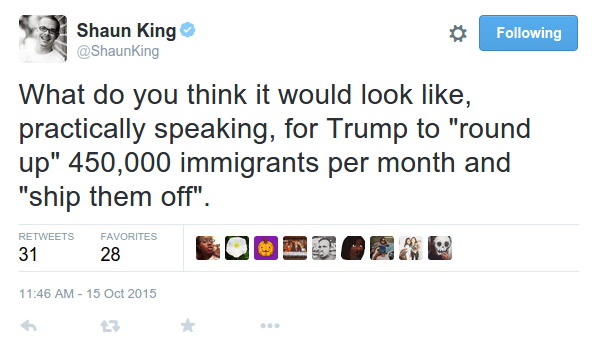
Shaun King asks a fair question about Donald Trump's plan to deport eleven million people over a two-year period. Answering it feels a bit like doing a sociopathic sort of "What If?," but sometimes it's good to see what's actually involved in a policy proposal.
If you want to deport all of these people, you'll have to do a few things:
(1) Figure out who you want to deport. (2) Round them up. (3) Transport them to wherever you're deporting them to. (4) Dump them there and get them to stay.
The biggest things that probably aren't blindingly obvious are:
– Identifying people is harder than it sounds, since it's not like everyone has proof of citizenship tattooed on their arms. You'll have to put people in the field, and they'll have to have a lot of leeway to deal with ambiguous cases. Which is another way of saying they need the power to decree someone an outsider and deport them.
– Rounding people up is easier than it sounds, Ben Carson to the contrary. The police have more guns, and if you're already at the point where the local field commander is willing to say "this entire neighborhood is probably deportable," it turns out that rounding people up and/or shooting resisters isn't very challenging at all. Most people will stop shooting when you threaten to kill their families, and the ones that don't, well, you just kill them and their families.
– Transporting people is much harder than it sounds. 450,000 people per month is a lot; even with serious packing, you can only fit about 80 people into a standard boxcar or truck; a typical modern train might have 140 boxcars or so, which means it can only transport about 11,000 people, and loading them takes time. Unfortunately, people are somewhat scattered out, so if you want this to work, you'll need to use trucks and so on to deliver people to staging areas, where you can store them for a while until a train is ready. Fortunately, there's a lot of prior art on how to concentrate people in a small space while they're getting ready to be loaded on trains.
– Mass-deporting people to an area you don't control is harder than it seems, because the people who control that area are likely to object. You'd probably have to conquer and subjugate Mexico as a first step, and then set up receiving camps on the other end. Unloading areas would have to be fairly heavily armed and guarded, of course, to keep people from attacking you; the logistics are somewhat similar to the staging camps on the sending side, only you have to worry less about killing people.
– Running this is going to be really expensive, so you might consider finding ways for the project to help pay for itself. So long as you have people concentrated in one place, maybe have them do labor as well? They can pay for their own deportation!
So I suppose the good news is that we can answer Shaun's question fairly straightforwardly, because this has been done before and we do know what it looks like. We don't quite have the right expertise in the US, because none of our past mass-deportation efforts were quite at this scale per month; the transatlantic slave trade moved roughly this many people over three centuries, the Trail of Tears moved only about 16,500 people, and the internment of Japanese civilians during WWII only about 110,000. But outside the US, there's much more experience with it; probably the world's top expert on it was Adolf Eichmann (1906-1962), who ran a program very much like this which managed to move people at about this rate.
Trump's team may be interested in checking him out; there's a tremendous amount written about his system, I'm sure it would be very helpful. And as I noted in a comment below, the design of this program really wasn't easy; they had to iterate through quite a lot of trial solutions before they could come up with a final one. You should always save work by studying prior art when you can.
'The prayer was composed by the Rev. Frank Pavone, national director of the anti-abortion group Priest for Life. It calls on God to "Bring an end to the killing of children in the womb, and bring an end to the sale of their body parts. Bring conversion to all who do this, and enlightenment to all who advocate it." The prayer also includes statistics about abortion in the U.S. and decries "the evil that has been exposed in Planned Parenthood and in the entire abortion industry."'
Office Depot says they have a policy against "the copying of any type of material that advocates any form of racial or religious discrimination or the persecution of certain groups of people," and that the prayer "contained material that advocates the persecution of people who support abortion rights." The complainant says that praying for conversion is not persecution.
So, honestly, I don't think Office Depot has much to stand on here. Praying for someone's conversion may be obnoxious, but it's not persecution. And, yes, the lady could have used the self-service copy machines there (and, in fact, was encouraged to do so), but that's a separate-but-equal argument. And, yes, the whole Planned Parenthood "selling body parts" thang is bogus, but religious expression can't be discriminated against based on claims to objective facts.
The irony here is that this is precisely the opposite of the religious freedom cases that have been making their way through the courts. And, yes, that cuts both ways. Conservatives who have been arguing that businesses should not be forced to do something they find morally objectionable should be (but, I suspect, are not) supporting Office Depot in this. And, conversely, liberals who have been arguing that businesses must be religion-agnostic in such matters and simply provide services to all comers should look long and hard before backing Office Depot's position.
The flyer is here: https://goo.gl/XITTof — it doesn't strike me as religious persecution, even though I'd only take one if i needed some scratch paper. Office Depot's further claim that this constitutes "hate material" to a level that legitimizes refusing to copy it seems hyperbolic as well, especially since they were willing to let the complainant use the self-service copiers.
[UPDATE: As I was writing this and looking up some sources, as of this evening Office Depot has backed down. I'm not thrilled that such material will be out there, but I think it was the right thing to do.]
I stopped (reluctantly, from a taste perspective) going to Chick-fil-A back in 2012 when it became clear that the company was involved in far-Right shenanigans, particularly with company profits going to fund anti-gay causes.
That controversy has died down some, but the Denver City Council, faced with a franchise application at Denver International Airport, has had concerns over it bring the proposal to a halt.
On the one hand, I'd rather the social aspects of the matter were handled more directly by people choosing (or not) to visit the hypothetical Chick-fil-A. Having the government penalize someone for their religious / political opinion is not a good thing (whether I agree with that opinion or not).
On the other hand, the government is involved here, not as censor, but as landlord and marketer. It may not be legit for them to say, "We don't like your beliefs so we will not do business with you," but is it legit for them to say, "We are concerned with how this reflects on the airport and how some visitors might feel about it," and reject it on that basis?
(Leaving aside the service level concerns over Chick-fil-A being closed on Sundays.)
I dunno. I just know that if they open up, that will be one more place where I don't go to Chick-fil-A.
From what this article indicates, a lot of legal citations based on scientific statistics are more like a bad game of Telephone (Chinese Whispers) than reliable bodies of previously established evidence that courts down the line can draw on.
In this case, an unsupported comment by someone with a monetary interest in showing how his sex offender treatment was best gets quoted in a pop psychology magazine, then mentioned in a filing by the US Solictor General, then quoted as justification for draconian legal measures by a Supreme Court Justice, and from there cited by courts across the nation for similar purposes.
You can't have an intelligent debate (let alone trial) about stuff if that's how shoddy your research is. It does make you wonder what other "statistics" we base our lives on that are similarly unfounded.
The Colorado Court of Appeals upheld (again) the ruling that a Lakewood baker who refused to bake a cake for a gay couple wanting to celebrate their (Massachussetts) wedding is guilty of discrimination under Colorado law.
'The appeals court wrote that the Colorado Anti-Discrimination Act "does not compel Masterpiece to support or endorse any particular religious views. The law merely prohibits Masterpiece from discriminating against potential customers on account of their sexual orientation."
Making a cake for a same-sex couple does not force the cake shop to convey a message supporting marriages between same-sex couples. But the law does prohibit the bakery from "picking and choosing its customers based on their sexual orientation."'
Yes. This.
Religious disapproval of something doesn't trump the law. "Free exercise of religion" doesn't mean being able to play the God card to avoid doing anything you don't like. Whether it's paying taxes that go to things you don't approve of, to hiring someone whose race your creed thinks you shouldn't be mixing with, to baking a cake for someone whose marital practices you don't think are morally correct — the right of religious objection is not absolute. If it were, would there be any legal barrier to human sacrifice, or smiting the heathen, or all the religious savagery of Europe that the Founders sought so diligently to avoid?
If Mr Phillips cannot bring himself to bake cakes for gay individuals — or blacks, or Jews, or veterans, or people in wheelchairs, or women — for reasons he considers religious, perhaps he should consider a change in business. That's not nice, or easy, but nobody ever said having the courage of your convictions was either.
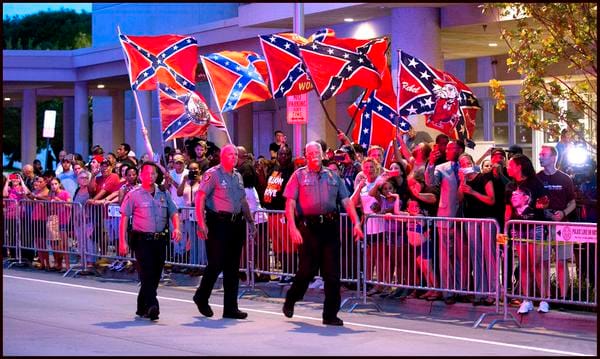
Actually, this demonstrates a good thing: the Confederate Battle Flag may be getting kicked off of official government displays, but the First Amendment means that individuals can still wave it around to reveal themselves as yahoos as much as they choose to — indeed, this make them easier to spot.
(Yes, yes, "Confederate Lives Matter". All human lives, including the ones enslaved and killed by the regime this flag represented, matter. Hauling down the Confederate flag from taxpayer-funded property and displays isn't about the lives lost in the Civil War, it's about the racist, treasonous regime they fought for.)
As a side note, yes, Oklahoma wasn't a Confederate state. It was, at the time, Indian Territory, where various tribes had been relocated (many from the Southeast) and dumped. Interestingly, most of the tribes there actually signed treaties with the Confederate military during the Civil War, and slavery in the territory wasn't ended until 1866. So that said, if the folk waving those flags would like to show their tribal bona fides, I'll grant them some claim to wanting to defend their "Southern Heritage."
I mean, yeah, it's nice when civil right recognition happens organically, and people recognize the value of human beings of various types and protect their "life, liberty, and the pursuit of happiness."
But people can be balky. Significant portions of the populace can be reluctant to recognize rights that make them uncomfortable, or angry, or that aren't the way they were taught growing up. As with the past issue of interracial marriage, or the modern issue of same-sex marriage, waiting for everyone to have their epiphany and join in a big circle singing "Kumbaya" only allows injustice to continue. When fundamental constitutional issues are at stake, the popular sentiment — whether by vote or by representative government — must give way to the law of the land.
Alabama Shows Why Civil Rights Shouldn’t Be Put to a Popular Vote
Consider for a moment what would have followed if the Supreme Court had left laws that prohibited interracial marriage “up to the states.” This is a perfect time for such reflection, as June 12, 2015, marks the 48th anniversary of the court’s historic ruling in Loving v. Virginia, a unanimous decision that…
I certainly agree that US police and justice system actions against the poorest and most disadvantaged populations within the country are in serious need of review and reform.
However, forgive me if I find the "vociferous" criticism from China, Russia, Turkey, and Pakistan to be … schadenfreudenisch.
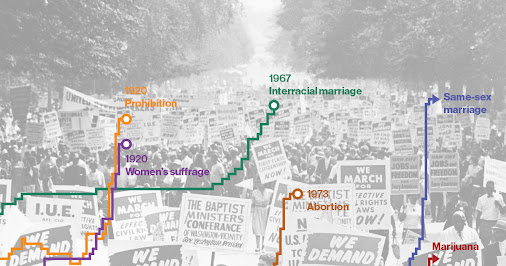
This article looks at some mass social changes and their timeline of acceptance (based on state laws then federal laws/rulings), including women's suffrage, abortion, prohibition, interracial marriage, and now same-sex marriage and marijuana legalization.
This Is How Fast America Changes Its Mind
As the Supreme Court considers extending same-sex marriage rights to all Americans, we look at the patterns of social change that have tranformed the nation.
Bryan, it’s been — well, it’s been a day or two since you last rose to the level of needing a gentle smackdown for your doltitude. What do you have for us today?
Oh, that should be good. What do you have to say, Bryan?
Homosexual activists, called the “Gay Gestapo” by lesbian Tammy Bruce, are busily suing or harassing every Christian business owner and wedding vendor they can find. So far they have gone after wedding photographers, bakers, florists, wedding chapel operators, counselors and now even wedding planners.
The legal principles involved here are pretty simple and straightforward — and have nothing to do with Christianity.
If a given state, county, or city has enacted a statute indicating that discrimination based on sexual orientation is not allowed, it’s not allowed. That’s not anti-Christian, that’s anti-discriminatory, and covers both those people (not all of them Christian, and not all Christians) who, for whatever reason, would prefer not to deal with gay people. These laws generally cover one or both of two areas: employment, and “public accommodations.”
So is discrimination good or bad, Bryan? If it’s motivated by religious belief, does that make it okay?
Employment is pretty straightforward — you can’t fire, not-hire, or treat in a discriminatory fashion someone based on their sexual orientation. The same is true for other protected classes: race, gender, national origin, age, even (gasp) religion. Exceptions are generally made for religious institutions: women can’t file employment discrimination suits because the Catholic Church doesn’t hire female priests.
But these exceptions are made for institutions that are explicitly religious in their make-up and purpose, such as churches themselves. They aren’t made for individuals who claim a religious belief in discrimination of some sort. The reason for that is pretty obvious, Bryan — anyone can claim anything as a religious belief, and the courts have generally been reluctant to decide who is being sincere and who is not.
So folk can’t say, “Well, my religion tells me that the races should be kept separate, so I only hire whites here.” Or, “My faith informs me that women should be at home, not in the workplaces, so I fired all the women-folk here.” Or, “The span of a man’s life is three-score years and ten, so I fire anyone who is over 70.” Or, “My faith thinks that Christians are evil oppressors of the True Belief, and so I don’t let any on my workforce.” That’s all not allowed, even if someone claims it violates their religious beliefs.
So is that oppressing people of faith, Bryan?
OMG! RELIGIOUS OPPRESSION!
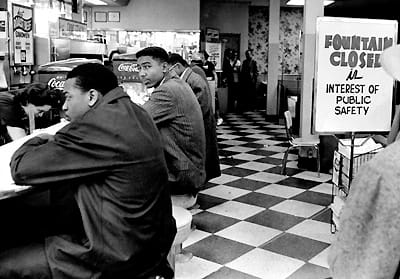
“Public accommodation” is a bit fuzzier to define, but essentially it means being open to the public to provide good and services. You can’t refuse a place at the lunch counter for blacks. You can’t open up a public restaurant just for men. You can’t have a golf course that Jews aren’t allowed to play at. If you open the doors to the public, you open them to all the public, especially protected classes (as noted above) that have been subject to discrimination in the past. It doesn’t make any difference if your disdain for serving blacks, women, Jews, stems from mere bigotry or from religious conviction.
But I’m sure we’ll see some examples below of the vast power of the state twisting the arm of hapless Christian businessfolk to force them to serve Those Kind against their Christ-inspired will:
Lana Rusev, who runs Simply Elegant Wedding Planning in Jacksonville, Florida, turned down a lesbian ceremony because of her deeply held conviction that marriage is exclusively a one-man, one-woman institution.
I can see her dilemma. There are people she thinks should not get married, but they want to, and come to her to plan the wedding because she’s a publicly operated business. That’s a tough situation to be in.
Rusev’s family fled Ukraine 26 years ago just to find freedom from this kind of anti-Christian hatred and oppression. Welcome to the land of the free, eh?
Really? They were also wedding planners who were being forced to plan weddings for lesbians? That is one hell of a coincidence, Bryan.
But, seriously, tell me about the “anti-Christian hatred and oppression” here.
For taking a stand on biblical principle, she has been blistered, demonized and vilified on her company’s Facebook page, and her business has been added to the LBGT no-go-zone directory.
Bryan, giving snarky reviews for bad service is what the Internet is FOR!
Wait … what? There’s no legal repercussions here, no fines, nothing, just people expressing how unhappy they are with Ms Rusev’s point of view? Really? Your example is even more of a crock than I thought, Bryan.
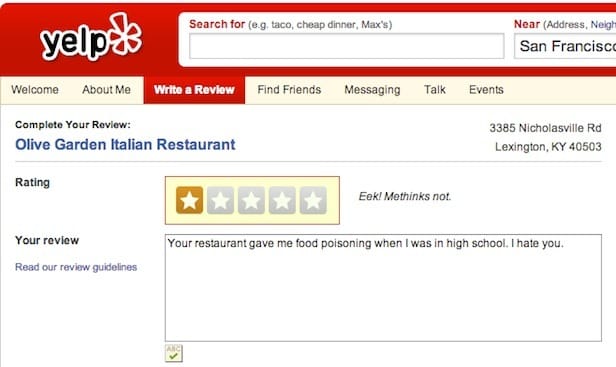
I mean, here’s essentially what’s happened: A customer goes into a store. The store owner says, “I don’t like your face, so get out.” The customer posts about their experience on the Internet. People say mean things about the store owner, and the store’s rating on Yelp drops to one star.
Guess what, Bryan, that happens every day. Hell, look at some of the things you’ve said about Muslims, about gays, about people whose Christian beliefs are at variance with yours. Are all those people somehow suffering some actual damage because of it? When people call you a dolt, Bryan, is that some sort of hate crime or oppressive act?
I’ve looked up some more detailed descriptions of what happened here. Ms Rusev declined the job because she was already busy that weekend, and then gratuitously added, “Due to my strong personal belief I do not feel comfortable planning a wedding for lesbian couples. I hope you understand and not take this personally.”
Sure, of course, if someone told me they thought my marriage was morally wrong, I certainly wouldn’t take it personally. No, wait, of course I would. Why is that any less offensive than people calling Ms Rusev a religious bigot?
Mean-spirited and bigoted …
Categories you have some expertise in, Bryan.
… members of what Bill Maher calls the “gay mafia” …
Probably the nicest thing you’ve ever said about Bill Maher. In fact, you had some pretty not-nice things to say about him (and vice-versa) just last year. Funny person to reference in your support.
And, can you be a bit more clear, Bryan — are the gays a “Gestapo” or a “Mafia”? I want to keep my terms straight.
… won’t rest until every Christian who supports natural marriage is under virtual house arrest, exiled from polite society and forbidden to engage in commerce of any kind.
Hard to believe, but when people find your attitude offensive, they don’t like to hang out with you.
If you routinely used racial epithets, you wouldn’t be surprised if people stopped inviting you to parties, Bryan.
If someone in a devoutly Christian town started going on and on about how Jesus is a fake and God is a mass murderer, he’d probably be “exiled from polite society.”
When you express your opinions in public, you can’t be arrested by the police (at least not according to the First Amendment), but the people around you can certainly turn their backs on you.
And if you operate a business, and you make it a point to tell people you would rather not have them as customers, it’s likely going to mean fewer customers. That’s why you don’t see a lot of political signs at most retail outlets and shops.
Your church may be next. …
And suddenly you veer into bizarro hypotheticals, Bryan. We’ve been talking about a wedding planner, and now you’re extending it churches?
… Do not think for one minute that the First Amendment all by itself will guarantee your church’s protection from rabid gay activists and their minions in the court system.
Except that there’s no basis to think that any church will be compelled to do anything, because of that actual First Amendment. Hell, we’ve had formal anti-discrimination laws regarding race for years, yet you can still find churches that won’t marry a mixed race couple. There aren’t a lot of them any more, but that’s not because of government oppression or “the black gestapomafia” but because most people think that’s a hateful and lunatic position to take.
The courts have already shredded the First Amendment virtually beyond recognition, …
In what way, Bryan? Hell, they’ve told us that corporations can claim First
… and as far as protecting your church’s religious liberty, it may be hardly worth the parchment it’s printed on.
Give me some examples of churches being legally compelled to hold a religious ceremony that they disagree with. Please, do.
A church in Lakewood, Colorado, is under fire from the gay lobby for canceling a funeral for a lesbian when her family insisted on including in the service pictures of her kissing her lesbian lover. The family is considering a lawsuit against the church, and given the predilection of the courts and its “Gay Rights Uber Alles” mindset, we can expect such a lawsuit to find a sympathetic ear.
Yeah, that sort of thing can REALLY screw up your Yelp score.
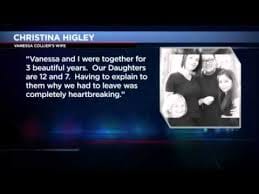
Having seen a lot of local coverage of that particular contretemps (1, 2, 3), the issue was not so much that the church would not hold the funeral, but that it canceled the funeral 15 minutes into the ceremony, with an open casket and the place full of 170 mourners, when the pastor of the church (who wasn’t even officiating) said that the memorial video (which had been dropped off days earlier) could not be shown because it included images of the deceased and her wife.It wasn’t a matter, even, of the deceased being a lesbian, as much as showing pictures that indicated it
It’s not surprising the family is considering suing — not because the church doesn’t want to be seen to be supporting the “gay lifestyle,” but because of how it handled the whole matter. Telling the family that pictures of the deceased’s spouse (who’s sitting right there) can’t be shown, in the middle of the funeral, and so the whole shindig is off is both ghastly and emotionally distressing in the extreme.
(I’d argue it’s even un-Christian, in a “Sabbath was made for the Man, not Man for the Sabbath” sort of way. The loving thing to do in the situation was for the pastor to consider and care for the feelings of the grieving people already present, rather than stand on a “Don’t show, don’t tell” theological point at the last moment. But that’s another matter.)
What can your church do to make its stance abundantly clear and head off possible lawsuits at the same time? The elders of my church have formally recommended to our church family an amendment to the Constitution and bylaws that spell out in no uncertain terms the church’s stance on homosexuality and gay marriage. (The elders have wisely provided church members with a 30-day comment period before the statement becomes official.)
In part, the intention here is to anticipate the possibility that the church will be approached to host a gay wedding and its pastor asked to perform a same-sex ceremony.
If you out your church like a banquet hall, the courts will probably treat it as one.
If you make your church sanctuary available to anyone who comes in and cuts a check, having an internal policy on homosexuality and gay marriage may not be enough, depending on the laws of the city and state you’re in; that makes it pretty close to being nothing more than a public meeting hall, which falls under public accommodation laws. I know that our church does have some rules and preconditions, but it’s not treated as a rental property.
I’d also recommend making sure whatever documentation you have for when people approach you about whether they can get married there make clear any conditions you have (hopefully in a pastoral fashion), so that a last-second change of plans, like what happened in Lakewood, doesn’t occur. That’s where people are going to get really cheesed.
I’m going to skip over the proposed change in your church’s “Statement of Faith,” Bryan, except to note the irony of noting that “every person must be afforded compassion, love, kindness, respect, and dignity” and that “hateful and harassing behavior or attitudes directed toward any individual are to be repudiated and are not in accord with Scripture nor the doctrines of the church.” You might want to check out some of your broadcasts and columns, Bryan.
To be forewarned is to be forearmed. It might be wise for every church in America to formally adopt this statement or one like it to prepare with prudence and foresight for a litigiously uncertain future.
It’s pretty darned clear that the only way that a church is going to get in trouble is if they treat their building as a public accommodation, open to all sorts of use … except when requested by a protected class. If the church’s sanctuary is treated as a holy place, you’re pretty safe on First Amendment grounds, unless you’ve mysteriously seen some case law that I haven’t, Bryan.
That said, there are an increasing number of Christian churches that actually welcome gay congregants, celebrate or bless same-sex weddings, and allow funeral services for gay people without asking their lives be visually bowdlerized.
Thomas Jefferson’s famous wall of separation, as he articulated it, was designed to protect the church from the intrusion and interference of the state (not, you will note, to protect the state from the influence of the church).
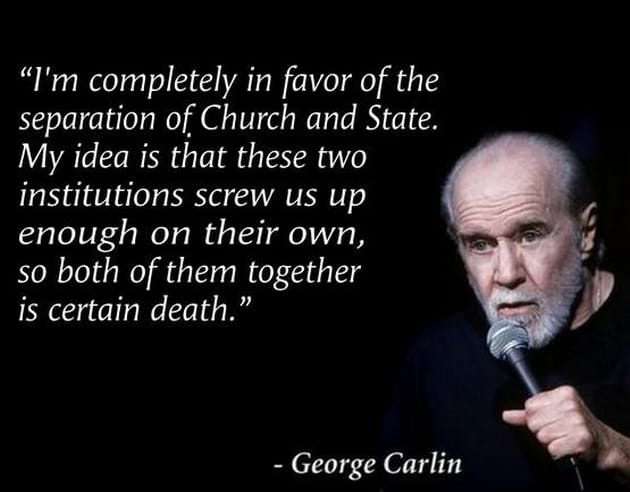
I think George has a valid point here, too.
Nicely played, Bryan, but nonsensical. Walls have to work both ways. If a church can “intrude and interfere” in the state, then the state will inevitably reciprocate on other churches. The Danbury Baptists (in the letter that provoked Jefferson’s famous response), noted “what religious privileges we enjoy (as a minor part of the State) we enjoy as favors granted, and not as inalienable rights.” The state was interfering with their church, but only because a majority denomination (Congregationalists) dominated in the state.
Jefferson’s wall, erected by the Constitution itself, was intended to prevent the very thing we are witnessing: the state breaking down that protective barrier and barging into the affairs of Christians, Christian business owners and churches and telling them what they must believe and do.
There is nothing the state is doing to tell Christian churches what they must believe. And, it’s worth reiterating, your major example given, Lana Rusev and New Hope Ministries in Lakewood are not under any sort of state / legal sanction regarding their beliefs. They are facing social opprobrium for what they’ve done, and, in the latter case, possible civil action for (my guess is) breach of contract and infliction of emotional distress.
It’s time to rebuild Jefferson’s wall, and this statement just might be the place to start.
Bryan, I assure you — when I see the government dictating to churches what they must do in their religion, or to people what they must believe, I’ll be right there on the picket lines with you. But I’m not going to support public businesses that discriminate — in employment or in serving the public — against folk on the basis of age, race, national origin, religion, or sexual orientation. If you can’t see the difference there, Bryan, I suggest you look again.
After Frederick Co. Commissioner Kirby Delauter threatened the Frederick News-Post over using his name in news stories without permission (http://goo.gl/lNPU6V, http://goo.gl/ZcgKHC), the FNP published this lovely editorial.
For added amusement, check the first letter of every paragraph.
Kirby Delauter, Kirby Delauter, Kirby Delauter
Knowing Councilman Kirby Delauter as we do, we weren’t surprised that he threatened The Frederick News-Post with a lawsuit because we had, he says — and we’re not making this up — been putting Kirby Delauter’s name in the paper without Kirby Delauter’s authorization. Attorneys would be called, Kirby Delauter said.
And last(ish) because you're probably sick to death about reading it from me, and I'm sick to death (and at heart) about writing about it. Because today I've not only been posting the stuff I have, I've been on a half-dozen other threads in the comments, arguing with people who see nothing wrong about this — who very baldly say, "I allow my elected officials to do whatever they think they need to in order to keep this country secure. And if that means we are a country that is hated and feared, that's ultimately the only way for us to survive."
And I keep coming back to that Abby Mann quote, "But survival as what?"
So read the below, please. George's preface holds what I believe in my head to be the case for how to deal with that ticking bomb / existential thread danger that the pro-torture folk use. He puts it at least as well as I ever have managed to. Do what you need to do, knowing that you're breaking the law and will be punished. Because if the stakes are that high and you're really a "hero," that's what you do.
And then read the Jim Wright post below it. Because it says everything else I think and feel on the subject, and rather than getting into long arguments on the matter I should simply post a link to that, because if it's not convincing then nothing I can say will be. Read it.
It always comes down to that ticking bomb, doesn't it. What if your son or daughter were in that city!
That person you have shacked to the chair is someone's son or daughter, too. Lose sight of that, and you become something else entirely. But OK, for the sake of argument…
#Torture is a "You had better be right" situation. You torture someone and you don't find the bomb/terror cell/innocent kidnapped daughter? You should accept your punishment.
Suppose it "worked", though? You got the information, saved the city, saved the innocent child, whatever?
You would certainly be willing to die to save a city, no? Would you go to prison to save a city? Would saving the city be enough, if you weren't also feted as a hero? Perhaps punished for torturing someone?
And in such a case, perhaps the President would grant you clemency. A pardon. But would you refuse to save the city otherwise? Would you let all those people die because something "unfair" might happen to you?
The legal prohibition against torture (the one you are violating in your Jack Bauer fantasy) is there to keep the city, and the country, worth saving. This is why it really doesn't matter if torture "works" or not.
Gratifying to read, here, an experienced military officer who says something similar to what I've always thought.
The Road to Hell
The evil that men do lives after them; the good is oft interred with their bones. – William Shakespeare It’s even worse than we thought. It is, isn’t it? If you’ve read the Senate Select Committee On Intelligence’s Study of…
Because at least one judge thinks (with reasons I suspect will be sustained) that the police can make you use your fingerprint to unlock things, even if they can't force you to enter a PIN or password.
Because, of course a 14-year-old girl in prison can give sexual consent to a 40-year-old corrections officer, so no way she should be able to sue the parish/county about it. Sure, the juvie guard is now in jail, but that’s not the parish’s fault, and clearly she was asking for it, so let’s just bang that gavel, dismiss the case, and go home, okay? Okay?
Mats Holberg has a point. You may disagree with Roe v Wade, just as others may disagree with District of Columbia v Heller. But it seems dangerous to me to treat one right as a sacred cow and the other as something to make as difficult as possible to exercise. Because tomorrow it may be turned the other way around.
The Sixth Amendment to the Constitution says "In all criminal prosecutions, the accused shall enjoy the right to a speedy and public trial, by an impartial jury of the State and district wherein the crime shall have been committed, which district shall have been previously ascertained by law, and to be informed of the nature and cause of the accusation; to be confronted with the witnesses against him; to have compulsory process for obtaining witnesses in his favor, and to have the Assistance of Counsel for his defence." (http://goo.gl/r1B4Aj)
But that whole "speedy trial" thing seems to mean in some jurisdictions more like "a trial whenever is convenient for the DA and the judge and the general court system to actually hold a trial." At least in this case, which doesn't sound like it's all that exceptional.
Remember: this could be you.
It seems to me the answer is really quite simple. If the courts are too busy to provide speedy trials because they are understaffed, then give them more money. If The People don't want to provide more money, then release people who aren't getting speedy trials and see how fast they'll be willing to pony up.