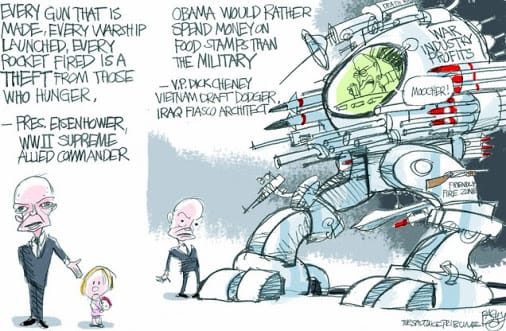
About the only way I can think of comparing Eisenhower and Cheney.
Reshared post from +Ron Dobbs
Bagley Cartoon Bald Republicans. Then and now

Armed forces, weapon systems, military budgets
Reshared post from +Ron Dobbs
Bagley Cartoon Bald Republicans. Then and now
I have no problem saying that extrajudicial killing by the government is wrong (let's leave aside the diplomatic/geopolitical aspects of operating in another country when they've told us not to), except against a combatant in time of war, at which time the "due process" thing is covered by a declaration of war or legal authorization of military force.
The problem being that, while one can (as the Obama administration, and the Bush administration before them, does) claim that the AUMF and "War on Terror" make remote drone strikes against terrorists, even American citizen terrorists, legal under the rules of war (we'll also set aside collateral damage issues), the slippery slope of declaring all terrorists as enemy combatants who can be killed by drones (or tanks) is that it allows a corrupt, immoral, tyrannical, or even just incompetent administration to kill anyone simply by saying that, well, they had good (but, of course, top secret) information that the person killed was a terrorist, so stop complaining.
Whether you think Obama is the second coming of Christ or the Anti-Christ, that's a dangerous power for even a saint. And it's now in Obama's hands, and the next president's hands, and the next president, and the next …
So to my mind the question becomes not whether the death of the New Mysterious American Citizen being gunned for would actually be an extrajudicial killing, because it I think there's enough evidence to indicate they're not. The question is whether being able to treat "terrorists" (or "Commie spies," or other past or future threatening groups of individuals who don't wear uniforms of an attacking army) as a group we are at war with is a sound idea, if there are no barriers other than competence and moral fiber to keep that power from being abused.
Tweaking the Constitution to Make Extrajudicial Killing Easier
A thought experiment to get assassination advocates back on the right side of the law
Reshared post from +Kee Hinckley
Navy accidentally sends reporter an internal memo describing how to block his FOIA request.
The apologized and tweeted (several times!) about how committed they are to free and open access. Uh huh.
Navy Apologizes After Mistakenly Sent Email
U.S. Navy officials have issued an apology for their response to a News4 reporter’s request for materials related to the September 2013 Navy Yard shooting rampage.
Granted, he's offering that as a better alternative to boot-on-the-ground invasion, which he rightfully recognizes would be extremely costly in US lives (presumably his Marine Corps experience in Afghanistan and Iraq informs him about that).
But the idea that the US would preemptively use nuclear weapons, and be the first to use them since their solitary, horrifying deployment in WWII, would be a moral and geopolitical outrage from which the US would never recover — and rightfully so.
Reshared post from +Jeffrey Raskin
GOP House Member Says Attack On Iran Should Be Nuclear
"I don’t think it’s inevitable but I think if you have to hit Iran, you don’t put boots on the ground, you do it with tactical nuclear devices and you set them back a decade or two or three. I think that’s the way to do it with a massive aerial bombardment campaign."
This is the face of Today's GOP. These people are not "conservative." They are radical reactionaries.
Congressman Says U.S. Should Use Nuclear Weapons If It Attacks Iran
Rep. Duncan Hunter (R-CA) thinks the United States should use tactical nuclear weapons on Iran if it decides to use military force against its nuclear program.
Reshared post from +Unofficial XKCD
#xkcd #whatif
If our Twitter timelines (tweets by the people we follow) actually extended off the screen in both directions, how tall would they be?
Twitter Timeline Height
Answering your hypothetical questions with physics, every Tuesday. New: @whatifnumbers, a Twitter feed of numbers I find while answering questions. Prev · Twitter Timeline Height. If our Twitter timelines (tweets by the people we follow) actually extended off the screen in both directions, …
Good. It's the only federal law I'm aware of that trumps a state's traditional prerogative to decide who is or is not married by their law, and for no other reason than folks didn't like the idea of gay marriage.
Embedded Link
Appeals Court Rules DOMA Unconstitutional
The federal government had no permissible federal interest in denying benefits to same-sex couples under the Defense of Marriage Act (DOMA), the 1st U.S. Circuit Court of Appeals in Boston ruled Thurs…
Google+: View post on Google+
– Go, Stephen, go!
 I really tried to stay away. Honest. Yet Bryan Fischer pulled me back in, after (a) posting that the Congressional Medal of Honor has been “feminized” because it’s being awarded to people who save lives, vs. just people who kill a bunch of the Bad Guys, then (b) posting a lengthy, defensive, and simultaneously offensive rebuttal to those who informed him that he was a dolt.
The re-rebuttal begins …
The blowback to my column of two days ago, in which I argued that we seem to have become reluctant to award the Medal of Honor to those who take aggressive action against the enemy and kill bad guys, has been fierce. It has been angry, vituperative, hate-filled, and laced with both profanity and blasphemy.
Hmmm … angry, vituperative, hate-filled, laced with concepts profane and blasphemous … I think you’re projecting, Bryan …
What is striking here is that readers who have reacted so viscerally to what I wrote apparently didn’t read it, or only read the parts that ticked them off. I’m guessing a fair amount of the reaction has come from those who didn’t actually read the column, but read what others said about the column. It’s been fascinating to watch.
Okay, let me go back and read the column …
… um ….
… okay, yeah, I have a visceral reaction all right. I think I’m going to lose my dinner.
For clarification, here are excerpts from my first column in which I clearly state that it is altogether right that we honor heroism and bravery when it is expressed in self sacrifice:
The Medal of Honor will be awarded this afternoon to Army Staff Sgt. Salvatore Giunta for his heroism in Afghanistan, and deservedly so. He took a bullet in his protective vest as he pulled one soldier to safety, and then rescued the sergeant who was walking point and had been taken captive by two Taliban, whom Sgt. Giunta shot to free his comrade-in-arms.
This is just the eighth Medal of Honor awarded during our wars in Iraq and Afghanistan, and Sgt. Giunta is the only one who lived long enough to receive his medal in person…
Jesus, in words often cited in ceremonies such as the one which will take place this afternoon, said, “Greater love has no one than this, that someone lays down his life for his friends” (John 15:13). So it is entirely right that we honor this kind of bravery and self-sacrifice, which is surely an imitation of the Lord of Lords and King of Kings.
I’m not sure there is a clearer or more forceful way for me to say it than I did right there, that we surely ought to continue doing what we have done, which is to grant our highest award for valor to those who risk their lives and even forfeit them, as our Lord and Savior did, in defending the lives of their friends.
Some have accused me of denigrating awards for such valor, which is nonsense, as the words above attest. I can hardly be rightly accused of denigrating an award given to those who I believe exemplify the courage and self-sacrifice of the Savior of the world. I have no doubt that I will continue to be accused of this, but such accusations are entirely without merit.
That’s a very nice spin on it, Bryan, but it just won’t fly. Yes, you say that’s all awfully nice and all … but then you turn around and indicate that it’s not enough. No, it’s not enough that we honor “those who risk their lives and even forfeit them … defending the lives of their friends” — if we’re not making a point to be honoring people who do so as they “kill people and break things.”
Even the very nice reference to Jesus gets this part added in the previous column:
However, Jesus’ act of self-sacrifice would ultimately have been meaningless – yes, meaningless – if he had not inflicted a mortal wound on the enemy while giving up his own life.
The significance of the cross is not just that Jesus laid down his life for us, but that he defeated the enemy of our souls in the process. It was on the cross that he crushed the head of the serpent. It was on the cross that “he disarmed the rulers and authorities and put them to open shame, by triumphing over them in it” (Colossians 2:15).
It’s only important that Jesus died in order to crush his enemy. Saving us is nice, but “meaningless.”
One can imagine — in fact, whole theologies, some of them very orthodox, have maintained — that Jesus’ death was not an “attack,” but a “rescue” … a throwing himself on a spiritual grenade of sin and death, perhaps, or running into the burning building of hell to bring out one more lost soul, or being the sacrificial man at the last ditch, whose actions allow his fellows to get away.
Lots of ways you can see Jesus’ death and resurrection. Turning it into a Commando Raid to Kill the Serpent is … not one I’ve often seen.
I’m not saying that our soldiers have become feminized in the least, especially those who have earned the Medal of Honor. It’s not our soldiers who have become feminized, it is the awards process that has become feminized.
And, of course, feminization is, by definition, bad.
What I am saying is that I am observing a trend in which we single out bravery in self-defense …
Darned feminists, celebrating defensive bravery!
… and yet seem hesitant to single out bravery in launching aggressive attacks that result in the deaths of enemy soldiers.

Believe it or not, racking up a body count by “launching aggressive attacks that result in the deaths of enemy soldiers” is not the criterion for receiving the CMOH:
The Medal of Honor … is awarded in the name of Congress to a person who, while a member of the Army, distinguished himself conspicuously by gallantry and intrepidity at the risk of his life above and beyond the call of duty while engaged in an action against an enemy of the United States; while engaged in military operations involving conflict with an opposing foreign force; or while serving with friendly foreign forces engaged in an armed conflict against an opposing armed force in which the United States is not a belligerent party. … The deed performed must have been one of personal bravery or self-sacrifice so conspicuous as to clearly distinguish the individual above his comrades and must have involved risk of life.
Nothing there about killing the bad guys. Nothing there about not killing the bad guys.
There have been eight CMOH’s awarded in Iraq and Afghanistan. And looking at the citations, guess what I discover?
Bryan Fischer is lying.
A shock, yes, I know. Either he’s lying, or he’s just accepting someone’s word as the basis for a screed without making any fact checks. As he put it in his earlier column:
According to Bill McGurn of the Wall Street Journal, every Medal of Honor awarded during these two conflicts has been awarded for saving life. Not one has been awarded for inflicting casualties on the enemy. Not one.
Let’s take a look at this most recent girly-girl citation, to Staff Sergeant Salvatore Giunta, awarded 16 November 2010. Here’s what happened:
Specialist Salvatore A. Giunta distinguished himself conspicuously by gallantry and intrepidity at the risk of his life above and beyond the call of duty in action with an armed enemy in the Korengal Valley, Afghanistan, on October 25, 2007. While conducting a patrol as team leader with Company B, 2d Battalion (Airborne), 503d Infantry Regiment, Specialist Giunta and his team were navigating through harsh terrain when they were ambushed by a well-armed and well-coordinated insurgent force. While under heavy enemy fire, Specialist Giunta immediately sprinted towards cover and engaged the enemy. Seeing that his squad leader had fallen and believing that he had been injured, Specialist Giunta exposed himself to withering enemy fire and raced towards his squad leader, helped him to cover, and administered medical aid. While administering first aid, enemy fire struck Specialist Giunta’s body armor and his secondary weapon. Without regard to the ongoing fire, Specialist Giunta engaged the enemy before prepping and throwing grenades, using the explosions for cover in order to conceal his position. Attempting to reach additional wounded fellow soldiers who were separated from the squad, Specialist Giunta and his team encountered a barrage of enemy fire that forced them to the ground. The team continued forward and upon reaching the wounded soldiers, Specialist Giunta realized that another soldier was still separated from the element. Specialist Giunta then advanced forward on his own initiative. As he crested the top of a hill, he observed two insurgents carrying away an American soldier. He immediately engaged the enemy, killing one and wounding the other. Upon reaching the wounded soldier, he began to provide medical aid, as his squad caught up and provided security. Specialist Giunta’s unwavering courage, selflessness, and decisive leadership while under extreme enemy fire were integral to his platoon’s ability to defeat an enemy ambush and recover a fellow American soldier from the enemy. Specialist Salvatore A. Giunta’s extraordinary heroism and selflessness above and beyond the call of duty are in keeping with the highest traditions of military service and reflect great credit upon himself, Company B, 2d Battalion (Airborne), 503d Infantry Regiment, and the United States Army.
The citation doesn’t say he got the award for “saving life” nor does it say it was “inflicting casualties on the enemy.” In point of fact, then-Specialist Giunta did both. and with valor. He attacked, he rendered aid, he counter-attacked, he freed a potential hostage.
I suppose Bryan doesn’t consider it all quite as masculine as if Specialist Giunta had launched a berserker attack against the insurgents, regardless of what else was going on around him, but …
I never even remotely suggested that we should stop honoring exceptional bravery in defense of our own troops; quite the opposite, as a matter of fact, as the above excerpts show. To borrow a phrase from Jesus, I say, “You should have practiced the latter without neglecting the former” (Matthew 23:23).
See, Bryan seems to think a dire battle situation — of the sort that CMOHs come from are either “defensive” or “offensive.”
Well, maybe Specialist Giunta is an exception. How about the one before that, awarded 6 October?
Robert J. Miller distinguished himself by extraordinary acts of heroism while serving as the Weapons Sergeant in Special Forces Operational Detachment Alpha 3312, Special Operations Task Force-33, Combined Joint Special Operations Task Force-Afghanistan during combat operations against an armed enemy in Konar Province, Afghanistan on January 25, 2008. While conducting a combat reconnaissance patrol through the Gowardesh Valley, Staff Sergeant Miller and his small element of U.S. and Afghan National Army soldiers engaged a force of 15 to 20 insurgents occupying prepared fighting positions. Staff Sergeant Miller initiated the assault by engaging the enemy positions with his vehicle’s turret-mounted Mark-19 40 millimeter automatic grenade launcher while simultaneously providing detailed descriptions of the enemy positions to his command, enabling effective, accurate close air support. Following the engagement, Staff Sergeant Miller led a small squad forward to conduct a battle damage assessment. As the group neared the small, steep, narrow valley that the enemy had inhabited, a large, well-coordinated insurgent force initiated a near ambush, assaulting from elevated positions with ample cover. Exposed and with little available cover, the patrol was totally vulnerable to enemy rocket propelled grenades and automatic weapon fire. As point man, Staff Sergeant Miller was at the front of the patrol, cut off from supporting elements, and less than 20 meters from enemy forces. Nonetheless, with total disregard for his own safety, he called for his men to quickly move back to covered positions as he charged the enemy over exposed ground and under overwhelming enemy fire in order to provide protective fire for his team. While maneuvering to engage the enemy, Staff Sergeant Miller was shot in his upper torso. Ignoring the wound, he continued to push the fight, moving to draw fire from over one hundred enemy fighters upon himself. He then again charged forward through an open area in order to allow his teammates to safely reach cover. After killing at least 10 insurgents, wounding dozens more, and repeatedly exposing himself to withering enemy fire while moving from position to position, Staff Sergeant Miller was mortally wounded by enemy fire. His extraordinary valor ultimately saved the lives of seven members of his own team and 15 Afghanistan National Army soldiers. Staff Sergeant Miller’s heroism and selflessness above and beyond the call of duty, and at the cost of his own life, are in keeping with the highest traditions of military service and reflect great credit upon himself and the United States Army.
Too bad that’s such a feminine tale of saving lives and being protective and nurturing. I’m sure the 10 dead and dozens of wounded dead insurgents are kind of embarrassed to have been taken down by such a “feminized” award-winning scenario.
How about the one before that?
Staff Sergeant Jared C. Monti distinguished himself by acts of gallantry and intrepidity above and beyond the call of duty while serving as a team leader with Headquarters and Headquarters Troop, 3d Squadron, 71st Cavalry Regiment, 3d Brigade Combat Team, 10th Mountain Division, in connection with combat operations against an armed enemy in Nuristan Province, Afghanistan, on June 21, 2006. While Staff Sergeant Monti was leading a mission aimed at gathering intelligence and directing fire against the enemy, his 16-man patrol was attacked by as many as 50 enemy fighters. On the verge of being overrun, Staff Sergeant Monti quickly directed his men to set up a defensive position behind a rock formation. He then called for indirect fire support, accurately targeting the rounds upon the enemy who had closed to within 50 meters of his position. While still directing fire, Staff Sergeant Monti personally engaged the enemy with his rifle and a grenade, successfully disrupting an attempt to flank his patrol. Staff Sergeant Monti then realized that one of his Soldiers was lying wounded in the open ground between the advancing enemy and the patrol’s position. With complete disregard for his own safety, Staff Sergeant Monti twice attempted to move from behind the cover of the rocks into the face of relentless enemy fire to rescue his fallen comrade. Determined not to leave his Soldier, Staff Sergeant Monti made a third attempt to cross open terrain through intense enemy fire. On this final attempt, he was mortally wounded, sacrificing his own life in an effort to save his fellow Soldier. Staff Sergeant Monti’s selfless acts of heroism inspired his patrol to fight off the larger enemy force. Staff Sergeant Monti’s immeasurable courage and uncommon valor are in keeping with the highest traditions of military service and reflect great credit upon himself, Headquarters and Headquarters Troop, 3rd Squadron, 71st Cavalry Regiment, 3rd Brigade Combat Team, 10th Mountain Division, and the United States Army.
It’s a shame all that life-saving stuff at the end waters down all the personal killing done by Staff Sergeant Monti earlier in the citation.
But enough debunking of Bryan’s core thesis, let’s go back to his self-aggrandizing defensiveness. He continues:
It is striking that a certain amount of the criticism I have received actually verifies my thesis.
Note that by noting a “certain amount” there’s no telling if this is all, most, or a handful of his respondents.
In response to my call to also honor those who have killed bad guys in defense of our country, I have been called everything from savage to brute to bloodthirsty to anti-American to un-American to traitor to “expletives deleted” to the antichrist himself.
Golly, I’d love to know about these comments in context. Were they about the idea that CMOHs should be given for folks who have shown valor in primarily attacking the enemy? Or were they about how killing people is not only a valorous event but a Biblically blessed and even morally desirable act? Or maybe they were about the idea that “feminine” is somehow being used as a pejorative …
Surely some of this supports my contention that we have become too squeamish to honor such valor. It’s almost as if it embarrasses us, as if we feel there is something inappropriate about awarding our highest honor to those who kill the enemy in battle. It is as if our culture has become so soft and so feminized that it makes us enormously uncomfortable to think about praising such actions. It’s like we know such warfare needs to be waged, but we’re hoping we don’t have to find out very much about it.
Because “feminized’ means “soft” and “uncomfortable” — and not wildly enthused about killing qua killing.
Remember, of course, that all of the CMOH winners above did, in fact, kill others. Indeed, they actually led attacks.
It apparently is easier for us to honor valor when exhibited in self-defense, but we find ourselves reluctant to honor killing the enemy when we are the aggressor in a military setting.
By my rough count, about 25% of the Medals of Honor during the Vietnam War were granted to soldiers who showed unusual bravery and courage in assertive military action against the enemy. So far, according to Bill McGurn of the Wall Street Journal, we have yet to do so even once in our wars in Iraq and Afghanistan. Surely there have been exceptional acts of bravery of those kinds in these wars, and yet we have failed to grant our highest honor for gallantry to any of them.
Actually, that’s an interesting question — are military operations in Afghanistan (or Iraq) comparable to Vietnam? Let alone WW II, etc.? After all, we’re not talking about typical large unit engagements, or assaults on enemy lines, but anti-insurgency operations, in both urban and rural settings. That leads, it would seem to me, to fewer purely offensive operations of the sort that would lead to “Charge of the Light Brigade” style CMOH opportunities.
And yet, remember that each of the above recipients managed to show valor, not just for all that feminized “saving fellow soldier” bits but also for aggressive actions.
 That’s when Bryan jumps on this theological bandwagon:
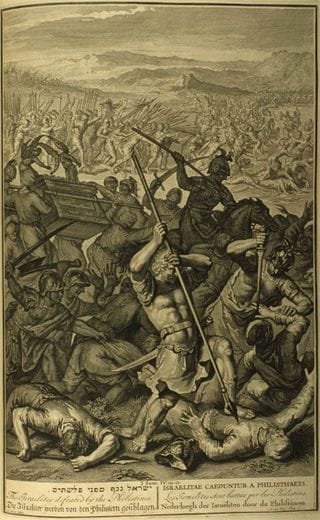
The Scriptures certainly know nothing of such squeamishness. Remember what drove King Saul into a jealous rage was when the women of Israel commemorated David’s exploits in song:
“Saul has struck down his thousands, and David his ten thousands” (1 Samuel 18:7).
And this was not the last of David’s exploits in just wars. He went down to the town of Keilah where he “fought with the Philistines and brought away their livestock and struck them with a great blow” (1 Samuel 23:5).
I’m finally snipping a bit of Bryan’s screed because the rest is all about the Righteous Warfare of the Old Testament, Saul and David and the rest.
This is the point where, to be honest, it’s hard to refute Bryan. Because, to be honest, it’s perfectly legitimate, Biblically, to use the Old Testament and Israel’s holy wars against the Philistines and the like to justify Going Out and Killing All the Bad Guys You Can as a sacred and God-approved thing to do.
Of course, doing that gets you into all sorts of interesting areas, as the wars of the Israelites are particularly bloody and, to modern thinking, downright evil. Consider Numbers 31:15-18, Deuteronomy 3:6-7, Joshua 6:20-21, Joshua 8:18-27, 1 Samuel 27:8-11, 1 Chronicles 20:1-3, 1 Samuel 15:2-3 …
Does Bryan think these acts would warrant the Congressional Medal of Honor? Is this how Bryan thinks our soldiers should be acting in Afghanistan and Iraq?
For what it’s worth (and I’m sure Bryan would consider me damned for it), I reject these passages as reflecting the will of God.
Skipping ahead, we get …
Christianity is not a religion of pacifism. Remember that John the Baptist did not tell the soldiers who came to him to lay down their arms, even when they asked him directly, “what shall we do?” (Luke 3:14).
A fascinating passage, but let quote it more in full (Luke 3:10-14):
“What should we do then?” the crowd asked. John answered, “Anyone who has two shirts should share with the one who has none, and anyone who has food should do the same.”
Socialist!
Even tax collectors came to be baptized. “Teacher,” they asked, “what should we do?” “Don’t collect any more than you are required to,” he told them.
Wasn’t Bryan just preaching the other day about how “the involuntary transfer of wealth is fundamentally immoral. The voluntary transfer of wealth, on the other hand, is noble and compassionate.” He was condemning taxation for health care, but it would seem to apply for any taxation. Yet Bryan ignores John the Baptist not telling the tax collectors to lay down their tax rolls …
Then some soldiers asked him, “And what should we do?” He replied, “Don’t extort money and don’t accuse people falsely—be content with your pay.”
No, John the Baptist doesn’t tell them to stop fighting — because, yes, sometimes it’s necessary. He does seem to address what was a more immediate problem regarding soldiers (whether Herod’s or Caesar’s) in Judea at the time — trying to supplement their income through extortion.
War is certainly a terrible thing, and should only be waged for the highest and most just of causes. But if the cause is just, then there is great honor in achieving military success, success which should be celebrated and rewarded.
One could argue that war, even when just, is so terrible that to celebrate it is to sinfully worship its evils — lesser evils, perhaps, but evils nonetheless. It’s like celebrating a mastectomy, even if it’s done for a high and noble cause.
That said, there can be valor in war, exemplified in self-sacrifice toward the cause. That’s not about killing per se. It may well involve the killing of others, as a last resort and to a higher end, or it may be the protection of one’s brethren in arms, or a mixture of both. The Medals of Honor described above all fit the bill. To denegrate them by noting that they reflect some sort of (obviously inferior, if not sinful) “feminization” is, frankly, sickening.
Similarly sickening is the idea that war’s about “killing people and breaking things.” While it’s fine to quote Patton’s “The object of war is not to die for your country but to make the other guy die for his,” killing for the sake of killing, even in a “holy cause,” is not a moral imperative. Indeed, it’s a claim that can be made by the “Bad Guys,” too. It devalues human life, the creation of God.
I am reminded of Rear Admiral Jack Phillip at the Battle of Santiago de Cuba in the Spanish-American War, who admonished his men who were celebrating the burning Spanish shop Vizcaya, “Don’t cheer, men; those poor devils are dying.”
And that echoes the older Talmudic tale: “When the Egyptians were drowning in the Red Sea, the angels in heaven began to break forth in songs of jubilation, but the Holy One, blessed be He, silenced them: ‘My creatures are perishing — and ye are ready to sing!'”
Bryan sums up:
The bottom line here is that the God of the Bible clearly honors those who show valor and gallantry in waging aggressive war in a just cause against the enemies of freedom, even while inflicting massive casualties in the process. What I’m saying is that it’s time we started imitating God’s example again.
If we leave aside the self-serving tales of conquest and genocide that fill the Old Testament, the New Testament (you know, the one that Changes Everything when it comes to dietary laws, but not, per Bryan, rules of warfare) doesn’t seem all that sanguine about war. While John the Baptist seems more interested in soldiery acting justly, Jesus mentions, pretty clearly, that violence is a sketchy option at best (Matthew 26:50-52):
And Jesus said unto him, Friend, wherefore art thou come? Then came they, and laid hands on Jesus and took him.
And, behold, one of them which were with Jesus stretched out his hand, and drew his sword, and struck a servant of the high priest’s, and smote off his ear.
Then said Jesus unto him, Put up again thy sword into his place: for all they that take the sword shall perish with the sword.
Those who individually act in valor in battle, offering up their lives, are worthy of praise. That they do so in pursuit of the death of their opponents is incidental; where they do so in clearly seeking to protect their comrades in battle is even more laudatory, to my mind. That Bryan seems to think that reflects some sort of dubious feminization of the Medal of Honor is, honestly, more indicative of his bloody mindset that anything else.
I’ll close only in noting one more CMOH tale, this one from WW II. Like the above, it’s a blend of fearlessness in striking at the enemy and a devotion to protect one’s comrades in arms. It refers to Private Rodger Young, who died on New Georgia, Solomon Islands:
On 31 July 1943, the infantry company of which Pvt. Young was a member, was ordered to make a limited withdrawal from the battle line in order to adjust the battalion’s position for the night. At this time, Pvt. Young’s platoon was engaged with the enemy in a dense jungle where observation was very limited. The platoon suddenly was pinned down by intense fire from a Japanese machinegun concealed on higher ground only 75 yards away. The initial burst wounded Pvt. Young. As the platoon started to obey the order to withdraw, Pvt. Young called out that he could see the enemy emplacement, whereupon he started creeping toward it. Another burst from the machinegun wounded him the second time. Despite the wounds, he continued his heroic advance, attracting enemy fire and answering with rifle fire. When he was close enough to his objective, he began throwing handgrenades, and while doing so was hit again and killed. Pvt. Young’s bold action in closing with this Japanese pillbox and thus diverting its fire, permitted his platoon to disengage itself, without loss, and was responsible for several enemy casualties.
Was that a somehow feminized Medal of Honor, Bryan? Did they sing girly-girl songs about it? Or was it acceptable only so long as there were enough other medals given to guys attacking Japanese pillboxes just for the sake of killing the Bad Guys?
First impressions are lasting ones. One of Bill Clinton’s first big public acts was tackling discrimination against gays in the military. It was a worthy subject, but probably not the…
First impressions are lasting ones.
One of Bill Clinton’s first big public acts was tackling discrimination against gays in the military. It was a worthy subject, but probably not the best subject to tackle first. Not only did the backlash lead to a screwy compromise (“Don’t Ask, Don’t Tell”), but it came across as an odd thing to squander the initial momentum of his presidency on — and set the stage for the failure of his health care initiatives.
Going from the opposite direction, the new Secretary of Education, Margaret Spellings, who started in her job on Monday, seems set to make an odd first impression, too.
The nation’s new education secretary denounced PBS on Tuesday for spending public money on a cartoon with lesbian characters, saying many parents would not want children exposed to such lifestyles.
The not-yet-aired episode of “Postcards From Buster” shows the title character, an animated bunny named Buster, on a trip to Vermont — a state known for recognizing same-sex civil unions. The episode features two lesbian couples, although the focus is on farm life and maple sugaring.
Education Secretary Margaret Spellings said the “Sugartime!” episode does not fulfill the intent Congress had in mind for programming. By law, she said, any funded shows must give top attention to “research-based educational objectives, content and materials.”
“Many parents would not want their young children exposed to the lifestyles portrayed in the episode,” Spellings wrote in a letter sent Tuesday to Pat Mitchell, president and chief executive officer of PBS. “Congress’ and the Department’s purpose in funding this programming certainly was not to introduce this kind of subject matter to children, particularly through the powerful and intimate medium of television.” She asked PBS to consider refunding the money it spent on the episode.
“Postcards from Buster” is a spin-off from the popular “Arthur” cartoon, and focuses on Buster traveling around the country with his video camera, exploring the places, peoples, and ways of life there.
That in so doing, a lesbian couple is encountered, though, is evidently unacceptable to Sec’y Spellings.
Spellings issued three requests to PBS. She asked that her department’s seal or any statement linking the department to the show be removed. She asked PBS to notify its member stations of the nature of the show so they could review it before airing it. And she asked for the refund “in the interest of avoiding embroiling the Ready-To-Learn program in a controversy that will only hurt” it.
In closing, she warned: “You can be assured that in the future the department will be more clear as to its expectations for any future programming that it funds.”
The department has awarded nearly $100 million to PBS through the program over the last five years in a contract that expires in September, said department spokesman Susan Aspey. That money went to the production of “Postcards From Buster” and another animated children’s show, and to promotion of those shows in local communities, she said.
The problem with soliciting and accepting government money, of course, is that it subjects you to the ideological whims of whomever is running the government (and subject to every taxpayer’s bitching about what is and/or isn’t shown). Sec’y Spellings is doubtless correct that “many parents would not want their young children exposed to the lifestyles portrayed in the episode,” but there are likely parents who would object to any number of other things shown, too. For example, the episode set in Utah mentions that (gasp) Mormons live there, and actually explores aspects of their lifestyle! Who knows where such indoctrination might lead?!
Alas, PBS has backed down on the matter, going further than Sec’y Spellings requested:
A PBS spokesman said late Tuesday that the nonprofit network has decided not to distribute the episode, called “Sugartime!,” to its 349 stations. She said the Education Department’s objections were not a factor in that decision. “Ultimately, our decision was based on the fact that we recognize this is a sensitive issue, and we wanted to make sure that parents had an opportunity to introduce this subject to their children in their own time,” said Lea Sloan, vice president of media relations at PBS.
[…] On the episode in question, “The fact that there is a family structure that is objectionable to the Department of Education is not at all the focus of the show, nor is it addressed in the show,” said Sloan of PBS. But she also said: “The department’s concerns align very closely with PBS’ concerns, and for that reason, it was decided that PBS will not be providing the episode.” Stations will receive a new episode, she said.
WGBH, which co-produced the episode, will be showing it, and will also make it available to other stations.
(via Julia)


