So, as an example, the 6-foot tall Fighter with a Strength of 16 (+3 Bonus) can:
Do a Running Long Jump of 16 feet forward (clearing a 4 foot high obstacle)
Do a Standing Long Jump of 8 feet forward (clearing a 2 foot high obstacle)
Do a Running High Jump of 6 feet high (with a reach of up to 9 feet)
Do a Standing High Jump of 3 feet high (with a reach of up to 6 feet)
If you land in difficult terrain, you need a DC10 Dexterity (Acrobatics) check to not fall down prone.
You can extend your arms half your height above yourself during the jump. Thus, you can reach above you a distance equal to the (height of the jump ) + (1½ times your height). (See, putting a height value on your character sheet finally means something!)
Movement and Jumping
The RAW rule is, your jump in feet (up or across) counts against your Movement. That implies that if you have a Speed of 30, and you want to try and long jump 20 feet, you can only move 10 feet beforehand. (Jumps can’t split across turns.)
For example, the Jump spell or a Ring of Jumping lets you triple your Jump — so the Fighter described above would get a Running Long Jump of (16×3=) 48 feet, right? Nope. If their Speed is only 30, they can only Jump that far (or less, given the 10 foot lead-up to a Running Long Jump).
This limitation can be extended, though, through:
Speed magic (e.g., Haste, which doubles your Speed)
The Dash action (which effectively doubles your Speed for the turn).
There are cases with spells where it is possible to jump higher than 10 feet, which raises the question as to whether you then take damage upon landing again.
People can disagree, but I’d be inclined to say no, especially as magic is involved: if your (magically-enhanced) muscles can propel you upwards 20 feet, they can absorb the (same) shock in landing after returning to the ground. Because magic!
So, what about Jumping in 5.5e?
Pretty much all the same as with 5e for the basic jumps.
The Jump spell is handled a little differently, and more simply: each turn, the recipient of the spell can long jump 30 feet by spending 10 feet of movement. No calculations needed.
So this one is short and sweet, but an important guideline to remember. It shows up in multiple 5e rulebooks, including the introductory material to the Players Handbook [PHB 7], repeated for emphasis in Xanathar’s and Tasha’s (emphasis mine):
Whenever you divide a number in the game, Round Down if you end up with a fraction, even if the fraction is one-half or greater.
That is, for those of you with an Excel frame of mind, always use TRUNC(), rather than ROUND() or CEILING().
A common example of this is with damage Resistance, which some monsters have. Resistance to a type of damage means it’s halved. If you do 15 points of fire damage to a creature with Resistance to Fire, they only take 7 points (15 / 2 = 7½, Round Down to 7).
Is there some deep, important, mystical and/or pragmatic reason to Round Down by default? No. I suspect things would all balance out decently enough if we handled rounding in a different fashion. But it is important that there be a rule so that one isn’t having to look up every case where fractions show up, seeing how the rounding should work for each. Consistency makes for faster, easier, less contentious gameplay.
Of course, as the preceding general rule in the PHB says, exceptions beat general rules, and there are places where there are specific exceptions to Rounding Down called out — either specifically changing how things should be rounded, or more often providing a minimum. For example, you regain half of your maximum Hit Dice used after a Long Rest, but the rules note a minimum of 1 Hit Die is recovered (otherwise 1st level characters would get nothing, as 1 HD / 2 = ½ HD, rounded down is 0 HD).
But unless an exception is called out, the general rule is always to Round Down.
And with 5.5e?
The same bedrock principle applies in 5.5e (2024), as seen on PHB page 8 and the Glossary:
Whenever you divide or multiply a number in the game, round down if you end up with a fraction, even if the fraction is one-half or greater. Some rules make an exception and tell you to round up.
It does seem to me, looking at the rules, that there are more exceptions called out, but not a lot.
So Invisibility is often one of those “DM Bane” spells or abilities. Sneak past all the guards, unable to be targeted, overhearing all the secrets, scouting out all the ambushes. It can be really annoying, if not an OP way to get around a lot of hard work.
But (spoilers!) in D&D 5e, it’s … useful, but not game-breaking.
A creature you touch becomes invisible until the spell ends [Concentration, up to 1 hour]. Anything the target is wearing or carrying is Invisible as long as it is on the target’s person. The spell ends for a target that attacks or casts a spell.
Well, that sounds ominous. Uber-rogues! Hidden assassins! Parties just waltzing through dungeons!
An invisible creature is impossible to see without the aid of magic or a special sense. For the purpose of hiding, the creature is heavily obscured. The creature’s location can be detected by any noise it makes or any tracks it leaves.
Attack rolls against the creature have disadvantage, and the creature’s attack rolls have advantage.
I.e.,
Impossible to see without the aid of magic or a special sense (see below for more detail).
Heavily Obscured — a Hazard defined as “A Heavily Obscured area—such as darkness, opaque fog, or dense foliage—blocks vision entirely. A creature effectively suffers from the Blinded condition when trying to see something in that area.”
It’s kind of funny to think of Invisibility as bringing an obscuring field (itself invisible) wrapped around you, but for purposes of the Hide action, that’s how it works. Being Heavily Obscured makes it much easier to Hide
An attacker is effectively “Blinded” while dealing with such a target (thus attacking at Disadvantage).
Still detectable by any noise it makes or any tracks it leaves (or any scent it gives off). A fairly common ruling, though not backed by RAW, is that this (under certain circumstances) represents a Disadvantage on Perception checks. Note that being detected doesn’t necessarily change the Disadvantage to attack such a target; in general, it mainly offers the opportunity to attack it.
“I have no visual or auditory or olfactory sign that there is anything near me. So I will not start swinging my sword.”
On the other hand, “I saw footsteps running through the puddle!” while not making you an easy target, does make your presence known and, potentially, able to be dealt with. “I hear a footstep, I see a splash in a puddle, I smell a familiar perfume — I swing, but I know I am at a Disadvantage.”
When you attack a target that you can’t see, you have Disadvantage on the attack roll. This is true whether you’re guessing the target’s location or you’re targeting a creature you can hear but not see. If the target isn’t in the location you targeted, you automatically miss, but the DM typically just says that the attack missed, not whether you guessed the target’s location correctly.
And …
When a creature can’t see you, you have Advantage on attack rolls against it.
What does that mean, basically?
Attack Rolls against an invisible creature have Disadvantage
Attack Rolls by an invisible creature have Advantage.
Which is pretty awesome, but is not game-dominating.
The Devil Is in the Details
Delving deeper, the Invisibility spell:
Requires Concentration. That makes it pretty good for “I will make you invisible, go scout ahead.” Less so for “Here, let me make you invisible mid-battle, as long as I OH MY GOD THE FIREBALL!”
Unless you are an Invisible Stalker, where Invisibility an innate condition that doesn’t require Concentration. Such cases will are clearly stated in the rules.
Ends when an Invisible creature attacks or casts a spell.
Prepping for an attack doesn’t drop the Invisibility (we’re not talking Romulan warbirds here)
For a Rogue, that attack that drops the spell is probably a Sneak Attack, since that gives them Advantage.
For a multi-turn spell-casting, starting the spell breaks the Invisibility.
I see you!
So what might counter Invisibility (beyond footprints or being noisy)?
Blindsight: “A creature with blindsight can perceive its surroundings without relying on sight.”
Tremorsense: “A monster with tremorsense can detect and pinpoint the origin of vibrations within a specific radius, provided that the monster and the source of the vibrations are in contact with the same ground or substance “
Truesight: A creature with truesight can, out to a specific range, see in normal and magical darkness, and see Invisible creatures and objects.
In general, the above are either (a) creatures living belowground or in the dark or in the Underdark, or (b) beings of a higher order.
How about magic?
See Invisibility does what it says on the tin: “see invisible creatures and objects as if they were visible” for an hour. Similarly, the 10th Level Divination Wizard class feature, “The Third Eye,” giver an option to “See Invisibility: You can see invisible creatures and objects within 10 feet of you that are within line of sight.”
(Note that a 2020 Sage Advice Compendium defines line of sight (in another context) as requiring being able to see something, leading some people to assert that the Third Eye feature does nothing because it only sees invisible things that are in line of sight. But this is very clearly “that would be within line of sight if they were visible” in meaning, and ruling otherwise is untoward nitpicking of the SA’s statement in a different context.)
Dispel Magic will work against an Invisibility spell just fine … but you need to be able to target it, meaning (most likely) a Perception roll first, with the caveats above.
Create Water is also a good sneaky way to be able to perceive an invisible creature, either through raindrops or through puddles.
And, just as a general note, Area of Effect spells are an excellent tactical counter to Invisibility (think “Depth charges vs suspected enemy submarine”).
Surprise. If you’re Invisible when you roll Initiative, you have Advantage on the roll.
Concealed. You aren’t affected by any effect that requires its target to be seen unless the effect’s creator can somehow see you. Any equipment you are wearing or carrying is also concealed.
Attacks Affected. Attack rolls against you have Disadvantage, and your attack rolls have Advantage. If a creature can somehow see you, you don’t gain this benefit against that creature.
Which all seems reasonable, but doesn’t actually define Invisibility — it almost arguably (and some folk have made the argument) doesn’t really state you can’t be seen.
The Invisibility spell simply conveys the Invisible condition to its target(s), which remains until the end of the spell duration or “immediately after the target makes an attack roll, deals damage, or casts a spell.” Greater Invisibility even lets you do those things and still be Invisible.
The rules on the Invisible condition contain nothing about using other senses (hearing, smell) other than special visual abilities to overcome the Invisibility (it’s implied by still being able to Attack, even at Disadvantage). More importantly, the rules no longer equate Invisibility with being Heavily Obscured, even though the effects (Disadvantage on Attack) are similar.
You have the Blinded condition while trying to see something in a Heavily Obscured space.
Though in the “Exploration” section of the PHB, it does get some definition:
A Heavily Obscured area—such as an area with Darkness, heavy fog, or dense foliage—is opaque. You have the Blinded condition when trying to see something there.
With the Hide action, you try to conceal yourself. To do so, you must succeed on a DC 15 Dexterity (Stealth) check while you’re Heavily Obscured or behind Three-Quarters Cover or Total Cover, and you must be out of any enemy’s line of sight; if you can see a creature, you can discern whether it can see you.
On a successful check, you have the Invisible condition while hidden. Make note of your check’s total, which is the DC for a creature to find you with a Wisdom (Perception) check.
You stop being hidden immediately after any of the following occurs: you make a sound louder than a whisper, an enemy finds you, you make an attack roll, or you cast a spell with a Verbal component.
This has three interesting implications:
First, if you have the Invisible condition, you don’t need to Hide because all Hide does is give you the Invisible condition.
Second, while we do not get anything explicit about how to detect a magically Invisible creature with other senses before they attack, do damage, or cast a spell, the Hide guidelines do provide some hints that could be used: a sound louder than a whisper, a suitable Perception roll against you, an attack, or a spell with a verbal component.
Third, the language that Hidden creatures gain the “Invisible” condition: does that mean the See Invisibility spell (“you see creatures and objects that have the Invisible condition as if they were visible”) or Truesight (“you see creatures and objects that have the Invisible condition”) should spot where people are hiding behind trees? RAW, it seems so, though that hardly appears to be the intent. Many people have spent a lot of time complaining about this.
But wait, there’s more. In a box under “Combat” and “Cover,” it discusses Unseen Enemies:
When you make an attack roll against a target you can’t see, you have Disadvantage on the roll. This is true whether you’re guessing the target’s location or targeting a creature you can hear but not see. If the target isn’t in the location you targeted, you miss.
When a creature can’t see you, you have Advantage on attack rolls against it.
If you are hidden when you make an attack roll, you give away your location when the attack hits or misses.
While that’s sort of focused on more conventionally hidden creatures, it also applies to magical invisibility as well.
Let’s mix it up even more.
In the order of combat rules on Initiative and Surprise, the rules read:
Surprise. If a combatant is surprised by combat starting, that combatant has Disadvantage on their Initiative roll. For example, if an ambusher starts combat while hidden from a foe who is unaware that combat is starting, that foe is surprised.
The term “hidden” isn’t defined anywhere. Is a person with the Invisible condition (from either a spell or from taking a Hide move) “hidden.” The “Surprise” section of the Invisible condition focuses just on the attacker getting Advantage on Init, not on this additional Disadvantage on Init for the defender.
In short, all of this in 5.5e is kind of a mess — things aren’t defined clearly, or where defined are simplified in unhelpful ways. The 5e rules had their own messy issues, but 5.5e has only made them, um, messier.
As a result, game tables will almost inevitably have to adopt some sort of house rules (probably borrowing from 5e rules). These could be as simple as defining the term “hidden,” acknowledging that in almost all Surprise situations there will be both Advantage and Disadvantage on Init, and some ground rules for how to actually detect Invisible creatures. Others might go for more elaborate revisions to the rules set.
So in addition to being a Tactical Guy, I’m a role-player, so I will likely emphasize those aspects in any game I can.
D&D is not a RP-heavy system by design; it’s originally derived from miniatures warfare gaming (which doesn’t reward someone running into the middle of the battlefield with a white flag to negotiate a truce), and the Experience Points that folk are incented after are for, frankly, killing things. This has “gotten better” over the years, but killing does still seem to be the best way to get XP. So, as a general rule, one does not hop into a D&D game expecting penetrating psycho-drama and lengthy inter-character dialogs.
Right. Got it.
There Will Be Role-Playing
I still encourage players to think about the personality aspects of their characters — 5e has rather clumsily loaded traits, ideals, bonds, and flaws into the character creation process, related to background. It’s a start, but I would hope players would come up with something a bit more organic, using those background-driven items as, well “inspiration.”
Role-playing is also important, in my games, when encountering people not in the party. The folk encountered, especially in town, are not pop-up clue dispensers. I can’t promise Shakespeare, but there will be character interactions, so I expect something more than “I walk up to the Bartender and roll on Deceive.”
All of which ties into the post topic: Inspiration [PHB 125]!
What is Inspiration?
Inspiration!
From a meta standpoint, Inspiration is an optional rule, based on whether the DM wants to use it. I’m not sure why they would not, but if your tables doesn’t use it … it’s worth asking why not.
Mechanically, here’s what the book say (emphasis mine):
Inspiration is a rule the game master can use to reward you for playing your character in a way that’s true to his or her personality traits, ideal, bond, and flaw.
By using inspiration, you can draw on your personality trait of compassion for the downtrodden to give you an edge in negotiating with the Beggar Prince. Or inspiration can let you call on your bond to the defense of your home village to push past the effect of a spell that has been laid on you.
Those examples given are a little misleading. You get Inspiration by (as a limited example) drawing on those personality traits in some fashion … and can then use Inspiration to do something better than usual. RP-wise, you can draw on that connection (“As I talk to the Beggar Prince, I remember that morning giving my last gold piece to that hungry child [for which I got Inspiration because it ties into my character origin], and I hold onto that insight as to what hunger really means as I negotiate for my friends’ release”), but it’s not completely necessary.
Gaining Inspiration
The 5e DMG (pg. 240) specifically suggests giving Inspiration for:
Roleplaying: A character does something notable and memorable that is consistent with their personality bonds, flaws, nature, etc.
Heroism: A character does something notably heroic — usually taking some sort of huge risk (with possible loss of life).
A Reward for Victory: Giving Inspiration when a character levels up is common at many tables. Other noteworthy goal achievements (slaying the BBEG, or even one of their powerful lieuts) can also qualify.
Genre Emulation: A character helps support the conventions and tropes of the genre — e.g., calling out that they are falling for a dame in a noirish setting because that’s what loner heroes do; leaning into the creepiness and fright of a horror -focused game.
That all seems pretty in line with my thoughts. The PHB similarly says:
Your GM can choose to give you inspiration for a variety of reasons. Typically, GMs award it when you play out your personality traits, give in to the drawbacks presented by a flaw or bond, and otherwise portray your character in a compelling way. Your GM will tell you how you can earn inspiration in the game.
As noted, good role-play will (or should — see below) almost always net Inspiration at my table. Sometimes it might not happen until after the session when I’m doing the game logs, but …
I also give Inspiration for particularly fun, imaginative, or memorable action by a character. If it’s the sort of thing you’d tell stories about afterwards in a tavern, or that might even be mentioned in the Saga of You that some bard will write someday — it’s worth Inspiration. If it’s something that made every player at the table cheer, laugh, or yelp with surprise (and will be told about at gaming tables to come) — it’s probably worth Inspiration as well.
Since the DM controls the reward of Inspiration, you can keep it from becoming too mechanical or from players “gaming” the system for it. Inspiration should feel like a real reward for doing something for doing something that makes the game more interesting, entertaining, or enjoyable for everyone at the table.
One last thing: the DMG also suggests the DM can dangle Inspiration out for someone when they are considering an action that might provide such a reward (e.g., playing Horatius at the bridge to let their friends escape). That makes it feel a bit too transactional and mechanical to me, the sort of thing that deflates the value of Inspiration.
Using Inspiration
If you have inspiration, you can expend it when you make an attack roll, saving throw, or ability check. Spending your inspiration gives you Advantage on that roll.
Basically, any time you roll a D20, you can burn your Inspiration to gain Advantage. It’s not always a game-changer, but it’s a nifty little boost.
Some tables include house rules letting you burn Inspiration to give someone else Advantage, or even to given an enemy Disadvantage. Thematically that’s a bit more dubious; it’s also potentially imbalancing.
Something tangential to the that, though, is this:
Additionally, if you have inspiration, you can reward another player for good roleplaying, clever thinking, or simply doing something exciting in the game. When another player character does something that really contributes to the story in a fun and interesting way, you can give up your inspiration to give that character inspiration.
Don’t let this erode down to players just giving their own Inspiration at the very last second to someone else who badly needs to make a roll. It should most likely happen out of combat, and the giver should provide some justification. (Note, though, that some tables effectively pool their Inspiration together; to me, that robs it of some of its color.)
Use It Or Lose It
Inspiration is a binary — you either have it or you don’t. You can’t earn multiple “points” of Inspiration.
That means that if you do something Inspiration-worthy, and you still have your previous Inspiration, you don’t get anything.
The biggest problem I see with players (myself included, when in that role) is holding onto their Inspiration “just in case.” Better to use it at the first point where it would be useful, and work at earning more. Fireball coming down your throat and you used DEX as your dump stat? Time to spend that Inspiration die to get Advantage on that DEX Save …
The DMG [p. 240] suggests each character should get around one Inspiration a session. That seems a bit high to me (and I’m not wild about an Inspiration quota), but if you have players that are doing solid RP and coming up with interesting ideas, it’s certainly not an impossible rate for them.
Some GMs put some bounds as to how long Inspiration can hang around out there — resetting it at the time of a Rest of some sort, for example. I understand that thematically, and it certainly encourages people to use their Inspiration while they have it, but I tend to be more lenient than that.
Helping the DM
There are a couple of other ways (at my table) that helping the DM can also generate Inspiration.
A player who makes substantive contributions to the game outside of it (keeping game logs, posting lots of funnies in the campaign forum, etc.) might sometimes get Inspiration for their character. I don’t do this every time because I don’t want it to be quite so quid pro quo, but occasional Inspiration is a nice tip-o-the-hat to a helpful player.
I know as a GM that I often have a dozen balls in the air, and keeping an eye out for someone making the game “more exciting, amusing, or memorable” sometimes fails because I’m too busy trying to decide what spell the evil wizard is about to cast.
Because of that, I encourage players to let me know if someone deserves Inspiration. I rarely say no (largely because I’m rarely asked for an unworthy cause).
Closing Thoughts
The DMG [p. 240] has further suggestions of when and why to award Inspiration, and some variants on the rule. It’s worth a read.
Inspiring!
I find that players often forget they have Inspiration available when playing in a VTT like Roll20. A simple way around that is to create or designate a token Status Marker for Inspiration. Alternately, I use the Dealer API/Script by Keith Curtis (see here and here) with some simple macros to put (or take) a shiny gold D20 on the player IDs on the Roll20 desktop, complete with an inspiring message. Fun, and very visible so that it doesn’t get forgotten!
How does this change in 5.5e?
Pretty fundamentally.
First off, it’s called HeroicInspiration now, probably to help distinguish from, say, Bardic Inspiration (a bardic class feature the lets the bard give another creature a D6 (rises with level) to use on any failed D20 Test in the next 24 hours).
Secondly, it’s no longer an Optional Rule, but baked into the system.
In addition to tweaking the name, the whole thing has evolved from top to bottom.
Using Heroic Inspiration
In the Vocabulary section of the 5.5e (2024) rules, it reads under “Heroic Inspiration“:
If you (a player character) have Heroic Inspiration, you can expend it to reroll any die immediately after rolling it, and you must use the new roll.
So two differences here:
It’s providing a die reroll, rather than Advantage. Effectively that’s the same, but process-wise it means considering using it only after a failure, rather than “I’ll use my Inspiration, oh, look, I succeeded on both rolls, so that was a waste.” It also helps it stand out against all the other mechanisms that award Advantage.
The reroll can be on any die roll, not just a D20 Test. Going up against that giant with your great axe and rolled a 1 on that D12 damage die? Now’s the time to try and improve on it! Leveling up and rolling your new Hit Die and score a 2 rather than a 10? Give it another go! Trying to heal your buddy and rolled something crappy in healing HP? Heroic Inspiration to the rescue! Your Wild Magic just did something disastrous? Let’s try our luck again! Death Saving Throw got a Nat 1? No problem!
If you gain Heroic Inspiration but already have it, it’s lost unless you give it to a player character who lacks it.
So you are still limited to a single “on/off” of having Heroic Inspiration, but if you get another one, you can (through some metaphysical concept) pass it on to another player. That seems a little odd (and like a homebrew rule that got formal approval in 5.5e), but there you go.
Getting Heroic Inspiration
But … how do you get Heroic Inspiration in 5.5e? Well, it’s still allowed / encouraged for the DM to award it for good role-playing, as in 5e [DMG 46]
You can also use Heroic Inspiration to reward roleplaying, immersion in the game, and heroism. Use it to incentivize the kind of behavior you want to see in your game, such as acting in character, taking risks, thinking strategically, cooperating well, or embracing the tropes of a particular genre.
The DMG commentary about it has gone from about a full page down to a short sidebar, but it still hits the fundamentals.
There’s also a PHB (p. 13) description:
Typically, DMs reward it when you do something particularly heroic, in character, or entertaining. It’s a reward for making the game more fun for everyone playing.
That last bit is important. It’s not just about the Player, or even the Player impressing the DM, but how the Player’s actions make the game better.
That said, the biggest change here is that Heroic Inspiration is produced through rule mechanics, too, e.g.,
If you are of the Human species — you get Heroic Inspiration after each Long Rest.
The Fighter (Champion) subclass 10th level feature “Heroic Warrior” gives you Heroic Inspiration at the start of any turn when you don’t have it (!).
The Musician (Origin Feat) lets you play a song after any Short or Long Rest and give Heroic Inspiration to some of your allies who hear you.
Spending a Short Rest in your Bastion will net you Heroic Inspiration.
Those are the mechanics I found; no doubt there are others or, at the very least, others will show up in future source books. Heroic Inspiration is now a more unique tool to tweak new classes, spells, and feats; it will be used. But will it be overused (or, frankly, is it overused now)?
On one hand, giving so many ways to get Heroic Inspiration kind of cheapens it? Charging the orcs to save the orphan you befriended? Epic! Took a nap in your Bastion? Literally ho-hum.
Oh the other hand, people will be more likely to use Heroic Inspiration if they know there are ways they will get it back. Which is no small thing.
I’ve found Insight rules terribly underutilized in the D&D games I’ve been in. Wisdom (Insight) [PHB 178] is essentially Perception for personalities.
Your Wisdom (Insight) check decides whether you can determine the true intentions of a creature, such as when searching out a lie or predicting someone’s next move. Doing so involves gleaning clues from body language, speech habits, and changes in mannerisms.
Examples of using Insight
Bob the Tailor is a town elder, who’s fluttering around trying to keep the party from the abandoned mine outside the town. It would be useful to know where his fear is oriented — toward the party, toward the town, toward a third party, or toward himself? Is he lying when he talks about the mysterious music people have heard in the area? If we we say we’re going to the mine anyway, does his fear spike — or is it anger? Is his smile when he sees the constable walking this way the confidence of seeing an approaching ally, or a deceptive cover for terror at being discovered?
Insight can help with all that.
In other cases, you might use Insight to figure out if the guy you’re gambling with is confident in his hand. How does he feel about that last card he drew? Is your date having a good time? Sure, she says she likes that roast beast you ordered for her … but how is she really feeling?
If someone’s trying to actively resist others using their Insight against them, they usually roll Charisma (Deception). (This is a case where one could easily use other base states for the Deception role, however — an academic using Intelligence (Deception) in hiding their bias in a paper, for example, or someone using Strength (Deception) to hide how incredibly freaking heavy that chest of gold they’re showing off with is.)
But rather than Active rolls, this is also a case where Passive skills come into play — the GM can consider passive Insight (or another’s passive Deception) to give give unsolicited clues about “He’s behaving a little twitchy,” or “He seems genuinely worried about you,” or even “You notice she seems attracted to the barkeep.”
Limitations of Insight
It does have limitations. It can indicate that someone is lying — but not necessarily what they are lying about, or why they are lying, or what the truth is. People lie, after all, for a lot of reasons. Insight might tell you that the city guard you’re talking with still seems highly suspicious of you after your story … but it won’t tell you if he’s going to let his friends know to keep an eye out on you, or that he’s going to try to ambush you later on.
In short, Insight gives you, well, insight into underlying feeling, reactions, etc., but not necessarily why they are reacting that way. Is the guard at the door speaking a bit flatly when he tells you about how great a guy the grand vizier is? Yeah, you can pick that up with Insight, but it’s going to be more difficult (i.e., take more time and questions and other actions) to tell if the change because of some sort of loyalty spell, or from fear that the vizier’s secret police are monitoring him, or even just boredom with people pumping him for information about the vizier.
Tells
Some DMs just provide the “tells” the player is seeing, and lets them draw conclusions. “The guy definitely has sweat beading on his forehead.” “Her eyes keep shifting around the room, never quite meeting yours.” “His voice is definitely rising in pitch and intensity.” “She’s tugging at her ear, the same way she was during that card game last night when she had a winning hand.” Things like that.
Of course, “things like that” are actually sort of Perception things — something that can just come out of the DM’s color text or description of the interaction. Insight seems to blend both Perception and Investigation (what is there, and what does it mean) for social interactions. If all the DM gave me was vague physical tics, I’d probably ask for more of what that means to me (and not trust that I the Player understand such things the same way as the DM or module writer).
The nature of Insight — picking up on tells, physical and verbal expressions, etc. — also requires up front you have a way of perceiving and interpreting such things. Dealing with the human barkeep at the tavern is one thing. Trying to read the body language of a gelatinous cube is another.
Even in less extreme situations, Insight might be hampered by unfamiliarity with the target’s customs and culture: shouting and waving around your spear might be an expression of hostility by this never-before-met humanoid, or it might be a ritualized greeting, or a mating display. Insight might still work, but less reliably.
Remote use of Insight
Finally, Insight can be used without the target standing in front of you — picking out a great gift for your girlfriend (or for the prince) based on what they’ve enjoyed in the past, or figuring out how likely the savage Orcish war leader you keep encountering is to attack the city or respond to various counters. I’d probably use a normal Difficulty DC as the opposition, and familiarity (or lack thereof) with the target would be a key in determining how difficult the estimate was.
Overusing Insight
Because it deals with interpersonal relationships, Insight can be easily abused or overused. Overuse of Insight is a bit like overuse of Perception (“I evaluate every person in the bar” is like “I search every room thoroughly”); it’s doable, but should carry some costs (time being a major one, but also something like the likelihood someone is going to catch you staring at them — or their love interest — and take offense).
Overuse also takes away a bit from Role Playing. The DM should be able to use passives to feed needed clues to the players about how people are behaving without their insisting on active Insight rolls, just as they feed visual prompts in the normal course of things rather than players requiring active Perception roles as they walk through town.
Who rolls Insight?
Note: Insight is one of those skills (like Perception, etc.) where sometimes it makes more sense for for the DM to roll it for a character, to determine if you can figure out something, can’t figure out something, or are deceived in your insight about something.
I would suggest as well that, like Perception,Insight can be abused by having everyone gang up about it. “Well, Sue, you can try using Insight to tell whether the merchant is ripping you off.” “Okay, I’ll try that.” “Me, too!” “Rolling Insight.” “Wait, let me do it, too!”
Aside from the fact that everyone rolling Insight means it’s likely someone is going to hit the DC, it’s also unrealistic. Insight depends on observation, focus, and over some period of time. While it’s often invoked mid-encounter (“Is the barkeep being truthful about when the wizard left?”), in most cases it should take some time — some questions, some comments, some jokes, some interpersonal communications to baseline the subject’s reaction. Having a party of 8 trying to do that to one target is unlikely (or suspicious). Aside from the person doing the actual talking, everyone else probably has something else to keep their attention (the guards, that guy in the corner, the gems in the idol, that meal last night, etc.).
Which is still more reason to let the DM do the rolling behind the screen. “Sue, you’re pretty sure he’s marking up the price outrageously, even though you don’t know him that well. Jeff, you think the merchant’s honest, but, to be fair, you were just talking with Mary about what supplies the group needs. Bob, you’ve been shopping for those potions you wanted, so I don’t think you’ve had a chance to figure out anything about how this guy ticks.” At the very least, the likely engagement of individual characters and the time they invest should go into the DC they have to beat with their Insight roll.
Are there changes in how Insight works in 5.5e (2024), rather than 5e?
Actually, for all that 5.5e zeroes in on social interactions (asserting Influence as its own Action, for example), Insight gets very little love, only showing up in the PHB in the 5.5e Skills list, which says only:
Discern a person’s mood and intentions.
Okay, it also shows up in the Search [Action] Vocabulary, where it’s sub-task in such actions is “Thing to Detect: Creature’s state of mind.”
I don’t find any other reference to it in the PHB or in the DMG.
It’s strange to have less information than the previous edition. Weird.
If anyone finds something more, please let me know.
So something happened in the game the night before I wrote this up that, at the time, I kind of blew through, but I wanted to give it some thought. This is, of course, just the sort of thing I have sometimes taken justified criticism for overthinking. But it’s a situation we’ve run into more than once, and I’d like to have figure out a rubric for myself to adjudicate against.
And, as a caveat, it’s always worth noting up front that time and combat in D&D are abstractions designed to turn the chaos of real-life combat into something manageable. While a level of verisimilitude is the goal, manageability always trumps that. Just as D&D is not a physics simulator, it’s not a great combat simulator (falling somewhere between an FPS and Chess).
When the slow guy is supposed to lead off the attack
So, here was the sitch: as the party crept up two different sets of stairs to the upper floor where the local BBEG had their throne room, the plan was that Theren the Sorcerer was going to begin combat by lobbing his Vitriolic Sphere into the center of the bad guys.
How should the combat have been sequenced? Even handwaving aside the question of whether anyone knew that Theren was going first (there was probably an excess of allowable coordination between the two subgroups, since they were going up two different sets of stairs and not using any sort of communication magic) …
Did Theren’s action take place outside of the Initiative order? Did his executing the attack start the combat so that’s when everyone rolls Init?
(Short answer: no.)
Did Theren’s Init get changed to the top of the Initiative order? Since he’s the one initiating the combat?
(Short answer: still no.)
Did everyone with Init rolls before Theren sort of get skipped over? (That’s what I did, but it effectively means that those higher Init rolls become low Init rolls, which is “unfair”.)
(Short answer: it should have been “voluntary”)
Did everyone before Theren in the Initiative order (ally and enemy) actually get to go in some fashion before Theren did?
(Short answer: it should have been that way, yes.)
And did it matter if the bad guys were surprised or not?
(Short answer: Yes and No. But in this case they were not — the Baroness had perceived you coming up the stairs and called for you to come in and play.)
In short: Initiative is rolled when combat begins. You can not make an attack outside of Initiative.
So, no, Theren doesn’t get to bypass the Initiative roll, or have his Init moved to the top of the order, or whatever. (Some folk have house rules for this, but that creates its own problems.)
So let’s simplify the situation a bit and say that the top Initiative order, when rolled, was (leaving out other players and bad guy mooks):
20 – William
15 – BaronessBBEG (the enemy)
10 – Theren
The first question is: is there Surprise? This is determined before Initiative is rolled, technically, though I don’t think it makes a difference.
If you’re surprised, you can’t move or take an action on your first turn of the combat, and you can’t take a reaction until that turn ends. A member of a group can be surprised even if the other members aren’t.
So if Baroness BBEG were surprised by this attack out of nowhere in her throne room (ignoring the previous sounds of the battles below), it counters her Initiative to a large degree. The beginning of the combat can be handled this way:
William says he is choosing to Ready an attack if anyone runs up to the top of the stairwell before his next turn. He’s doing this to let Theren get that shot off as agreed, rather than running into the middle of the room and spoil the AoE plans. It’s essentially giving up his turn, but there you go.
Baroness BBEG is Surprised — she’ll effectively see Theren coming, but will be unable to act on her turn. After her turn occurs, she would be able to take a Reaction (if she had Counterspell, she could then use it against Theren’s impending attack), and she will be able to act normally at the beginning of her next turn.
Theren pops up and acid bombs everyone’s ass.
So Surprise mechanics make things simple(r), because they provide for higher-Init enemies to be locked in place (but ready to go next time).
But in the case of the game that triggered this discussion, there was no Surprise (the party simply wasn’t stealthy climbing those stairs). Which means that there is a disconnect between Intent (lob an Vitriolic Sphere before they can act) and Execution (oh, they acted before I could lob my Vitriolic Sphere, because they had better rolls on Initiative). Or, as one site I saw put it:
“If your player wants to stab the bandit in the face before he has time to act, that’s what a high Initiative roll is for, not a Surprise round.”
Without Surprise, it’s Theren starting to move for his guns first, but the other folk outdrawing him.
“But Dave,” you may say, “she couldn’t see Theren before he came up the stairs.” That’s true, but because she isn’t Surprised (i.e., she was aware of a threat, and so ready to act/react), she still is able to act first as she chooses, because her Initiative is higher.
This gets into the whole idea that 6-second Rounds are themselves an abstraction — if there are six people in the room it’s not that Person 1 literally goes in the first second, Person 2 in the second second, etc. It means that within that six second timeframe, Person 1 acts before Person 2, who acts before Person 3, etc. That doesn’t completely match reality, because not everyone is declaring their actions before they happen as in some games (so that higher Initiative folk know what is coming), but it is essentially how 5e abstracts “People running around and into each other with intent to do mayhem.”
So here’s what should happen (should have happened in this simplification of last night):
William does whatever he’s doing — Dodging, Readying an action, casting Spike Growth in the middle of the room to make sure that nobody runs away before Theren can act, whatever. He’s choosing to back Theren’s play, but still moves faster/before Theren does, because he has higher Initiative.
Baroness BBEG “Readies an action.” Because I’m the GM, you don’t get to know what it is (“Chuck my magic spear at the first person atop the stairs over there”). Neener-neener. But she declares this (whispering in the GM’s head) before Theren because she isn’t Surprised and has higher Initiative.
Theren reaches the top of the stairs and turns to cast his spell …
… and Baroness BBEG executes her Readied action (throwing her spear at the first person atop the stairs, Theren, which hits) …
… and, if still alive, Theren throws his Vitriolic Sphere.
(Note: one of the players reminded me afterwards that Theren was Invisible. This gets into Perception checks, Active vs Passive, etc., to deal with his footsteps and verbal components, etc. In which case she might have been Surprised or she might have been aware something screwing was going on and still chucked her spear with Disadvantage against an Invisible foe before Theren could cast his spell (which would then drop his Invis).
Note that Theren could have said, “Well, heck, they aren’t Surprised so someone might plan to attack me” and change his plans from what had been intended. Or maybe, despite his intent and the team’s plans, William might have taken their Action to attack or distract the Baroness, which might have led to another change of plans by Theren. While Initiative lets people act first, the structure of the game from that point means that people are aware of the actions taken previously by people with better Init, allowing them to revise their plans accordingly.
(In the Action Economy, there’s a significant advantage in going first … but after that, Initiative is like Time: just a way to keep everything from happening at once.)
The bottom line is
You can’t easily plan your way into something that is the equivalent of Surprise (“I go before anyone else does”) if there is no Surprise present and you roll a low Initiative. That’s what Initiative is kind of for — if you roll poorly, you go later in the round.
If the other players who would have gone first want to effectively skip/delay their turn (do a Dodge or a Ready or maybe even a Help), that’s their prerogative for the tactical situation.
The enemy is under no such obligation, and if any of them have higher Init than the “this is how I am starting this combat” attacker, they get to do their thing first (which may be standing there in Surprise, or may be shooting you under the table).
Even if Greedo intended to fire first.
Here are some articles that touch on this — which, given the volume, shows this is something a lot of GMs fret about, though most of the scenarios here involve Surprise, which, as noted, simplifies the question a lot.
So there’s one more area where this kind of thing has come frequently into play, the “We arrange ourselves at the door and charge in” scenario, when the Doughty Fighters at front roll crap Init (because they used DEX as a dump stat) and everyone queued up behind them rolls better Init than them and basically have to:
Move through the Doughty Fighters (as Difficult Terrain, and potentially exposing themselves to attack, which is kind of why you wanted the Doughty Fighters to run in first).
Ready an Action to move in when the Doughty Fighters have and the space is clear (but not then being able to attack or anything, because Ready only lets you take a single Action or a Move).
Fire ranged attacks past the Doughty Fighters (if the angle through the door cooperates).
Waste their turn.
The bottom line there is: yup, those are kind of your choices when everyone in front of you is slower. Hopefully the bad guys inside the room are Surprised!
So what’s different in 5.5e?
The new 5.5e (2024) rules are fundamentally the same, but with a few differences that can affect the above conversation.
First, Surprise is handled differently. Rather than the sort of complex (and deadly) “Everyone rolls Initiative, but Surprised folk don’t get any sort of actions until their first turn, and then they only get Reaction(s) until their second turn,” instead, it’s “Everyone rolls Initiative, but Surprised folk do so at Disadvantage.”
Much simpler, and it still means Surprised folk may get badly hurt unless they have a very high Init modifier or roll really well. Especially if the folk on the Surprising side have managed their Stealth, successfully Hidden, and therefore get Advantage on their Init rolls.
5.5e also addresses the question discussed above: “How do we let the guy who’s going to initiative combat actually do so?” While still insisting on keeping everything inside the Initiative framework for combat, the new PHB and Basic Rules favor the combat initiator by allowing the DM to give them Advantage on their Initiative roll. The problem can still happen, especially if the party wants to give the first shot to someone who used DEX as a dump stat, but it doesn’t hurt.
Second, squares containing Allies/Friendlies on a grid map are no longer considered Difficult Terrain. That makes clearing the corridor into the room a lot easier, even if folk are not lined up by Initiative (which, technically, they can’t be anyway).
I tend to be rule-abiding. But sometimes the rules just aren’t fun. So … sometimes the rules need to change.
So here are the house rules we play with at my table.
I tend to follow the Rules as Written (RAW), sometimes the Rules as Intended (RAI), as makes sense. I’m not big into whole-hog replacing play-tested sub-systems, if only because I’ve seen how easily that can send things heterodyning all over the place.
That said, not all rules are created equal, and things that make for grinding busy-work and management by the player or GM can usually be elided or adjusted when playing with mature individuals who are there for fun.
My House Rules
I use Inspiration. I also encourage players to nominate each other’s characters (or call out their own character to me) to receive Inspiration. It’s a fun mechanic to reward special moments of RP or action.
Bookkeeping that is no fun is no fun.
I tend to be loosey-goosey about Material spell components, except for expensive ones. (Verbal and Somatic I do pay attention to.)
I tend to be loosey-goosey about encumbrance, unless things look ridiculous.
Keep track of your arrows. I mean, it’s not that big a deal. When guidance is needed, I use the “you can recover half your missiles from any combat.”
Dead bodies constitute Difficult Terrain.
We play on a square grid. We use the basic “1 square vertical, horizontal, or diagonal = 5 feet” variant in the PHB 192, rather than the someone more accurate “the first diagonal square is 5 feet, the second is 10, the next is 5, etc.” variant in DMG 252, because it’s just simpler.
Leveling takes place during a Long Rest. Unless for meta purposes it makes sense to do it some other time. But, in general, “I just realized, I know more spells” seems more suitable to happen overnight than while walking down a path.
I prefer Milestone Leveling to getting finicky about XP, dealing with absences from encounters or the table, etc., in ways that leave players unbalanced. Defining adventure goals as the basis for leveling just makes more narrative sense to me, and makes it easier for me and the players.
You take a Short Rest as you Long Rest. So you can be back up some HP if attacked before the end of your Long Rest.
I tend to Roll Actives vs use Passives, since VTTs make it trivial to do so.
You can use a successful Dexterity (Acrobatics) roll to keep you from going prone when you land from a fall, vs a DC equal to the damage you took (stick the landing!).
Flashing Before Your Eyes: Any time you are dying during your turn (other profound incapacitations might apply), the DM (if he remembers or is reminded) will ask you a question about your character or their history. If you answer the question, you get Inspiration.
If an obstacle to your ranged weapon is closer to you than to what you are shooting, you can ignore the obstacle (no cover); otherwise, use the cover rules (usually half-cover, AC+2). I.e., a close obstacle can be easily shot around.
Ranged attacks with altitude difference: (Discussion)
thrown/twanged weapon at a higher altitude target: the effective range is the sum of the horizontal and vertical distance
thrown/twanged weapon at a lower altitude target: the effective range is the greater of the horizontal or vertical
spell: the range is the sum of horizontal and 1/2 the vertical.
People may be assumed to be sleeping in their armor, unless humor or the DM who has a specific reason for it otherwise make a note that it is not so. Changing out of or into armor is time-consuming and Not Fun. If there are no 5e rules penalizing swimming in armor, we can assume that in this world armor is lightweight and comfortable to wear and sleep in.
In a similar fashion, it’s assumed peoples’ weapons are always with them, unless it is noted otherwise by players or DMs. That would be socially (and logistically) awkward most of the time, but the alternative is a lot of Not Fun moments.
Concluding Notes
Finally, I always try (though sometimes fail) to remember two things about Rules and D&D:
D&D 5e is not a physics simulator. It’s not even a great combat simulator. Appeals to reality are less important than verisimilitude (feeling like reality), and both of those are less important than keeping the game rolling along smoothly.
The Rule of Cool should always have a place at the table. If someone proposes doing something one-off that is going to be one of those cool moments in a movie that people will talk about for ages … don’t worry about RAW, but remember why you’re all gathered around the table to begin with.
You can lend your aid to another creature in the completion of a task. When you take the Help action, the creature you aid gains Advantage on the next ability check it makes to perform the task you are helping with, provided that it makes the check before the start of your next turn.
Sometimes two or more characters team up to attempt a task. The character who’s leading the effort–or the one with the highest ability modifier–can make an ability check with advantage, reflecting the help provided by the other characters. In combat, this requires the Help action.
A character can only provide help if the task is one that he or she could attempt alone. For example, trying to open a lock requires proficiency with thieves’ tools, so a character who lacks that proficiency can’t help another character in that task.
Moreover, a character can help only when two or more individuals working together would actually be productive. Some tasks, such as threading a needle, are no easier with help.
So it’s not enough to Help by holding the thief’s tool kit while they are picking the lock, or shouting encouragement to the guy trying to climb a cliff wall. You have to be able to do the thing you are assisting, and describe how you are helping.
What is the difference between Help and Working Together? The former is an action type during combat. As GM, I might be a little lenient on combat-setting “how are you helping?” actions, e.g., “I stand there, looking menacing at the attacking goblins, while screening the Rogue from view as she tries to pick the lock so we can get out of here” (you’re not directly assisting with the lockpicking, but you are sacrificing your action to let the Rogue focus on their without worrying about being stabbed = Advantage!).
Helping with Combat Rolls
More frequently, Help is applied directly to combat situations.
Alternatively, you can aid a friendly creature in attacking a creature within 5 feet of you. You feint, distract the target, or in some other way team up to make your ally’s Attack more effective. If your ally attacks the target before your next turn, the first attack roll is made with Advantage.
This might be a way, for example …
If you know the opponent has resistance or immunity to your flaming sword, maybe you can be more effective Helping the other fighter who uses a cold-based weapon.
If you know the opponent will be hit harder and more effectively by an ally (because of the nature of their weapon, or just because they have a huge damage bonus on strength), you might consider whether its worth effectively giving up your attack(s) for them to get an attack at Advantage.
If your Rogue wants to get Advantage for their Sneak Attack. Your standing within 5 feet of the target automatically allows the Rogue to Sneak Attack for extra damage; giving them Advantage on the roll through Help is icing on the cake. (See also below, “A Moving Distraction.”)
Note that this not a matter of Reach, but a 5 foot limit. So if someone with a Glaive (a Reach weapon that can attack at 10 feet) wants to provide Help, they need to step in to 5 feet from the opponent.
Also note that Help is just for the first attack (To Hit) roll. That makes it somewhat more useful at lower levels, when you are only sacrificing one attack to make that happen, and the bonus is going to the only attack the attacker has to use.
Help is also usable to assist with spell attacks, granting Advantage on any sort of spell attack roll against that target. Again, the Helper needs to call whom they are helping.
Finally, Help is an action frequently assigned to familiars and animal companions and the like — these often cannot attack, but can be commanded (or urged) to “Help the Fighter!” (“Bark bark!”)
As a GM, I like to encourage players to give me some idea of what they are doing to “help” in this way. “I wave my hands and attract the orc’s attention.” “I feint toward her to grab her attention.” “I shout, ‘Ashtuk, is that you?'” No mechanical effect is applied except the Advantage it provides, but it’s nice color regardless.
Am I Helping a specific attacker?
Yes. Probably. “I am going to Help the Rogue with their attack on the goblin I’m next to,” Not “I’m going to help someone on our side attack the goblin, whoever gets in their blow first.” That seems to be the standard read. In which case, if the Paladin goes after the goblin first, they do not get the Advantage bonus. And if the Rogue decides on a different target, the Help has been wasted.
This has been a matter of dispute, though, even among the game designers, with Jeremy Crawford asserting that you don’t have to identify a specific ally to Help, and Mike Mearls suggesting you do. I read the language (above) as being about “a friendly creature” and “an ally,” which I interpret as being “in particular”; I could see, though, interpreting it “in general.” … so ask your DM!
If you use the Help action to distract a foe, do you have to stay within 5 feet of it for the action to work?
No, you can take the action and then move away. The action itself is what grants advantage to your ally, not your staying next to the foe.
How does that work? Because each round is 6 seconds long, and a lot happens in that 6 seconds. You don’t need to keep standing next to someone to have effectively distracted or feinted toward them within that six seconds.
True, you’ll still an Opportunity Attack unless you can get a Disengage in there some way, like through a Rogue’s Cunning Action. But this can be a handy tactic for Helpers like a familiar owl using its Flyby ability.
(Note that Sneak Attack makes it very clear that the 5-foot proximity alternative to getting Advantage, to allow a Sneak Attack, needs to be measured at the time the Rogue is attacking. So you can’t just run by a target and have them suited for a Sneak Attack on the Rogue’s later turn … but you can run by, doing as Help as you pass, and the Rogue will then have Advantage and therefore be able to Sneak Attack the target even if nobody is standing next to them.)
So is this different in 5.5e?
Why, yes, yes it is.
The basics are much the same in 5.5e (2024) as in 5e. Info on the Help action can be found under Actions in the PHB and Basic Rules “Playing the Game.” The Summary for Help is short, sweet, and to the point:
Help another creature’s ability check or attack roll, or administer first aid.
In more detail, in the Vocabulary “Help [Action]” item talks about these.
Helping on a task
Assist an Ability Check. Choose one of your skill or tool proficiencies and one ally who is near enough for you to assist verbally or physically when they make an ability check. That ally has Advantage on the next ability check they make with the chosen skill or tool. This benefit expires if the ally doesn’t use it before the start of your next turn. The DM has final say on whether your assistance is possible.
The main difference here from 5e is being more precise about when you are qualified to Help someone — the answer being, if you have Proficiency with the skill or tool they are using (rolling on).
Again, you don’t have to be standing next to them: you can yell advice to someone using Athletics to climb that rock wall (“Don’t grab that brown rock — go for the black one next to it!”) as well as help your Rogue pick a lock … if you have Proficiency in doing the activity yourself.
Helping in Combat
Assist an Attack Roll. You momentarily distract an enemy within 5 feet of you, giving Advantage to the next attack roll by one of your allies against that enemy. This benefit expires at the start of your next turn.
The notes written about 5e above still pertain except that you are clearly not helping a specific ally with the attack, but any “one of your allies” (the next one who attacks that target).
That might in turn argue that if you are playing in 5e (2014) still, this new, clearer read should be treated as a clarification of, not a change to, the 5e ambiguity about this. Ask your DM.
Anything else?
It’s not mentioned in the Vocabulary, but the Summary mentions “administer first aid”. This actually refers to Stabilizing a Character, which reads:
You can take the Help action to try to stabilize a creature with 0 Hit Points, which requires a successful DC 10 Wisdom (Medicine) check.
Stabilizing is the lowest level of medical care, basically stopping the still-unconscious person to stop bleeding out. Using a medical kit or or administering first aid (which will bring someone back to consciousness) takes more time.
There’s additional (or parallel) information in the Group Checks article.
Questions about this pop up sooner or later in every campaign, as it’s an area that 5e either does fine or poorly, depending on which online forum you go to or specific question you examine.
So what happens when instead of bashing each other with hunks of steel or eldritch energies, you get up-close and personal
You can attack to Grapple
This is discussed on PHB 195. Essentially you use one of your Attacks to make a skill contest:
Attacker: roll Strength (Athletics)
Defender: roll Strength (Athletics) or Dexterity (Acrobatics)
In other words, Grapplers need to be a lot better at that skill, or be pretty darned strong.
If you win, the target is Grappled (technically, has the Grappled condition, PHB 290).
Which, honestly, doesn’t do much. It basically reduces Speed to 0, even if the target has other features that increase its speed beyond base.
But a grappled target can still punch grappler, stab them, etc. They are more restrained by being within 5′ of their grappler (which gives them Disadvantage on spell attacks or ranged attacks), but melee attacks are just fine.
Grappling does keep the grappled target from running away until help arrives or until the target breaks the Grapple. They can try that by taking their Action to roll Strength (Athletics) or Dexterity (Acrobatics) vs the grappler’s Strength (Athletics) again.
The grappler can also slowly (half speed) drag a grappled target with them — or continue attacking them at close range (with no particular advantage, and with the same disadvantages).
Note:
When you have Grappled someone, you are not yourself considered Grappled.
When you have Grappled someone, you are using up one hand (the other hand is considered free for attacks, etc.)
Aside from breaking free of the Grapple through a contest, it can also be broken by:
The grappler being Incapacitated.
An effect knocking the grappled target out of the reach of the grappler or the Grappling effect, e.g., being knocked away by a Thunderwave.
Note there is a Grappler feat you can take. This gives you Advantage on attack rolls against someone you are grappling, and the opportunity to pin (restrain) someone (through another grapple check).
Grappling is part of the Unarmed Strike category, but instead of doing damage on a hit, and rather than an Athletics/Acrobatics contest (5.5e hates contests), the target has to make a Strength or Dexterity save vs a DC of (8 + attacker’s STR mod + attacker’s Proficiency Bonus). It’s simpler dice rolling, though the attacker will need to provide some numbers to make it work.
Once grappled, a player can keep the grapple, attack the target (with a hand not in use), move the target, or release.
The target can escape by using their action for a Strength (Athletics) or Dexterity (Acrobatics) check vs. that same DC.
Grappled creatures have Disadvantage to attack rolls against anyone other than their grappler.
If you move someone you have grappled, instead of halving your speed, each foot costs an extra foot of speed — similar to difficult terrain, which means it stacks with it. (This doesn’t apply when the Grappler is two sizes or more larger than the Grappled.)
Once Grappled, someone can use a Utilize and a pair of manacles to bind a Small/Medium Grappled (or Incapacitated, or Restrained) creature on a Dexterity (Sleight of Hand) check against DC 13.
The Grappler feat is also rewritten. Once per turn if you hit with an Unarmed Strike, you can both do damage and try to Grapple them. You have Advantage to attack creatures you have grappled, and you can move them around at normal speed (if your size or smaller). (It also gives you +1 ASI for Strength or Dexterity.)
What if more than one person at a time is Grappling you?
While executing a Grapple takes one Attack (of however many you have within your Attack action), escaping a Grapple takes an entire Action. If more than one person has you Grappled, you can only escape one Grapple per turn … which means tag-teaming Grapplers can seriously cause you a problem.
Monster and Spell Grapples and Restraints
This is where things get a little tricky. Or more straightforward. You decide. The Grappled and Restrained conditions are quite separate, but come up a lot in spell and monster attacks: e.g., a Giant Octopus you Grappled with its tentacles; a Web spell causes the Restrained condition (PHB 292).
Just like with a Grapple, a Restrained creature’s speed becomes 0, and it can’t use any bonus to its speed.
Attack rolls against the Restrained target have Advantage, and the their attack rolls have Disadvantage.
The Restrained target also has Disadvantage on Dexterity saving throws.
(Note that the Grappler feat lets the grappler get Advantage on the Grappled target — but, more interestingly, it lets a grappler roll a second Grapple attack, which, if it succeeds, means both the grappler and the grappled target are both Restrained. Which actually seems kinda sucky.)
So, Dave, how do I do something useful with this?
Grappling by itself is kind of limited in what it can do. But with a little work, it can make an effective attack. So how do you grab an opponent and actually subdue him.
The vast consensus I’ve read on this is Grapple them (so they can’t get away) and then do a Shove attack (PHB 195, same Ability checks as the Grapple) to knock them Prone …
… at which point they get the Prone condition’s effects (PHB 292), and as Prone:
they can only crawl (but not if they’re Grappled and at speed 0!)
or they can get up (but not if they’re Grappled and at speed 0!)
they are at a Disadvantage to attack (Prone!)
attacks on them have Advantage (Prone!)
… and they probably have to use their whole Action to try to desperately break the Grapple.
Are you, the attacker, also Prone at that point? A good question. Consensus seems to be “No, but describe what you are doing to your DM.” I’d think of it as the arm twist behind the guy on the ground; you’re enough on your feet that you are not considered Prone, and can defend attacks normally (albeit with one hand), etc.
Given that, as long as you maintain this, you can continue attacking the Grappled+Prone guy and other folk can attack them, too, with Advantage, and that should distract them from attacking you back (as they desperately try to break the Grapple).
Consensus is that Grappling is much better (when by the players) in 5.5e (2024) than 5e. Monks, especially, are seen as natural beneficiaries of this.
One of D&D 5e’s strengths is trying to keep things simple. There’s a fair amount of complexity, but after 4e’s highly tactical structure, 5e leans on the KISS principle where it can.
That said, the DMG provides all sorts of optional rules that can add in a bit of crunchiness to things, or a bit of complexity (fun fact: Feats are optional rules.). Early on in my Princes of the Apocalypse campaign, I decided the following would not be part of my game, and I had no regrets.
Flanking
I gave some very serious thought to using the optional Flanking rules from the DMG (p. 251):
Flanking on Squares. When a creature and at least one of its allies are adjacent to an enemy and on opposite sides or corners of the enemy’s space, they flank that enemy, and each of them has advantage on melee attack rolls against that enemy.
When in doubt about whether two creatures flank an enemy on a grid, trace an imaginary line between the centers of the creatures’ spaces. If the line passes through opposite sides or corners of the enemy’s space, the enemy is flanked.
I’ve been playing D&D with miniatures my entire gaming career (hex and squares), so the whole “Theater of the Mind” that 5e tries to get back to after the uber-tactical 4e is, for me, just not something I can do. As such, Flanking (which was big in 3, 3.5, and 4) feels natural. “Get on either side of that dude; he can’t protect himself from all directions.”
The consensus (though not unanimous) conclusion of the Internet is that the 5e Flanking rule doesn’t work well:
Advantage is too big of an, um, advantage for this (“Advantage is an enormous benefit that lands 13 or higher 50% of the time, is almost twice as likely to crit, and has 1/20th times as likely to botch.”).
Maneuverability in combat is now easy enough (previous editions allowed Opportunity Attacks when walking around an opponent) that Flanking allows Advantage to come up too often, unbalancing everything (and deprecating a lot of other rules / Feats / actions that provide Advantage).
It’s been suggested that, as a house rule, rather than Advantage, a small uptick in the To Hit could be given (e.g., +1 or +2). This, though, flies in the face of 5e’s philosophy to avoid those endless kind of plusses/minuses that became overwhelming (it’s thought) in 4e and slowed everything down; that was the point of the Advantage/Disadvantage rules. (Roll20 makes it a little easier, but I understand their point.)
One suggestion I’ve also seen is that the Help move (PHB 192) takes the place of Flanking:
Alternatively, you can aid a friendly creature in attacking a creature within 5 feet of you. You feint, distract the target, or in some other way team up to make your ally’s attack more effective. If your ally attacks the target before your next turn, the first attack roll is made with advantage.
Help is way-underutilized as a move; for player characters, there’s always a “But I want to be the one to hit him!” feeling. But the suggestion has been made that, esp. against a powerful opponent, this maneuver actually does more net good by helping a high-damage person hit more reliably, and its use doesn’t break anything.
So, for the time being, I don’t do the optional Flanking rules.
(Flanking was not included in the new PHB or DMG for 5.5e, even as an optional rule.)
Facing
I am also don’t using the optional Facing rules (DMG 252), which are pretty crunchy and, honestly, are more of a PitA on a VTT because of the need to define facing of, and perform rotation on, the tokens. 5e has a sort of situational awareness vibe going on, and, as an Ease of Use rule, I’m fine with that.
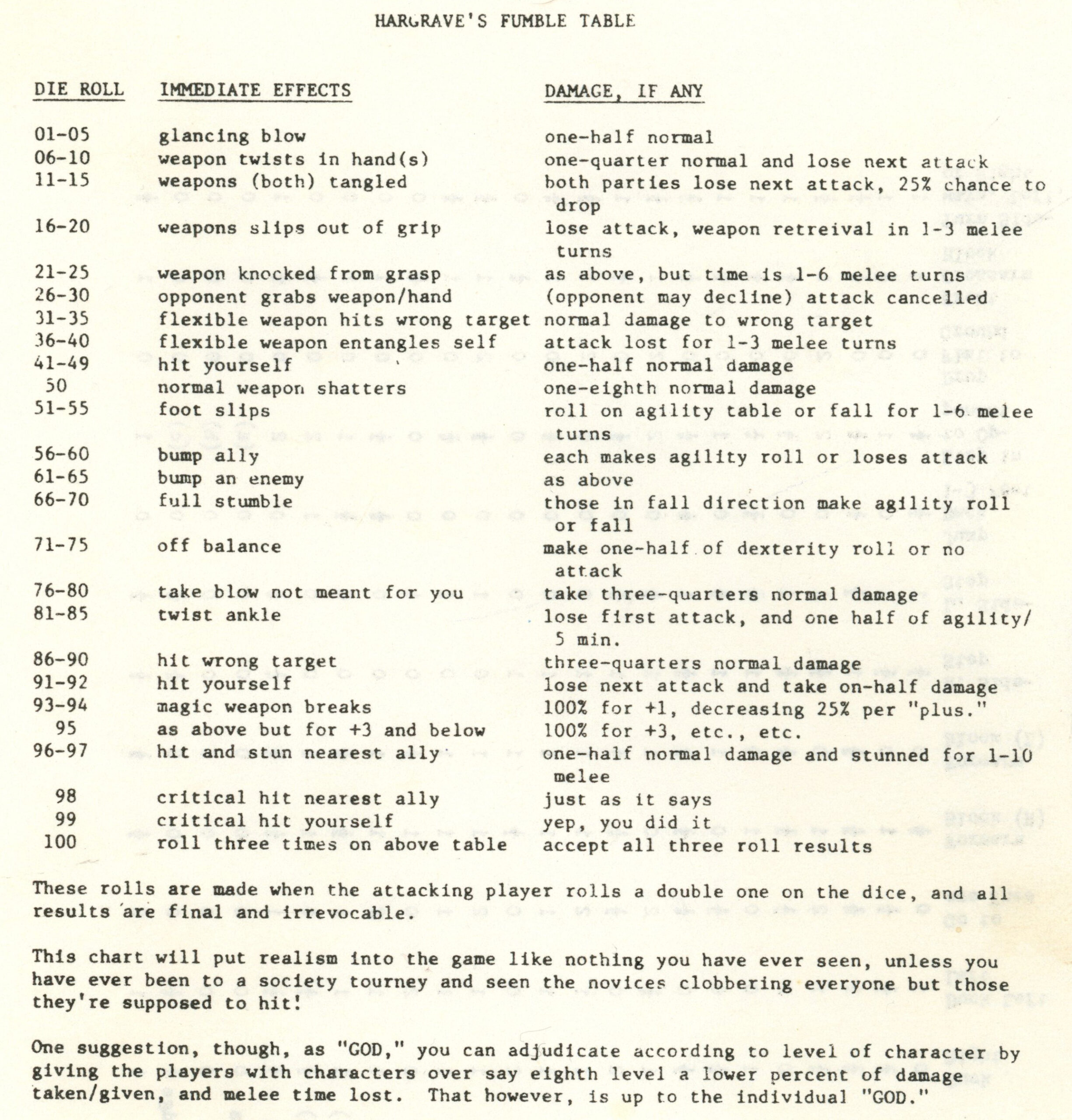
This isn’t actually a 5e optional rule, but I grew up with Fumbling — having some sort of ill effect happen on a Nat 1, beyond just missing — being a Big Thing, and everyone sill always laughs about what happens when someone (preferably not them) rolls really poorly.
(A Nat 1 in combat is an automatic miss, which is about as Fumbly as 5e is willing to go.)
I eventually ran accross a ThinkDM article with the best reason for not having Fumbles (Nat 1 rolls) “do something bad,” especially in combat.
As characters advance, they get (in most classes) the ability to make multiple attacks each turn. This is particularly true with Fighters, who eventually can be making four attacks in a turn.But if you have a 5% (1/20) chance of fumbling in any given attack, the cumulative chances of fumbling in a round begin to climb …
Wait, what?
Missing is bad enough; a more disastrous effect becomes counterintuitive. Or, as the article notes, “A level 20 Fighter shouldn’t be dropping their weapon every 30 seconds.”
(A thought that comes to mind is having the “fumble” effect/table kick in only on the last attack of someone’s chain. So our intrepid fighter still only has a 5% chance in any given round, and if they want to play it uber-safe, they can sacrifice their last attack as they “take their time.” I’m not going to do that, but it would ameliorate a lot of the concern.)
Of course, a lot of that depends on the fumble table one uses. This was a matrix that described the “special effect” that came with a fumble — not just a miss, but a humiliating miss. This one, from the Arduin Grimoire, was all the rage back in my college days (though in those distant times it was rendered in cuneiform on clay tablets):
Ouch
It was a simpler, more blood-thirsty time.
Still, at the level of abstraction 5e runs at, there’s really no good cause for this that can’t be covered by color text or, in case of a real run of bad luck, a symbolic penalty of some sort. That’s up to the GM to adjudicate.
Anyway, math.
ADDENDUM: Here’s an additional ThinkDM rule idea: a Fumble only occurs if you fumble all of your attacks on your turn. That means that higher-level folk are much, much less likely, though it can be, um, very unfortunate for a 1st level fighter.
An even better alternative raised in the comments there would be to have a Crit or a Fumble provide Advantage/Disadvantage for the next roll for 1 turn. If I were going to adopt anything as a house rule (which I don’t think I am), it would probably be this last one.
Sooner or later, a question of falling comes up. Maybe it’s a pit trap, or a shove off a bridge, or an unsuccessful jump, or an expired flying spell, or …
It’s (always) a good time to remember that the goal of 5e is not to recreate actual physics, but to provide easy, quick, workable verisimilitude, generally favoring the players. The falling rules are a good example of this.
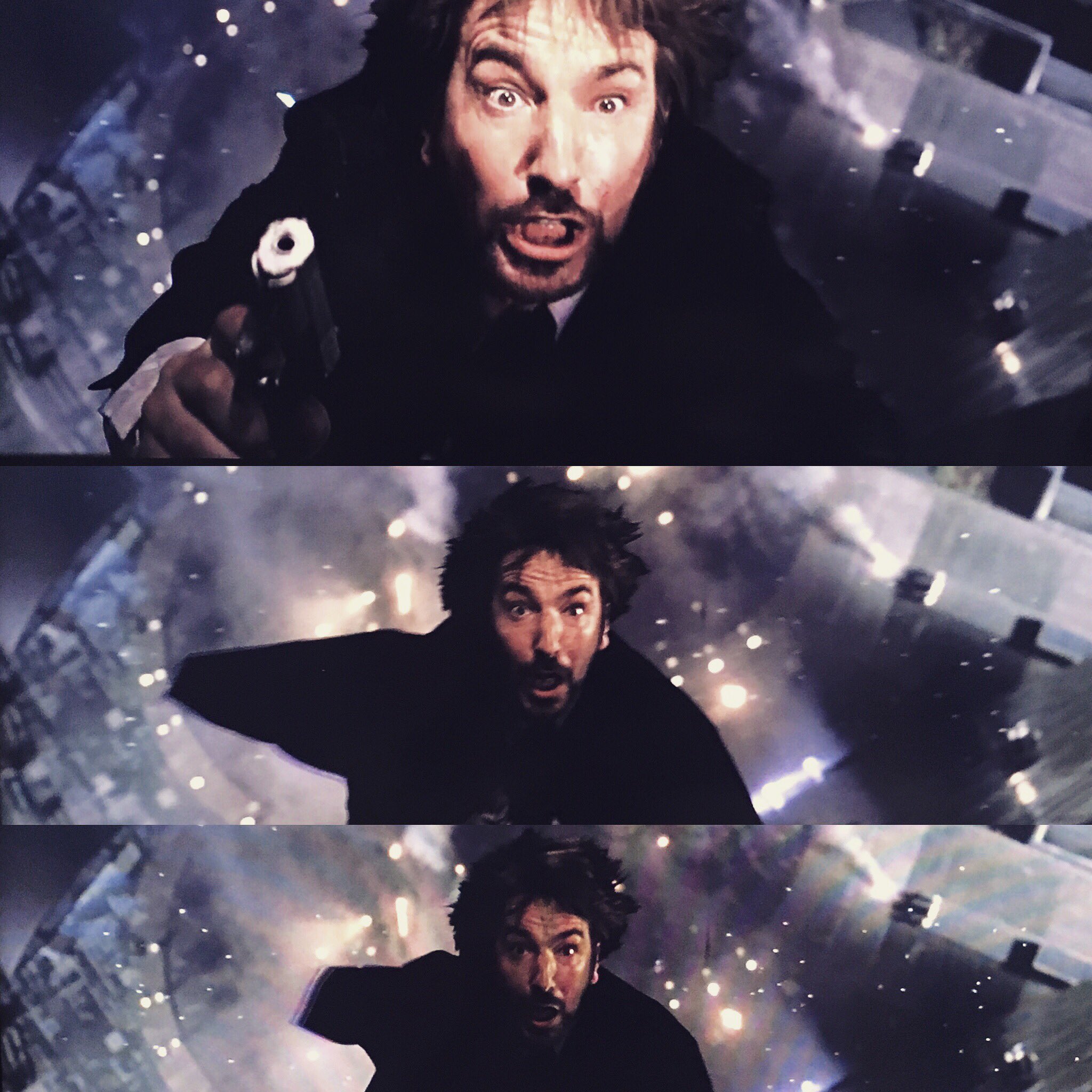
Fun Fact: Alan Rickman was dropped before he was expecting it, leading to some great facial expressions as he fell.
Of course, that raises other questions, many of which are answered in optional DMG/XGE/TCE rules.
You will “instantly” fall up to 500 feet in the turn you begin falling. You then fall an additional 500 feet at the end of each succeeding turn.
This mean no intervention by self or others during that first 500 feet if you don’t have a Reaction ability (such as Featherfall).
But after that everyone, including yourself, may be able to do something.
Note that though you fall 500 feet, you reach terminal velocity (so to speak) after only 200, given a max damage of 20d6.
From a physics perspective, in five seconds you will fall 180m, or 590 feet, so this is actually pretty realistic, at least that first turn.
Flying creatures that need to actively move to fly will fall if they are (a) knocked prone, (b) have speed reduced to 0, or (c) lose the ability to move. If the creature is noted as being able to hover, or is being held aloft by some spell effect, this doesn’t apply.
(In 5.5e, this is framed, “While flying, you fall if you have the Incapacitated or Prone condition or your Fly Speed is reduced to 0. You can stay aloft in those circumstances if you can hover.”)
The first round they will fall 500 feet minus their current flying speed.
In the case of the “prone” condition, they can on their next turn (if the ground doesn’t intervene) “get up” (using half their movement) to recover.
If you fall into water, make a Strength (Athletics) or Dexterity (Acrobatics) check; if you succeed, damage is reduced by half, per TCE. (Ditto for 5.5e.)
If you fall onto another creature, per TCE, the target must succeed on a DC 15 Dexterity save to avoid being impacted by the falling creature:
Any damage resulting from the fall is divided evenly.
The impacted creature is knocked Prone, unless it is 2+ sizes larger than the falling creature.
I’d rule that intentionally falling onto another creature probably takes an Dexterity (Acrobatics) check (perhaps against their AC?).
This is different from creatures that attack by dropping onto their targets or leaping onto them from above. They will often have specific rules about damage they might take when doing so (e.g., the Piercer).
The Featherfall spell is cheap and easy and is cast as a Reaction, reducing falling speed to 60 feet/round, and landing you gently on your feet. It can affect up to 5 targets within 60 feet, including yourself, and lasts for a minute. (Pretty much ditto in 5.5e.)
The Monk ability Slow Fall feature is possibly a bit misnamed, but essentially you can use it as a Reaction to reduce falling damage by an amount of Monk Level x 5 hp. (Pretty much ditto in 5.5e.)
Earlier editions required something to slow you down (grabbing the wall, tree branches, etc.), but 5e does not; think of it as a three-point “hero landing.”
The Enhance Ability spell lets you pick “Cat’s Grace” as its DEX version. Among other things, it means the recipient “doesn’t take damage from Falling 20 feet or less if it isn’t Incapacitated.” (The 5.5e version of this does not include this ability.)
Using a Fly spell (etc.) will help, but only if it’s a fall of over 500 feet, otherwise you won’t have a chance to cast it before hitting the ground (unless you can cast it as a Reaction). (The 5.5e version does the same.)
There are a variety of abilities that let you reduce damage to yourself or others that seem to apply here, e.g., Spirit Shield, Bastion of Law, Guardian Coil, Song of Defense.
Anything that gives you resistance/immunity to bludgeoningdamage will likely help here, depending on how it operates.
Note that someone else using a Slowspell won’t help, as the falling creature‘s speed isn’t a factor in the damage or distance. (It doesn’t completely make sense, but them’s the rules).
Note that Athletics/Acrobatics do not, by RAW, do anything around reducing falling damage, though they have in previous editions. That’s all physics, baby. (Ditto in 5.5e.)
I would, though, support a house rule that a successful Dexterity (Acrobatics) roll vs. a DC equal to the damage you took might keep you from going Prone (sticking the landing!).
The effect looks like a regular flame, but it creates no heat and doesn’t use oxygen. A continual flame can be covered or hidden but not smothered or quenched.
There is explicit text here saying that such flames cannot be smothered or quenched (largely because it seems that this is not a true flame, but an illusory flame light source). Fine. If something is written with such an immunity, they are immune. If not, they are as quenchable as normal flames.
5.5e (2024): The same text is used.
Suggestion: Things are only countered if it says they are.
Rules As Written (RAW) philosophy is pretty literal. If a spell has an effect, the spell spells that out in its description. If it’s not mentioned, it’s not an actual effect.
So, for example, Gust of Wind,Create/Destroy Water, and Prestidigitation all explicitly state they can snuff flame. If a spell doesn’t mention that as an effect, it doesn’t happen.
(Note that these often specify “unprotected flames” — not drawing a distinction between a magical vs natural flame.)
5.5e (2024): The same is true for the write-ups in the new edition spells.
Suggestion: Things can be countered if the counter-spell is a higher level than the original spell.
This is inspired by the Light/Dark setup. Darkness (2nd level) notes:
Nonmagical light can’t illuminate it. … If any of this spell’s area overlaps with an area of light created by a spell of 2nd level or lower, the spell that created the light is dispelled.
5.5e (2024): The Darkness spell reads:
If any of this spell’s area overlaps with an area of Bright Light or Dim Light created by a spell of level 2 or lower, that other spell is dispelled.
So there’s (in this case) some sort of “This quashing power is equal or greater to the power being quashed, so score” effect. This is a potential problem, though, because …
Curse you, Magic Items!
Magical items (or magical features of dungeon rooms) are often written without any indication of what spell effect they use, or what they are/aren’t immune to, or what level such a spell would be.
Take the case of the magical burning spears wielded by Razorblasts in the Princes of the Apocalypse campaign. The Razorblasts can turn them on or off (though it isn’t indicated how), but there’s not even instruction on what would happen if a party member picked one up and wanted to use it. Some of the Earth Cult weaponry in that module is explicitly Earth Cult magic-specific, but that’s not the case with the fire effects noted. Are the flames an attribute of the Razorblasts, derived from the worship of Imyx, or enchantments on the spears themselves? Only the DM know for sure (or guesses quickly).
There isn’t even a canonical weapon rule or example to draw from for something like those spears. The Flame Tongue weapons do more damage than the spears did. The Flame Blade 2nd level spell does as well (and is a weapon substitute, not enhancement).
Based on the above, the magical effect on the spears (which was +1d6 fire) is some sort of specialized elemental 1st level effect.
Okay, so it should be arguably easy to quench them, right?
But magic fire is not the same as physical fire. If you throw a bucket of water on a torch, the torch goes out, and trying to re-light it will be a pain because the fuel (the torch) is wet. But a blade that can have a magical fire turned on — well, the bucket of water will arguably quench it, but once the water is gone, it can be retriggered, unless the item’s rules have some weird “once a day” rule.
So what does this all mean?
It means doing some quick vamping as GM when someone creates one of these conflicts.
For example, you are in a room that has magical columns that, on a command word, begin to glow with a fiery heat, doing damage to anyone nearby. The amount of damage is spelled out. Nothing else is. (This, too, is from Princes of the Apocalypse). Jackie the Cleric casts a Big Wall of Water Spell (whatever) at the opponents in the in a room with magical columns.
It should have no direct effect on the magical columns, though, because those aren’t a flame source. Color text of special effects of steam and maybe therefore vision obscuring occurs. (Indeed, “I want to cover our withdrawal by shooting a big wall of water at the magma pillars” is a Rule-of-Cool clever idea that would probably net some Inspiration.)
It also knocks out the flames of the magical spears. But as of the opponents’ next turn start, they can reignite them because the water is not existing in perpetuity about their spearheads, and the momentary spell only overrides the permanent enchantment temporarily.
What, by the way, makes damage “magical”?
Slight digression, though it’s related to the topic. Let’s say William drops a Tidal Wave on people’s heads. Is that magical damage?
I mean, obviously, manifesting a huge block of water in the middle of a room is a magical effort (it’s a magical spell, in fact), but is the bludgeoning damage produced “magical”? Or is it effectively the same as produced by a mechanical trap that dumps a similar huge block of water over people?
5e goes with the following rubric to determine if something (including damage) is magical (via the Sage Advice Compendium):
Determining whether a game feature is magical is straightforward. Ask yourself these questions about the feature:
Is it a magic item?
Is it a spell? Or does it let you create the effects of a spell that’s mentioned in its description?
Is it a spell attack?
Is it fueled by the use of spell slots?
Does its description say it’s magical?
If your answer to any of those questions is yes, the feature is magical.
So is a Tidal Wave‘s attack is considered magical for purposes of “immune to bludgeoning damage not from a magical attack?” The answer is, it seems, “Yes,” because, for example, it is fueled by the use of spell slots. Even though, yes, there is no functional difference between it and a ceiling trap that drops a similar amount of water in a similar pattern.
5.5e (2024): The definition for “Magical Effect” is:
An effect is magical if it is created by a spell, a magic item, or a phenomenon that a rule labels as magical.
What about the Infamous Tidal Wave vs Fire Elemental debate?
What happens if you cast a Tidal Wave at a Fire Elemental?
This is a debate only because
Tidal Wave has a calculable volume (but weird physics and dynamics to figure out impacts on surface areas, etc., which means you only take a fraction of that), and
Fire Elementals have a unique vulnerability / damage accrual measured by gallon and/or depth of water.
I have seen Reddit calculations from 6 hp damage to 25,000ish hp damage from such an attack, depending on the estimated surface area of a Fire Elemental and assertions as to how TW attacks work.
Rather than a bunch of crazy calculations (which are anathema to 5e), I as the DM would likely say, “It does its normal Bludgeoning damage (4d8), which the Fire Elemental Resists. However, it does double that amount (8d8) in Cold damage because the Fire Elemental is made of fire and is vulnerable to water. Also, the Fire Elemental doesn’t go Prone because they are immune to that Condition.”
So probably no insta-kill for a 3rd level spell, sorry, but a butt-load of insta-damage, multiplied by every Fire Elemental in the area.
A OneD&D Note
This isn’t actually confirmed, but looking at the materials released so far regarding race-based magic, it looks like those rules may address some of the above, not just because it’s all kind of confusing, but because rather than arbitrary magical effects, documented magical spells are being used instead. That’s actually a good thing. Hopefully they will follow through with clearer answers and mechanics for all this.
5.5e (2024): Things actually ended up the opposite of what was mooted in early “OneD&D” playtest material. Creatures (including Player Character races) that previously had spell-based powers now get those powers laid out and a recharge die roll given for them.
On one level, that’s a good thing: it keeps the DM from having to quick consult spell information and keep track of spell slots. On another, it does create problems with consistent rulings on various forms of magic.
The point (very generally speaking) of D&D is to make the opponent worry about death. But it’s important for players to know about the rules, too, especially as they’ve changed since editions gone by.
Death (and Unconsciousness)
It’s important to understand a bit how down-and-out damage works in 5e. There’s no such thing as “going negative” here. When you drop to 0 HP (the bottom, you can’t go lower), you fall Unconscious (PHB 292): you’re Incapacitated, can’t move, can’t speak, are unaware, drop anything being carried, fail all Strength and Dexterity Saves … and Attacks against you have Advantage, and any hit is considered a Crit if attacked from 5 feet away.
But that’s the least worry you have. Because one of two things happen:
If the damage was so massive that the extra damage (theoretically beyond 0) equals or exceeds your HP maximum, you are dead, dead, dead.
Tick-tock …
If not, then you are “just” bleeding out, and need to start making Death Saves each turn (PHB 197). If you start a turn at 0 HP and are not yet stabilized, roll 1d20.
On 10+, you succeed. Three total success, you become stable and will live.
On 1-9, you fail (a nat 1 counts as two fails). Three total fails, you are dead, dead, dead.
On a nat 20, you immediately gain back 1 HP and can regain consciousness.
Note that if someone inflicts further damage on you while unconscious, it counts as a Death Save failure; a crit (which is the auto-result of a hit from within 5′) counts as two fails. This also restarts the Death Save process. And if you take damage at 0 that is equal or greater than your normal number of HP, you die.
It’s only a flesh wound!
A stable creature stays at 0, Unconscious. It will heal 1 hp (and regain consciousness) in 1d4 hours (this does not count as a Short Rest). Healing spells are, of course, welcome to accelerate this process.
Note that this technically happens to the bad guys as well; the presumption, though, is hitting 0 kills a bad guy (they either fail their Death Saves, or you go around slitting throats after the battle). Best not to dwell on it. Powerful / significant enemies might get a Death Save process.
Indeed, as people can gift each other with their Inspiration, other folk could feed their Inspiration to a dying party member (“Don’t you die on me, man! Don’t you die on me!”)
As far as that goes, anything that helps on saving throws helps on a Death Save. So a Bless spell would work, too.
Knocking someone unconscious
Whether you want to avoid being a murder-hobo, or want to interrogate a prisoner who won’t surrender, you can intentionally knock someone out instead of death on opponents. (Vice-versa, too.)
“No, I’m just knocking him out. Hard.”
You simply declare, on any melee (martial or spell) attack that would have killed someone, that you are instead knocking them Unconscious (PHP 292) at the moment when the DM would say they’re dead. You don’t have to proclaim “subduing” damage in advance or anything; beating someone into unconsciousness is very much the same as beating them to death: it’s all in what you do after they fall down.
A foe rendered Unconscious this way is considered stable. They will wake up (regaining 1 hp) in 1d4 hours. You can leave them behind, bind them and leave them behind, or change your mind and gack them. If you want to interrogate them, then you either need to wait, or use some healing magic on them.
The Time Limit is how long after death the spell can be used. Note that Gentle Repose (Cleric or Paladin, 3rd lvl spell) can extend the time limit for a raise spell by 10 days if cast within the time limit for that raise spell.
Dancing with Death
As implied under Spellcasting Services (PHB 159), these revivifying spells are not the sort of thing that you find being cranked out at your local temple, and even in a Big City they’re not a commodity service. Stolen souls, headless bodies, lack of bodies, death by fire, being turned undead, can all block some of these spells. Missing body parts can be an issue. Finding a 500gp diamond might not be easy, either. And many of these spells have consequences — limits on what they can restore (see article), being Necromantic in nature (ew), or the services that will be requested in return. (And clerical spells, esp. high level ones, have to be cast to a purpose sanctioned by the deity involved.)
Which isn’t to say it can’t happen, but don’t think of all this as the wild and wooly AD&D days when raising up dead PCs garnered as little consideration as murder-hoboing a complex (if wholly illogical) underground ecosystem.
So does any of this change under 5.5e?
The basic progression of 0 HP –> Death Saves and how all that works is mostly the same.
There are minor changes in death-undoing spells. Reincarnate incorporates the updated species options in the PHB. Resurrection no longer cures non-magical diseases.
Like all things 5e, WotC set out to simplify the mechanics of how people were protected out on the battlefield by various objects.
5e set up basically four conditions:
no cover / uncovered (the default)
half cover
three-quarters cover
total cover.
The first and last usually get treated separately. It’s the partial covers in the middle that are of most interest here.
It’s difficult to talk about cover separated from a battle-map. Or, rather, if you are just running Theater of the Mind, cover is a matter of the GM asserting it (or agreeing to player assertions about it) by fiat. A lot of the below will depend on working on a square grid (extensible to a hex grid, if one likes; check out the DMG pages referenced below).
The key here as to what cover a target has is counting the points on any one of their squares from any of the points in your square to see how many are blocked.
So here are the effects of cover on attacks, based on the rules here. This most often comes into play with Ranged attacks (including Spells), but
Points Blocked
Cover Type
AC and DEX Saves
Examples
1-2
Half
+2
Low wall, large furniture, narrow tree trunk, or a creature* (friend or enemy) directly in front of them
3-4
Three-Quarter
+5
Portcullis, arrow slit, thick tree trunk. Any of the target visible.
*A creature at least half as large as the target standing next to them. But … see my House Rules below.
Points Blocked: As in the diagram above, on a grid, choose a (most favorable) corner of the attacker’s space. Trace a line from that corner to each of the corners of a square (any one) the target occupies. Based on how many of those points are blocked, you can determine the level of cover.
So if any of the points are blocked, there is at least Half Cover. But also note that, even if the all the corners are blocked (e.g., the target is behind an arrow slit), if you can see any of the target, it’s in Three-Quarter cover.
Total Cover: A target that cannot at all be seen / is completely concealed cannot be targeted by an attack or spell (though some spells can reach it in an Area of Effect — Fireballs, for example). Total Cover also starts to invoke rules for Hiding and the like.
Sizes of the characters involved can affect this (Small creatures behind larger creatures, etc.).
Multiple Covers provide the most difficult cover level. Arguably shooting an arrow past four people is more difficult than shooting an arrow past one person, but the KISS principle applies. As GM you can rule a cluster of Half Covers equal a Three-Quarters Cover, but the Rules As Written say that it’s still only Half Cover.
Combat and Cover at Corners
Combat and Cover at Corners
Consider the case in the picture — Fighter and Kenku squaring off (so to speak) at an architectural corner. Do the have cover from each other?
It might seem so, especially since the Move rules for grids indicate you can’t move through such a corner (PHB 192):
Corners. Diagonal movement can’t cross the corner of a wall, large tree, or other terrain feature that fills its space.
But for combat purposes, there’s no cover, because the kenku can take his top two corners (or the fighter his right two) and see (allowing for map/grid irregularities) along the wall all the other points of the opponent’s square.
It seems counter-intuitive, but there you are. Similar rulings can be made around doorways (the three squares on the other side of a 5-foot door have no cover from someone standing in the doorway on the other side, treating walls has having no thickness).
House Rule: Proximity to the Obstacle
Proximity to the Obstacle: Rules as Written say that obstacle are obstacles. My House Rule is a little more nuanced:
The attacker can ignore Half or Three-Quarter Cover if the attacker is closer to the obstacle than the target.
It’s all a matter of perspective. If an ally is right in front of me, I can weave around in my 5-foot square to get a clear shot; if they are right in front of the target, they provide much better cover for that target.
Take three examples that I will, for no particular reason, label as William (W) and Moony (M) dealing with a Goblin (G).
The normal use case is #1, where Moony is up there whomping on the Goblin, and William is behind, shooting a bow at the Goblin. That’s pretty clear; the Goblin gets Half Cover from Moony against William’s bow shot.
Consider case #2, where Moony was right in front of William. The penalty shouldn’t count here; it’s easy in a 5-foot space for William to shoot past Moony at the Goblin, adjust to shoot over Moony’s shoulder or to one side or the other. Assuming Moony isn’t doing jumping jacks in front of William, and is of a comparable size, that makes sense.
Use case #3 — where Moony is midway between William and the Rat is a bit more dodgy (so to speak). The angle to shoot around Moony is more difficult, though not as difficult as when Moony is right in front of the Rat.
So, what’s the ruling here? 5e would treat all three circumstances as providing cover, but I don’t like that. So I’ll borrow from the 3.5e rules:
Attacker can ignore the cover if he’s closer to the obstacle than his target.
At least as applies to Half and Three-Quarter Cover. In case #1, cover rules apply; in case #2, they do not; in case #3, William would need to take a step forward to fire and ignore the cover.
Some Other Notes
Note this is one of the few cases were 5e bakes in bonuses (vs using Advantage/Disadvantage). Assuming Advantage gives you about a +4 on a roll (it varies), that becomes too crude a measure for this.
There is a Variant Rule (DMG 272) about the chances of hitting the cover if you miss your target. KISS, man. Also, we’ll assume that people are being particularly careful not hit their allies.
Note that the Sharpshooter and Spell Sniper feats basically do away with Cover for their user. That’s pretty cool.
Update: OneD&D
In “Unearthed Arcana 2022 – Expert Classes,” the Hide action is allowed when behind Three-Quarters or Total Cover. The Sharpshooter and Spell Sniper feats ignore Half and Three-Quarters Cover, as in 5e.
But what about 5.5e?
Things are pretty much the same in 5.5e (2024), with just a few things different.
Cover now works against Fireballs, rather than those flooding through any opening. There are also some changes in other spells (check your spell list!).
In 5e, Fireball reads:
A bright streak flashes from your pointing finger to a point you choose within range and then blossoms with a low roar into an explosion of flame. Each creature in a 20-foot-radius sphere centered on that point must make a Dexterity saving throw. […] The fire spreads around corners.
In 5.5e, the spell says:
A bright streak flashes from you to a point you choose within range and then blossoms with a low roar into a fiery explosion. Each creature in a 20-foot-radius Sphere centered on that point makes a Dexterity saving throw.
Nothing there about it spreading around corners … or around Total Cover.
The Optional Rule about hitting the cover if you miss your target is no long there, in part because a lot of objects now have AC defined for them.
This one is pretty straightforward, but also gets into complexities from how earlier versions of D&D have done it, and how some other systems do it, too.
Cones are not 90° angles
So that’s the main thing to remember. It was a mistake our group made in our first game, and an easy one to because that’s how some other systems do it (like 3.5e and Pathfinder). But not 5e.
When playing on a battle map (if you are doing Theater of the Mind, then just do what the GM says), here are rules for cones:
The come fromone of the corners of your square. (If you are running on a hex map, then cones are one of the few things that are easier that way, and please look it up yourself.) They don’t come from the middle of the square. They come from the corner. This is true for most spellcasting in 5e (DMG 251), and missile weapons, and line of sight — though the difference does not stand out in most cases.
The width of the cone equals the range from that corner. So the first five feet (square) the cone is one square wide. At two squares away, the cone is two squares wide. At three squares (the classic 15-foot cone), the cone is three squares wide. Etc.
Or, to quote rules:
Starting point, as the rules put it (DMG 251):
Choose an intersection of squares or hexes as the point of origin or an area of effect, then follow its rules as normal. If an area of effect is circular and covers at least half a square, it affects that square.
A cone’s width at a given point along its length is equal to that point’s distance from the point of origin.
That comes out, I am told, as a 53° angled cone, not 90°.
Which all seems simple until you try to map it out on squares, because squares suck.
If you want to be really technical, you could use (whether on a real life mat or in a VTT) an actual cone template that is X feet wide when it is X feet out, and then pick squares that have a majority of their space included in the cone. But I find it easier to just say “Pick a single square, now pick two beyond that, now pick three along the same angle beyond that,” and let the player figure it out.
(I also have some square templates that can be dragged onto the VTT map which can sometimes help. But most cones are short enough that it’s not necessary.)
So, for example …
What does that look like, practically? Here is a simple drawing, which can be rotated in 90° increments:
So a straight cone on a square grid map. The question marks indicate a choice — pick one or the other to be in the cone (arguably, based on whichever corner you are casting from). As noted, at 5 feet the effect is 5 feet across. At 10 feet, the effect is 10 feet across (two squares). At 15 feet, the effect is 15 feet across.
Here’s another:
This one’s at an angle, and is serving double duty.
The red mage is doing a cone at an angle downward (remember this can be rotated in 90° increments). At 5 feet, it’s 5 feet wide. At 10 feet it’s 10 feet. At 15 feet, it’s 15 feet wide.
(While cones emanate from a corner, they don’t necessarily target a corner.)
The yellow mage is shooting at a straight 45° angle down and right. This gets a bit more complex because of 5 foot increments and how you calculate diagonals on a square grid in D&D, but again, 1=1, 2=2,. 3=3
Player’s choice. As long as you are starting from a corner, following a line of some sort, and are X squares wide for an X square length of the spell cone, you’re golden.
If that’s still confusing … maybe go for non-cone spells. 🙂 (Though, to be honest, cubical spells have their own weirdities …)
Meanwhile, on the Virtual Table Top …
It’s worth noting that the VTT we use in our group, Roll20, has created under its rules some nice cone (and other shapes) drawing tools that you can also do for drawing purposes. You can configure them to snap to a corner (though you have to do it each time, irritatingly), to have a given arc (though there is an option you can set for making width and length equivalent, as 5e wants), and to either vanish when you let loose of the mouse button, or persist until you click elsewhere.
All well and good, but its still giving you fractions of squares. (The same is true with a template on a physical battle map). How do you count those? If the cone touches any part it gets counted in? That can significantly increase the AoE. Only include fully-covered squares? That can significantly decrease the AoE. Require a square to be at least 50% covered to be included in the cone? That’s what the rules (DMG 251) suggest. Fine, but that requires irritating adjudication and then fiddling about by the spell-caster (“If I just tweak the angle a bit, I’ll be able to get this guy, but not that guy … what if I …?”). Bah.
Note that these same questions come up with any AoE. Circles cut through (at an arc!) squares. Line spells, if they start from a corner, cut through partial squares if not orthogonal, but also touch on two rows of squares if they are.
Does 5.5e change any of this?
Nope. The text in the 5.5e (2024) DMG (p. 44) for cones says pretty much the same thing as in 5e (2014).
All of the Areas of Effect are treated similarly, except for adding in a new AoE: Emanation, which as far as I can tell, is a spherical effect that comes from character / object emanating the effect, and moves with them.
This is not a rule, actually, but a design philosophy that went into 5e, which gives it a very different flavor (and advancement path) than earlier versions. If you have no interest, you can skip it, though it does answer some questions about what sort of loot you’re likely to find in treasure hordes.
It boils down to a simple questions: Should Joe Shlub, the peasant, be able to hit Conan the Barbarian with his pocket knife?
Or, put a little differently …
Earlier versions would have basically said no:
Conan’s AC should be waaaaaay too high for Joe Shlub to ever hit.
So that’s what advanced most when you rose in levels and experience: your AC (by attribute and by powers, esp. magic armor), and your To Hit to counter it (again, through advancement and through +N Swords of Incredible To Hit).
So Conan has great TH numbers, but he needs them to wrassle with the fantastic AC numbers of the Ancient Red Dragons he’s being thrown against.
5th Edition answers the Joe Shlub question with a yes.
The goal is that everyone always has a chance to hit.
So we focus, in advancement and balance, on essentially the other side of the combat equation: damage and HP, the ability to deal it out and the ability to take it.
So Conan does tremendous damage when he lands a blow … but the dragon has triple-digits of HP.
In short, what most goes up in a 5e game over time is not TH and AC (though they do slowly increase), but Damage and Hit Points. As an example, by the end of the previous campaign we were playing (which brought us to the 19-20 range), we all had a buttload of HP, and the Rogue was doing like 7d6 Sneak Attack damage on top of his weapon. Accuracy and the difficulty of hitting something, instead, stayed within well-guided bounds … i.e., “Bounded Accuracy.”
Joe Shlub can hit Conan — but it’s only ever going to be a scratch. (A mob of Joe Shlubs doing a lot of scratches, aggregating damage output higher than Conan can individually, though … can be a threat, due to the Action Economy.)
WotC has managed all this by putting some mathematical limits on things. Here are some articles that explain it well (the first gets into the not-difficult math, the second into the history):
The former in particular has the basic design table that drives everything, focused on difficulty to achieve something, and keeping strict caps on it.
DC or AC
Difficulty
To Break …
Armor
To Hit …
5
Very Easy
a glass bottle
an inanimate object
10
Easy
a wooden chair
No Armor
a badger
15
Medium
a simple door
Leather Armor*
a troll
20
Hard
a small chest
Plate Armor**
a dragon***
25
Very Hard
a treasure chest
a tarrasque
30
Nearly Impossible
a masonry wall(1 ft. thick)
a deity
*with shield and +2 Dex modifier
**with shield
***Adult Red Dragon is AC 19
This is also why Advantage / Disadvantage is so powerful. It not only simplifies the unruly flocks of plusses-and-minuses that 4e (and earlier) had, it gives a massive jump (roughly +4 in effect) to hit, but temporarily.
The bottom lines:
There is always a chance you can hit something (a nat 20, if nothing else). It can probably hit you back a whoooooole lot harder, but that’s not the point. As we’ve learned by doing, even a nassssty monster, surrounded by enemies, doesn’t have a long life expectancy (thus, even nassssty monsters are going to have minions to run interference). Again, that’s because of the Action Economy.
Things that affect TH/Armor are going to be relatively rare and limited. Older systems handed out +3, +4, +5 weapons/armor like door prizes. In 5e, a +1 TH weapon is an expensive and relatively rare thing, available only in big cities. +2 is incredible, and unlikely to be found for sale anywhere. +3 is a thing of legends. You’re a lot more likely to find a sword that bursts into flames and does an extra 1d6 damage than a +1 sword.
This has been your Game Design lecture for today. We now return to your normal programming.
Does 5.5e change anything with this?
Not as far as I can tell. The design foundation of Bounded Accuracy still applies with 5.5e (2024) rules.
Bonus Actions are actually pretty easy, but they are not well explained in the 5e Players Handbook.
When can you use a Bonus Action?
On your turn, one of the things you may be able to do is a Bonus Action. The trick to understanding it is that you only get Bonus Actions that the rules specifically say you get. Certain rules give you a Bonus Action. You can only ever use one Bonus Action on your turn, and it can only be on your turn (you can’t use a Bonus Action in an Opportunity Attack, for example).
If you aren’t using or eligible by the rules for a Bonus Action, you don’t get one. There isn’t a “Bonus Action phase” in the turn or something. What you can do as a (single) Bonus Actionhas to come from a rule or ability applicable to your character.
Note that some spells have their casting time as one Bonus Action. These spells can only be used as a BA. Also, you cannot cast a Bonus Action spell if you have cast anything more than a Cantrip as your regular action.
Though that isn’t specified by the rules. (Source)
An Example
So, for example, my Rogue, Tener, started off with only one thing I could do as a Bonus Action (the one available to everyone): a second melee attack using Two-Weapon Fighting (PHB 195).
At second level Rogue, he got the class ability Cunning Action (PHB 96), which meant I could use my Bonus Action to Dash, Disengage, or Hide.
At third level Rogue, he got the Thief archetype ability of Fast Hands (PHB 97), which meant I could use my Bonus Action for Sleight-of-Hand, disarm a trap, unlock a lock, or Use an Object.
But I couldn’t use my Bonus Action to, say, Help, because that wasn’t a Bonus Action defined for my character. I could only do those specific actions defined for my Bonus Action in my rules.
Does everyone have Bonus Actions?
Some characters don’t have any Bonus Actions, at least at lower levels (except the option of Two-Weapon Fighting, if they choose it).
When can I take a Bonus Action?
One more thing about Bonus Actions: some have prerequisites and some have none. For example:
Cunning Actionhas no prerequisites. Whatever else I do on my turn, whenever I want in my turn, I can use the Bonus Action to, for example, Dash.
Two-Weapon Fighting says “When you take the Attack action and attack with a light melee weapon that you’re holding in one hand, you can use a bonus action to attack with a different light melee weapon that you’re holding in the other hand.” Therefore, you need to, in sequence:
(1) take an Attack action with one hand; then, later in your turn, you can
(2) use the Bonus Action to attack with the other hand.
You can do any other allowable things in between — chat with someone, Move, etc. But you can’t use the Bonus Action first in this case.
Monk’s Flurry of Blows speficies “Immediately after you take the Attack action on your turn …” In order to use the FoB Bonus Action, you have to
(1) take an Attack action, and then immediately (no Moving in-between)
(2) use the FoB Bonus Action.
The only time you get a Bonus Action is if you have a rule (usually from a class, race, or feat) that says you have a Bonus Action, and then it’s only good for what the rule says you can do with it. (And you can only do a single BA on your turn.)
Everyone has a Bonus Action for Two-Handed Fighting (allowing you to do the second attack as a Bonus Action). That’s pretty much it.
As a Rogue, your Cunning Action allows you to take a Bonus Action, but only to do a Dash, Disengage, or Hide. (This is a “restriction,” yes, but it’s actually granting you Bonus Actions that nobody else necessarily has. Similarly, if you take Thief, at 3rd level you can do a Sleight of Hand, disarm/unlock, or Use an Object as your Bonus Action on a turn.)
Can I take a Bonus Action to Help someone?
This came up early in my campaign. In short, unless you have a Bonus Action that specifically says you can Help on your BA, you can’t.
That said, “Help“ (PHB 192) is a great Action for a character to take on their turn when they’re not sure what to do or if they don’t think their own attack on the BBEG will be effective, or if someone else will have a great attack.
For Rogues (again as it came up in my campaign) it doesn’t really come into play for allowing a Sneak Attack, though, because to Help for combat (giving Advantage) the Helper has to be adjacent to the target — which, if they are, means a Rogue can already Sneak Attack the target anyway (PHB 96) (though a Help would let you roll Advantage on the attack, which is not for nothing).
But, again, Help can’t be done in a Bonus Action unless someone has that specifically as something they can do as a BA.
So does any of this change in 5.5e?
Basically? No, not really. Bonus Actions per se work the same way in 5.5e (2024). Various skills and talents and spells and class features have been shifted into (or out of) being a Bonus Action. The key here is not to assume anything — look it up before you take it for your new 5.5e character.
For example:
Druids can now all Wild Shape as a Bonus Action (previously only Circle of the Moon Druids could).
Paladins’ Lay On Hands is now a Bonus Action feature, not an Action one.
Drinking (or administering) a Potion of Healing is now a Bonus Action, not an Action. This has been a common house rule, but now it’s official.
It’s important to distinguish between an “attack” and the Attack Action.
An “attack” is when you roll a D20 (usually) to try to hit someone. Attacks may be made in the Attack Action, but they can occur at other times.
An Attack Action is one of your turn slots which may include one more more attacks in it.
Extra Attack vs. MultiAttack
“Extra Attack” is something Fighters (etc.) get as a class advantage at various times. It means that when you take the Attack Action, you can do multiple attacks (e.g., instead of a single longsword blow on the orc, you take two, or even three).
(This is different from doing Two-Weapon Fighting (PHB 195) where the second attack is a Bonus Action).
“Multiattack” is something NPCs (and a few shapeshifting PCs) do — an animal’s claw-claw-bite, for example. It is its own Action, a Multiattack Action, not an Attack Action. Each of those attacks is usually also available separately, which is important with Opportunity Attacks.
That all sounds picky, but it means that if rules refer to an Attack Action, a Multiattack Action does not count.
Reactions, Opportunity Attacks, and Readying
Opportunity Attack (PHB 195) allows, as a Reaction (not during your turn, but during someone else’s), “one melee attack” when the target tries to step out of reach. Extra Attack doesn’t come into play (because it’s not giving you an Attack Action, just an attack): the Paladin doesn’t get to swing twice against a retreating foe, just once. Neither does Multiattack: when you move away from the giant bear, it can claw at you, but not claw-claw-bite.
Readying lets you take a pre-specified Reaction (“if anyone steps in front of me, I will swing my sword at them”). You can only Ready a single attack, not an Extra Attack or a Multiattack, because Reactions don’t take place on your turn. E.g., the Monk (PHB 79) notes that the Extra Attack is only on their turn. Ditto Fighter (PHB 72). Multiattacks are also intended only on the attacker’s turn.
Similarly, you can only use a Bonus Actionon your turn (PHB 189). A two-weapon fighter can Ready an attack (or take an Opportunity Attack) with their rapier, but not their Bonus Action attack with a dagger.
So does this change in 5.5e?
Very little about this changes in 5.5e (2024), from an overall structure of rules. Various special abilities (class features, feats) and circumstances (e.g., Surprise) make different use of Actions or Bonus Actions (or Reactions) than they did before.
Common Actions are much more carefully defined in 5.5e than in 5e.
The list of Actions is also changed a bit:
Action
Summary
Attack
Attack with a weapon or an Unarmed Strike.
Dash
For the rest of the turn, give yourself extra movement equal to your Speed.
Disengage
Your movement doesn’t provoke Opportunity Attacks for the rest of the turn.
Dodge
Until the start of your next turn, attack rolls against you have DISADvantage, and you make DEXterity saves with ADVantage. You lose this benefit if you have the Incapacitated condition or if your Speed is 0.
Help
Help another creature’s ability check or attack roll, or administer first aid.
Hide
Make a Dexterity (Stealth) check.
Influence
Make a Charisma (Deception, Intimidation, Performance, or Persuasion) or Wisdom (Animal Handling) check to alter a creature’s attitude.
Magic
Cast a spell, use a magic item, or use a magical feature.
Ready
Prepare to take an action in response to a trigger you define.
Search
Make a Wisdom (Insight, Medicine, Perception, or Survival) check.
Study
Make an Intelligence (Arcana, History, Investigation, Nature, or Religion) check.
Utilize
Use a nonmagical object.
The most significant differences here:
There is now a Magic Action for, well, magic. Rather than have spellcasting be part of Attack, and using a magic item part of Use an Object, they have been separated. This should allow for better refinement and definition of when what can (or cannot) be done, and differentiation between using spellcasting and sword-swinging.
There is now a specific Influence Action for CHArisma-based actions (and WISdom (Animal Handling). The point here is to clarify that these are Actions that take a turn (an Action), not things that — maybe? — you can do while also swinging your sword around.
Use an Object is now Utilize, and, as with the above, it is defined strictly for non-magical objects. At the same time, using Utilize with special tool kits (e.g., Thieves’ Tools) is much better defined; each tool kit has a Utilize action or two. That means that the previously poorly defined Pick Locks and Disarm Traps are clearer in what happens and how (specifically using Sleight of Hand and Thieves’ Tools against a DC 15).
Search used to include both WISdom rolls (e.g., Perception) and INTelligence rolls (e.g., Investigation). This has now been broken out between Search (WISdom) and Study (INTelligence). We’ll cover that distinction more in the appropriate entry. Main outcome here is to group together like things for common effects and usage rules, and to (re)clarify that these sorts of things take an Action.
Avoiding damage when falling. [Old school D&D, but not in 5e]
Using Athletics vs Acrobatics
In many way, you can narratively figure out which one makes sense, and different characters might use one or the other for the same action. Consider how Aragorn (an Athlete) would do something, vs. how Legolas (an Acrobat) would do it. A crowd of orcs to get past? Aragorn bulls his way through, while Legolas tumbles and leaps and dodges past, but the final effect is the same.
In a couple of cases in the rules there are explicit options as to which you can use.
Grappling: The Grappler rolls an Athletics check vs. the Grapplee rolling either with either Athletics (think “breaking free”) or Acrobatics (“slippling free”). If the Grapple succeeds, the Grapplee can repeat the contest as their action on their turn.
Shoving: Same as Grappling, only with a push-back or push-down as the result.
Or if gymnastics isn’t your thing, consider a parkour routine; there are clearly both STR and DEX things going on there. (And CON, and INT, if not WIS, for that matter.)
To complicate things further, Abilities and Skills are not fixed in their combination. One can imagine a Strength (Acrobatics) roll being legitimately allowed, or a Dexterity (Athletics). Indeed, there is technically in 5e no such thing as a Skill check; everything is an Ability check, potentially modified by proficiency in a given Skill set.)
No huge conclusions here, just an observation about similarities and differences and what the fundamentals of two ambiguously-named skill sets are. Again, using the guidelines described above as guard rails, narratively figure out what it is that you’re doing. And, of course, note that both of these skills are good candidates for an occasional invocation of the “Rule of Cool.”
A House Rule
As noted above, in previous editions of D&D, Acrobatics could help save you from a fall by reducing its damage. That was explicitly left out of 5e, so I’m reluctant to re-insert it.
I would house-rule, though, that a successful Dexterity (Acrobatics) role might keep you from going prone after a fall, vs a DC equal to the damage you took (stick the landing!).
Bonus OneD&D Note:
(Not so fast! Things changed after that first play test. See below.)
According to the Character Generation playtest document, Grappling and Shoving are now part of the Unarmed Strike action — hit the target with an Unarmed Strike (D20 + STR mod + Proficiency) vs their AC.
If you were going for a Grapple, the target becomes Grappled, with a STR or DEX check each turn vs a DC of (8 + STR Mod + Proficiency) to break free.
If you were going for a Shove, you succeed.
This reduces the number of contests, but also reduces the use of Athletics and Acrobatics.
Jump farther than normal, stay afloat in rough water, or break something.
Acrobatics is defined as the skill to
Stay on your feet in a tricky situation, or perform an acrobatic stunt.
Also, in keeping with some of the initial playtest documents, these two skills have been made less essential, as part of 5.5e (2024)’s dislike of skill contests.
The most fundamental change is that Athletics (and sometimes Acrobatics) no longer play a role in Grappling and Shoving. Which seems a bit weird, to be honest.
Both of those are considered part of the Unarmed Strikes category of attacks. The initial “to hit” is an Unarmed Strike against their AC. Then, to judge what the “damage” (effect) is, rather than doing an Athletics vs. Athletics/Acrobatics contest as 5e did, the target must make a
STRength or DEXterity Save (their choice) vs. DC = (8 + shover’s STRength mod + shover’s Proficiency Bonus)
If the target fails, then on a Grapple they are grappled, and on a Shove they are shoved back five feet or knocked Prone.
There is still no canonical use of either skill to mitigate Falling damage or its resulting Prone status, but you can use either as a Reaction, against a DC 15, to land head or feet first in liquid (like water) and take only half damage.
As in 5e, when taking a Long Jump, a DC 10 Acrobatics roll is needed if you land in Difficult Terrain and want to avoid going Prone.
One of the 5e design mission statements was to Keep It Simple, Stupid. This KISS principle was a response to the ultra-crunchy tactical game which was 4e. I like miniatures and tactics, so I liked 4e, but it did, by focusing on numbers and formulae so much, drain a lot of color from the game. As I started up my 5e campaign, I constantly found myself running head-smack into things that 4e did that 5e did not, by design, and having to figure out why.
So what is it?
Rather than having players maneuver a blizzard of plusses and minutes on attacks, 5e tries to reduce it down to a simple set of questions for any Attack, Save, or Action Check roll:
Does the attacker (die roller) have, at the moment, an Advantage over the defender?
Does the attacker have, at the moment, an Disadvantage, compared to the defender?
Then:
If there’s no Advantage nor Disadvantage, it’s a Normal attack — roll 1d20.
If there is both Advantage and Disadvantage, it’s a Normal attack — roll 1d20.
If there is justAdvantage — roll 2d20 and take the higher die roll.
If there is justDisadvantage — roll 2d20 and take the lower die roll.
Note that (KISS) these are not additive. There is no “Super-Advantage,” and no “Well, you have one Advantage and two Disadvantages, so that comes out to Disadvantage.” There is either just Advantage, or just Disadvantage; otherwise it’s a Normal 1d20 roll.
So what impact does this have?
There are some fancy graphs out there, but Advantage is roughly a +4 on a d20, statistically. Or, as put another way, “Advantage is an enormous benefit that lands 13 or higher 50% of the time, is almost twice as likely to crit, and has 1/20th times as likely to botch.” So 5e doesn’t hand out the status lightly.
Or, put in pictures (please feel free to ignore if math makes you twitchy):
Having Advantage (blue) boosts your numbers up a lot, esp. in the middle range (trying to hit at least an 8-16); having Disadvantage (green) drags your numbers way down.
When do you have Advantage or Disadvantage?
There are a lot of conditions that create Advantage or Disadvantage (since there are very few conditions any more, except cover, that throw numbers, not Ad/Disad). A good survey can be found here:
A few common ones for combat:
Using the Dodge action during combat has any attack roll against you made at a disadvantage until the start of your next turn (if you can see the attacker). DEX saving throws while Dodging are made with advantage. (Note to GMs: bad guys should Dodge a lot more than they do.)
Using the Help action during combat can give an ally advantage in one of their own ability checks before the start of your next turn (see “working together”). Alternatively, it can provide advantage on the first of an ally’s attack rolls against a monster.
Attacking an enemy while hidden (if they don’t detect you approaching) or otherwise unseen grants you advantage on attack rolls. Conversely, attacking an enemy you can’t see has you making the roll with disadvantage.
Ranged attacks whose target is within a weapon’s long range (but not within normal range) have a disadvantage on the attack roll.
Ranged attacks (including rolled spell attacks) in close combat (within 5 feet of a hostile creature who can see you and isn’t incapacitated) have a disadvantage on the attack roll. (Spells that require a Saving Throw don’t have this problem because they have no attack roll.)
Attacks made while prone are at a disadvantage. Attacks at 5′ made on someone who is prone are at an advantage, but attacks beyond that are at a disadvantage.
You can spend a your point of Inspiration to make an attack, save, or action check at advantage.
Advantage also shows up as a balancer. Kobolds, for example, have a Mob Tactics ability; if a kobold is next to an ally in combat, they each get Advantage on their attack roll. Thugs and Wolves have analogous abilities. That makes them more of a threat than you might think.
How do I roll Ad/Disad?
Normal physical tabletop, just roll two D20s and pick the higher (or lower) one as need be.
The Roll20 VTT standard 5e character sheet provides multiple ways to roll advantage, set through the Settings (gear icon) on the sheet toggle (CORE|BIO|SPELL|cog):
Advantage Toggle — You’ll see a ADVANTAGE | NORMAL | DISADVANTAGE toggle at the top of the character sheet which you can adjust for each roll. [This is what I do, because I like to be sure I have all my settings right and am not throwing more dice than needed.]
Advantage Query — For each Attack/Save/Action Check roll, you’ll get as pop up window asking if you have Advantage or Disadvantage. [I find this annoying, myself — though in higher level campaigns it becomes more convenient, given the number of spells, buffs, and situations that impose ADV/DISAD]
Always Roll Advantage — This will roll 2d20 on everything, then you can apply the roll (higher number for Advantage, lower number for Disadvantage, left-hand number for Normal). [This is a very common way people do this, and for the DM the monsters are all done this way.]
Never Throw Advantage — Always just roll 1d20; if you need to roll a second die, do it again.
So how does this change in 5.5e?
The Advantage/Disadvantage mechanic is the same in 5.5e (2024). This is the most persuasive (though not dispositive) argument that 5.5e is fundamentally the same as 5e.
Most of the changes here are about when ADV/DISAD are used (e.g., when Surprise occurs in a 5.5e game, the Surprised folk roll their Init at Disadvantage).
 Part of an ongoing series of 5e (2014) Rules notes. See the end of the post for notes on 5.5e (2024) rules.
 Pretty much all the same as with 5e for the basic jumps.