D&D 5e/5.5e Rules – Spells: Moonbeam!

A pale-glowing cylinder of DOOM!

Know the RulesPart of an ongoing series of 5e (2014) Rules notes.  See the end of the post for notes on 5.5e (2024) rules.

In my most recent campaign, the Druid’s Moonbeam was colloquially known (well, at least by me) as the Orbital Death Laser of Doom.

It’s really not an exaggeration.

orbital death laser

Let’s talk about Moonbeam

This is another one that has had some revising done on it since the original 5e release — so if you’re looking up material about it, make sure it’s referring to the “same” spell.

Here’s the official description for this Level 2 spell.

A silvery beam of pale light shines down in a 5-foot-radius, 40-foot-high Cylinder centered on a point within range [120 feet]. Until the spell ends, dim light fills the cylinder.

When a creature enters the spell’s area for the first time on a turn or starts its turn there, it is engulfed in ghostly flames that cause searing pain, and it must make a Constitution Saving Throw. It takes 2d10 radiant damage on a failed save, or half as much damage on a successful one.

A Shapechanger makes its Saving Throw with Disadvantage. If it fails, it also instantly reverts to its original form and can’t assume a different form until it leaves the spell’s light.

On each of your turns after you cast this spell, you can use an action to move the beam up to 60 feet in any direction.

Moonbeam, like Lightning

This one has some similarities to Call Lightning, but some significant differences.

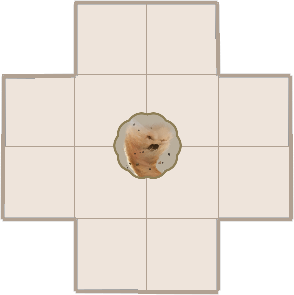
Moonbeam (5' radius) AoE token
Moonbeam (5′ radius) AoE token for grid combat.

Like CL, the effect is a 5-foot radius centered on a grid intersection (i.e., 4 squares). The cylinder involved is 40 feet high, but there’s no verbiage (as in CL) to indicate that if you are not in a 40-foot tall room, you can’t cast it; the height seems primarily oriented toward cases of dealing with flying creatures.

While CL allows the target radius to be moved anywhere under the cloud on the caster’s turn, Moonbeam‘s cylinder can be moved by the caster (as an Action) in any direction 60 feet, as long as it remains within the 120 foot range from the caster on that turn. So while someone can run out from under CL‘s cloud (which is immobile), the Moonbeam caster could run after someone who was trying to get outside of that 120 range and move the beam on top of them again.

Moonbeam and damage

This is a little more difficult to glean from the spell description, and had to be more fully explained in an official Sage Advice CompendiumDamage is done to victims within the radius on their turn, not on the spell-caster’s turn, i.e.:

  • When a target begins their turn inside the cylinder.
  • When a target enters the cylinder during their turn (if they did not already start there).

But targets do not take damage when:

  • The cylinder is cast or moved onto the area where a target is standing.
  • The spell is moved across a target on its way to a different location.

Looked at another way, you’d generally see Moonbeam’s use as such:

  1. The caster drops the Moonbeam on an opponent. The opponent takes no damage at that time.
  2. The opponent’s next turn begins … and they take their 2d10 radiant damage (or Save). They presumably move away …
  3. The caster’s next turn starts — and they move the Moonbeam atop the same target. Who doesn’t take damage right then, but …

Laser, move, repeat.

Note that targets can be involuntarily moved into the cylinder by some effect (a shove, a Thunderous Blast), and this does actually count as “enters the spell’s area for the first time on a turn.”.

Entering such an area of effect needn’t be voluntary, unless a spell says otherwise.

This same arrangement holds true for a number of other AoE hazards, e.g., Blade Barrier. If it moves onto you, you don’t take immediate damage. If you move into it (even against your will), you do. And, in such a case, you’ll end up taking damage twice — when shoved in, and then at the beginning of your turn.

Note that this, too, is a Concentration spell. Between that and having to use your Action to move the Moonbeam, use of this spell is pretty much a full-time job. But the orbital death laser’s damage potential, especially against mooks, or round-over-round against bigger targets, makes all that worth it.

dnd 5.5/2024Any changes in 5.5e?

This spell has some significant differences in 5.5e (2024), though in principle it is much the same.

A silvery beam of pale light shines down in a 5-foot-radius, 40-foot-high Cylinder centered on a point within range. Until the spell ends, Dim Light fills the Cylinder, and you can take a Magic action on later turns to move the Cylinder up to 60 feet.

So this part is much the same, just edited a bit and with the Magic action used for the targeting movement.

When the Cylinder appears, each creature in it makes a Constitution Saving Throw. On a failed Save, a creature takes 2d10 Radiant damage, and if the creature is shape-shifted (as a result of the Polymorph spell, for example), it reverts to its true form and can’t shape-shift until it leaves the Cylinder. On a successful Save, a creature takes half as much damage only. A creature also makes this Save when the spell’s area moves into its space and when it enters the spell’s area or ends its turn there. A creature makes this Save only once per turn.

So there are some significant differences here:

  1. As you would intuitively assume (but was not the case in 5e), Save and damage rolls take place when the spell is first cast.
  2. It also seems you can drag this spell across bad guys (“when the spell’s area moves into its space”), which is pretty nasty.  You can only do it once (per turn), though, as damage is only taken when the Save is rolled, and the Save is only rolled once per turn. (A target could still be damaged multiple times a round if shoved into and out of the beam by different people on their turns.)
  3. People in the beam take damage if they end their turn there (not start it).
  4. Any sort of shape-shifted creature, is affected, though there is no mention of Disadvantage on the Save.

So before, Moonbeam lagged on causing damage until the start of a target’s turn. Now in 5.5e, it causes damage as soon as they enter the beam or the beam is cast/moved onto them, and if they remain standing in the beam, they take damage at the end of their turn.

This would seem to make Moonbeam a bit more powerful than in 5e, and the ability to march the Moonbeam down a row of bad guys on a turn potentially makes it much more powerful. 

D&D 5e Rules – Spells: Call Lightning!

Summoning lightning sounds really cool. And it is. Under the right circumstances.

Know the RulesPart of an ongoing series of 5e (2014) Rules notes.  See the end of the post for notes on 5.5e (2024) rules.

I won’t say that Call Lightning is an overrated spell, but it’s a spell that sounds a lot more cool and flexible and awe-inspiring than it actually turns out to be when you try to play with it (properly). It comes across as an alternative to Fireball for Druids, also a 3rd Level Conjuration, but it most certainly is not.

Let’s start with the description.

Range: 120 feet

A storm cloud appears in the shape of a Cylinder that is 10 feet tall with a 60-foot radius, centered on a point you can see within range directly above you. The spell fails if you can’t see a point in the air where the storm cloud could appear (for example, if you are in a room that can’t accommodate the cloud).

When you cast the spell, choose a point you can see under the cloud. A bolt of lightning flashes down from the cloud to that point. Each creature within 5 feet of that point must make a Dexterity saving throw. A creature takes 3d10 lightning damage on a failed save, or half as much damage on a successful one. On each of your turns until the spell ends, you can use your action to call down lightning in this way again, targeting the same point or a different one.

If you are outdoors in stormy conditions when you cast this spell, the spell gives you control over the existing storm instead of creating a new one. Under such Conditions, the spell’s damage increases by 1d10.

This one is a bit more complex than it seems, and it “suffers” by having had its text significantly updated some time into the 5e era; a lot of websites discussing the spell (from when 5e first launched) do not have the spell described correctly . The original text got confusing about the height of the cloud.

So, you need to be in a room or area that has at least ten feet of clearance (to accommodate the height of the cloud). As an example, my kitchen/family room ceiling is only 8 feet high. So this will be most useful out of doors, in tall caverns, or in Intentionally Impressive Rooms (throne rooms, cathedrals, etc.).

(I have seen suggests that if the room is only 10 feet high then the area concerned is all in cloud and thus can’t be seen into. That effect is not explicitly called out, and, frankly, gets into complications I’d rather avoid. If I were to do it, rather than blocking vision I’d make the area into a Dim situation, impacting Perception checks in and out, but not much more).

You don’t need quite this much space, but almost.

The rules indicate the room/space must accommodate the cloud. That means an interior room has to be not just tall enough, but wide enough to accommodate a 60-foot radius, i.e., 120 feet wide.

The cloud gets centered on a point no more than 120 feet away (a grid intersection, not a square, if you are playing on a grid), and as noted, has a radius of 60 feet.

Impress your friends!

On each turn, the caster can choose a point (again, a grid intersection, not a square), and everyone in a 5-foot radius of that point (i.e., the four squares around that intersection) get zorched. The point can be anywhere under that 60-foot radius cloud, and can be moved around (as an Action) each turn. (I would rule that any area to be zorched must be under the cloud.)

It’s a Concentration spell, so you can keep it going for up to 10 minutes, or until someone figures out you’re the one doing it and starts trying to break your concentration.

Call Lightning vs. Fireball

I mean, this doesn’t have to be a competition … but, frankly, the subject is going to come up.

Advantages of Call Lightning
  • Lasts for 10 minutes (of Concentration)
  • You can hit the same target every. single. round. That’s a lot of 3d10s over 10 minutes.
  • Works anywhere under a 60 foot radius
  • Range is only 120 feet, but with a 60 foot radius from that point.
  • Lightning damage is less resisted than fire.
Advantages of Fireball
  • 8d6 beats 3d10 (the first time).
  • Can be cast anywhere, not just in a space that will fit a cloud 10 feet high and 120 feet across.
  • Hits its entire area upon casting.
  • Range is 150 feet (but only a 20 foot radius from that point).
  • LoS not necessary for effect; can affect targets around a corner.
  • Can set stuff on fire.

Call it anecdata, but during a 2½ year weekly campaign, our Druid had an opportunity to cast Call Lightning maybe … twice? Whereas our Sorcerer let loose with a Fireball at least every second or third session.

That said, if the opportunity does arise, and if it’s thematically proper to the character, Call Lightning can be a ton of fun to cast.

Any changes in 5.5e?

dnd 5.5/2024Maybe.

The basic language of the spell is fairly similar in 5.5e (2024):

The storm cloud:

A storm cloud appears at a point within range that you can see above yourself. It takes the shape of a Cylinder that is 10 feet tall with a 60-foot radius.

Here’s the main difference: there’s no longer any language about the spell failing if the room is not large enough to accommodate such a cylinder. Does it? Better ask your DM first to make a ruling before you assume it does (or doesn’t). If the limitation has actually been eliminated, this is a much more useful spell.

The zorching:

When you cast the spell, choose a point you can see under the cloud. A lightning bolt shoots from the cloud to that point. Each creature within 5 feet of that point makes a Dexterity saving throw, taking 3d10 Lightning damage on a failed save or half as much damage on a successful one.

Until the spell ends, you can take a Magic action to call down lightning in that way again, targeting the same point or a different one.

While edited a bit from the 5e text (and calling in the new Magic action), everything else here is the same. The spell also has the added language for using a natural storm out of doors.

So, is there a change? There’s probably someplace in the 5.5e rules I haven’t run across about how AoEs that don’t fit in the space work. Barring that (and not seeing any commentary online), I would, again, discuss it with your DM about whether they want to allow you to blanket any 60-foot radius area with four-squares-at-a-time lightning bolts for ten minutes. As far as I can tell, 

D&D 5e Rules – Spells: Fireball!

“Ka-boom?”
“Yes, Rico. Ka-boom.”

Know the RulesPart of an ongoing series of 5e (2014) Rules notes.  See the end of the post for notes on 5.5e (2024) rules.

It’s a classic, so much so that it’s inspired a dozen memes. It’s every magic-user’s favorite 3rd Level spell: Fireball!

So, what does that bad boy look like?

A bright streak flashes from your pointing finger to a point you choose within range and then blossoms with a low roar into an explosion of flame.

Each creature in a 20-foot-radius sphere centered on that point must make a Dexterity saving throw. A target takes 8d6 fire damage on a failed save, or half as much damage on a successful one.

The fire spreads around corners.

It ignites flammable objects in the area that aren’t being worn or carried.

Fire Ball Gif GIFs | TenorFrom PHB 241.

What’s not to like? Hitting everyone in a large radius with 8d6 of fire damage?  It is Teh Awesome.

Of course, Fire is one of the most commonly resisted damage types (largely “thanks” to Fireball), and the save is on DEXterity, which is something a lot of bad guys have in abundance.

But, still, it’s pretty damned amazing. No wonder all the spellcasters cannot wait to get it, and then to use it.

So let’s talk about the rules.

The Rules of Fireball

Fireball has, traditionally in D&D, been a debate about physics, calculating the volume of the fireball, then the volume of the room, then figuring out the blowback if the latter is smaller than the former, etc.

5e has simplified this. Though the spell talks about an “explosion of flame,” the consensus is that, RAW, it acts more like a volume that is suddenly filled with roiling flame, as long as there is an open channel within range.

There’s no ka-boom that roars down the hallway like in Backdraft. 

Walls and doors, etc., block the effect.

All this does mean that Fireball can affect folk out of line of sight. The following picture (source unknown) illustrates:

The magic user on the steps casts Fireball in the middle of the corridor ahead. (Properly speaking, spells should anchor on an intersection, not in the middle of a square or an edge. But I digress.)

The lady around the corner gets hit, even though she’s out of Line of Sight from both the caster and the center of the spell, because the fireball spreads around the corner — within the 20 foot radius.

The figure in the room, though, is not hit because the doors are all closed. If the upper door by the lady was open, though, that figure would get hit, even if it’s a lot longer to walk from the center of the spell to that figure than 20 feet.

AoE 20ft radius orange
Fireball AoE template

(I’ve seen some suggestion that the line-of-explosion has to go through full squares; that seems to be a DM call, though. Under that suggestion, the figure in the room would not get hit if the upper door was open, because the effect has to go through half-squares. This gets solved, though, by using a squares template, especially on a VTT, rather than drawing a circle.)

(And, no, we’re not going to worry, for purpose of area of effect, whether the doors catch on fire and burn through.)

fireball meme

References: 1 2 3 4 5 6

dnd 5.5/2024So how about in 5.5e?

There’s been a significant change in how Fireball works in 5.5e (2024).  Fireball now respects cover.  

Here’s the write-up:

A bright streak flashes from you to a point you choose within range and then blossoms with a low roar into a fiery explosion. Each creature in a 20-foot-radius Sphere centered on that point makes a Dexterity saving throw, taking 8d6 Fire damage on a failed save or half as much damage on a successful one.

Flammable objects in the area that aren’t being worn or carried start burning.

This is almost precisely the language 5e uses, but leaving out the very significant “the fire spreads around corners” verbiage. The implication is that total cover from the point of the explosion (not the PoV of the caster) shields the target. It’s no longer an instantly roiling sphere of flames; it’s an explosion (as the text has always implied).

Fireball remains a very nifty spell, don’t get me wrong. But 5.5e gives it a small nerf for cover.


D&D 5e/5.5e Rules – Spells: Augury!

It’s the Poor Man’s Prophecy … but that doesn’t make it easy to adjudicate.

Know the RulesPart of an ongoing series of 5e Rules notes.

As a DM, I really dislike prophecy / fortune-telling / prognostication spells. Letting the players know something about what’s coming, when something is coming, feels like a horrible idea. And if I have to decided on the fly if something is going to be coming … then it’s even worse.

River Song - spoilers
… sweetie.

Don’t make me Augury. You wouldn’t like me when I’m Augury.

In the case of my most recent campaign, it was about our druid and his Augury spell (PHB 215-16):

By casting […]  you receive an omen from an otherworldly entity about the results of a specific course of action that you plan to take within the next 30 minutes. The DM chooses from the following possible omens:

  • Weal, for good results
  • Woe, for bad results
  • Weal and woe, for both good and bad results
  • Nothing, for results that aren’t especially good or bad

The spell doesn’t take into account any possible circumstances that might change the outcome, such as the casting of additional Spells or the loss or gain of a companion.

We dithered a bit over whether this spell was focused on actions taken in the near term (or started in the near term?), the results in the near term, or both. A lot of people also have this problem, because it’s, honestly, a poorly worded spell.

Other groups have had questions come up around, say, results for whom (the caster? the party? an identified individual?). If going down this path is going to help the caster get their reward from the sheriff, but also lead to another party member’s arch-nemesis getting a shot at them, what should the results be?

Or results from the perspective of whom (the caster? the spell’s otherworldly entity?). If the party is thinking of attacking the, oh, let’s say a lich, a goal a LG deity might wholly support, even if it’s certain death for the players … how should Augury turn out?

There’s a lot of interesting meta discussion out there about Augury (for those who find such things interesting), but here’s where I fall:

Timing

The spell is about “the results of a specific course of action that you plan to take within the next 30 minutes“.

While some interpret this as “only things you are doing and have results in the next 30 minutes,” I think there is room there for not just actions, but a course of actions which is initiated within that 30 minutes. The course may not be completed in 30 minutes. The results may not be achieved or clear in the next 30 minutes. But Augury can, with increasing vagueness, deal with things beyond a half hour.

An (ironic) look to the past

Some folk note that the 3.5 rules were a lot more clear on this:

The augury can see into the future only about half an hour, so anything that might happen after that does not affect the result. Thus, the result might not take into account the long-term consequences of a contemplated action.

The rules lawyers then argue whether (a) that should help inform how to treat the 5e rules, or (b) the lack of such language in 5e means this restriction is no longer true. I would probably lean into the latter interpretation, as the rules are evolutionary, not de novo each edition. I think it also makes better story sense.

Some hypotheticals

For the otherworldly being (i.e., the DM), the more specific and bounded the course of action and timeframe are, the clearer the results. So, “Should we go through these doors and into the dungeon beyond?” is kind of open-ended … and the augury will be more approximate.

Dungeon Door
Dungeon Door

On consideration, the DM (the otherworldly entity) knows that

  • The dungeon is likely to take several hours.
  • The first room, even the first 30 minutes of rooms, are easy-peasy.
  • The dragon at the end will be hard, even dangerous, but the treasure is pretty awesome.

The Augury would probably show Weal, for that treasure that lies at the foreseeable end of the course of action you are beginning in the next thirty minutes, even if the road may be bumpy to get there.

But … if the dragon was knowably (by the otherworldly being) of a CR that would quite likely lead to a partial or total party kill, then even if the path to it was some hours long, an Augury should show Woe.

In other words, it’s not just a “am I safe for the next 30 minutes?” spell, but “are my plans being initiated right now leading to significant benefit or harm going forward.” The further forward, the more hazy. And it’s not open-ended: “Yes, if you set off on this quest in the next 30 minutes then, at the end of your life in fifty years, you will look back on this day in pride, and your deity will reward you in the afterlife” is beyond the spell’s scope.

So let me frame the generic question this way: “Will this specific course of action I am taking lead most proximately to my being benefited or harmed?” That proximity may be beyond the thirty minutes. And the coupling of the dragon and the treasure she sits on may lead to a Weal and Woe answer. But it won’t be a “Yes, you will get through rooms 1-5 of the dungeon and find 50gp there, so definitely Weal, but, whoa, room 6 is gonna be a hot mess for you, but that’s more than 30 minutes out, so further deponent sayeth not!”

ThiefAnother example: “Should I pick up this idol?” The idol is secretly cursed to draw attacking undead to you at the next New Moon, which is a week away. What should the Augury say?

I’d have it say Woe, even if the results aren’t within the next 30 minutes. On the other hand, if the idol was necessary to get into the Castle Arrgh, the next big step on the quest, then I’d give a Weal and Woe result; I might even do that if the curse drew attackers right now, because the proximate Woe is balanced by a greater later Weal. (I might also phrase it as “Woe and Weal,” to give some sense of the sequence.)

D20What about results that depend on die rolls? That one gets (ha!) dicier. Some folk argue that the spell assumes success (“We are going to sneak past the guards and find the plans in the leader’s tent — Weal or Woe?”), but if the DM thinks that highly unlikely due to the factors unknown to the players (a guard with a really high Perception), what to do?

In that case the DM should press to frame this into the specific questions, either (a) “We are going to sneak past the guards” → Woe) or (b) “We are going to look for the plans in the leader’s tent” → Weal.

In some cases, where everything hinges on a particular die roll (specifics good!), I might let the player make that roll in advance and so determine Weal or Woe. But in general, the spell itself demurs from “possible circumstances that might change the outcome”. The DM usually has to go with the probability curves. And if the players question it later when the Weal result turns pear-shaped?  Well, even an otherworldly entity isn’t omniscient.

Lord Of The Rings Gandalf GIF - Lord Of The Rings Gandalf Indeed GIFs

Maybe a metaphor will help

Here’s a final metaphor: Weal or Woe is like an elevation rise on a road. “Will this road climb higher?”

The clearest answer is how the roadway is right now (you’re on a flat patch, on an upslope, on a downslope) … but there might be a hill in the near distance that’s visible, or a vale … and a taller mountain, seen hazily, beyond that.

The more explicit the question, the closer the proximity, the clearer the answer; the further away, the hazier the answer, so that specifics become generalities, and the chance of Weal and Woe (“you will go uphill, and you will also go downhill”) becomes greater.

So whose Augury is it, anyway?

Is the Augury from the perspective of the caster, the party, the otherworldly entity (patron? deity?) of the caster, or what? What determines a “good” vs “bad” result?

It seems to me that it’s from the perspective of the person casting the Augury. And it’s how they will feel about it at the time of the result, not some sort of objective measure (HP left, gold pieces in pocket, etc.). Maybe Weal means the player losing at a gambling bet, but learning that the loss goes to feed some orphans, evocative of the player’s origin story. Or maybe Weal means returning the artifact to their deity’s temple, even if they lost one of the party members along the way. Or Woe means losing that party member only to gain a treasure, and contemplating on the meaninglessness of gold against their value of friendship. (Or maybe those are a blend of Weal and Woe.)

Those are complex activities to fit in the scope of an Augury, but they are offered as edge cases.

That all requires a bit of understanding about the character. Do they value their deity’s goals above their own comfort, or even survival? How do they feel about loyalty to the party, vs personal gain? Ultimately, it’s about what they value.

So, yes, it’s more difficult than a simple XP/HP vs GP comparison, but that’s also life.

A couple more hypotheticals

Example. “Should we camp here where it’s safe, rather than keep going?”

Effects: The party is saved from a dangerous encounter down the road with orcs, but without the party’s intervention, the orcs kill their hostages, whose bodies will be found on the road the next day by the party.

Augury result: I would argue Weal and Woe … probably. If it’s an easy encounter, then it would be just Woe (the character was never in real danger, and something they would value, innocent lives, was lost). If it was a convention of liches, not orcs, and the hostages were dead regardless, it would be Weal (you’re alive, buddy, and can potentially do something about the bad guys later). A particularly Good-aligned caster might get results leaning to Woe (personal survival is less important than saving lives), while Neutral or Evil one might be focused on Weal.

Example: “Should the Rogue go into town to find out whether the caravan has come through?”

Effects: The Rogue is likely to be arrested upon setting foot in town for shenanigans the last time there, and be thrown into the clink overnight. The caster has previously opined that the Rogue needs a comeuppance. Also, in jail, the Rogue will find out about the caravan, before being released the next day.

Augury resultWeal. Yeah, the Rogue is going to be pissed at the outcome (“Even the bedbugs had bedbugs!”), but the caster is happy about both the poetic justice and the intel being gathered.

Does any of this become clearer in 5.5e?

No, not really. The language of the spell is pretty much the same in 5.5e (2024) as in 5e.


D&D 5e/5.5e Rules – Spells – Spellcasting per Turn!

So how many spells can you actually cast in a turn, or a round?

Know the RulesPart of an ongoing series of 5e (2014) Rules notes.  See the end of the post for notes on 5.5e (2024) rules.

So how many spells can you cast in a turn?

The answer? Everyone say it together: It depends!

But first, a minor digression (that isn’t)

Terminology:

Round:  A cycle round the table, ordered by Initiative, during which each PC/NPC takes a turn.

Turn: A PC/NPC’s spot, ordered by Initiative, when the PC/NPC can move and take actions. Each PC/NPC gets one turn per round.

So, each round, your character gets to take their turn. There are parts of the round that are not your turn (but during which you may React).

This is important in understanding the below.

Okay, let’s answer the question

Let’s start with the Sage Advice Compendium:

Is there a limit on the number of spells you can cast on your turn? There’s no rule that says you can cast only X number of spells on your turn, but there are some practical limits. The main limiting factor is your Action. Most spells require an Action to cast, and unless you use a feature like the Fighter’s Action Surge, you have only one action on your turn.

By default, you can, pragmatically, cast one normal spell per turn, using the Cast a Spell Action. Most spells have a casting time of 1 Action. Easy peasy, right?

But what about spells that you can cast as a Bonus Action? There aren’t many, but they say it right in the spell timing. (It’s worth noting “Action” and “Bonus Action” are not interchangeable; if something is one, it cannot be done as the other.) So if you cast a Bonus Action spell, can you then cast a regular Action spell?

Yyyyeah, but it creates some limitations:

Bonus Action
A spell cast with a Bonus Action is especially swift. You must use a Bonus Action on your turn to cast the spell, provided that you haven’t already taken a Bonus Action this turn. You can’t cast another spell during the same turn, except for a cantrip with a casting time of 1 Action.

and

If you want to Cast a Spell that has a casting time of 1 Bonus Action, remember that you can’t cast any other spells before or after it on the same turn, except for cantrips with a casting time of 1 Action.

So, if you cast a spell, such as Healing Word, with a Bonus Action timing, you can cast another spell with your Action, but that other spell must be a cantrip, not a levelled spell.

But what about Sorcerers?

Sorcerers have a metamagic tool, though, called Quickened Spell

Quickened Spell
When you Cast a Spell that has a casting time of 1 Action, you can spend 2 Sorcery Points to change the casting time to 1 Bonus Action for this casting.

So that lets you cast a levelled spell of 1 Action casting as a Bonus Action instead. But that doesn’t get rid of the limitation above: “If you want to Cast a Spell that has a casting time of 1 Bonus Action, remember that you can’t cast any other Spells before or after it on the same turn, except for cantrips with a casting time of 1 action.”

Again, this is confirmed in the most recent Sage Advice Compendium:

Does Quickened Spell allow a sorcerer to cast two spells a round of 1st level or higher?
No, the sorcerer must follow the rule for casting a spell as a Bonus Action and casting another spell on the same turn; the other spell must be a cantrip with a casting time of 1 Action.

Along this line, there is an Epic Boon that allows a spell you know to be turned into a Bonus Action spell permanently. But we needn’t delve into that right now …

To sum up …

So, what are valid combos?

  • YES: Cantrip @ 1 Action + Spell @ 1 Bonus Action
  • YES: Cantrip @ 1 Action + Cantrip @ 1 Bonus Action
  • NO: Spell @ 1 Action + Spell @ 1 Bonus Action
  • NO: Spell @ 1 Action + Cantrip @ 1 Bonus Action

Unless noted otherwise, the Bonus Action can go before or after the Action, but remember that you can only cast something as a Bonus Action if that’s its timing in the spell book, or if you use Quickened Spell to cast it.

But what about spells that give Bonus Actions?

If a spell gives you a Bonus Action, using that Bonus Action does not trigger this limitation effect (because you aren’t casting the spell in the Bonus Action). For example.

The rule on casting a spell as a Bonus Action (see PH, 202) applies only on the turn you cast the spell. For example, Spiritual Weapon can be cast as a Bonus Action, and it lasts for 1 minute. On the turn you cast it, you can’t cast another spell before or after it, unless that spell is a cantrip with a casting time of 1 Action.

Until Spiritual Weapon ends, it gives you the option of controlling its spectral weapon as a Bonus Action. That Bonus Action does not involve casting a spell, despite the fact that it’s granted by a spell, so you can control the weapon and cast whatever spell you like on the same turn.

But what about Action Surge?

One further edge exception to this is if you are a spellcaster who’s taken a couple of levels of Fighter (or are doing the Eldritch Knight fighter subclass).

Action Surge
Starting at 2nd Level, you can push yourself beyond your normal limits for a moment. On your turn, you can take one additional Action.

As noted by the Sage Advice column, using Action Surge would give you two Actions on that turn, and both of them could be Cast a Spell. And that wouldn’t be limited to cantrips:

If you cast a second spell using Action Surge, you aren’t limited to casting a cantrip with it.

If you also cast a Bonus Action spell of some sort, though, those regular Action spells would be limited to cantrips (both of them). Because, again,

If you want to Cast a Spell that has a casting time of 1 Bonus Action, remember that you can’t cast any other spells before or after it on the same turn, except for cantrips with a casting time of 1 Action.

Well, then, what about Reaction Spells?

The rules about spellcasting actions also get bumped about by Reaction spells. Some spells (such as Shield) can be cast as a Reaction. You only get one Reaction per round, and Reactions (to others’ actions) usually take place outside of your turn. But … not always.

Reaction Timing
Certain game features let you take a special action, called a Reaction, in response to some event. Making Opportunity Attacks and casting the Shield spell are two typical uses of Reactions. If you’re unsure when a Reaction occurs in relation to its trigger, here’s the rule: the Reaction happens after its trigger completes, unless the description of the Reaction explicitly says otherwise.

Once you take a Reaction, you can’t take another one until the start of your next turn.

and

Reactions
Some spells can be cast as Reactions. These spells take a fraction of a second to bring about and are cast in response to some event. If a spell can be cast as a Reaction, the spell description tells you exactly when you can do so.

There are some weird edge cases where you might end up using a Reaction spell on your own turn. E.g., on my turn …

  1. I Cast a Spell Fireball at the orcs.
  2. I take a step forward, coming into range of the enemy wizard.
  3. The enemy wizard fires off his Readied action of “Cast a Spell Magic Missile If I Step Within Range.”
  4. I React with a Shield spell.

I react on my own turn, and that’s fine. And there’s no problem with effectively my casting two spells (my Action and my Reaction) because there’s no limitation on that; none of the conditions discussed above come into play because this doesn’t involve a Bonus Action.

But consider this case:

  1. I use a Bonus Action to cast a Shillelagh cantrip.
  2. I Cast a Spell Flame Bolt cantrip at the orcs (since I have already cast as a Bonus Action, I can only do a cantrip as my Cast a Spell action).
  3. I take a step forward, coming into range of that enemy wizard.
  4. The enemy wizard fires off his Readied action of “Cast Magic Missile If I Step Within Range.”
  5. I React with a Shield spell … but I can’t.

Because Shield is not a cantrip and because I cast a Bonus Action spell and I can’t cast another leveled spell on my turn once I’ve done that. Again, as the rules say, once you’ve cast a spell as your Bonus Action, “You can’t cast another spell during the same turn, except for a cantrip with a casting time of 1 action.” That includes Reactions on my turn, just like it includes the second Action in an Action Surge.

If the enemy wizard acted right after my turn and fired the Magic Missile, then the Shield could be cast as a Reaction just fine, because I would not be Reacting on the same turn as when I cast a Bonus Action spell. Zany, but true.

As a further note, I am not sure if there are any Reaction Cantrips. As of 2014, at least, Jeremy Crawford was able to say:

Casting a Bonus Action spell does preclude casting a Reaction spell on the same turn.

In short …

So the answer to “How many spells can I cast on a turn?” seems to be:

  • Three levelled spells (Cast a Spell, Action Surge+Cast a Spell, Reaction) or
  • Three spells (Cast a Spell cantrip, Action Surge+Cast a Spell cantrip, Bonus Action)

If you don’t want to get into Action Surge, it looks like the number is two.

Bonus Action spells are really powerful in the flexibility they provide (more than one spell in a turn!), but they also gum up what else you can do, spellcasting-wise. Caveat incantor.

Any changes in this with 5.5e?

dnd 5.5/2024In theory, 5.5e (2024) has the same basic restrictions. In actuality, some wording alterations may (or may not) fundamentally changed things.  (Remember, when in doubt, The Rule of Cool as well as The DM can dictate how they want rules to work.)

One terminology change:  there is now a Magic Action for players to use, which combines casting spells with using magical items. Such things usually will note that they require a Magic Action.

One other terminology change. Instead of referring to “levelled spells” (for any spells with a level number, or over a Cantrip), 5.5e works off of “spell slots” or refers to spells that require a spell slot to use. That sounds similar, but there’s one key difference.

In the 5.5e PHB (p. 236) the rules note:

One spell with a Spell Slot per Turn
On a turn, you can expend only one spell slot to cast a spell. This rule means you can’t, for example, cast a spell with a spell slot using the Magic action and another one using a Bonus Action on the same turn.

Which sounds like the 5e rules, except that it doesn’t take into account spellcasting that doesn’t use spell slots, like using magic items, including scrolls, or species magic features or class magic features. All of those are tracked and expended in a different way (e.g., species X can cast spell Y once per day).  But they still don’t use spell slots — so are they legal to be stacked as a Bonus Action with a spell-slotted spell in the Magic action?  Or to use as a Magic action spell alongside a Bonus Action slotted spell?

More importantly, was this change intentional, or an inadvertent result of the terminology change?

For the moment, consult with your DM.

Note that 5.5e’s Sage Advice Compendium includes the following:

Is there a limit on the number of spells you can cast on your turn?

There’s no rule that states you can cast only X number of spells on your turn, but there are some practical limitations. The main limiting factor is your action. Many spells require an Action to cast, and unless a feature says otherwise, you only have one Action on your turn. You also must abide by the rule of only expending one spell slot to cast a spell on your turn.

So, for example, if you take your Bonus Action to cast Healing Word using a spell slot, you can also take the Magic action to cast Vicious Mockery—a cantrip which doesn’t require a spell slot.

D&D 5e/5.5e Rules – Spell Scrolls!

Spells Scrolls aren’t spells, but they aren’t magic items, but they are actually both, which, yes, is sometimes confusing.

Know the RulesPart of an ongoing series of 5e (2014) Rules notes.  See the end of the post for notes on 5.5e (2024) rules.

The basic rule: you can only use a spell scroll if you are in a class that has the spell on its spell list.

Things seem pretty simple if you just look at the DMG’s description of Magic Items: Scrolls (DMG 139):

The most prevalent type of scroll is the spell scroll, a spell stored in written form …. A scroll is a consumable magic item. Unleashing the magic in a scroll requires the user to read the scroll. When its magic has been invoked, the scroll can’t be used again. Its words fade, or it crumbles into dust.

Unless the scroll’s description says otherwise, any creature that can understand a written language can read the arcane script on a scroll and attempt to activate it.

However, under Spell Scroll (DMG 200), the process is much more elaborate and restrictive (and in D&D, specific beats general):

spell scroll bears the words of a single spell, written in a mystical cipher.

If the spell is on your class’s spell list, you can read the scroll and cast its spell without providing any material components. Otherwise, the scroll is unintelligible.

Casting the spell by reading the scroll requires the spell’s normal casting time. Once the spell is cast, the words on the scroll fade, and it crumbles to dust. If the casting is interrupted, the scroll is not lost.

If the spell is on your class’s spell list but of a higher level than you can normally cast, you must make an ability check using your spellcasting ability to determine whether you cast it successfully. The DC equals 10 + the spell’s level. On a failed check, the spell disappears from the scroll with no other effect.

That page also includes a table for determining the saving throw DC and attack bonus:

Spell Level Rarity Save DC Attack Bonus
Cantrip Common 13 +5
1st Common 13 +5
2nd Uncommon 13 +5
3rd Uncommon 15 +7
4th Rare 15 +7
5th Rare 17 +9
6th Very rare 17 +9
7th Very rare 18 +10
8th Very rare 18 +10
9th Legendary 19 +11

Spell scrolls can also serve as fodder for a spell book.

A wizard spell on a spell scroll can be copied just as spells in spellbooks can be copied. When a spell is copied from a spell scroll, the copier must succeed on an Intelligence (Arcana) check with a DC equal to 10 + the spell’s level. If the check succeeds, the spell is successfully copied. Whether the check succeeds or fails, the spell scroll is destroyed.

If you want to read a discussion of whether Spell Scrolls need to actually be scrolls, check here.

What if I just want to know what is on the scroll, just not cast it (yet)?

Since we don’t have Read Magic any more in D&D, how do we know what is on a scroll? That’s actually … a question without a very clear answer.

The Identify spell will do it. But short of that, the answer is, “It depends.”

If the spell scroll is just a recipe for the spell, then the normal rules of (1) reading scrolls and (2) identifying what it does apply:

  • you need to be able to read
  • you need to be able to cast the spell in order to read it (i.e., it has to be in your class spell list)
  • and you need to spend a Short Rest trying to puzzle it out, just like any other magic item.

A beneficent, organized, communicative spellcaster, in forming the scroll, might have put a label on it (“Spell of Fireball” in plaintext). In which case you’d have a pretty big clue as to what it is and does, assuming you could find a beneficent, organized, communicative spellcaster’s works. And that you could actually trust that was what it does.

In theory, you could just cast the spell by reading it for the first time, without actually knowing what it does until the very end. A charitable GM might even let you make some sort of roll (e.g., Intelligence (Arcana) vs 10 + spell level) if, as you realize at the last moment what it does, you wanted to abort casting it. (It would still suck up a turn’s Action, though, as a minimum cost.)

I would also be willing to entertain the idea that, if you simply spend a Short Rest focusing on a scroll, you should be able to get an impression of what it does even if you could not use it and/or read it. A sense of the type of magic (necromantic, evocation), aspects of it (heat, cold, water, steel), colors, a usable class (choirs singing, the smell of damp earth), that sort of thing.

Or maybe not. Since you cannot actually read the scroll without being able to cast it, it sort of plays like “language” (“Crap, this thing is in German. Anyone know German?”) … but it’s definitely not a language. I mean, it’s possible to have a scroll that is usable (intelligible) to a druid and a sorcerer,  and second one to a sorcerer and a wizard, and a third to a wizard and a druid, and language simply doesn’t work like that. Instead, it’s as though the words and formulae tie into some sort of internal mindframe, some perception of reality, that is shared within some magic-using classes in some ways, but not non-magic-using classes (except, sorta, Rogues).

So more like, “Crap, this one is giving me a migraine looking at it, someone else want to give it a go?” Which might be the quickest way to deal with spell scrolls when found during an adventure, just having the various magic-users in the party pass each of them around until someone can read it. That is, you can quickly (if maybe painfully) tell if your class can use the spell, though you’ll need to spend that Short Rest to determine what precisely it is.

(Some interesting discussion here about this whole sub-question.)

What about Thieves?

Thieves are (in some cases) a weird exception to the above. At 13th level, Thief Rogues get “Use Magic Device” ability (PHB 97), giving them access to magical devices they would not be able to otherwise access.

By 13th level, you have learned enough about the workings of magic that you can improvise the use of items even when they are not intended for you. You ignore all class, race, and level requirements on the use of Magic Items.

This includes spell scrolls, per the Sage Advice Compendium:

Does the Thief’s Use Magic Device feature allow them to use spell scrolls? Yes. The intent is that a Thief can use spell scrolls with Use Magic Device

The thief would still have to make the ability check to actually cast the spell successfully, with the spellcasting ability = 0 (vs a DC of 10 + spell level), and without any proficiency bonus added in (basically a straight d20). If the spell requires a further spell attack roll, again the spellcasting ability is 0, but proficiency bonus does apply.

Do I have to Concentrate if I use a Spell Scroll to cast a spell that requires Concentration?

Yes. As the basic rules say (emphasis mine):

Some magic items [such as spell scrolls] allow the user to cast a spell from the item. The spell is cast at the lowest possible spell level, doesn’t expend any of the user’s spell slots, and requires no components, unless the item’s description says otherwise. The spell uses its normal casting time, range, and duration, and the user of the item must concentrate if the spell requires Concentration. Many items, such as potions, bypass the casting of a spell and confer the spell’s effects, with their usual duration. Certain items make exceptions to these rules, changing the casting time, duration, or other parts of a spell.

So scrolls give you the advantage of no components and no spell slots required. But you still have to concentrate/control the spells they cast.

Does any of this change in 5.5e?

dnd 5.5/2024The 5.5e (2024) edition rules do change some of the above.

Scrolls are now cast using the Magic Action in combat (which lets you cast a spell, or use a feature or magic item that requires a Magic action to activate).

The DMG (216) defines magical scrolls (beyond their physical description) as:

The most prevalent scroll is the Spell Scroll, a spell stored in written form. However, some scrolls, like the Scroll of Protection, bear an incantation that isn’t a spell. 

Great.

Just like in 5e, when reading the scroll to unleash its power, the scroll itself (or the writing on it) is destroyed.  The section concludes (on DMG 217; emphasis mine):

Any creature that can understand a written language can read a scroll and attempt to activate it unless its description says otherwise.

That sounds like the wide-open-reading clause in the 5e DMG.  However, if you look up Spell Scroll in the 5.5e PHB under (ch. 6) Equipment > Adventuring Gear, you find …

If the spell is on your class’s spell list, you can read the scroll and cast the scroll using its normal casting time and without providing any Material components. If the spell requires a saving throw or attack roll, the spell save DC is 13, and the attack bonus is +5.

There’s nothing about spell scrolls in the Magic Items section of the PHB (p. 233), but in the Crafting rules right afterwards, it does talk about creating spell scrolls, much more clearly than 5e did. 

  • A table is provided showing the time and cost of doing so (based on the spell level).
  • The scribe has to have Proficiency in Intelligence (Arcana) or in Calligrapher’s Tools, and must prep the spell each day while they are writing the scroll. 
  • Any material items are consumed when the scroll is completed.
  • For leveled spells, the Scroll’s spell uses Spell Save DC and Spell Attack Bonus of the scribe. For cantrips, the Scroll’s spell works as though the caster were the scribe’s level.

Spell Scrolls also come up in the Wizard class description [PHB 167], talking about expanding a Wizard’s Spellbook:

You could discover a Wizard spell on a Spell Scroll, for example, and then copy it into your spellbook. […]  When you find a level 1+ Wizard spell, you can copy it into your spellbook if it’s of a level you can prepare and if you have time to copy it. For each level of the spell, the transcription takes 2 hours and costs 50 GP. Afterward you can prepare the spell like the other spells in your spellbook.

Unlike in 5e, so far as I can tell, no Arcana roll is needed, nor is the Spell Scroll destroyed by doing so.

Thief and Use Magic Device

For this completely reworked Level 13 subclass feature, it notes (among other things):

You can use any Spell Scroll, using Intelligence as your spellcasting ability for the spell. If the spell is a cantrip or Level 1 spell, you can cast it reliably. If the scroll contains a higher-level spell, you must first succeed on an Intelligence (Arcana) check (DC 10 plus the spell’s level). On a successful check, you cast the spell from the scroll. On a failed check, the scroll disintegrates.

D&D 5e/5.5e Rules – Swimming! And Drowning! And Water Combat!

Sooner or later, you end up fighting in the water. Or swimming. Or being held under the surface. So how does that work in 5e?

Know the RulesPart of an ongoing series of 5e (2014) Rules notes.  See the end of the post for notes on 5.5e (2024) rules.

5e has very much simplified (perhaps oversimplified, some argue) the issue of dealing with water as an obstacle, a location for fighting, and a danger. Always remember, D&D is not a physics simulator (or, as some have countered, it is a horrendously and hilariously bad physics simulator).

Note that there are a lot of exceptions below for creatures that have a Swimming speed in their stat block.

Movement in the Water

Water is basically considered Difficult terrain if you don’t have a native Swimming speed. That is, each foot moved costs two feet of movement. If the terrain within the swim is itself Difficult (e.g., a strong current, a kelp bed, etc.), this might increase to each foot moved costs three feet of movement.

You can, however, use any other movement speed (e.g., walking, flying) to swim with.

If the water is “rough,” making any progress swimming might require a Strength (Athletics) check.

There is (remarkably) no distinction in speed between swimming underwater or swimming on the surface.

Don’t forget the Dash action, if you are doing nothing but movement.

Long-Distance Movement in the Water

swimming
Long-distance swimming

If you have a Swimming speed, you can swim all day without penalty; use Forced March rules from the PHB.

Otherwise (per DMG 116), you need to roll a CON Save vs DC 10 for each hour swimming. Failure means +1 level of Exhaustion. Beyond that, there is a cap on 8 hours of swimming per day.

Deep Water

The pressures and temperatures of deep water take their toll. Per DMG 116, for creatures lacking a Swimming speed:

  • if swimming over 100 feet deep, makes every hour count as two for Exhaustion checks and limits.
  • if swimming over 200 feet deep, makes every hour count as four for Exhaustion checks and limits.

Vision in the Water

  • Clear water, bright light — 60 foot visibility to notice an encounter
  • Clear water, dim light — 30 foot visibility to notice an encounter (Disadvantage to Perception).
  • Murky water / no light — 10 foot visibility to notice an encounter (Disadvantage to Perception).

The above presume light sources or Darkvision.

Doing Stuff in the Water

By which we mean, of course, combat and magic.

Combat in the Water

Underwater Knight
Note: breathing gear is cheating.

When fighting underwater, again unless you have a native Swimming speed:

  • Melee weapon attacks are at a Disadvantage (as you and/or your weapons are slowed by the drag of the water) …
    • … except for a thrusting/piercing weapon like a dagger, javelin, shortsword, spear, or trident.

This melee weapon restriction Rule-As-Written would seem to apply to fighting while on the surface (swimming), or even while partially immersed (imagine fighting in waist-deep water); I’m not sure that last makes sense, and an appeal to the DM might be possible. (I can see any sort of melee weapon attack being at Disadvantage when standing in, but not under, water, as you are partially Restrained.)

  • Ranged weapon attacks are possible underwater, but they are at a Disadvantage …
    • except when using a crossbow, net, or a weapon thrown like a javelin, spear, trident, or dart.
    • They are an automatic miss if beyond normal range.

Magic in the Water

Back to the Future - Enchantment under the Sea
Also known as …

You can cast spells underwater.

  • But if they have a Verbal componentyou have stopped holding your breath and have gone into step 2 of Drowning (below).
  • Material components may be difficult to manipulate while swimming or immersed in water. Arcane/Spiritual Foci are your friends!
  • Somatic components aren’t a problem, as only a single hand is needed for them.

Spells that require a to-hit roll do so at a Disadvantage (if above water, because of aiming while trying to stay afloat; if underwater, because of the murk and visual distortion underwater, and drag on your body).

True Lies swimming under water fire
Great way to resist Fire damage, Harry!

When you are fully immersed in water, you have Resistance to Fire damage.

But aside from that, spells don’t do anything tricky. For example, lightning does not electrify the whole area. (Remember (a) Bad Physics Simulator, and (b) it’s not actual lightning, it’s magic acting like lightning (handwaves)).

Going “Prone” underwater

If something should knock you Prone while in the water, you are instead tumbling/floundering … but suffering the same status effects as being Prone condition (including slowed movement, Disadvantage to attack, Advantage to adjacent attackers) until you “stand up” / regain control with half your movement. (References 123).

Drowning

DrowningThe rules here are essentially the same as suffocation rules:

  1. You can hold your breath for (CON mod + 1) minutes (with a minimum of 30 seconds or five rounds).
  2. After that you survive (CON mod) rounds (minimum of 1) without needing more air.
  3. After that, you are at 0 hp and are unconscious and dying. You can’t stabilize or heal until you can breathe — even if you make your three successful Death Saves, you only erase any unsuccessful ones and start the process over. You can be magically healed, but that can only get you back up to Step 2 unless you are out of the water by then.

Example: A creature with CON = 14 (CON mod = 2) can hold their breath for 3 minutes (30 rounds). After that, they start drowning/suffocating, and have 2 rounds (12 seconds) to reach air before dropping to 0 hp.

Note that 3 minutes (or even 1 minute) is a ridiculous amount of time in the game. People tend to be terrified of their character running out of air … the first time they get into underwater combat.  (It’s still a real danger, but not a present one.)

Workarounds

  • Various races can either breathe underwater, or (such as Lizardfolk and Tortles) can hold their breath for longer, as defined in their stat blocks.
  • Wild Shape and Polymorph can change folk into creatures that can swim or breathe in water.
  • Anything that magically gives you a Swimming speed will be useful in the above.
  • Water Breathing is a spell that literally lets you breathe underwater for 8 hours. It’s a 3rd level for Druids, Rangers, Sorcerers, and Wizards, can affect up to ten people, doesn’t require concentration, and can be done as a ritual. Alternately, Water Walk (same parameters) lets you walk on water and not worry about having to breathe it.

Wait, that’s it?

But aren’t there some classic tropes that these rule ignore?

Yes.

Drowning in armor
“A Drowning Viking, possibly Olav Trygvason (968-1000) of Norway at the Battle of Svold on 9th September 1000”
  1. There’s no provision for heavy armor or a full backpack dragging you to the bottom, etc.; if you are strong enough to wear it, you are strong enough to swim in it (handwaves) … which is good, because it takes 5 minutes to remove heavy armor.
  2. There are no provisions for using up breath faster if you are (slowly) flailing about with your greatsword instead sitting still and preserving oxygen.

Again, largely this is because D&D is a crappy physics (and biology) simulator, and intentionally so. The game design thought seems to be “Does this complication take away from the fun? Does it mean extra calculations, rolls, and otherwise bogging-down of the game? Then simplify or eliminate it.”

(Note to self: if I ever decide this is too simplified, this site has some interesting homebrewed additions.)

Any changes here with 5.5e?

dnd 5.5/2024The rules in 5.5e (2024) for swimming (and drowning) aren’t changed too much from 5e (2014).

One place there is more clarification seems to be with when these swimming rules come into play for movement and combat.  The Difficult Terrain definition notes it applies in water between shin-deep and waist-deep. Water any deeper than that you are arguably either swimming (feet off the bottom) or most of your body is underwater and your movement (for moves and combat) are hampered enough that the swimming rules start to apply.

Swimming is defined in 5.5e:

While you’re swimming, each foot of movement costs 1 extra foot (2 extra feet in Difficult Terrain). You ignore this extra cost if you have a Swim Speed and use it to swim. At the DM’s option, moving any distance in rough water might require a successful DC 15 STRength (Athletics) check.

That’s pretty close to 5e, if a bit more simplified. 

The drowning rules are a little different (though, as before, they come up under Suffocation as a Hazard): 

A creature can hold its breath for a number of minutes equal to 1 plus its CONstitution modifier (minimum of 30 seconds) before suffocation begins.

So far, so same.

When a creature runs out of breath or is choking, it gains 1 Exhaustion level at the end of each of its turns. When a creature can breathe again, it removes all levels of Exhaustion it gained from suffocating.

Here’s where things get interesting (and simpler in a useful way) in 5.5e. Rather than have a final CON-based seconds to get to air and then dropping to 0 hp, you “simply” start accruing Exhaustion each round, i.e.,

  • Your D20 Test rolls are reduced by (2 x Exhaustion level)
  • Your Speed is reduced by (5′ x Exhaustion level)

This is fully reversable, instantly, upon being able to breathe again. 

But, if it goes on 6 rounds (6 levels of Exhaustion), you are dead. Not dying. Dead. No Death Saves or Stabilizing. 

Simpler. Not necessarily more or less dangerous.

The rules on combat underwater remain the same as far as disadvantages and weapon / range limitations if you don’t have a Swim Speed. I could not find any commentary on spellcasting underwater, but presumably it is much the same.

There is still no distinction made for hauling around massive weight or armor  and how well you can swim (or sink). There is also still no modification in the drowning rules for minimizing activity.

Deep Water swimming has been modified (DMG 68). Only a 100 foot level is specified; after swimming an hour at that depth or below, creatures without a Swim speed need to succeed on a DC 10 CONstitution Save or take a level of Exhaustion.

If water is particularly “frigid” (DMG 68), then creatures can be immersed in it up to CON minutes; after that, each minute requires a DC 10 CONstitution Save or take a level of Exhaustion.


D&D 5e Rules – Skills – Group Checks!

Everyone wants to roll their own Skill check. Sometimes, that’s not the best idea.

Know the RulesPart of an ongoing series of 5e (2014) Rules notes.  See the end of the post for notes on 5.5e (2024) rules.

This is actually an interesting and (at my table) rarely used game mechanic: dealing with skill checks as a group, rather than as individuals. It not only can save time, but it can get around some of the problematic aspects of Skill checks.

Group Skill Checks

The rock chimney needs to be ascended — not by an individual, but by the whole party.

The goblin encampment needs to be snuck past — not just by the rogue, but by that jingling oaf of a fighter, too.

The suspicious guard is eyeballing everyone who passes — and the whole party has cultist robes, hoping they can slip by.

5e includes a method for groups, as a whole, to make an Ability or Skill check.  As laid out in PHB 175:

To make a group Ability Check, everyone in the group makes the Ability Check. If at least half the group succeeds, the whole group succeeds. Otherwise, the group fails.

The idea here is that more experienced or skillful players are helping the less experienced or skillful ones to succeed.

“Put your feet right where I put mine … there you go, that’s it, great!”

“Watch out for that stick there — don’t step in it because it will snap and make a loud nose and ruin our chance to sneak by.”

“I wish you peace, diligent guardian of the temple, as do all my friends, riiiiiight?”

Group checks are useful where all the characters are

doing the same thing,
against
a challenge with a single DC value
and will
succeed or fail as a group.

Some examples:

  • Does the group get through a swamp without running into quicksand or a similar hazard?  Roll as a group on Wisdom (Survival) vs a DC.
  • Does the group sneak by the observation post without being heard?  Roll as a group on Dexterity (Stealth) vs a standard passive Perception value.

This mechanic works less well when there are multiple values in the challenge/opposition, and where an individual can potentially shine.

As well, the mechanic’s applicability is limited. You could use it, in theory, for spotting traps, for example, but it makes a lot more sense that the rogue is looking for traps and that their Perception is what makes or breaks the deal, rather than have them succeed personally, but then have the group fail as a whole because presumably a bunch of people did poorly and distracted the rogue from a trap they should have found.

Helping someone else

This is related, but similar. Note that someone can do a Help action in combat to give a person making the Skill or Ability Check do so with Advantage (if the helper can explain how it is they are helping, of course).  That’s how this all functions tactically in a battle.

The Ranger’s background gives her a lockpicking ability to Help with — not as good as the Rogue’s, who’s frantically working with his tools against the lock, while the other party members fend off the guards, but good enough to offer useful advice, hand the correct next pick to the Rogue, and overall give the Rogue an Advantage in trying to get the door open.

In theory, it works that way for other activities. So, under the rules for Working Together:

Sometimes two or more characters team up to attempt a task. The character who’s leading the effort—or the one with the highest Ability Modifier—can make an Ability Check with Advantage, reflecting the help provided by the other characters. In combat, this requires the Help action (see chapter 9).

A character can only provide help if the task is one that he or she could attempt alone. For example, trying to open a lock requires proficiency with thieves’ tools, so a character who lacks that proficiency can’t help another character in that task.

Moreover, a character can help only when two or more individuals working together would actually be productive. Some tasks, such as threading a needle, are no easier with help.

So, for example, when searching the room for something, a pair is actually better off with the best-Perception person doing the search, and someone else assisting them (for Advantage) than both people doing the search roll (because rolling with the highest Skill twice gives you a better chance than rolling once with a high Skill and once with a lower one).

Notes:

So does any of this change under 5.5e?

dnd 5.5/2024Not really. The new half-edition, 5.5e (2024) still has the Group Check mechanism, but it’s in the DMG (p. 28), and more examples are given for its use.

One note: the everyone-sneaking-past-the-guard scenario I suggested above is explicitly called out as not a good time to be using this mechanic.

Group checks aren’t appropriate when one character’s failure would spell disaster for the whole group.

So, it notes, one character being noisy would get the guard’s attention, no matter what the sneakier people in the group did.

It also notes that  when a single check is sufficient (e.g., finding a hidden compartment with a WISdom (Perception) check; only one person needs to be successful, not everyone.

Other examples given (my titles):

Group Research:  Everyone does an INTelligence (Investgation) roll in the library to see if everyone fanning out and skimming through books (once the Wizard has told them what to look for) successfully finds the information being sought.

Mountain Climbing:  The group is roped together climbing a dangerous mountain. One person failing a STRength (Athletics) check is okay — they have other team members to brace themselves as the rope draws taut. But if over half the party slips …

The Big Party:  Someone in the group insulted a noble as a big to-do, and he’s demanding the whole party gets kicked out. Doing a group CHArisma (Persuasion) check might make more sense than just relying on the Bard.

Helping Someone Else

This is talked about more in the Help article, but not much has changed in 5.5e, except that helping (in or out of combat) requires some sort of applicable Proficiency, not just arguable backstory as to how you are helping.

(By implication, if you are using the Help Action in combat, you must be using a skill or ability or tool/weapon that you have Proficiency in, like, say, a weapon.  Just shouting and waving your arms doesn’t do anything to distract if you don’t have Intimidation or Performance or something.)

D&D 5e/5.5e Rules – Skills – Abilities, and Mixing and Matching!

Understanding how Abilities connect to Skills is important. Understanding how you can change that connection is priceless.

Know the RulesPart of an ongoing series of 5e (2014) Rules notes.  See the end of the post for notes on 5.5e (2024) rules.

5e has a system that interestingly modular, providing for a lot of flexibility, and occasional confusion.

5e has also given terminology a big stir, so sometimes folk (especially those coming from earlier editions, homebrews, or variant systems) get a little mixed up as to what’s being referred to as what. So forgive me if I digress a bit first …

Everything starts with Abilities

Abilities from a character sheet

Abilities are your five primary statistics (and some people still refer to them as your stats):

  • STRength, measuring physical power
  • DEXterity, measuring agility
  • CONstitution, measuring endurance
  • INTelligence, measuring reasoning and memory
  • WISdom, measuring perception and insight
  • CHArisma, measuring force of personality

Everything you as a character can do stems from or is primarily influenced by these stats. (And, just to start there, I remember back in the good old days when they were a bit more nonsensically ordered STR, INT, WIS, DEX, CON, and CHA — so D&D has shown a bit of rational evolution there.)

Your level as a Player Character in each of these Abilities is from 3-20, though, depending on how you build them at character creation, it’s rare you’ll start off above 18.

(And, yes, I am also old enough to remember when stats capped at 18 — or, rather, went to 18 plus a fraction. Strange days.)

Based on the level of the Ability, you get an Ability Modifier:

Score Modifier
1 -5
2-3 -4
4-5 -3
6-7 -2
8-9 -1
10-11 +0
12-13 +1
14-15 +2
16-17 +3
18-19 +4
20-21 +5

In many ways, the actual Ability Score is meaningless; it’s the resulting Modifier that ultimately impacts the game mechanics, as modifying D20 die rolls associated with that Ability. Indeed, many character sheets emphasize the Modifier vs the Score (which begs the issue of why, aside from legacy / nostalgia reasons, we still need the Ability Score itself any more … but that’s a change for the next edition).

You could (and some systems can) run quite neatly with just these Abilities dividing up all your capability into six buckets. But since the golden days of D&D, people have wanted a bit more.

Skills!

Skills from a Character Sheet

Those Abilities are a bit broad for the level of tactical and adventuring crunchiness that D&D players consider the sweet spot.  So long ago, lists of skills were developed that people could specialize in through some mechanic, influenced primarily by the Ability they are associated with.

So, for example, Sleight of Hand is a very different skill than, say, Acrobatics. Both are clearly associated with the Dexterity (“measuring agility”), but you can easily think of someone who would be mediocre at one but dazzling in the other.

The normal 5e Skill list is alphabetical, but you can also break it out by the Abilities they traditionally align with:

Strength
  • Athletics
Dexterity
  • Acrobatics
  • Sleight of Hand
  • Stealth
Intelligence
  • Arcana
  • History
  • Investigation
  • Nature
  • Religion
Wisdom
  • Animal Handling
  • Insight
  • Medicine
  • Perception
  • Survival
Charisma
  • Deception
  • Intimidation
  • Performance
  • Persuasion

(There are no Skills based on CONstitution.)

The modifier on the D20 roll for any given skill starts with the modifier for the Ability it’s associated with. You can also have special Proficiency in a given skill (usually from your Class, or from a Feat, or even from a Race), which means you add your Proficiency Bonus in.

So with the character in question, when they make an Acrobatics roll, they roll a D20, add in their DEXterity Ability Modify (+1), and then (because it’s checked off as a Proficiency), their Proficiency Bonus (+2) — 1d20+3.

Mixing and Matching Abilities and Skills

You will almost never see a Skill written in official material like this:

Athletics

Instead, it will be written as

Strength (Athletics)

But why? Doesn’t Athletics imply Strength?

Not necessarily.

There are a couple of ways of looking at this. You are actually always rolling these checks on an Ability — this is a STRength check, this is a CONstitution check, this is an INTelligence check, etc. The Skills listed are only to help you narrow down which Ability you are rolling (“Oh, I’m trying Sleight of Hand, so this is going to be a DEX-based roll) or to indicate a specific proficiency in the technical aspects of what is essentially a Sub-ability, a Skill.

swimming
What is the pertinent Ability here?

But sometimes that technical training and experience of a Skill can be applied to different Ability at its base. Let’s say you have been thrown overboard from a ship by pirates, and you need to swim to an island you can barely see in the distance.

Okay, well, clearly, Athletics is going to be the technical Skill set. But what the Ability is is what actually matters. This isn’t a race across the pool where STRength is the deciding factor. This is going to be all about endurance … so you’re going to be using CONstitution as the active Ability.

So, yes, you will be rolling Constitution (Athletics). 

To use the character sheet bits above, you’ll make a roll of 1d20 + 3 (CON modifier) + 2 (Proficiency Bonus for Athletics), for a 1d20 + 5.

(Yes, yes, the character in question has the same STRength and CONstitution, which means the die roll is the same in this one particular case, but I hope you see the point.)

So, yeah, sure, STRength normally powers Athletics, and WISdom makes sense with Perception … but it doesn’t have to be that way. The rules treat those as the default. If you can make a cogent argument for it to the DM, you can use any ability to power a skill, such that the skill roll becomes:

1d20 + (the chosen Ability modifier) + (your Skill Proficiency Bonus)

(If you are not using a VTT like Roll20, you’ll have to calculate this manually, but it’s pretty easy.)

This is both good story-tellilng — using the appropriate Ability for a given test — but it’s also something the the Players can use to their advantage (leaning into their stronger Abilities) or the DM can use to mix things up a bit.

Tear phone book in half
Using Strength for Intimidation

As another example, from the PHB, you usually use CHArisma as the basis for your Intimidation rolls — bringing your force of personality to play in beating down their resistance. But if you’re some savagely-strong looking barbarian, maybe you just show your target how you can snap them in half as easily as this thick log waiting to go into the fireplace, with a Strength (Intimidation) roll.

Your intent here is still to intimidate, but rather through word and body language (CHArisma), you’re using force of sinew (STRength). But Intimidation as a skill has its own goals and techniques; if you have proficiency in them, you should be able to use them different ways.

Indeed, I can easily imagine other types of intimidation —

  • Intelligence (Intimidation): showing off your vast knowledge to cow a sage
  • Constitution (Intimidation): demonstrating how nonchalant you are standing in a bed of coals to make your torturers quail
  • Dexterity (Intimidation): plucking flies out of the air to daunt some fellow thieves

Yes, you could argue in that last case what you are really doing is Dexterity (Sleight of Hand) — but it’s not, because your purpose in the scene is not actually to catch flies, but to completely unnerve the person you are engaged with, to break their will and intent: thus Intimidation.

This Reddit thread has some other fun examples. If you’ve got a high CONstitution, you could argue for using it with a variety of non-CON-associated Skills:

  • Constitution (Deception): You jump into near-freezing water, but want to convince the others to Come on in, it’s fine, no, no, not cold at all, do you see me shivering?
  • Constitution (Sleight of Hand): You have the duke’s large signet ring hidden in your mouth, but the guards are checking everyone. Can you swallow it without anyone noticing?
  • Constitution (Animal Handling): Wrangling … that damned … cat … who is very liberal … with use of … teeth and claws …

Not all combinations are easy to think of examples for (Strength (History) … maybe something about how you were the only person back at the monastery strong enough to get Abbot Shang’s Book of Exceedingly Great Dimensions down from the shelf to study from it). But figuring out a way to lean a higher Ability into a Skill roll can give you a real boost … if you can talk the DM into it.

So does 5.5e change any of this?

The new 5.5e (2024) release includes some changes, but they are mostly cosmetic.

dnd 5.5/2024Unlike 5e, the default 5.5e character sheet [PHB 34] now lists skills under the abilities they are usually associated with. I think that’s a nice improvement.

In combat, the skills associated with some of the abilities get their own named Action types:

  • Search – for usually WISdom-based skills
  • Study – for usually INTelligence-based skills
  • Influence – for usually CHArisma-based skills (plus WISdom (Animal Handling).)

Mixing and matching Abilities and Skills is still included in the rules, in a sidebar on PHB 14

Each skill proficiency is associated with an ability check. For example, the Intimidation skill is associated with Charisma. In some situations, the DM might allow you to apply your skill proficiency to a different ability check. For example, if a character tries to intimidate someone through a show of physical strength, the DM might ask for a Strength (Intimidation) check rather than a Charisma (Intimidation) check. That character would make a Strength check and add their Proficiency Bonus if they have Intimidation proficiency.

One thing that strikes me is that, in a lot of areas, 5.5e has pivoted from rolling against Ability (Skill) to just rolling Ability checks, while at the same time really focusing on Proficiency as what reflects greater skills (this was mechanically true in 5e, as well, but not quite as prominently). 

It’s also moved from a lot of contests (a character and opponent both roll their skill, the one with the highest final number wins) to checks of Skills and Abilities against a fixed DC. If that seems weird, though, consider that that is exactly what normal combat is (rolling a check of your weapon skill against a fixed AC, rather than a contest where the defending character gets to roll to dodge or deflect the blow).

D&D 5e Rules – Skills – Retrying!

If at first you don’t succeed … can you try, try again?

Know the RulesPart of an ongoing series of 5e Rules notes.

Rolling skills to get something done can be a tense moment. The whole campaign might depend on how well you can sneak, or spot someone sneaking, or open that lock, or disarm that trap.

And, since a D20 provides a linear distribution of results, it’s quite possible to fail that roll.

Then what?

How to Succeed at Skill Rolls while Trying A Whole Bunch

So, what is a Skill (Ability) Check? Well, per PHB 174:

To make an Ability Check, roll a d20 and add the relevant Ability modifier. As with other d20 rolls, apply bonuses and penalties, and compare the total to the DC. If the total equals or exceeds the DC, the ability check is a success — the creature overcomes the challenge at hand. Otherwise, it’s a failure, which means the character or monster makes no progress toward the objective or makes progress combined with a setback determined by the GM..

What happens when you fail a Skill / Ability roll? Can you try again? How many times?

Can you try, try again?

Interestingly enough, there’s no easy answer there. I’ve read DMs assert that they only let a single roll happen; if you fail, that shows it’s just not doable (by you, at least). I’ve read others say you can only retry if the circumstances or your approach explicitly changes.

(I’ve also seen guidance that rolls should only be asked for if the results of failure are significant or interesting. So there’s that, too.)

To my mind, a lot depends on what it is you are trying to do (duh). As much as D&D tries to make all skills identical in their structure and use, they really aren’t. Some skills, in their application or in the circumstances at hand, lend themselves more or less to retries.

  • “I search the room.” Okay, you blew your Perception roll. Can you search it again, search it harder, search it in a way you didn’t before?  Sure. Tell me what you’re doing differently.
  • “I try to convince the guard to let us pass.” Okay, you blew your Persuasion roll. Can you try again? Well, certainly not the same way or with the same line of argument. I mean, if she didn’t believe the Captain sent you when you said it once, she’s not going to believe it a second time.
  • “I try to remember my History to see if I know of the dread Egnarts.” If you fail, chances are you’re not going to succeed in “remembering” again, without explaining a very different approach.

In some cases, letting an attempt be retried is just fine. In other cases, retrying at a Disadvantage seems to make sense (“Oh, did I say the Captain? I meant the Duke, my uncle …”).

What does “failure” mean?

We tend to think of “failure” as “What I asked for didn’t happen.”

  • The lock didn’t pop open.
  • The guard wasn’t convinced.
  • The mule refuses to move.

But look at that definition of an Ability Check again, particularly on the “failure” part:

Otherwise, it’s a failure which means the character or monster makes no progress toward the objective …

Okay, that’s what we usually think of failure like.

… or makes progress combined with a setback determined by the DM.

Which is very modern “failing forward” game design for something like D&D, and, frankly, is something I never thought of for this system — and it’s something that makes sense, esp. if (a) the DM wants to move things along, and/or (b) you just barely missed your roll.

  • You hear a couple of tumblers in the lock move, but it doesn’t open; your next attempt will be at Advantage … but that will take more time.
  • You got the lock open … and the door opens wide, to reveal the room full of guards.
  • You got the lock open, but broke your favorite lockpick, putting you at Disadvantage in picking locks until you can get it replaced.
  • The guard grudgingly lets you pass, but sends a runner to check with the Captain, just in case. 
  • The mule moves, but quite intentionally steps on your foot in doing so. 

Those are all legitimate things for me as the DM to do (or you as the player to suggest).

Can’t I just “Take 10” or “Take 20”?

So those are D&D 3.5e rules, but 5.0 kinda-sorta has them. Kinda-sorta.

Taking 10 in 3.5e usually just meant “Act like I rolled a 10” so as to avoid the chance of a low roll (when a high roll wouldn’t really be needed).

This is mathematically the equivalent of using a Passive Skill in 5e.  Which seems a little weird (“I’m searching the room … passively”).

Taking 20 was the interesting one in 3.5e:

When you have plenty of time (generally 2 minutes for a skill that can normally be checked in 1 round, one full-round action, or one standard action), you are faced with no threats or distractions, and the skill being attempted carries no penalties for failure, you can take 20. In other words, eventually you will get a 20 on 1d20 if you roll enough times. Instead of rolling 1d20 for the skill check, just calculate your result as if you had rolled a 20.

Taking 20 means you are trying until you get it right, and it assumes that you fail many times before succeeding. Taking 20 takes twenty times as long as making a single check would take.

Since taking 20 assumes that the character will fail many times before succeeding, if you did attempt to take 20 on a skill that carries penalties for failure, your character would automatically incur those penalties before he or she could complete the task. Common “take 20” skills include Escape Artist, Open Lock, and Search.

5e doesn’t have this … precisely. But on DMG 237, “Multiple Ability Checks,” there’s a “Take 20”-like mechanism:

Sometimes a character fails an ability check and wants to try again. In some cases, a character is free to do so; the only real cost is the time it takes. With enough attempts and enough time, a character should eventually succeed at the task. To speed things up, assume that a character spending ten times the normal amount of time needed to complete a task automatically succeeds at that task. However, no amount of repeating the check allows a character to turn an impossible task into a successful one.

So in cases where failure doesn’t incur a penalty (except burning time), you can spend ten times the normal amount of time (ask your DM for a SWAG) and just assume a success if the task is possible (which I read to mean, if rolling a 20 on the skill would allow it to succeed). This is a bit looser and more cinematic than 3.5’s rule, but there you go.

It does mean that, if the party is willing to take the time, the DM can dispense with Perception rolls in each room and just say, “After about an hour, you find the hidden compartment under the book case. And, no, that doesn’t count as a Short Rest.”

Is that a good thing? That’s up to you to decide.

Is there any change or clarification in 5.5e?

dnd 5.5/2024A bit. The intent is still there, it’s just made a little looser.

On DMG 28, “Trying Again” 

Sometimes a character fails an Ability check and wants to try again. In many cases, failing an Ability check makes it impossible to attempt the same thing again. For some tasks, however, the only consequence of failure is the time it takes to attempt the task again. For example, failing a Dexterity check to pick a lock on a treasure chest doesn’t mean the character can’t try again, but each attempt might take a minute.

If failure has no consequences and a character can try and try again, you can skip the Ability check and just tell the player how long the task takes. Alternatively, you can call for a single Ability check and use the result to determine how long it takes for the character to complete the task.

The language is similar; the biggest difference (besides leaning on how it might not work) is that in 5e you could just assume “ten times the normal amount of time” would succeed, and in 5.5e, the DM gets to make the duration up.

D&D 5e Rules – Size!

Size matters! Though … maybe not as much as it once did.

Know the RulesPart of an ongoing series of 5e (2014) Rules notes.  See the end of the post for notes on 5.5e (2024) rules.

If we all remember the Golden Rule of D&D Rules —  This Is Not A Physics Simulator — then the weirdities of how 5e runs “Size” will … be a little less weird.

Let’s Start with a Table!

Size Space Example HD
Tiny 2.5 x 2.5 feet
(4/sq)
Imp, Sprite d4
Small 5 x 5 feet
(1 sq)
Giant Rat, Goblin, Halfling, Gnome d6
Medium 5 x 5 feet
(1 sq)
Orc, Werewolf, Human, Elf, Dwarf, Dragonborn d8
Large 10 x 10 feet
(2×2 sq)
Hippogriff, Ogre d10
Huge 15 x 15 feet
(3×3 sq)
Fire Giant, Treant d12
Gargantuan 20 x 20 feet
(4×4 sq)
or larger
Kraken, Purple Worm d20

So that shows all the size categories, the space they take up on a (square) battle map grid, and some examples … as well as what, in general, their Hit Dice look like.

Most Player Characters are Medium in size — though some races drop down to Small, and a couple of outliers are Large.

How About Some Pictures?

D&D Size Comparison
D&D Size Comparison

Yes, that’s straight out of the book, but it is so pretty. I will take it down if Hasbro asks me to.

Size and Space

The space described in the table above is that personally controlled by the creature. A human is not actually 5×5 feet, but effectively occupies that space, and rules on passing into or through space apply to all squares so controlled.

Guys in a couple of five foot squares

You can pass through an enemy creature’s occupied space (ducking past them, under their legs, etc.) if you are 2+ sizes smaller than them. Note that it’s still considered Difficult terrain (double cost), and if you continue on past their reach they will get an Opportunity Attack. So Halflings can duck past an Ogre this way, while Humans could dodge around a Fire Giant’s legs.

(See also: D&D 5e Rules – Moving Through a Hostile Creature’s Space! – Blog of Heroes)

Note also that some creatures (typically those larger than Medium) may have physical melee attack reach of more than the normal five feet.

Surrounded!

Spaces taken by creatures cannot overlap. That means, for example, if you as a Medium humanoid are surrounded by enemies, how many enemies that is depends on their size. You could be surrounded by eight Medium enemies, but only four Large enemies could surround you.  Similarly while you and your Medium friends could surround a Medium Orc with only eight of you, that Large Ogre would need to be surrounded by twelve Medium opponents.

Grappling and Shoving

You only grapple something no more than 1 size larger than you. When grappling, your speed is halved unless the grappled creature is 2+ sizes smaller than you.

Thus, as a Medium Human, you could grapple an Ogre, but not a Treant.  Similarly, an Ogre could grapple a Halfling and move off with them at full speed.

You can also only try to Shove something no more than 1 size larger than you.

Getting Small

A creature can squeeze into a space one size category smaller.  So a Large creature could squeeze through a 5 ft square opening or 5 ft wide corridor.

When doing so, it counts as Difficult terrain (double movement cost), and the squeezing-through creature has Disadvantage for attacks and Dex saving throws, and attackers have Advantage on attacking them.

What Else Does Size Do?

Not a whole heck of a lot. In 3.5e, small creatures got an AC boost, larger creatures an AC deficit, but this no longer exists in 5e.

Size does have an impact on the Encumbrance load that can be carried, but I try to avoid Encumbrance rules.

How about with 5.5e?

dnd 5.5/2024Not a lot of differences here.  The lovely size comparison drawings are lost, alas, though the table of what sizes mean still remains.

Movement

There is a note that “A creature’s space is the area that it effectively controls in combat and the area it needs to fight effectively,” which is useful clarification.

Cover

The squares with the diagrams are also missing on 5.5e (which seems to not like visual rules).  Instead, we have a table to define it:

Half – Offered by another creature or an object that covers at least half of the target.
Three-Quarters – Offered by an object that covers at least three-quarters of the target.

One could argue that’s the same as obscuring 1-2 (half) of the square corners of the target, or 3 (three-quarters_ of the corners, but it’s still a bit loosey-goosier. (I will probably continue to use the corners picture).

Grappling and shoving

Grappling remains only possible if the target is no more than one size larger than the grappler. The same is true for Shoving.

Getting Small

While moving through a space “sized for a creature one size smaller than you” remains Difficult Terrain, there is no mention made of combat Advantage or Disadvantage around it.  This might be because the rule was moved into the Glossary for “Difficult Terrain,” but it seems an odd change. It might be implied by Size language around the space needed to combat effectively.


D&D 5e/5.5e Rules – Rolls, High and Low!

Yay! I rolled a 20! That means I win everything, right? Right?

Know the RulesPart of an ongoing series of 5e (2014) Rules notes.  See the end of the post for notes on 5.5e (2024) rules.

This is another thing that can engender confusion until it gets spelled out plainly, especially since it’s about something that has changed over various D&D editions, varies with other D20-based games, and has been house-ruled for eons.

What happens when you roll a natural (that’s the face showing on the die) 20 on a d20? What happens when you roll a natural 1?

You rolled a Nat 20 on your skill check

When is a die roll a different die roll?

There are, in 5e, three types of d20 rolls:

  • Attack rolls — rolls you make to successfully hit with an attack (against a given Armor Class (AC)).
  • Ability Checks — rolls you make to check against an ability or skill to see if you succeed in your attempt (against a given Difficulty Class (DC)).
  • Saving Throws — rolls you make to avoid or minimize the effect of a spell or other environmental hazard (against a given DC).

These are all done with a d20, but, despite that, each is treated independently in the rules.

For example, the Rogue’s Reliable Talent class ability (PHB 96) says “Whenever you make an ability check that lets you add your proficiency bonus, you can treat a d20 roll of 9 or lower as a 10.” That applies only to Ability Checks, not Saves or Attacks.

When is a crit not a crit?

This has a more global aspect. On Attacks (only!),

  • a naturally rolled 20 is always a hit (and a critical hit, at that), regardless of modifiers or the target’s Armor Class.
  • a naturally rolled is always a miss, regardless of modifiers or the target’s Armor Class. (5e does not have a “fumble” rule.)

This auto-hit or auto-miss rule, though, does not apply to Saves or Ability Checks.  For example, a natural 20 on a Saving Throw does not guarantee success. In fact, it just means that you have met or beat any DC of 20 or below. If the DC is 25, it doesn’t, Rules-As-Written, mean a thing other than you did not save.

That said …

Most DMs will do something to recognize a natural 20 (especially if it’s called to their attention), and sometimes a natural 1 as well, on a Save or Ability Check, even if the RAW doesn’t call for it.

This might be as simple as something narrated, calling out (without game effect) the natural beauty of the thing you did that you rolled a nat 20 on … or the gob-smacking ineptitude of the thing you did that you rolled a nat 1 on.

You dive for cover from the dragon’s breath, but mis-judge and fly through its center instead. You take [the standard] damage, but you can hear the dragon actually laughing at you.

Sometimes they may even given you a partial success for that nat 20.

You don’t manage a clean landing — but you’re on your feet, even if you’re going to be at half-speed next round.

or

Your valiant effort doesn’t succeed, but it came closer than you thought it would — take an Inspiration.

But don’t count on that, unless the DM is house-ruling something of that sort as a normal case.

What about in 5.5e (2024)?

dnd 5.5/2024Not a lot has changed in 5.5e, besides some nomenclature.

Ability checks, attack rolls, or saving throws, all of which involve rolling a D20, are now called “D20 Tests.” Certain spells and circumstances are called out in the rules for affecting D20 Tests, and thus they affect those three different types of rolls.

That said, crits still only happen with a nat 20 on an attack roll, and a nat 1 on an attack roll is still always a miss. Rolling a nat 1 or nat 20, as with 5e, has no rules-based effect if you are rolling for ability checks or saves.

Roll20 – Area of Effect templates

A home-made game aid for Roll20 that makes life (for me, at least) a lot easier.

For my Princes of the Apocalypse game (which we ran on Roll20 with a standard 5-foot grid), I built some Roll20 AoE templates for spells, to make it easier to see and use the AoE and to provide a longer lasting way to show a still-active area spell.

So why is this needed?

There are ways to show the area of a spell. At a minimum, you can draw something on the screen — but that gets messy and not always easily movable. It’s also hard to draw some shapes, like cones.

Also, even if you draw something with the circle tool, you have two problems — precisely knowing the center point to anchor it on, and, more importantly, clarity on what squares are affected by the spell or not. Yes, you can interpolate (“I think that’s less than half the square”), but that’s just argument fodder.

Roll20 and various adjuncts to it provide area tools for AoEs (Roll20’s native tools have improved dramatically of late), but they still have a couple of problems. First, again, they are actual geometric figures (e.g., circles), so interpolation is still needed. Second, they are non-persistent — you can set them to Linger, but a player can only have one up at a time (I’m not sure if two players can have theirs up simultaneously); you can maybe eke by for that initial Fireball, but if you have a Spike Growth that stays up for a long time, you’re back to drawing a circle on the map.

What I wanted was a way that players could express a proper spell area (cones, squares, circles, even rectangles) in full squares, that they could move as needed for placement, and that would let me (as the DM) resolve the effects on those within the area, whatever the shape, and that could be left on the map for non-instant duration spells.

The answer: AoE templates.

Now coming to a marketplace near you

You can buy spell templates in the Roll20 marketplace. In fact, I did.

Unfortunately, the ones I bought turned out to be one or more of:

  1. Obtrusive (covering up too much of the underlying terrain).
  2. Ugly (a judgment call on my part, to be sure)
  3. Wrong (there are different ways of calculating a 15-foot or 20-foot radius circle on a grid, partly based on whether you are centering on a square middle or on a square corner. Who knew?) (And D&D 5e renders cones differently from other editions or systems.

I wanted something that would be:

  1. Largely transparent — clear enough to be visible, but not blocking the map people were on.
  2. Reasonably attractive
  3. Correct, based on my reading of how (especially) cones and circles/spheres work, including anchoring on a grid vertex (corner), not (except in rare, specified occurrences) on the centers of grid squares.

So, after a couple of failed tries, I decided to roll my own.

Rolling my own

I used a drawing program I have to basically build up a sample AoE as a drawing, trimmed to the edges, with transparency on anything outside of the borders. There would be a grid within the AoE, with solid borders along the grid, and the squares inside tinted but mostly transparent, with a slightly thicker border around the edges to make its boundary clear. I sized it to fit a 70 pixel cell grid.

For a given shape (a 20-foot radius circle, for example), I usually started with something gray. I could then use the color select / color dump functions to remake it into different colors based on the type of spell — orange for a Fireball, green for a Spike Growth, etc.

Once I had a drawing how I wanted it, I uploaded it to my Art Library in Roll20. Then I created an NPC character named, for example, “Fireball (20r)”. I assigned the drawing to it as its image and as its token.

I dragged out a token, sized it to the grid properly, made it into a drawing, and then reassigned that as the token. Lastly, I assigned that character to be seen and controlled by the mage who could throw fireballs.

AoE 20ft radius orange
20-foot radius orange circle

Now when that mage wants to throw a fireball, they can see in an “AoE” folder in their Journal “Fireball (20r)”.  They can then drag that out onto the map, move it to where they want their fireball to off, and say, “Hey, DM, your orcs are on fire.”  I can easily see the orcs in question, push the fireball token to the “bottom” of the token layer (something which Roll20 does not allow players to do, for some reason) so that I can click on each of those orcs, and start rolling saves …

And, once the excitement is over, I or the mage can easily delete the AoE.  Or, if it were a more persistent spell, leave it there for people to see.

Embellishments and Edge Cases

Moonbeam (5' radius) AoE token
Moonbeam (5 foot radius) AoE token

For some spells, I felt the need to decorate. So, for example, my Moonbeam template has a little Crescent moon in it. And, yes, I did it as a circle, rather than filling up the squares, largely because it’s a small template, and there’s no question which four squares are encompassed by it.

Similarly, for the Dust Devil’s radius of effect, I included a little Dust Devil icon in the center.

AoE 10ft radius Dust Devil
Dust Devil (10ft radius) AoE token

The biggest hassle are cones, both because of 5e’s rules, and because the vary in shape depending on the direction they are cast. Which left me, for example, with these two templates for a 15 foot cone.

Diagonal 30-foot cone
Orthogonal 30-foot cone

Yes, this is all about the confusion of trying to fit a cone cross-section onto a square grid.

Both of these can be rotated, by the player or DM, in increments of 90 degrees and still line up

The orthogonal one includes a bunch of question marks because of 5e’s cone rules. The basic rule there is that the cone is as wide at a given point as it is long. That means at ten feet away, it’s ten feet wide, etc. But you have to then ask “is that ten feet leaning to the left or to the right?” because, for symmetry, at ten feet away orthogonally, it’s actually a potential range across fifteen feet. So for the diagonals, the player has to say “This cone includes the questionable squares on the left, not on the right” or vice-versa. The alternative is to have two orthogonal templates, and that would be kinda crazy.

The diagonal one doesn’t suffer from that, though it does dredge up the concerns about how diagonals are counted distance-wise on a grid in D&D. In 5e, the basic rule is that a diagonal is as long as an orthogonal — vertical or horizontal — distance, which is nonsense, but quite easy to work with, and the rule we use at my table. Other folk use the older 3.x rule (given as an option in the DMG) that the first diagonal is five feet, the second is ten feet, then five, then ten; under that rule, my diagonal template would need to be changed.

Lastly, cones don’t need to be shot as a straight orthogonal or diagonal — they can be further canted. Fine, whatevs. Since I don’t want to force the players to pick from dozens of templates, they can just rotate one of these partially and we’ll interpolate. The “it’s as wide as it is long” rule makes that a bit easier.

In conclusion

Anyway, this works for my virtual table, and it’s pretty easily extensible as people level up and get new AoE spells of different shades and shapes.

I’ve made a bunch of the ones I crafted early days available here, for you to copy, recolor, and have fun with. Some of them are a bit rough, but that’s what you get for free, and, honestly, the roughness is very rarely visible one the Roll20 desktop.

D&D 5e/5.5e Rules – Ready!

The Ready Action is handled differently than in earlier editions, which leads to a certain amount of confusion.

Know the RulesPart of an ongoing series of 5e (2014) Rules notes.  See the end of the post for notes on 5.5e (2024) rules.

It’s not always possible (or best idea) to just attack-attack-attack. Sometimes you want to … take some time, to seize the right moment, to make sure you understand the situation and can best act on it.

That’s what the Ready Action is for, probably one of the most confusing actions for new (or new, veteran) players.

So, what is the Ready action?

Part of the confusion here is that previous D&D versions have had the concept of “holding” or (4e) “delaying” a turn (“I’m going to hold until the wizard lightning bolts that guy to see if I need to hit him again or go over and help the rogue”). 5e reframes and reduces that concept to Readying an Action. It’s much more constrained as (a) it requires defining a trigger-response pairing, and (b) if the trigger doesn’t happen, your Action for that turn is lost.

Sometimes you want to get the jump on a foe or wait for a particular circumstance before you act. To do so, you can take the Ready Action on your turn, which lets you act using your Reaction before the start of your next turn.

So an important couple of things here. First you are waiting for a particular circumstance, and second, you are not only using your turn’s action for Ready, but it will depend on you having your Reaction left in order to use it. And if the circumstance doesn’t occur … you’ve essentially “wasted” your actions for the turn. (Yes, “they also serve who stand and wait,” but it’s still kind of disappointing.)

A different way of looking at a Readied Action is that it’s a called Reaction to a specific circumstance (vs a canned Reaction such as an Opportunity Attack or a spell that can be cast as a Reaction).  You don’t so much declare an Action as declare a Reaction you are going to take before your next turn. (I wonder if it would be a bit less confusing if they called it “Ready Reaction” rather than “Ready Action”.)

First, you decide what perceivable circumstance will trigger your Reaction. Then, you choose the Action you will take in response to that trigger, or you choose to move up to your speed in response to it. Examples include “If the cultist steps on the trapdoor, I’ll pull the lever that opens it,” and “If the goblin steps to me, I move away.”

So the trigger has to be a perceivable circumstance. You can’t Ready an Action  in response to something you are unaware of.

(Can you make some sort of Perception / Investigation / Insight check as part of that? Good question. The answer is no as an Active check, because that’s an Action (the Search Action, to be specific); the DM could let you do a Passive check, because that’s automatic. But, then, that whole Active/Passive check thing gets complicated, especially when combined with Hidden stuff.)

The Reaction to that perceived circumstance is then to either:

  1. Take a single Action (if you are a high enough level fighter to have multiple Attack Actions, you can still take only one, because that feature can only be used on your turn, not elsewhere in the round), or
  2. Move.

(Note: don’t wait until the goblin steps up to you to Move, or else they will get an Opportunity Attack on you; wait until the step within ten feet of you.)

When the trigger occurs, you can either take your Reaction right after the trigger finishes or ignore the trigger. Remember that you can take only one Reaction per round.

A Readied Action is binary: when the trigger occurs you must decide to take that Reaction right then, or decide to ignore it and the Readied Action goes away (though it doesn’t count as having lost your Reaction for purposes of other types of Reactions).

If you say, “If a goblin steps out of cover over there, I will throw my javelin,” then once the goblin charges out of cover, you can’t wait until it gets to as closer range to shoot: you have to take the shot right then and there.

When you Ready a Spell, you cast it as normal but hold its energy, which you release with your reaction when the trigger occurs.

To be Readied, a spell must have a casting time of 1 action, and holding onto the spell’s magic requires Concentration. If your Concentration is broken, the spell dissipates without taking effect.

For example, if you are Concentrating on the Web spell and Ready Magic Missile, your Web spell ends, and if you take damage before you release Magic Missile with your reaction, your Concentration might be broken.

This is also important; a Readied spell burns the spell slot, whether or not the Reaction is triggered or you choose to let it be triggered.  For this reason, a lot of magic-users only Ready cantrips, since nothing is “lost” if it isn’t used.

So, in summary:

  • Attacks are limited to a single attack, as with Opportunity Attacks (in both cases you are using a Reaction). Even if you normally get three attacks on your turn, you can only Ready one attack. The Extra Attack ability notes that it only applies on your turn. Read more about Actions and Attacks here.
  • It only allows Movement or an Action (not a Bonus Action, as Bonus Actions only occur on your turn).
  • That said, even if you are using Ready for your turn’s action, you can still also Move and take a Bonus Action. So it doesn’t mean you are completely paralyzed.
  • You only get one Reaction between turns. If you make an Opportunity Attack, or any other Reaction (like Counterspell) before your Readied Action triggers, you lose your Readied Action (and vice-versa). Conversely, if you managed to use your Readied Action, you cannot take another Reaction.
  • Readied spells actually burn the spell slot (if any) upon Readying, and require Concentration to hold onto until the trigger occurs (if it ever does), interrupting any other Concentrated-upon spells and possibly being lost if you fail a required Concentration check before it’s triggered.

What conditions can you Ready for?

To my mind, the “perceivable circumstances” for the Readied action require a something you can focus on — a place, a person, a proximity.

Examples that seem to me to be legit Readied (Re)actions

(beyond the ones mentioned in the actual Ready text above):

  • If an opponent steps into the doorway, I will Flamebolt them. [place]
  • When that archer steps back out from behind the tree to shoot me, I will shoot them. [place]
  • If an opponent steps next to me, I will hit them. [proximity]
  • Once the paladin engages an opponent, I will shoot their opponent. [person] [Rogues, this could allow a Sneak Attack, as that is allowed on any turn, not just yours.]
  • If an opponent steps onto the trap door, I will pull the lever. [place]
  • If an opponent gets within ten feet of me, I will run toward the door. [proximity]
  • Whichever of the two people I am standing next to first has someone step next them I will attack their attacker them. [person]
  • If Bob gets out of that cluster of bad guys, I’ll drop a Fireball there. [place]
  • If the guard pulls out her sword, I’ll stab her. [person]

Examples that seem to be to be too broad or complex or rule-bending to be an Readied action:

  • If an opponent steps next to me then I will Disengage and Move toward the door. [You can act or you can Move. Disengage is an action, and does not include actual movement]
  • If an Orc comes through the door, I will Flamebolt them. But if it’s an Orcish captain, I’ll Fireball them. [You can only prep one spell, and discernment as to Orcish rank is probably more complex than than you can take as a Reaction.]
  • When the Orcs arrive, if I am attacked I will Dodge, but if not, then I will Help my neighbor [You can’t plan more than one action or circumstance. Just Dodge instead.]
  • If an opponent gets within ten feet of me, I will Dash away. [Movement from a Ready is only up to your normal full movement, and is an alternative to taking an Action; Dash would be an Action, but it doesn’t actually move you, it just changes how far you can move.]
  • If people come out of one of the other three doors into the room, I shoot them. [Unless the doors are right next to each other, that’s too much to keep track of for a trigger; I tend to rule that focus of that sort is, at most, across a 90 degree arc, or about how broadly you can really see without moving your head.]

Remember that you are not obliged to follow through on a Readied action; you have enough Reaction time to either do the Readied action or to abort it (which, for  a spell, means the slot has still been used up).

Spells

Also note that, for Readying a spell, that takes Concentration to maintain the readiness (you basically casting but holding the spell), so any Concentration spell you have running would drop when you do so. This is true:

  1. Even if the spell you are casting doesn’t normally require Concentration — it’s the Readying and holding of it that requires the Concentration.
  2. Even if you don’t eventually fire the spell — it’s the Readying that burns the spell and starts the Concentration.

There is an interesting extrapolation that since a Readied spell is actually cast on the player’s turn, not on the Ready-triggered release toward an enemy, then Counterspell would need to be cast as a Reaction on the casting, not the release. Which is really weird as it implies that the attacker knows you’ve cast (say) Fireball before it actually goes off, and is especially pernicious with an attack of Readying / casting a spell outside of Counterspell range, then running close enough to be able to actually release it as the trigger condition. Counterspell already makes my head hurt with its causality issues, so I’m going to try not to think about it.

So why does Ready work this way?

The Sage Advice Compendium goes into a bit of detail as to why things were designed this way, vs. previous editions (esp. 4e) that allowed folk to simply delay their position on the Initiative list in a round. It doesn’t change gameplay, but it’s still kind of interesting to understand the design goals.

For a variety of reasons, we didn’t include the option to delay your turn:

  • Your turn involves several decisions, including where to move and what action to take. If you could delay your turn, your decision-making would possibly become slower, since you would have to consider whether you wanted to take your turn at all. Multiply that extra analysis by the number of characters and monsters in a combat, and you have the potential for many slowdowns in play.
  • The ability to delay your turn can make initiative meaningless, as characters and monsters bounce around in the initiative order. If combatants can change their place in the initiative order at will, why use initiative at all? On top of that, changing initiative can easily turn into an unwelcome chore, especially for the DM, who might have to change the initiative list over and over during a fight.
  • Being able to delay your turn can let you wreak havoc on the durations of spells and other effects, particularly any of them that last until your next turn. Simply by changing when your turn happens, you could change the length of certain spells. The way to guard against such abuse would be to create a set of additional rules that would limit your ability to change durations. The net effect? More complexity would be added to the game, and with more complexity, there is greater potential for slower play.

Two of our goals for combat were for it to be speedy and for initiative to matter. We didn’t want to start every combat by rolling initiative and then undermine turn order with a delay option. Moreover, we felt that toying with initiative wasn’t where the focus should be in battle. Instead, the dramatic actions of the combatants should be the focus, with turns that happen as quickly as possible

In short, the 5e designers decided that somewhat more elaborate, and limited, rules for Readying Actions would actually make the game flow more smoothly, quicker, and in a less complicated fashion. I can’t say that I disagree.

Does any of this change in 5.5e?

Not really, no. The text in the 5.5e (2024) Vocabulary is practically identical to the 5e rules quoted above.

D&D 5e/5.5e Rules – Ranged Attacks and Relative Height!

Combat is not always on the same level, no matter how two-dimensional the map looks.

Know the RulesPart of an ongoing series of 5e (2014) Rules notes.  See the end of the post for notes on 5.5e (2024) rules.

This discussion has very little Rules-as-Written (RAW) basis; RAW really don’t address this.

This actually doesn’t come up very often, unless you have flying characters (insert cat hissing here). But sooner or later, at the very least you will encounter flying enemies — or else you’ll have people shooting down (or up) at you from a ledge in a big chamber, or things like that.

And inevitably the question will be asked: “How far away are you?”

D&D 5e has, as a design goal, relative simplicity, at least from older editions. It’s very easy to add a lot of complexity over a relatively niche cases, but this really does feel like something that we should be able to come up with a way to approach it. It strains (my) suspension of disbelief to ignore altitude differences, and it’s just the sort of thing that players will raise at the moment it becomes contentious that you probably don’t want to improv.

So let’s consider a couple of home-brew approaches, since the question of how to deal with it is, again, not addressed in RAW that I’ve been able to find.

How far away are you?

Let’s assume you are:

  • shooting at something that is
  • A feet away from you horizontally, and
  • B feet above you (or below you) vertically.

For range purposes, what is the actual distance C you are firing/throwing?

1. Pythagoras

Huzzah for ancient Greek geometers! The actual distance C is the square root of (A2 + B).

This is geometrically accurate, but also requires a pocket calculator (or an online right angle calculator).

2. Diagonals

This is actually a pretty clever workaround:  C = (A + (B/2)).

This “works” from extending the grid system and using the DMG 252 optional rules for diagonal movement (treat the first diagonal as 5 feet, the second as 10 feet, etc.).

In my games, we don’t use that style of movement because it’s a PitA and the basic grid rules on PHB 192 are fine enough — but for these purposes it makes for an easy head calculation.

But there’s a problem here we’re not talking about (yet)

This is all cool if you are just shooting lasers (or firing spells) — weapons that ignore gravity.

But a lot of these use cases are for when you twang with your bow, or throw something (often pointy).

Gravity is your enemy if you are twanging/throwing upward. It’s your friend, to a degree, when twanging/throwing downward.

Amusing memes aside, the high ground does carry an advantage.  But beyond that, aiming at things above you (or below you) isn’t something that most people train on.

So that brings us another suggestion:

3. Simple Math

If you are twanging/throwing at something higher than you, the effective distance C is (A + B).

If you are twanging/throwing at something lower than you, the effective distance C is the greater of A or B.

This takes into account that gravity is a bitch (harder uphill ranges), while keeping things easy and rewarding the high ground.

4. Just fudge something

We’ve focused on figuring out range. A lot of tables just ignore that aspect, count the horizontal squares/hexes/distance (to see how it fits into the weapon range factors), and then apply a modifier to the attack based on high ground or low ground. In 3.5e, height advantage provided a +1. Some tables, in 5e, just apply Advantage for being higher, or Disadvantage for being lower (a rather extreme  plus/minus, but 5e is about simplicity).

That’s a bit of a fudge that gives some feel and is easy to do, but it strikes me as a little too simple.

Let’s Test It

Target 1. Pythagoras 2. Diagonals 3. Simple Math
100 ft away, 30 ft up 104 115 130
30 ft away, 100 ft up 104 115 130
100 ft away, 80 ft up 128 140 180
100 ft away, 100 ft down 141 150 100

Which is “best”? Whichever one is easiest and feels right. My house rule inclination is to go with Option 3 for everything, or, if you are feeling a bit more adventuresome, use Option 3 for thrown/twanged attacks, Option 2 for magic attacks.

Note that this affects the Bad Guys as much as it does you.

How about 5.5e?

The 5.5e (2024) rules really don’t change any of this. You can find plenty of discussion about house rules for this through your favorite search engine.

D&D 5e Rules – Perception and Investigation (and Passive Perception)!

Perception! Investigation! Never have skills meant to clarify the world made it so muddled.

Know the RulesPart of an ongoing series of 5e (2014) Rules notes.  See the end of the post for notes on 5.5e (2024) rules.

The Vagueness of Simplicity

Once upon a time D&D had things like “Detect Traps” and “Disarm Traps” and lots of other very specialized skills for spotting and understanding and doing things about hidden things, and dangerous things, and dangerous and hidden things.

5e’s mechanics are arguably simpler and cleaner and more straightforward … but understanding when you should use them is definitely not. Questions always come up …

Is this a Perception roll or an Investigation roll? Or should this be done as Passive Perception? What about Insight?

If a module says one way or the other (“The trap can be found with a Perception roll of 13 or better”), that’s generally the way to do it. Most DMs, in lieu of that, default to their favorite.

Wisdom and Perception

Wisdom reflects how attuned you are to the world around you, your perceptiveness and intuition. Wisdom checks are used to test that.

Perception is a special kind of Wisdom check, used to spot, hear, or detect something’s presence, usually using natural senses, esp. if the thing looked for is obscured, hidden, or easily missed. It represents general awareness of surroundings and keenness of senses. Perception is the player’s ability to spot and detect people or items; it has nothing to do with making intelligent decisions about those people or items.

  • “I can hear people talking on the other side of that door.”
  • “I’m looking for tracks.”
  • “Something is creeping forward through that brush.”
  • “I smell something disgusting.”
  • “I am looking for signs of a secret door.”
  • “I think I spotted bad guys lying in wait up there.”
  • “I heard footsteps following behind us — but I don’t see anything.”
  • “The floor tiles in that part of the room are a little different color.”
  • “Ah, there’s the sign for the street he told us to turn on.”
  • “Wait, there’s light coming from under this stone wall; there might be something behind it.”
  • “I need more arrows; I’m keeping my eyes open for an armorer.”
  • “I’m searching his quarters for any paper or documents.”
  • “Ah, there are some dandelions I can use for that potion.”
  • “At this point, I think this tunnel is passing right under the castle.”
  • “There’s a needle trap on this chest; I’ve seen this kind of thing before.”
  • “Is there anything unusual about this room?”

Are you attempting to hear, spot, or detect something? Are you using your senses (sight, hearing, smell, taste, touch)? Does what you’re attempting rely on awareness of the surroundings (or one focused point)? Are you attempting to merely perceive or find something, not determine a deeper, hidden message? Then it’s Perception.

Intelligence and Investigation

Intelligence measures mental acuity, accuracy of recall, and the ability to reason. Intelligence checks are used to draw on logic, deductive reasoning, memory, knowledge, and/or education.

Investigation: This is the ability to put together clues and make deductions the others wouldn’t make. E.g. …

  • “There should be a hidden panel right there.”
  • “This wound was caused by a stiletto.”
  • “He’d want his magic wand close at hand in case his pursuers found him. I’m going to look in the bedding and side table.”
  • “Are any of the books in this book case levers for a secret door?”
  • “That’s the point where the tunnel is most likely to collapse.”
  • “It took me a while, but I found where this scroll refers to an item in our quest.”
  • “What do I think this room was used for?”
  • “Good spotting those scratches on the floor. Here’s what I think they mean.”
  • “I go through the files to see if they tell us who the wizard’s father is.”
  • “That patch of floor you pointed out … it looks like if you step there, it will depress and, I suspect, trigger a trap.”
  • “How large of a creature made these tracks?”
  • “I’ve never seen a trap like that before. Let’s figure out how you can disarm it.”
  • “The baron is incredibly vain. I’m going to focus my search for the map behind his giant portrait.”
  • “Can I figure out why the shopkeeper is so angry?” (That he is angry is, if needed, an Insight roll.)

Just trying to find something is not an Investigation; it’s PerceptionUsing what is obvious (or has been Perceived by you or someone else) to figure something out is Investigation.

Investigation and Perception

Sherlock (Benedict Cumberbatch)Here’s an example. Think about Sherlock Holmes (we’ll focus on the Benedict Cumberbatch Sherlock version).

I’d argue that Sherlock isn’t great at Perception.  I mean, he notices a lot of stuff, but it’s generally not hidden stuff.  The lipstick on this, the scratches on that, the inscription on something else — they are all visible to everyone in the room. That’s half the gag: everyone has seen all the clues that he has, but …

His Investigation is off the charts. He takes all those Perceived things and correlates them into an unbelievable set of conclusions. “The was a depressed banker who took swimming lessons and enjoyed old EastEnders reruns. What? Isn’t it obvious?” At which point he rattles off the Perceived items that everyone has seen (zoom in camera) and how it all makes sense.

Sherlock’s Perception is average, but his Investigation is awesome — which makes sense with his Wisdom being mediocre but his Intelligence being pegged at 20.

Just because you can Perceive a clue, doesn’t mean you can understand it; that’s where Investigation comes in. Perception might notice small holes in the wall. Investigation would determine they are a dart trap — or perhaps vents allowing a door to close, or recessed buttons to open a secret panel.

The DMG, p 238, also notes:

If you have trouble deciding whether to call for an Intelligence or a Wisdom check to determine whether a character notices something, think of it in terms of what a very high or low score in those two abilities might mean.

A character with a high Wisdom but low Intelligence is aware of the surroundings but is bad at interpreting what things mean. The character might spot that one section of a wall is clean and dusty compared to the others, but he or she wouldn’t necessarily make the deduction that a secret door is there.

In contrast, a character with high Intelligence and low Wisdom is probably oblivious but clever. The character might not spot the clean section of wall but, if asked about it, could immediately deduce why it’s clean.

Wisdom checks allow characters to perceive what is around them (the wall is clean here), while Intelligence checks answer why things are that way (there’s probably a secret door).

Ideally, one would have someone with high Perception to find things, and then someone with high Investigation* to understand what those things mean.

*Or other INT-based Ability.

Another point to consider: the underlying question from the GM should always be, “What is your character doing?” “I’m searching the chamber” is perhaps too vague — are you going along and tapping all the walls? Are you standing in the middle and getting a sense of the layout of things? Are you lifting up each crate, or rifling through each drawer? What are you searching for, and how are you trying to find it? That can make clear if you are Investigating or Perceiving (and affect what a successful roll means).

However …

And all that said, it’s important not to make things too cumbersome. “All right, Bob, make a Perception roll to see if there’s something off about that chest lock. Okay, Susan, you’ll need to Investigate to identify the trap that Bob is found. Excellent, now Ted, make a Dexterity (Thieves Tools) roll to disarm it.” That’s an accurate way to do things, but also kind of clumsy. Most cases described in official materials related to traps tend to go Perception+Disarm rolls, leaving out the Investigation piece. That makes sense for normal, “obvious” traps. For more elaborate traps, that may not be the case.

(One idea I’ve seen is letting an added Investigation check be made to gain an Advantage on the disarm.)

And a final thought: The question is always, “How can we best have fun?” The rules and interpretation and all should be promoting that end, not defeating it. Depending on how we see what “fun” is (challenge, competition, story, humor, simulation, etc.) may create variation, but worrying too much about “Are we following every rule to the letter, and where the rules are ambitious how can we succeed in our duty?” is not (except for the extremely LN amongst us) most likely to get us there.

Wait, what about Insight?

That’s used for figuring out stuff about people and their emotions and motivations. It’s sort of like Perception for psychology.  Read more about it here.

References

Here are some places to look for more information, including some good web pages for reference (much of the material there has soaked into the above):

Bonus Topic: Passive Perception (Again, Still, Some More)

That there are Active and Passive versions of most skills is clear in the rules. I still find it frustrating in how Active vs Passive Perception is described and its varied applications (let’s hope the new  2024 not-an-edition of D&D gives us a bit more clarity on this (see below))

Then this SkullSplitterDice article caught my eye, and I found it summarizes a lot of the debates and struggles I had over the concept of Passive Perception and what it means and when one can or should use it, so I’m going to walk through it and comment.

Passive Skill Checks are used, the article suggests, for three reasons:

1. “To gloss over a lot of time attempting the same thing over and over.”

Or, as it says as an example on PHB 175, “Such a check can represent the average result for a task done repeatedly, such as searching for secret doors over and over again.” This is roughly like “Take 10” in D&D 3.5. If there’s no cost to re-attempting (re-rolling) or failing (or consequence to the time it takes), then the Passive Skill lets the GM simply say, “Yeah, you eventually do it” if it is higher than the DC of the obstacle.

From a Passive Perception standpoint, this would be difference between, “I am going to search the room” and “I am going to spend an hour searching and re-searching the room, because that secret door has got to be here somewhere.”  The former would be an Active roll; the latter a Passive check.

The problem is, if the DC is 20 and your Passive Perception is 15, you can theoretically spend forever doing it, Passively, and never find that Secret Door.

Plus, this stops mattering with the rule on DMG 237 for “Multiple Ability Checks”:

Sometimes a character fails an ability check and wants to try again. In some cases, a character is free to do so; the only real cost is the time it takes. With enough attempts and enough time, a character should eventually succeed at the task. To speed things up, assume that a character spending ten times the normal amount of time needed to complete a task automatically succeeds at that task. However, no amount of repeating the check allows a character to turn an impossible task into a successful one.

That takes a lot out of “re-rolling,” rendering this aspect of Passive Skills moot.

2. “To average out a lot of minor consequences.”

The example given here is using a Bard’s Perform as a Passive to represent how they do on any given night, rather than rolling for each hour, or each bar, or each song. (One could question, in this case, whether the consequences of a spectacular performance before the right crowd, or a complete botch-up of one before the wrong crowd, might not be so minor.)

I’m not sure how to fit that into Passive Perception, however.

3. “To allow the DM to get check results without the players knowing about it.”

This always comes up, as if to trump any and all other vagueness.  “Use this, because then you don’t have to warn the players that something is up by having them roll or by your rolling behind the screen.”  Very meta.

Also, very useless if the GM is using macros in a VTT like Roll20. One click and I can generate the party’s Active Perception rolls, as easily as having their Passive Perceptions on a piece of paper in front of me. (In fact, the macro I use shows the Passive and a thrown Active Perception for each player, so it’s literally the same effort for me.)

So this use of Passive Perception doesn’t gain anything.

All that said …

I will add two more uses I read elsewhere about that aren’t included in the article:

4. To provide a basement for Active Rolls.

This is a weird one, and while used by a lot of people (including some important WotC folk), it bugs me. The idea is that if Passive Perception is, say, 12 … you can never roll on Active Perception below a 12, because, well, if Passive Perception is what you just automatically notice, how could you Actively notice any less than that?

I disagree, for two reasons:

First, Passive Perception in this case is normal conscious and unconscious awareness in a situation.

  • If I start peering at the bookcase looking for a crack that signals a secret door, I should very much be more likely to find it than if I just glanced around the room — but I am also less likely to notice the crack in the opposite wall.
  • If I’m worried there are Orcs in the chamber ahead, I might be distracted from noticing the Roper on the ceiling above me.

I.e., my Active Perception can definitely “roll” lower than my Passive Perception.

Second, the Rogue’s Reliable Talent ability at 11th Level literally does this basement thing.

By 11th level, you have refined your chosen skills until they approach perfection. Whenever you make an ability check that lets you add your proficiency bonus, you can treat a d20 roll of 9 or lower as a 10.

That’s essentially the level of a Passive check. If we treat Passives as the basement for an Active roll, this Class Feature is meaningless. Boo.

5. To let monsters search for you without a die roll.

There is one other use case the article doesn’t mention, and, interestingly, it’s the only place in the rules that really spells out a case of using Passive Perception:

When you hide, there’s a chance someone will notice you even if they aren’t searching. To determine whether such a creature notices you, the DM compares your Dexterity (Stealth) check with that creature’s passive Wisdom (Perception) score, which equals 10 + the creature’s Wisdom modifier, as well as any other bonuses or penalties. If the creature has Advantage, add 5. For Disadvantage, subtract 5. For example, if a 1st-level character (with a Proficiency Bonus of +2) has a Wisdom of 15 (a +2 modifier) and proficiency in Perception, he or she has a passive Wisdom (Perception) of 14.

(In general skill contests between players and opponents, 5e leans toward die rolling on the player side (for obvious feelings of having agency). While some contests are roll-vs-roll, if there is one side that will not be rolling, it will be the non-player side.)

The question is, why use the the non-PC’s Passive Perception? Why not have the monster roll, too? It’s literally just as easy for the DM to do that, particularly (again) when using a VTT.

So what does all this mean?

There are a lot of folk who lean heavily on using Passive skill rolls, including for Perception.

But all the above means I’m not likely as a DM to do much with Passive Perception or other Passives. They don’t add much other than letting the DM be sneaky, and I can be imperceptibly (see what I did there?) sneaky without them.

The only thing that might change that would be if someone in my game took the Observant feat, which adds +5 to your Passive Perception and Passive Investigation. That might make me re-evaluate all this, which I’d rather not, so I hope they don’t.

Bonus Topic: Other Intelligence checks

Intelligence (Investigation) tends to be about the here and now, figuring out present clues and circumstances to deduce and understand them. Other Intelligence abilities are more academic.

Use Intelligence (History) to recall lore about historical events, legendary people, ancient kingdoms, wars, locations, etc.

Use Intelligence (Arcana) to recall lore about spells, magic items, eldritch symbols, magic traditions, planes of existence (and their inhabitants).

Use Intelligence (Religion) to recall lore about the gods, rites and prayers, churches, holy symbols, and cults.

These three are largely not interchangeable, at least in terms of the info they give, though there could be some overlap. For example, imagine standing in front of a statue of a woman in regal robes and holding a staff with an interesting design on it.

  • History would potentially inform you of who that is, or maybe least their era or realm (based on the fashion style). The crafting of the sculpture might also provide some further information; if the statue itself is or resembles a famous one, the lore behind it might be revealed. The crown on her head, the pattern on her cloak, a national symbol on a necklace could provide clues.
  • Arcana could tell you about that staff and its history and abilities. Or it might recognize who the figure is if they were a ground-breaking spell-caster or researcher. Their gloves might have warding symbols against fire, indicating who their opponents were. If they are in the midst of spell-casting (showing a somatic element), that might be identifiable as well.
  • Religion might inform you about that holy symbol woven into their robes, or if this matches a recorded form of a deity. It might also tell you if their stance or garb matches a particular faith practice or ritual, with possible further info (including time and place) stemming from that.

Also, of course, use Intelligence (Nature) to recall lore about terrain, plants, animals, weather, and natural cycles. That might not help with the statue … except it could assist with recognizing the stone and where it’s from, or how the wear pattern indicates an age, or even, if creatures or plants are depicted in the statue (the flowers at her feet, the dragonet sitting on her shoulder) provide information about the time or place being referenced.

dnd 5.5/2024Does any of this actually get better or easier in 5.5e?

5.5e (2024) does some shuffling of the deck chairs in ways that might be helpful, but I guarantee people will still get these things mixed up.

Definitions

In the PHB Skills list, we have:

Perception – Wisdom – Using a combination of senses, notice something that’s easy to miss.
Investigation – Intelligence – Find obscure information in books, or deduce how something works.

Okay, interesting. The Action list has a couple of interesting entries here, too.

Search – Make a Wisdom (Insight, Medicine, Perception, or Survival) check.
Study – Make an Intelligence (Arcana, History, Investigation, Nature, or Religion) check.

In 5e, these were lumped together under a single “Search” Action.

These are further broken out in the PHB Glossary:

Search [Action] – When you take the Search action, you make a Wisdom check to discern something that isn’t obvious. […] Perception: Concealed creature or object.

Study [Action] – When you take the Study action, you make an Intelligence check to study your  memory, a book, a clue, or another source of knowledge and call to mind an important piece of information about it. […] Investigation: Traps, ciphers, riddles, and gadgetry.

That’s a little strange for Investigation, but, okay.

There’s a separate Glossary entry for Passive Perception

Passive Perception is a score that reflects a creature’s general awareness of its surroundings. The DM uses this score when determining whether a creature notices something without consciously making a Wisdom (Perception) check.

A creature’s Passive Perception equals 10 plus the creature’s Wisdom (Perception) check bonus. If the creature has Advantage on such checks, increase the score by 5. If the creature has Disadvantage on them, decrease the score by 5. For example, a level 1 character with a Wisdom of 15 and proficiency in Perception has a Passive Perception of 14 (10 + 2 + 2). If that character has Advantage on Wisdom (Perception) checks, the score becomes 19.

It’s a useful distinction that Passive Perception is about not consciously trying to Perceive something, but just generally looking around. In keeping with it being a fixed score (no rolling), the Advantage / Disadvantage is given a flat bonus/penalty.

Multiple Ability Checks

This shows up as “Trying Again” in the 5.5e DMG (p. 28).  The language about success being automatic at at ten times the normal duration has been dropped; instead, the DM just says how long it takes to do successfully (perhaps after a single ability check to see how “good” the overall attempt is).

Checks vs Contests

I didn’t go into it in a lot of detail above because it wasn’t necessary, but Wisdom (Perception) checks in 5e were often used in contests against other things, such as Dexterity (Stealth).  5.5e tends to prefer checks against DCs. So rather than holding off on an ambushing party rolling their Stealth vs the ambushees rolling their Perception, folk hide with Stealth against a DC (usually 15), and their success then serves as a DC for the approaching folks’ Perception (or Passive Perception at some tables).

I don’t know if any of that will make it easier for players (and DMs) to keep track of the difference between Perception and Investigation (let alone Insight), but it’s at least a fresh look at it.
D&D 5e/5.5e Rules – Moving Through a Hostile Creature’s Space!

Sometimes you need to get past an enemy without taking the time to kill them.

Know the RulesPart of an ongoing series of 5e (2014) Rules notes.  See the end of the post for notes on 5.5e (2024) rules.

There are a number of rules that deal with the basic question of “How do I get past that guy?” Note that all the below observations are caveated by class or racial powers that may say otherwise. Monks and rogues and some smaller creatures get special abilities to do some of this stuff.

Note also that if you use any of these, you still run the risk of an Attack of Opportunity if, once past, you continue running beyond someone’s reach.

Also, if the either of the opponents here is one of those that does damage to a melee attacker “within five feet,” I would as DM incur that penalty to these maneuvers as well (even if they are not, strictly speaking, melee attacks). In other words, if you are shoving, shoving past, or even tumbling around that flaming guy, you’re going to get burned (and if it’s the flaming guy trying to move through an occupied hex, the target’s going to get burned, regardless of whether the attempt was successful).

The Magic of the Five Foot Square

Guys in a couple of five foot squares

Okay, if you are doing Theater of the Mind, more power to you. I run on a 5-foot square grid.

Obviously a Medium creature (as most players and many opponents are) does not fill the entire square, like some sort of gelatinous cube. Instead, the square represents what war-gamers would call a “zone of control.” A player in a 5-foot square can be anywhere (and, in a sort of quantum fashion, everywhere) within it. Even if you are leaning waaaaaaaay over to one side to shoot arrows at that goblin behind partial cover, you are still blocking that orc from traipsing through the other side of your 5-foot square.

The basic rules of 5e (and D&D in general) is that, with some identified exceptions and weird edge cases, opposed beings cannot occupy the same 5-foot square. So, other than slaying that enemy in your way, how can you get past them?

Here is a summary of the ideas spelled out below …

If you are _____ than your opponent … … then consider _____.
Bigger Overrunning
Bigger (a lot) or Smaller (a lot) Moving Through
Stronger Shoving, Shoving Aside, or Overrunning
More Agile Tumbling Past

Moving Through

You can move through a hostile creature’s space only if the creature is at least two Sizes larger or smaller than you. Remember that, even in those cases, another creature’s space is Difficult Terrain for you.

Cost: Difficult Terrain movement.

Shoving

There are a couple of possibilities here — a bog-normal Shove attack, or an optional Shove Aside.

Note that in neither case do you need to worry about “Difficult Terrain” as you are never deemed to be in the same square as the enemy (don’t think about it too hard).

If we think of You (Y) doing one of these attacks against the Enemy (E), here is where they would end up with a Shove (S) or an (optional) Shove Aside (A)

S  S  S 
A  E  A
   Y

Shove

You can use a Shove as an attack in the round, pushing the target away from you 5 feet (think of the offensive line in a football game). Once you push them away, you can step into their space and then beyond.

“Away” on a square grid would be straight back or diagonally back. (The DM might want to opine on that one, but Jeremy Crawford says diagonal counts as “away”. More discussion here.)

For a Shove, the target can’t be more than one Size larger. You as the shover make a Strength (Athletics) roll vs. the target’s (choice of) Strength (Athletics) or Dexterity (Acrobatics).

You could also knock them Prone with a Shove attack but that doesn’t clear out the space for you to move through.

Cost: One Attack.

Shove Aside

This is an Optional Rule on DMG 272: Rather than using a Shove to move someone back (or Prone), you use Shove to move them to the side.

Essentially, this is a more difficult Shove attack (shifting someone at a 90 degree angle), with the same skill comparison, so you as the shover roll at Disadvantage. If successful, the opponent is shoved 5 feet to the side, meaning you can move through their square at no additional movement penalty.

As a DM, the added difficulty seems quite fair and I wouldn’t hesitate to allow this Optional Rule.

Cost:  One Attack.

Tumbling Past

This is another Optional Rule, so check with your DM first. DMs, this can provide color, but it can also make your sneaky rogue types (who probably have a high DEX) a lot more dangerous.

This can be found in the DMG, page 272: As an Action or Bonus Action, you roll Dexterity (Acrobatics) vs the  Dexterity (Acrobatics) of the one you’re trying to Tumble past; if you win, you can move through (but not stop in) the hostile creature’s space (as difficult terrain).

There’s no specific penalty for failure here — except that you’ve burned an Action or Bonus Action, successful or not.

Costs: Action or Bonus Action; Difficult Terrain movement.

Overrunning

Yet another Optional Rule, on DMG page 272, this is basically just shoving your way past the opponent (or using your Strength to do a Move Through).

As an Action or Bonus Action, you roll a Strength (Athletics) check vs the defender’s Strength (Athletics). You are at Advantage if of a larger Size, or Disadvantage if of a smaller Size. If successful, you can move through the square (as Difficult terrain).

Cost: Action or Bonus Action; Difficult Terrain movement

But what about Jumping Over them?

The Jumping rules really don’t allow this. Or don’t work well with it.

First, High Jumps don’t help, since they are only up-and-down, according to the rules. (Yes, Olympic High Jumps involve some horizontal distance, though often not much,  I don’t think anyone is envisioning jumping backwards over an orc and then landing on their own back on a huge fluffy pad.)

Second — this is not an easy thing to do. Even under highly controlled non-combat situations.

You just can’t jump high enough on a Long Jump to reliably get over an opponent’s head.  The height you achieve on a Long Jump, with a successful Strength (Athletics) check vs DC10, is (distance/4) feet; assuming the space a Medium creature controls space is not just 5×5, but 5x5x5, you would need a distance jumped of 20 feet (20/4=5) to get past them (i.e., with a Running Long Jump, that means you’d need a STR of 20).

Magic might help: a Jump spell (or Ring of Jumping) triples your jumping distance, thus your someone with a STR of, say 16, would theoretically be able to Jump 48 feet, clearing 12 feet high …

… although the irritating Jumping rules still, even with  a spell, restrict your Jumping distance to your Speed. If your speed is 30, you can only jump 30 feet (or 20 if you are doing a Running Long Jump that takes a 10 foot run-up). That still lets you clear that 5 foot height (20/4), and it means you only need a Strength 10 to (barely) jump over an opponent. (Speed magic would help here even more.)

That said … is a 5 foot height being the vertical control zone actually a real thing? Eh … given that D&D tends to be a bit vertically challenged in terms of accommodating things that are above ground level, you could argue it for most Medium characters (esp. as weapons and armor aren’t generally pointed at / oriented toward / limber regarding upward attacks). If you remember the Golden Rule that D&D is not a physics simulator (it’s not even a combat simulator), it kinda-sorta works fine.

Since you would be flying over the enemy’s head, there is no Difficult Terrain consideration. Thank goodness for that.

Taller creatures will tend to be Large in Size, and thus fill up (or control) a 10-foot square space (a lot more to jump over), but even if they don’t, maybe the best way to handle it is with a higher DC on that Strength (Athletics) check (DM discretion).

What does happen if that Strength (Athletics) check to jump over something fails?  In theory, just as with a non-opponent Long Jump, the jump fails at that point, and you end up, probably Prone, in the square in front of the enemy you tried to jump over. But we’ll leave those esoterica as an exercise for the student.

But Don’t Forget …

The Rule of Cool.

Sliding past/under, or jumping up-over, a bad guy is a pretty bad-ass cool move, the sort of thing that will have characters (or their players) bragging about over beers for months or years to come.

Which means, on an exceptional basis (e.g., in a boss fight) the DM should probably be willing to bend the rules at least a bit to allow such an attempt, even of the numbers don’t quite work out. The rules are there to let you know what should normally work and what normally shouldn’t. But ultimately, that judgment belongs to the DM — and a balls-to-the-wall unexpected heroic attempt … should get at least a bit of latitude.

Any changes here with 5.5e?

dnd 5.5/2024Why yes. Yes there are — fairly significant ones.

First, though it doesn’t apply specifically to this post’s topic, while in 5e moving through a friendly character’s square was considered Difficult Terrain, in 5.5e, it’s not — just a normal space to move through.  This makes stack-ups at doorway a lot less painful. 

Similarly, you can move through, at speed square of a Tiny creature.

It remains Difficult Terrain to move through the square of an Incapacitated creature (which as a house rule we include dead bodies), or of a creature that is two Sizes larger/smaller than you. 

While in 5e you could not end movement in the same square of another creature, 5.5e allows it if it is an involuntary action (e.g., being hurled there telekinetically).  If you find yourself unwillingly end your turn in such a square, you are Prone unless you are Tiny or are a larger Size than the other creature. Even if you go prone, the other creature is not affected unless it ends its turn in the same square.

A Shove is now a form of Unarmed Strike in 5.5e.  Rather than doing an Athletics vs. Athletics/Acrobatics contest (5.5e really doesn’t like contests), instead, the shover just says they are doing so, and the target must make a

STRength or DEXterity Save (their choice)
vs.
DC = (8 + shover’s STRength mod + shover’s Proficiency Bonus)

A Shove is only possible if the target is no more than one Size larger than the shover.

The new 5.5e rules make no mention of the previously optional Overrun or Tumble Past or Shove Aside rules.  The same is true for a lot of the Optional Rules in 5e’s DMG; whether these are a permanent simplification or wil be reintroduced in a later supplement remains unknown.

Jumping rules are pretty much the same as in 5e.


D&D 5e/5.5e Rules – Mounted Combat!

Sooner or later, either the good guys or the bad guys are going to charge in on a mount.

Know the RulesPart of an ongoing series of 5e (2014) Rules notes.  See the end of the post for notes on 5.5e (2024) rules.

This came up in my Princes of the Apocalypse game, related to Earth cult Burrowshark riders atop Bulettes, but the questions discussed apply to random folk on horseback just as much.

Conquistadors on horsebackAn historic note that may be of interest or illumination to some of the questions here: it is said that when the early indigenous peoples of the horse-less Americas — including in the sophisticated realms of the Aztecs and Incas — first saw the Conquistadors on horseback, they thought they were seeing some horrifying human-animal hybrid. The dividing line between the Rider and the Mount is the focus of most of the rules in 5e around mounted combat. As you might expect, the answers are not always intuitive ones, otherwise “anyone could do it.”

Main Caveat

As noted endless times before, D&D 5e is not an accurate simulator of reality; it’s a fairly effective (usable with minimal fiddling) simulator of reality, with just enough verisimilitude to make it both fun and grokkable. Also, even though it’s derived originally from military miniatures combat rules, Napoleon’s Old Guard didn’t have to deal with gigantic flying dragons with Liches piloting them, so its miniature/grid rules sometimes get weird.

Second Caveat

A lot of the below also depends on playing on a grid (square or hex; the examples I’ll give are for squares).  If you are running Theater of the Mind, you can rule on this however you like, and nobody can say you nay (or neigh).

In other words …

In other words, Rules As Written (RAW) are pretty crappy (or, to be more delicate, inadequate to the task) on this overall subject. Let’s look at them — Mounted Combat rules (PHB 198).

Right. Time for my interpretation.

So here’s my first question: Where is the rider on their larger mount, and how does that attack the rider’s reach and the reach of those around the mount?

Where is the Rider on the Mount?

So, take the image to the right:

The Bulette is a Large creature, and so “occupies” a 10×10 space (4 squares). The Rider is a Medium creature, and so “occupies” a 5×5 space (1 square).

(Note that this would work the same for a Horse — a Large creature — and its Medium Rider.)

So some questions:

  1. In which of the four squares of the Bulette does the Rider actually sit?
  2. How does that affect the Rider’s ability to attack (their reach)?
  3. How does that impact Area of Effect spells that only partially overlap the Mount?
  4. What about Opportunity Attacks against the Bulette — will they also reach the Rider, or only if the Rider is “adjacent” to the attacker?

In the picture, I have the Rider in the upper right corner of the Bulette. The Rider is a 5 foot reach from Initiate 1, but 10 feet from Initiate 2. So …

  1. Can Rider only attack Initiate 1?
  2. Can Initiate 2 only attack the Bulette, not the Rider?
  3. If the Rider wanted to attack Initiate 2, can the Rider just move to the lower left-hand corner of the Bulette? If so, does that cost Movement for the rider, and does it provoke an Opportunity Attack from Initiate 2?
  4. If the Bulette moves one square diagonally down-right, both Initiates could presumably Opportunity Attack the Bulette, and Initiate 1 could Opportunity Attack the Rider … but could Initiate 2 Opportunity Attack the Rider?

On the last question, as noted above, the rules actually answer it:

If the Mount provokes an opportunity attack while you’re on it, the attacker can target you or the Mount.

But how can that be?

It can be, because where your token is in your occupied area, regardless of size, is only an approximation.

As a Medium creature, you “occupy” five feet square of space.  But you don’t really occupy that space like a 5×5 wood frame.

Guys in a couple of five foot squares

There’s a lot of space there to shift around in. Heck, if on the opposite sides of the squares, those guys couldn’t even reach each other with swords.

Put another way, a Bulette is not really a circle with a radius of 5 feet. It does not actually occupy a 10×10 foot square.

A Burrowshark (Bulette rider) on a Bulette.

So looking at the picture, a Bulette is pretty wide. But not square. And that’s even more the case for horse. A horse is a Large (10×10) creature  for game purposes, but for real purposes it should be more like 5×10.

The area a Large creature takes up (ditto for even bigger categories, but let’s keep it “simple”) is the area it “controls” in game terms, such that you cannot stop within it unless you are two size categories smaller or more. In a quantum sense, the creature exists within that area as an abstraction, a probability field, moving and shifting and occupying all that space such that a horse (or Bulette) can be attacked with 5-foot reach weapons from either side.

(Remember the Main Caveat about D&D rules, above.)

The same is true for the Rider, who exists as an abstract occupant of the entire area of their Mount, moving around and leaning as the Mount moves around, attacking and attacked by all 12 adjacent squares. That’s the only way of rationalizing “If the Mount provokes an opportunity attack while you’re on it, the attacker can target you or the Mount” (or the Mounted Combatant feat that lets the Rider force an Opportunity Attack to be on them, not their Mount).

Knight on Horseback in BattleAgain, think of a knight on horseback in combat. He’s not sitting there like a 5×5 lump on a 10×10 bigger lump. The horse is wheeling around, rearing, as the knight guides it forward and back and side-to-side and about in circles, bending and leaning, raining blows in all directions.

Remember, Facing is an optional rule. If in a six second turn, a creature can attack both front and back, without spending any  movement to do so, than the Rider on that creature can do the same.

So to go back to my questions above. In my informed opinion:

  • The Rider can attack both Initiate 1 and Initiate 2 — and be attacked by them.
  • If the Rider has the Bulette withdraw, both the Bulette and the Rider can potentially take an Opportunity Attack by either or both Initiates.

Now, as you can imagine, this is not immediately obvious, and not well-spelled out by the rules, and is subject to a lot of varying opinions. D&D 5e Designer Jeremy Crawford has provided a number of guidances here that don’t necessarily agree with my opinion.

Aura issues get weird — if the Rider has an aura extending ten feet away from them, is their abstracted location all-encompassing (the aura extends from the full Mount, not just a square (the rider) within it? Or do we still pick a square? I don’t have a good answer for that.

AoE issues are also weird — if that Fireball hits one, two, three squares of that four-square mount, does the Rider have to make a save? Or maybe a save at Advantage? Well, the Mount takes full damage and has to make its save. I would suggest that the Rider has to do the same. .

This gets even weirder when you consider long weapons, like lances, which explicitly Disadvantage you if you are attacking a creature five feet away. The only ruling that makes any sense to me here is that if there is a square within the area of the Mount that is ten feet away, then you can control the Mount to be there so that you are not at Disadvantage.

(Note that I keep referring to “you” as the Rider. The rules also apply when Uzbarkh the Unholy is the Rider bearing down on you.)

Nazgul and Fell Beast (by Coliandre)Does this begin to break down when you consider Huge Mounts or above — a character flying on an ancient red dragon is not going to simultaneously be on every square the dragon takes up, for attack or defense right? Except, again, the figures are shown on a grid as squares/circles, which means there’s a presumption of movement within the space, and if a dragon can bite in every direction on its turn, presumably the Rider on its neck can do the same with their sword.

Some pertinent articles:

Controlling Mounts and Attacks

I didn’t do this well when I was overseeing that Bulette battle. Going back to the mounted combat rules in the PHB:

While you’re mounted, you have two options. You can either control the Mount or allow it to act independentlyIntelligent creatures, such as dragons, act independently.

You can control a Mount only if it has been trained to accept a rider. Domesticated horses, donkeys, and similar creatures are assumed to have such training. The initiative of a controlled Mount changes to match yours when you mount it. It moves as you direct it, and it has only three action options: Dash, Disengage, and Dodge. A controlled Mount can move and act even on the turn that you mount it.

An independent Mount retains its place in the initiative order. Bearing a Rider puts no restrictions on the actions the Mount can take, and it moves and acts as it wishes. It might flee from combat, rush to attack and devour a badly injured foe, or otherwise act against your wishes.

So, first off are Bulette’s intelligent creatures? The general threshold for Intelligent creatures is INT 4 (Animal FriendshipAwaken, and Detect Thoughts all fail if INT is higher than 3). Bulettes (and Horses) are INT 2, so they are not intelligent.

The Wisdom (Animal Handling) skill can come into play here (bulletizing mine):

When there is any question whether you can

  • calm down a domesticated animal
  • keep a Mount from getting spooked
  • intuit an animal’s intentions

the GM might call for a Wisdom (Animal Handling) check. You also make a Wisdom (Animal Handling) check to:

  • control your Mount when you attempt a risky maneuver.

Note that AH is not actual training. You can only control your unintelligent Mount if it has been trained. And for combat purposes, a Mount really needs to be trained to the noise, smells, and pain of combat, otherwise it will be uncontrolled and probably try to run unless you’re spending all your actions on AH (to an unintelligent, untrained Mount, anything in combat is a “risky maneuver”).

To break the above down into a matrix:

Controlled Mount Independent Mount
Unintelligent Mount Requires training/AH to accept a Rider.
Use Rider’s Init.
Moves as directed (may need AH for dangerous sitches).
Can only Dash, Disengage, Dodge as actions.
Requires some training/AH to accept a Rider.
Has its own Init.
Can move and act as it pleases, including attacks.
With training/AH, can be guided by the Rider.
Intelligent Mount N/A. Intelligent Mounts are always Independent Has its own Init.
Can move and act as it pleases.
As it is intelligent, it may coordinate with the Rider if training or communication is possible.

So if we assume that the Burrowsharks have trained their Bulettes to combat (they have, plus there’s some mystic ju-ju going on), then they have two choices:

  • Keep the Bulette under control. Initiative is synchronized. The Bulette will only Dash/Disengage/Dodge, but is unlikely to break, flee, etc.
  • Let the Bulette be “independent” under its combat training. The Bulette and its Rider have different Initiatives (requiring more coordination), but the Bulette can Attack (no small thing). Note that it may sometimes choose to Attack (or Dodge, or whatever) differently than the Rider wants. (This is a bit more fuzzy when the GM is running both characters.)

D&D 5e does not, btw, demand DEX (or Athletics) saves for Riders whose Mounts do something the Rider doesn’t expect.

When I first did this kind of thing, I allowed the Bulette to act independently, but synced its Init with the Rider. I also had their attacks probably more coordinated than they should have been (combat training will let the Rider guide the attacks of their unintelligent Mount, just as the Rider can guide their movement, but the Mount remains independent and more likely to snap at what attacks it).

Something else to note here: the restrictions on a Controlled Mount are to Actions. One can posit that a Controlled mount should still have access to Bonus Actions (very rare) and Reactions, including Opportunity Attacks.

Pertinent link: When is a mount considered too intelligent to be controlled?

Falling Off Mounts

This didn’t come up last I ran mounted combats, but it could have. For the record:

  • If the Mount is moved against its will by an outside force (e.g., a Thunderwave spell), the Rider must make a DC 10 DEX save, or else fall off.
  • If the Rider is knocked Prone by an attack/spell/effect, the Rider must instead make a DC 10 DEX save, or else fall off.
  • If the Mount is knocked Prone, the Rider can use their Reaction to dismount as it falls and land on their feet, or else fall off.

Fall off = land Prone on a space within 5 feet of the mount. The RAW does not address the (very real in historic terms) danger in that last instance of having your mount fall atop you, probably doing substantial damage.

Surely they have improved this in 5.5e, right?

dnd 5.5/2024Given that 5.5e (2024) is a distillation of everything WotC and the community have learned over the last decade (since 2014) to improve any weaknesses in the fundamental engine, this would seem like a huge place to make changes and improvements.

Nope.

In fact, as far as I can tell, things here are worse. Less space is allocated, but the same text is used, such that some things have been clipped out:

  1. There is now no provision for using your Reaction to save and land on your feet if the Mount is knocked Prone. In fact, it doesn’t actually address the issue of what happens if you make (or don’t make) your save if your Mount is knocked prone. The language has been simplified, and something has been lost.
  2. The distinction between an Independent vs Controlled Mount is still there, but the definition between the two has been significantly cropped.
  3. The language about when the Mount triggers an Opportunity Attack the Rider can be targeted is also gone. Intentional change, or editing oversight? 
  4. The Mounted Combatant  feat has changed slightly. In 5e it said that an attack targeted on the Mount could be redirected to target the Rider; in 5.5e, it says an attack that hits the Mount can instead be redirected to hit the Rider, meaning a mounted combatant has no better AC than their mount does, regardless of the Rider’s armor.
         I suspect that one will be errataed away pretty quickly, but it hasn’t yet.) Or maybe it’s to make up for now getting a 1-point ASI with that feat.

The one place where maybe the 5.5e rules are better is on when a Controlled Mount acts.  In 5e, its initiative is synced with the Rider, but it was still ambiguous as to whether the Mount’s actions took place simultaneous with the Rider’s, or as its own turn (immediately before or behind). In 5.5e, the Rider and Mount clearly share the same turn (“it moves on your turn as you direct it”), making things a bit more flexible.

Net-net, the 5.5e rules aren’t very good, but the 5e rules aren’t either. It would be nice to see that addressed some time.

D&D 5e/5.5e Rules – Magic Items: Investigating and Using!

What do I do with this loot that just might be magic?

Know the RulesPart of an ongoing series of 5e (2014) Rules notes.  See the end of the post for notes on 5.5e (2024) rules.

I grew up in the era where you always had a mage in the party who took  Detect Magic to spot the glowy magic items, and then Identify to suss out what it is.

5e has simplified this a great deal, though much of the info is semi-hidden in the DMG (p. 136). There are several ways of getting at whether an item has magical properties and, if so, what they are:

  1. As the DMG says, the fastest and easiest way to reveal an item’s properties is with the Identify spell. Note that Identify can be done as a Ritual, so any wizard, bard, or cleric of divination can do it, taking 10 minutes and not burning a spell slot. If you don’t know the spell, then 10gp will hire someone (in an appropriate locale) to cast it for you.
  2. You can also focus on a magic item with which you are in physical contact during a Short Rest. I usually require the characters to sort of wield the item more or less like they would — wear the boots, hold ring in your hand, wave the sword around a bit. At the end of the rest, you have learned the item’s properties and how to invoke them. This is the most common method, as it is relatively cheap and easy.
  3. You can also try to do an Intelligence (Arcana) check to see if something about the object can identify it (“The elves often put wings on the leather of Boots of Flying” or “That is the symbol for the Orcish God of Fire” or “Rings that chime with that particular note are most likely magic, from the lost realm of Midoria”). This is much quicker than the Short Rest option, but likely less complete. (Some suggestions on how this might work.)
  4. Alternately, you can guess from clues on the item itself, or can just start wielding it and figure out how it works.

Note that for scrolls, a tiny sip will let you know what it does without it (most likely) having an effect on you.

Attunement

Some magical items require more than just identification and working instructions to invoke its magical powers. Instead, they are of sufficient power that they require a mystical bond be created between the wielder and the item called Attunement.

If an item requires this, it is listed with the item. Until such an item is Attuned, its magical properties do not manifest (an unattuned +3 Vorpal Sword is just a very cool looking normal sword in combat). Note that some items can have a prerequisite (e.g., class, race) for Attunement.

Attunement takes an additional Short Rest (beyond the initial identification), in physical contact and focusing on the item. Practice use of or meditation over the item might be helpful here. At the end of the rest, “the creature gains an intuitive understanding of how to activate any magical properties of the item, including any necessary command words.” More complex or powerful items may require additional Short Rests or presentation of circumstances where an ability manifests. (“You suddenly feel no fear of the flames, realizing they are not harming you but humming softly.”)

An item can be attuned to only one person at a time, and a person can only attune to three unique items at a time.

Attunement ends if prerequisites are no longer met, if the item is over 100 feet away for at least 24 hours, if the owner dies, or if another creature attunes to the item. You can also voluntarily drop an attunement with another Short Rest.

Spell-casting items

Items that allow spells to be cast are cast at the lowest possible spell and caster level, don’t expend any spell slots, and require no components (unless otherwise specified). Rules for range, casting time, duration, and concentration apply (again, unless otherwise specified).

For items that depend on the user’s spellcasting ability, if you don’t actually have a native spellcasting ability (e.g., a Rogue with Use Magic Device), the ability modifier is +0 but your Proficiency Bonus does apply.

So what about in 5.5e?

Again, things are pretty much the same between 5e (2014) and 5.5e (2024), just organized differently or clarifying things a bit better..

D&D 5e/5.5e Rules – Magic Items: Buying and Selling!

Past editions have been profligate with magic items. 5e is a different beast.

Know the RulesPart of an ongoing series of 5e (2014) Rules notes.  See the end of the post for notes on 5.5e (2024) rules.

TL;DR: Anything with magic items is expensive and difficult and unlikely under 5e.

For design reasons having to do with Bounded Accuracy and stuff like that, magic items — especially anything permanent, or anything to alter combat stats (TH, AC) — are rare as hen’s teeth in 5th Edition D&D.

The following is meant to provide guidelines. Bearing in mind how magic items can unbalance a campaign (especially weapons and armor with plusses), the DM should, as always, look for ways to make things fun and make things work for the story.

The rules on this stuff are something of a mess, to be honest, scattered in the PHB, the DMG, with major (optional) updates in XGE, which is what I’ll mostly follow (starting round XGE 134) None of it makes it easy along the lines of “I step into Ye Olde Magick Ytem Shoppe and …” For most stuff beyond the common, it’s a matter of searching out, then negotiating with buyers/sellers. This can literally take weeks.

It might be easier to go attack a dragon and check out their horde …

Buying the Easy Stuff

Okay, it’s not all that bad (or I won’t let it be in my game). Common stuff — the equivalent of picking up items at the local drug store — is relatively easy to find, if only because demand for it is there. In addition to XGE, I’ve found a very nice set of purchase tables (explained here) that discuss all sorts of purchasing (and selling) at different types of shops in different locals.

Some quick summaries of readily available items.

Rarity Potion Cost (gp) Scroll Cost (gp)
Common 50 Lvl 0 – 50
Lvl 1 – 100
Uncommon 250 – cities only Lvl 2 – 250 – cities only
Lvl 3 – 500 – cities only
Rare 2500 – cities only, if at all Lvl 4 – 2500 – cities only, if at all
Lvl 5 – 5000 – cities only, if at all

So, for example, a Common Potion of Healing is available at 50gp or so; quantities may be limited, and may vary by locale and shop. Especially as you get into Uncommon and Rare, the chances are high that stock and locations will be constrained.

Buying the Hard Stuff

Once you start getting beyond what gets stocked at the local Walgreens, it becomes a lot harder. Magic is rare, so finding it in a shop is situational (e.g., “Poor Drunken Bob used to be a mighty paladin. He finally hocked his +1 Greatsword with me last week. Only reason I’d carry something like that.”). It’s possible a shop in a trading town or small city might have something immediately on hand, but not guaranteed. The following is based largely on the “Downtime” rules in XGE.

Finding a magic item to purchase takes at least one workweek (5d) of effort, and 100gp in Expenses. You roll Charisma (Persuasion) to determine the quality of the seller, +1/extra work week you take, +1/extra 100gp you spend. (This also provides a wealthy lifestyle, so you can impress them). The roll is against the DC to Find in the table below.

Rarity Level Find
a seller
Asking Price (gp) Example
Common 1+ DC 10 (1d6+1) * 10
Avg 45
Potion* of Healing 2d4+2
Uncommon 1+ DC 15 (1d6) * 100
Avg 350
Potion* of Greater Healing 4d4+4
Weapon +1
Adamantine Armor
Wand of Magic Missiles
Rare 5+ DC 20 (2d10) * 1K
Avg 11K
Potion* of Superior Healing 8d4+8
Weapon +2
Armor +1
Wand of Fireballs
Very Rare 11+ DC 25 (1d4+1) * 10K
Avg 35K
Potion* of Supreme Healing 10d4+20
Weapon +3
Armor +2
Wand of Polymorph
Legendary 17+ DC 30 (2d6) * 25K
Avg 175K
Vorpal Sword
Armor +3
Ring of 3 Wishes

* Potions, scrolls, and other consumables cost only half price.

So, what do you find?

DC Check Total 

 Items Acquired

1-5

Roll 1d6 times on Magic Item Table A. (Common)

6-10

Roll 1d4 times on Magic Item Table B.

11-15

Roll 1d4 times on Magic Item Table C.

16-20

Roll 1d4 times on Magic Item Table D. (Uncommon)

21-25

Roll 1d4 times on Magic Item Table E.

26-30

Roll 1d4 times on Magic Item Table F.

31-35

Roll 1d4 times on Magic Item Table G. (Rare)

36-40

Roll 1d4 times on Magic Item Table H. (Very Rare)

41+

Roll 1d4 times on Magic Item Table I. (Legendary)

Complications can happen.

Spellcasting As A Service

Rather than buying a (consumable) magic item, you can also hire a spell-caster to do something for you. Services for relatively common spells (Cure Wounds, Identify) are easy enough to find in a city, possibly even in a town, costing 10-50gp (plus any expensive material components) (PHB 159)

The general rule of thumb for such costs:

(Level)2 × 10 + (Consumed Materials×2) + (Non-consumed Materials×0.1)

Temples are likely to provide the following spell services to the general public, assuming it’s a large enough establishment to have clerics that can do it:

Spell Level Cost (gp)
Cure Wounds 1 10
Prayer of Healing 2 50
Gentle Repose 2 50
Lesser Restoration* 2 50
Remove Curse 3 100
Revivify 3 400
Divination 4 210
Greater Restoration 5 450
Raise Dead 5 1000

*Outside of temples, itinerant priests can perform these.

Temples may perform other spells, but most likely only for adherents to the god in question.

Other magical services that can be relatively easily obtained outside of temples (in addition to the above spells that are not solely in cleric/adjacent classes):

Spell Level Cost (gp)
Identify 1 20

Prices, as with all things, can be affected by social interactions and local economic circumstances. I.e., you may be able to use Charisma (Persuasion) to sweet talk getting a desired service. On the other hand, if there is a major war or plague going on, such services may be swamped by the demand.

Selling a Magic Item

This is similar to buying one (and similarly comes from XGE, pp 133-34).

Unless you’re talking about something Common, most vendors can’t afford to buy such items, especially in smaller towns. You can pretty easily sell something to the local Walgreens that they regularly stock, or even something of the same rarity, but beyond that requires a vendor with resources, and likely some sort of Charisma (Persuasion) roll to assure the buyer of the quality.

For a more formal approach, you can find a buyer for one magic item by spending 1 work week and 25gp to spread the word. You can only sell one item at a time. Make a Charisma (Persuasion) check to determine the offer (you don’t have to take it).

Rarity

Base Price (gp)
(half for consumables)

Common

100

Uncommon

400

Rare

4K

Very Rare

40K

Legendary

200K

DC Check Total

 Offer % of base price

1-10

50%

11-20

100%

21+

150%

Every work week (5d) spent provides a 10% chance of a complication — also known as DM fun! Maybe someone else in the area is looking for such an item (making buyers eager to pick one up … or making buyers who have one want to get rid of the competition).

The net-net of all this is that magic items are not that much fun, certainly not that easily available with all the monster loot you keep finding, and you’ll have better luck knocking over dungeons until you find that +2 glaive you are looking for than to go to the local town and figuring to pick up such a thing at Ye Olde Magick Shoppe on the central square.

As a DM, if there’s something someone seems to need (or is jonesing for), it’s easier for me to tweak the treasure drops and provide it that way, than grinding folk through this.

So does 5.5e change any of this?

dnd 5.5/2024Since it’s based on the same underlying Bounded Accuracy principles, I wouldn’t expect many changes in 5.5e (2024). And, as far as I can tell at a quick glance, there aren’t that many.  Mostly things are just reorganized and clarified. Higher level magic and things that increase damage or AC are rarer than hens’ teeth. A sidebar goes out of the way to say that the game is balanced without magic items, so they are in no way necessary.

Your players may disagree.

Chapter 7 of the DMG has a number of pages describing magic items (including how Potions and Scrolls work), commentary on magic item rarity and value, tracking of magic items and expectations of how many a party should have at given levels, crafting magic items, and a variety of magic items to use in the campaign.  What I see looks much like the guidelines and tables in 5e. 

The PHB has (in ch. 6) a nice new table on the cost of spellcasting services, as well as spell scroll crafting times and costs. Aside from that, things are pretty much the same.