What Classic Movie Are You?
Didn’t care for the movie, but I’ll settle for the analysis.
(via A Small Victory)
What Classic Movie Are You? Didn’t care for the movie, but I’ll settle for the analysis. (via A Small Victory)…
Didn’t care for the movie, but I’ll settle for the analysis.
(via A Small Victory)
Moving all folks who want to wave around signs and not be subjected to strip searches to “Free Speech Zones” far away from where the President is speaking is draconian,…
Moving all folks who want to wave around signs and not be subjected to strip searches to “Free Speech Zones” far away from where the President is speaking is draconian, but possibly understandable in a time of war.
Moving just folks who are protesting against the President, but leaving sign-waving folks who support the President, is pretty clearly unconstitutional, since it discriminates on the basis of criminal speech. Claiming it’s a security measure is ludicrous. (Hint: Mad suicide bombers and shooters can pretend to be supporting the Pres.)
Stopping a public disruption once it starts is one thing. Preemptively doing so by trying to single out protesters, is counter-productive. And those who support it need to realize that it can and will come back to bite them (even if it doesn’t get worse) in other administrations that they may not care for. (For example, similar free speech zones occured at various times during the Clinton years.)
Lots of discussion on the blog circuit, most of it negative on the idea.
Katherine started in her new pre-school yesterday. Margie dropped her off, and I picked her up. Coming in mid-year isn’t a big deal for the kids (there’s a certain amount…
Katherine started in her new pre-school yesterday. Margie dropped her off, and I picked her up.
Coming in mid-year isn’t a big deal for the kids (there’s a certain amount of churn, especially in pre-school, and they’re all young enough that the cliques haven’t formed as yet), but it’s a big deal for the parents. We not only have all the classroom procs to learn from scratch (snack days, etc.), but we’re inundated with the first semester’s materials from the speech therapist. Lots of good stuff there (and an inventation as to how much more we want to get each week), so we can start doing some stuff at home to work on Katherine’s issues.
(The speech therapist was really impressed by how good her counting skills were for her age, which, she said, is great, because there’s lots of games and stuff that use counting for repetition of sounds.)
Anyway, Katherine seemed to have a great time, and the teacher and TA said she had done really well integrating into the class. She was really tired, though, and crashed that evening without any difficulty.
Of course, if you decide that “Serenity” was an interesting Firefly episode, and remember that you have an early version of the script on your hard drive, and think it…
Of course, if you decide that “Serenity” was an interesting Firefly episode, and remember that you have an early version of the script on your hard drive, and think it would be entertaining to send it to your wife for her edification, and you do so using your company’s e-mail system …
I don’t know when things changed, or if it was just a California thing, but I always thought it was universally true that a felony conviction cost you your right…
I don’t know when things changed, or if it was just a California thing, but I always thought it was universally true that a felony conviction cost you your right to vote. Screw society enough to be a felon, and society politely asks you to sit in the corner and be quiet …
Well, I guess that’s neitehr as universal nor as uniform as I thought. Many states allow ex-cons to vote. Others reinstate voting rights once parole or probation are over. Some states even let those inside of prison vote. The idea is that by encouraging participation in society, by getting that buy-in, you may reduce crime.
It’s an interesting idea. I’m not sure how much I buy it, but it’s certainly worth debating.
On the other hand, why debate it when you can sue to have things your way?
The American Civil Liberties Union and several minority rights advocates filed suit yesterday, seeking to overturn a New Jersey law that prohibits convicted felons from voting after they have left prison and are serving terms of parole or probation.
“The purpose of the lawsuit is to expand democracy and expand voting rights,” said Prof. Frank Askin, director of the Rutgers Constitutional Litigation Clinic and one of the lawyers who prepared the suit. “Public policy favors reintegrating ex-offenders into society, including making them full participants in civic life. We don’t believe the state has any justification in denying these people the right to vote.”
What’s interesting here is that, though, is that while the suit is put forward as a civics debate on how best to “reintegrate ex-offenders” (to be established by judicial fiat), the suit’s arguments have nothing to do with that.
The suit contends that denial of voting rights to those on probation or parole violates the New Jersey Constitution’s provisions guaranteeing equal opportunities under the law. Mr. Askin said most parolees or probationers in New Jersey are black or Hispanic, in numbers that he said were disproportionate to the propensity of their racial groups to commit crimes. Consequently, Mr. Arkin said, black and Hispanic communities have been denied an equal opportunity to influence the electoral and political process.
He said 80 percent of the 15,000 ex-convicts now on parole in New Jersey and 60 percent of the 70,000 on probation are black or Hispanic.
In other words, law barring felons in prison or on parole or probation from voting isn’t wrong because of “public policy,” but because it’s The Man Keeping Us Down.
I note that the number of black or Hispanic folks being talked about here – about 50,000 — is a tiny fraction (less than 1%) of the total 7 million blacks or Hispanic adults in the state. That doesn’t mean it’s fair, or that it’s good public policy, but it’s hardly a significant impact on the black and Hispanic communities’ ability to “the electoral and political process.”
Again, it’s a public policy matter that can be debated. But trying to bypass that debate by making sweepingly overblown statements in support of a law suit is hardly a way to guarantee anyone’s “equal oppotunity to inluence the electoral and political process” — aside from anyone being able to sue to influence it.
… but can I pleeeeeeeeeaaazzzzze have a Death Ray? Pleeeeeeaaaaazzzeee? I’ll never ask for anything else again, I promise! (via GoaF)…
The US Supreme Court is considering hearing a case against the Mississippi state flag, which contains the Confederate battle emblem. Unlike most such suits against Confederate symbols, though, the suit…
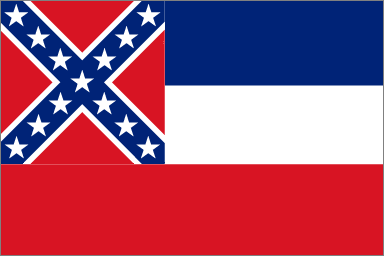 The US Supreme Court is considering hearing a case against the Mississippi state flag, which contains the Confederate battle emblem. Unlike most such suits against Confederate symbols, though, the suit is being brought by a Muslim, claiming that the flag is a religious symbol, based on the St Andrew’s Cross (like the Scottish national flag), and thus violates the Constitutional boundary between church and state.
While that argument seems to rest on dubious historic grounds (the designer of the Confederate battle emblem never referred to St Andrew’s cross in its description), there are other states where the connection is far clearer. The Hawaiian state flag, for example, has a Union Jack in the corner — a combination of the crosses of St George, St Andrew, and St Patrick (a triple threat!), and thus much more clearly of religious origin.
But, I mean, yeesh, guys. While it’s sometimes way too easy for folks to slip particularly obvious religion into governmental workings under the guise of “historical and cultural heritage,” this is a case of that being a legitimate excuse if ever there was one. I suspect that that not one in ten thousand Americans realizes the original religious symbolism of the Union Jack, for example — the union of the banners of the patron saints of the three countries involved. It’s hard to argue prejudice when we’re talking ignorance, instead.
It’s even worse with the Mississippi case, since I would argue that virtually nobody looks at the Confederate battle emblem and says, “Hey! Christian symbology!”
Except, it seems, the person bringing the suit.
Heck, Maryland would be a more obvious target, half of its flag containing clear crosses (the arms of the Crossland family). The official flags descriptions of New Jersey and New York both refer to the “goddesses.” And let’s not talk about how eagles, bears, stags, and even stars and, ahem, crescent moons have been used as religious symbols, and feature prominently on various state flags.
Yeesh.
(via Technoptimist)
So whazzup with the construction at I-70/C-470? It’s been looking like they were shifting the North C-470 to East I-70 offramp further easdt, which might configure it more nicely, but…
So whazzup with the construction at I-70/C-470? It’s been looking like they were shifting the North C-470 to East I-70 offramp further easdt, which might configure it more nicely, but seemed unnecessary.
Finally went and dug up the info on the CDOT site.
The project is actually Phase II of the C-470 extension north of I-70, and is to add an offramp from East I-70 to North C-470 (which, until a few years back, Phase I, didn’t exist), as well as the analogous South C-470 to West I-70 ramp.
Never having made either of those vector changes in my travels, I’d no awareness that those ramps didn’t exist. All becomes clear now …
Construction is scheduled until Spring ’05.
Well, by golly, we managed to finally watch the rest of “Serenity,” the 2-hour pilot/premiere/last-ever-aired episode of Firefly. And, let me just join in with the general consensus to say…
Well, by golly, we managed to finally watch the rest of “Serenity,” the 2-hour pilot/premiere/last-ever-aired episode of Firefly. And, let me just join in with the general consensus to say that Fox programming execs are dolts.
Not that the ep was flawless. The initial battle scene never quite jelled. And while there are good bits before that, the episode doesn’t really click until the first group meal aboard Serenity, when about eleventy-dozen of the show’s themes and personality interactions suddenly snap into focus.
By the end of the ep, anyone who would say that it was confusing, or didn’t introduce the characters well, or, Gosh, Joss, why don’t you run a different in media res episode for the premiere, and we’ll hold onto this two-hour thang until the show’s been cancelled, is a certifiable dolt.
Feh.
So after it was over, I inquired of Margie if she was up for another one. No, she replied, she wanted to get to bed at a reasonable hour, so she didn’t want to commit to another 1-hour episode. So, after a short bit, I started the ep over, with the commentary track by Joss and Nathan Fillion (Mal) turned on. I figured, Well, heck, I can listen to it in the background, Margie can leave when she wants, and I can head up when I’m ready, too.
The full 2-hour episode later, we both decided it was really time to hit the sack …
No blogging today. Tonight, maybe, but not today. Busy, busy, busy ……
No blogging today. Tonight, maybe, but not today. Busy, busy, busy …
Everyone always thinks of Nazis fleeing Germany for Argentina or Brazil. But it seems, instead, the plan for the top leadership was to flee to Greenland. A German navigator has…
Everyone always thinks of Nazis fleeing Germany for Argentina or Brazil.
But it seems, instead, the plan for the top leadership was to flee to Greenland.
A German navigator has described for the first time a daring plan by the Nazis to evacuate their surviving leaders by flying boat to Greenland at the end of the Second World War.
The plan, which was scuppered by the German surrender, would have involved Hermann Goering, Heinrich Himmler and other senior figures taking off from north Germany to continue their struggle from abroad. Hitler himself was determined not to leave Berlin, where he eventually committed suicide.
The Greenland operation has been revealed by Captain Ernst Koenig, 93, who had previously been determined to keep the story secret until after his death. He was persuaded to speak earlier this month by friends in Britain.
[…] Terry Charman, a historian at the Imperial War Museum in London, said he believed Koenig’s story was credible and was backed up by incidental details revealed by other Germans.
(via Cronaca)
Nobody wants a military installation next door. But military installations often become wildlife sanctuaries — broad expanses of land, mostly protected from development, certainly protected from hunters. Hence, the Rocky…
Nobody wants a military installation next door. But military installations often become wildlife sanctuaries — broad expanses of land, mostly protected from development, certainly protected from hunters. Hence, the Rocky Mountain Arsenal — a chemical weapons plant and repository on the outskirts of Denver, is home to herds of antelope, deer, and is a bald eagle nesting refuge.
And, so, in Britain, the Salisbury Plain is largely controlled by the Ministry of Defense (the “tank crossing” signs are always entertaining to see on the road from Stonehenge to Avebury). And, so, wildlife within the military reservations there are largely protected. Including the badger population.
And, of course, badger hunting — for food, for bristles, for sport — has also dramatically declined in Britain.
Good stuff for badgers, right?
Bad stuff for archaeology, which has also, until now, benefitted from MoD ownership of much of the Salisbury Plain.
The 94,000-acre plain has 2,500 archaeological sites, more than 300 of them protected by law as Scheduled Ancient Monuments.
Since the MoD took it over for military exercises in 1897 it has become one of Britain’s best protected areas for wildlife and archaeology because little of the land is farmed. ‘It’s one of the most important historical landscapes in Europe – amazingly well preserved,’ says David Miles, chief archaeologist at English Heritage.
‘Most people think of Salisbury Plain for prehistoric archaeology, but it’s desperately important for the Roman period – you could walk around from one Roman village to the next, and down the streets in the village and down the country lanes to the next village. It’s almost like going back in time and seeing a countryside for the last 500 years or more.’
But badger populations have been booming on the plain, possibly causing TB epidemics among livestock, and certainly wreaking archaeological havoc.
To make matters worse for the archaeologists, badgers have an instinctive urge to dig – even when their sett is big enough, said Miles. ‘They are little bulldozers.’
The result on Salisbury Plain, Morton estimates, is badger setts in more than 52 Bronze Age barrows and Iron Age enclosures. They have burrowed into key sites such as the late Bronze Age East Chisenbury Midden, a rare accumulation of the remains of ceremonial events, built of layers of bones, flint, pottery and manure like a giant ‘chocolate cake’, he said.
Each sett generates tens of cubic yards of soil and scatters remains, so the damage can be considerable. ‘The layers become hopelessly jumbled … to such a degree that a large part of the information is lost forever.’
Problem is, short of extremely expensive fencing, or a nationwide culling of the badger population — neither of which is very palatable — there’s not a lot to be done.
Sure, the flashy stuff — Stonehenge, Avebury, places like that — will get the protection they need. But the less prominent sites, and the ones with possibly the most yet to tell us, are likely to be in big trouble.
(via Cronaca)
Yet another indication of the — well, I won’t say trouble, but I will say complications — you get into when the government interacts with religion. As a veteran, the…
Yet another indication of the — well, I won’t say trouble, but I will say complications — you get into when the government interacts with religion.
As a veteran, the VA will provide you with a tombstone, within certain regulations as to content. Part of what can show up on the headstone are various religious symbols. Some 32 symbols are available, everything from an array of Christian denominations to symbols for members of the Native American Church of Amercia, Hinduism, the Tenrikyo Church, Sufism Reoriented, Ekankar, Baha’i, Buddhism, Unitarians, various others, and even a symbol for avowed Atheists (an “A” within an Atom, if you’re curious).
The full list with examples can be seen on the official VA form.
The complication is, of course, that once you start recognizing some symbols, it’s difficult for the government to justify not recognizing more, including ones that some folks would have fits over, such as the Wiccan pentagram.
The VA has responded to requests for such markers with, well, stonewalling via “We’re putting together new regulations to cover just that sort of thing” letters for several years. Hence an online petition, supported by a Yahoo group, which seeks to get the VA to recognize the pentagram as a legitimate symbol (just as the US military’s chaplaincy recognizes Wicca as a legitimate religion).
Of course, having the government “recognize” which religions are “legitimate” is also fraught with peril, but that’s the part of the ongoing tension between religion and the state. Something to consider.
(via Rey)
A recent study in New Zealand indicates that silver cars are safer than other colors. They found a significant reduction (about 50%) in the risk of serious injury in silver…
 A recent study in New Zealand indicates that silver cars are safer than other colors.
They found a significant reduction (about 50%) in the risk of serious injury in silver cars compared with white cars.
There was a significantly increased risk of a serious injury in brown vehicles and the risks for black and green cars were also raised. The risk of a serious injury in yellow, grey, red, and blue cars was not significantly different from that in white cars.
I can imagine that visibility, esp. at night, might be a factor here. Silver cars are, well, glittery. Light colored cars would be visible, but not as reflective. Darker colors would be less visible.
An interesting study. Though I won’t really believe it until I see it affecting insurance premiums (and you’d better believe that’s being looked at).
(via PRBop)
For those who don’t visit Doyce’s page (and why don’t you?), be aware that he’s putting together a very nice Firefly Wiki. Most fine. I expect to delve through it…
For those who don’t visit Doyce’s page (and why don’t you?), be aware that he’s putting together a very nice Firefly Wiki. Most fine. I expect to delve through it extensively once I (ahem) finish watching all the DVDs.
David Bernstein notes differences in how we attribute success or failure: I’ve noticed that Americans have a tendency to publicly attribute any success they have had–anything ranging from winning a…
David Bernstein notes differences in how we attribute success or failure:
I’ve noticed that Americans have a tendency to publicly attribute any success they have had–anything ranging from winning a Little League playoff game to winning the lottery–to God’s intervention on their behalf. But I haven’t noticed a countervailing tendency to blame God when things go wrong, an especially annoying defect in the sports world, where victories are freely attributed to Jesus’s blessings. If God wanted the Marlins to win the World Series, doesn’t that mean he wanted the Yankees to lose? Just once, I’d like to see the losing Super Bowl quarterback tell the media “Guess Jesus really had it in for me today.”
It may be an overgeneralization, but there’s some truth to it. A couple ideas of why.
While not being willing to discount by any means divine intervention in human affairs, reading it into fortune (or failure) is an iffy proposition at best. It gets into a very tangled thicket of free will vs predestination, why God lets bad things happen to good people, and other thorny conundra that are uncomfortable to examine, let alone assert.
Still, an interesting observation.
(On a related topic, pre- rather than post-event, consider Mark Twain’s “The War Prayer,” too.)
Sports is probably one of the pop culture thangs I am most decidedly least interested in. Still, the “Pete Rose comes kinda-clean” story requries at least some comment. On the…
Sports is probably one of the pop culture thangs I am most decidedly least interested in. Still, the “Pete Rose comes kinda-clean” story requries at least some comment.
On the one hand … I think it’s wildly scummy of Rose to finally make this (partial) confession of having gambled on baseball back in the day — the sin that got him kicked out of the game — just as his first round of eligibility for getting into the Baseball Hall of Fame is expiring. It strikes me as just the sort of opportunistic ploy that — wel, should make him ineligible for same.
On the other hand, what are the criteria for benig elected to the BHOF? Well, after looking over the web site, I still don’t know. There are lots of rules for voting, but I didn’t see any sort of charter statement as to what the folks involved are voting for.
So, from a sheer talent kind of thing, yes, Pete Rose should be in there — as should “Shoeless” Joe Jackson, another ineligible member.
But it’s not the Baseball Hall of Talent. Arguably, Rose is infamous for his violation of the cardinal rule of baseball play — Don’t Gamble.
On the other hand, it’s been argued that there are plenty of other ot-very-nice fellows in the BHOF, and it should be based on contributions to the sport, not on sainthood.
So does the Rose scandal net out a negative contribution? That would seem to be best decided by the Baseball Writers’ Association of America, who are the ones who do the electing (though Rose is running out of time for them; soon he’ll have to be elected instead by the Baseball Hall of Fame Committee on Baseball Veterans, who are thought to be a lot less sympathetic). But nobody can vote for him right now, because Rose, like Jackson, is on the baseball ineligible list, which he on for his only-now-somewhat-confessed gambling.
Net? I don’t think he should be made eligible. He can be — and is — recognized as an outstanding player in the history of the game (even at the BHOF Museum), but keeping him off the BHOF roster seems a fitting punishment for his sins, particularly since they have not fully been confessed.
But, then, what do I know about baseball?
Yes, I would really like to do this, sometimes….
Yes, I would really like to do this, sometimes.
I love my friends. I love my family. I appreciate their wanting to wish me a Happy Birthday, or otherwise involve me in activities by phone that I enjoy being…
I love my friends. I love my family. I appreciate their wanting to wish me a Happy Birthday, or otherwise involve me in activities by phone that I enjoy being involved in. There is not a single individual phone call — of the five I believe I received tonight — that I would rather not have received.
But in aggregate, it made for a rather — harried evening. Maybe next year, we’ll go out … 🙂
On the other hand, there is little to warm the cockles of your heart during the day than to receive a phone call from your three-year-old singing you “Happy Birthday,” especially as accompanied by your wife. That was neat.
Game WISH asks, What do you think is the best cast size for the games you’ve played? What are the factors that go into your answer: genre, play group, gaming…
Game WISH asks,
What do you think is the best cast size for the games you’ve played? What are the factors that go into your answer: genre, play group, gaming system, etc.?
Basically, 4-5. The best games I’ve ever played or run have had groups that size. Large enough that there are enough possibilities for different interactions and strengths. Small enough that everyone gets plenty of face time with the GM and each other. Large enough that if someone can’t make it, it’s not a disaster. Small enough that you can fit easily around a table. I’ve found that number to work pretty well in most genres and groups I’ve been in.
Six can still work, especially if you end up with groups of three or two. Seven, though, means lots of downtime for individual players, even if they’re all in a single swarm. It’s too easy for folks to get distracted, or resort to other passtimes to while away the hours. Plus it’s nigh impossible for the GM to subplot for that many, and group melees take for-frelling-ever.
The only possible thing to bump above the 4-5 number might be an Amber game. The mechanics free up a lot of time, and it’s relatively easy to drag people in — or push people out — of the current spotlight. It’s still rough on the GM, though.
Another problem with larger numbers is that the personal commitment drops. If you’re one of 7-8 players, it doesn’t seem like as much of a big deal if you no-show a session. (If you’re one of 2-3 players, on the other hand, it can feel like too heavy a burden, like too much is riding on you, and you may feel compelled to be there beyond what’s probably proper.)
I currently have five in my Spycraft group, and that’s just peachy. I’d rather not have more. My previous effort for a supers campaign foundered under seven players (and my unrealistic desire to run heavy subplots for each of them). My Amber campaign ended up with 4-5, but was up at 6-7 at times, which was, in fact, probably too many.
I do undestand, though, how the numbers creep up. It’s difficult to say no, and it’s often difficult to invite person A, who you really want, without inviting person B, whom you’re less sanguine about (even if they’re not spouses). And, of course, as a primary social gathering, the temptation is to invite in all your friends, esp. if you’re only running one game … (Piece of advice: don’t. Accept the word of One Who Knows.)
(via Doyce)