https://buy-zithromax.online buy kamagra usa https://antibiotics.top buy stromectol online https://deutschland-doxycycline.com https://ivermectin-apotheke.com kaufen cialis https://2-pharmaceuticals.com buy antibiotics online Online Pharmacy vermectin apotheke buy stromectol europe buy zithromax online https://kaufen-cialis.com levitra usa https://stromectol-apotheke.com buy doxycycline online https://buy-ivermectin.online https://stromectol-europe.com stromectol apotheke https://buyamoxil24x7.online deutschland doxycycline https://buy-stromectol.online https://doxycycline365.online https://levitra-usa.com buy ivermectin online buy amoxil online https://buykamagrausa.net

Is there a need to fear?

The new Underdog trailer is up. It’s cute, though it would be better seen in a theater without knowing you’re seeing an Underdog trailer. And the official site (which, oddly,…

The new Underdog trailer is up. It’s cute, though it would be better seen in a theater without knowing you’re seeing an Underdog trailer.

And the official site (which, oddly, doesn’t have a link to the trailer yet) is up, too.

My question is — how is this “Underdog” again? Granted, the original cartoon was a bit thin on the ground, concept-wise (in a world or both people and anthropomorphic dogs (?), nebbish Shoe Shine Boy is secretly rhyming super-hero Underdog, who regularly gets trounced in round one, takes an Underdog Energy Pill, and beats the baddies in round two), but there seems little beyond the name and the idea of a super-powered dog here that relates to even that.

Oh, well. Maybe Katherine will enjoy it.

Book Review: Freakonomics

I got the book a couple of Christmases back from my brother-in-law’s family, but never quite got round to reading it. Did manage to pick up the audiobook version, though…

I got the book a couple of Christmases back from my brother-in-law’s family, but never quite got round to reading it. Did manage to pick up the audiobook version, though (and of the revised edition, to boot) and plowed through it in a couple of weeks of commuting.


Freakonomics by Steven D. Levitt and Stephen J. Dubner (revised ed.) (2006)

Overall Writing
Re-Readability Info

This is not a book about economics, at least not in the traditional Friedman / Keynes / Stock Market / Supply-Demand Curves kinda way that I had to plow through in college. Instead, it’s about how to use statistics and the economic concept of incentives and price (loosely defined) to glean interesting answers to apparently unsolvable questions. For example, why did violent crime, spiraling out of control at the beginning of the 90s, suddenly drop back to 60s
level? Why do crack dealers live at home? Is sumo wrestling crooked? How much can you trust your real estate agent? Do teachers cheat on standardized classroom testing? How much effect do parents have on kids, in particular with how they name them? For Levitt (the actual boy genius economist behind journalist Dubner’s words (and voice)), it’s not just a matter of asking the questions, or even answering them, but determining how do you know?

And that’s the subversive (in a good way) heart of Freakonomics — not so much the brain candy topics or conclusions, but the demonstration that statistical analysis and figuring out how to tackle questions can unravel seemingly insoluble problems.

The revised edition has repackaged some of the material, removed some of the Levitt biography, and addressed a couple of questions raised since the books original publication. It also includes in the appendix (the last disc) the original Dubner article on Levitt, and some related essays/articles.

Info: As the topics mentioned above (a subset of those tackled here) imply, there’s no Grand Theme or Unified Theory here presented. Instead, it’s like reading a series of lengthy “The Straight Dope” columns, backed up by statistics and clever analysis. You may not always agree with Levitt’s conclusions, but it’s hard to simply dismiss them as punditry. Some great information in here, much of it counter-intuitive or “against common sense.”

As important, as noted, is showing how the answers to many of these questions are out there — it’s “just” a matter of figuring out the right approach to the questions and how to tease the answers out of the data probably already at hand.

Writing: Dubner presents the material in an organized fashion. The presentation is done so in an informative, clear, and entertaining fashion. This is echoed in Dubner’s reading style for the audio-book, which is calm, engaging, slightly quirky, but in keeping with the subject (Levitt). He even does a good job of presenting tabular data, always a challenge in an audiobook format.

If there’s any criticism, it’s that the info and analysis presented is almost too slick, too glib, even too pat. The info can’t be dismissed, but one gets the sense that it springs almost full-blown from Levitt’s head, rather than requiring a lot of analysis and grunt work to test and retest hypotheses.

Re-Readability: I intend to listen to this again some time. There’s a richness of info here that can be missed on first pass, and it will be interesting to see if or how any of Levitt’s conclusions get

Overall: I highly recommend this book to … well, pretty much anyone. Folks with a statistical background will appreciate the cleverness. Policy wonks and bloggers will find some of the conclusions intriguing. And just “ordinary folks” will, I think, get a new appreciation for how economics, reason, and facts can be applied to the practical questions of this world.

Gmail for all

Google Mail was originally (three years ago) just a “by invitation” service, which let Google scale it appropriately and also lent it a certain cachet of rarity. That’s been expanded…

Google Mail was originally (three years ago) just a “by invitation” service, which let Google scale it appropriately and also lent it a certain cachet of rarity. That’s been expanded over time (first 5 invites per current user, then 100 invites, then anyone with a cell phone), and now the service is open to everyone.

E-mail is a personal choice, and no solution is the best solution for everyone, but I’ve been pretty happy with going with Gmail since last year, having converted from a Thunderbird client on my PC. I recommend folks take a look at it.

(via Les)

It’s De-Natural …

As we were setting up fondue pots, someone raised the question of “What’s Denatured Alcohol?” Margie, our resident biologist, hemmed and hawed over broken rings and other O-chem bits, while…

As we were setting up fondue pots, someone raised the question of “What’s Denatured Alcohol?”

Margie, our resident biologist, hemmed and hawed over broken rings and other O-chem bits, while I … hit the Internet.

Heh. Interesting answer. Denatured alcohol “’tain’t natural.” Emphasis on the “taint.” Essentially it’s ethyl alcohol which has been intentionally contaminated to make it dangerous or lethal to drink. Why? Because (a) folks will drink anything with alcohol if they can, which means that (b) anything with alcohol needs to pay an excise tax to the revenooers, and since there are industrial
uses for alcohol that don’t want to require payment of booze taxes, some industrial/not-for-consumption alcohols are (c) contaminated to be undrinkable but still usable.

And now you (and we) know.

Faboo Fondue

Last weekend Jackie suggested we get together for a fondue party, and so we did on Sunday. Lee and De had to cancel out at the last minute, but Jackie…

Last weekend Jackie suggested we get together for a fondue party, and so we did on Sunday. Lee and De had to cancel out at the last minute, but Jackie and and Randy and Stan (eventually) were there.

Everyone brought more food than we could eat, though that didn’t stop us from trying. Jackie and Margie did the cooking thang, starting with a couple of different cheese fondues to go with chopped apples and star fruit and chunks of yummy breads. Then a beefy wine broth and a chicken mojo sauce on the range to go with shrimp and lamb sausage and beef and swordfish and mushrooms and potatoes and a bunch of other chunks of meaty things. We adjourned briefly for digestion, watching a couple of
episodes of The Tick, before returning to the fray, this time with a milk chocolate and a dark chocolate sauce into which marshmallows and cookies and apples and, yes, more bread were dipped.

Yum. Add in a couple of bottles of wine and the fine company, and it was a very nice evening.

The Big Question

A few weeks back, I was climbing into the van with Katherine, preparatory to our all going somewhere, when she asked me from the back seat, “Daddy, what does SEX…

A few weeks back, I was climbing into the van with Katherine, preparatory to our all going somewhere, when she asked me from the back seat, “Daddy, what does SEX mean?”

It’s one of those defining parental moments — for me an odd admixture of “OMG OMG OMG!” with “Huh, wonder how this subject came up” with “Don’t worry too much, Dave, but do be aware that whatever you answer will likely affect her entire attitude toward sex for the rest of her life” with “Okay, how can I answer this in an honest, thorough, interesting, positive yet cautionary, inclusive, productive fashion, tailored to a six-year-old but in a way that won’t come back to haunt me?”

I don’t recall precisely what I began to calmly stammer out — something about interpersonal relationships (though I didn’t use that term, obviously), genders, and kissing, I think. I think I also started flitting about, hummingbird-like, regarding in 6-year-old terms things like values and cultural norms and —

Margie got in the car. “What’s up?”

“Katherine was wondering what SEX meant?”

Margie, of course, asked the return question I ought to have. “Why do you ask, pumpkin?”

“Because it’s written over there.”

And, yes, sure enough, up on the wall of the garage, some former teen residents of the house had put the word SEX up on the wall with those adhesive letters folks use on mailboxes. “SEX” And Katherine is in a stage where she reads everything that’s around her. Because she can.

“Oh,” I told Katherine. “That’s just something that some kids put up on the wall.”

“Oh, okay.”

And we drove off.

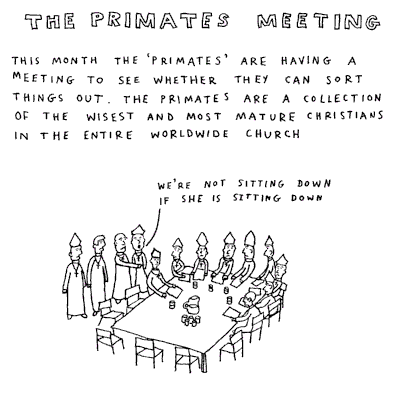
Summing up church politics

As related by Dave Walker. (More here.)…

As related by Dave Walker. (More here.)

Funny Faces

Brunch with Kitten. this post enabled by airblogging.com….

Brunch with Kitten.

this post enabled by airblogging.com.

Playing politics with fellowship

For shame. Seven of the primates at the big Anglican soiree down in Tanzania on Friday staged a public “huff” by not only refusing to participate in a communion service…

For shame. Seven of the primates at the big Anglican soiree down in Tanzania on Friday staged a public “huff” by not only refusing to participate in a communion service as long as Bp. Katharine Jefferts Schori, the Presiding Bishop of the Episcopal Church, was also there. Not only did they refuse, but they chose to issue a public statement describing how, sadly, they had to take their communion wafers
and go home (or back to the hotel).

A number of the Global South Primates have not shared in the Holy Eucharist today with their fellow primates. They include Abp. Peter Akinola, Abp John Chew, Abp. Benjamin Nzimbi, Abp Justice Akrofi, Abp. Henry Orombi, Abp. Gregory Venables, and Abp. Emmanuel Kolini. They represent more than 30 million faithful Anglicans.

Well, they are the ordained leaders of over 30 million Anglicans. The extent to which they actually represent them is difficult to say, since most of them don’t go through an election process similar to, say, Bp. Jefferts Schori. And, of course, morality is not about numbers.

They have released this statement:

On the Church of Nigeria web site. I.e., we have released this statement.

“We each take the celebration of the Holy Eucharist very seriously. This deliberate action is a poignant reminder of the brokenness of the Anglican Communion. It makes clear that the torn fabric of the Church has been torn further.

Here. Let us tug a bit more.

It is a consequence of the decision taken by our provinces …

I.e., us.

…to declare that our relationship with The Episcopal Church is either broken or severely impaired.

Scripture teaches that before coming to sit with one another at the Lord’s Table we must be reconciled. (Matthew 5:23-26 and 1 Corinthians 11:27-29) We have made repeated calls for repentance by The Episcopal Church and its leadership with no success. We continue to pray for a change of heart.

Oh, boy! Scripture!

Matthew 5:23-26 is an interesting choice to cite.

23“Therefore, if you are offering your gift at the altar and there remember that your brother has something against you, 24leave your gift there in front of the altar. First go and be reconciled to your brother; then come and offer your gift.

So is the responsibility to be reconciled that of these seven Primates, or of the Episcopal Church? Well, the latter part of their sentence above (“repeated calls for repentance by The Episcopal Church”) certainly clarifies their stand. On the other hand, I read that passage from Matthew as not requiring repentance before God, but reaching out to others with whom you have become estranged. Which, to me, indicates that everyone involved needs to try to reach out, not just we naughty Episcopalians.

The second half of the Matthew citation is the odd one:

25“Settle matters quickly with your adversary who is taking you to court. Do it while you are still with him on the way, or he may hand you over to the judge, and the judge may hand you over to the officer, and you may be thrown into prison. 26I tell you the truth, you will not get out until you have paid the last penny.

Which sounds like more of a warning to those congregations who have sought to leave the Episcopal Church and abscond with its property, or turn it over to foreign provinces — like, say the Church of Nigeria.

The Corinthians passage is even more interesting:

27Therefore, whoever eats the bread or drinks the cup of the Lord in an unworthy manner will be guilty of sinning against the body and blood of the Lord. 28A man ought to examine himself before he eats of the bread and drinks of the cup. 29For anyone who eats and drinks without recognizing the body of the Lord eats and drinks judgment on himself.

This doesn’t speak at all to reconciliation (as the archbishops assert) but to how one approaches the whole sitting at the table of the Lord. To put in context:

18In the first place, I hear that when you come together as a church, there are divisions among you, and to some extent I believe it. 19No doubt there have to be differences among you to show which of you have God’s approval. 20When you come together, it is not the Lord’s Supper you eat, 21for as you eat, each of you goes ahead
without waiting for anybody else. One remains hungry, another gets drunk. 22Don’t you have homes to eat and drink in? Or do you despise the church of God and humiliate those who have nothing? What shall I say to you? Shall I praise you for this? Certainly not!

So either the archbishops are saying that Bp. Katharine is coming to the table without recognizing the body and blood of the Lord (which would be an amazing accusation), or they’re questioning the whole point of everyone being there (which is odd, since they pressed for the meeting), or they are indicating that some folks are vying to show which has God’s approval (which sounds more like these archbishops than anyone else there).

Weird.

To continue with the archbishops statement:

We are unable to come to the Holy Table with the Presiding Bishop of The Episcopal Church …

Whom we will not deign to name.

… because to do so would be a violation of Scriptural teaching and the traditional Anglican understanding, “Ye that do truly and earnestly repent you of your sins, and are in love and charity with your neighbours, and intend to lead a new life, following the commandments of God, and walking from henceforth in his holy ways; Draw near with faith” (Book of Common Prayer)

This misses (by wide marks) two points. First, it implies that the Episcopal Church in general, and Bp. Katharine in particular, have actually sinned and are actually aware of this, and so are ineligible to sit at the table. That’s evidently a given from their perspective.

Secondly, though, it turns things on its head. The instruction in the BCP is to the individual, not those around them. It doesn’t say, “Do not draw near if there’s a sinner around.” The implication is somehow that Holy Eucharist is invalid and, in fact, wrong, if it’s done with sinners, which is a very odd, even heretical position (not to mention making it highly unlikely that you could ever have a valid eucharistic service).

Indeed, looking at Jesus’ own actions, he sought out the company of sinners and those who needed to be shown “a new life.” He sat at table all the time with folks he knew had fallen short of the mark, or that would. His last supper was with one who he knew would turn on him — but he did not decline to eat, nor did he even drive Judas away from the table. Knowing how Peter would also betray him as well, he didn’t get all huffy and go back to the hotel, or issue a press release, but
he showed that even faced with knowledge of such a betrayal and falling short of the desired relationship, the sharing of the bread and wine was the most important thing he could do.

Would that these few archbishops could follow such an example …

This is a painful decision for us and also for our host and brother, the Most Rev¹d Donald Mtetemela. He understands our painful dilemma and accepts our decision. Pray for the Church.”

… rather than stage a public walk-out, so “painful” that it has to be publicized.

It sounds to me like these individual bishops, or their provinces, are the ones withdrawing from “communion” — especially since it wasn’t just a matter of not being with Bp Katharine, but the other 31 Anglican provinces (and primates) there.

Why, yes, that is my church (again)

Huzzah for Google Alerts — which led me to spot this. “Hey!” I shouted to Margie. “We’re in the news!” “Who we?” she asked, understandably. “Good Shepherd — we’re in…

Huzzah for Google Alerts — which led me to spot this.

“Hey!” I shouted to Margie. “We’re in the news!”

“Who we?” she asked, understandably.

“Good Shepherd — we’re in the Rocky — and it’s …” My heart sank. “… a Jean Torkelson article.

Jean has not been kind to our parish in the past, nor to Episcopalians other than the “Boy, do we have a quote for you about how radical and unChristian and nasty those liburrrals at the diocese, including the Bishop, are” crowd. So I was more than a bit worried. The article is about the brouhaha in the Anglican Communion, as reflected in two Colorado parishes, and in the Colorado diocese as a whole. Ms. Torkelson spins (lightly) the conflict mostly from conservative press releases …

In Tanzania this week, Anglican leaders from around the world are debating how – or whether – the maverick Episcopal Church USA, one of 38 provinces in the Anglican Communion, can be brought back into the traditional fold.

Actually, there’s a lot more going on in Tanzania than just that. And it’s not just the Episcopal Church — the Church of Canada is in similar “hot water,” and plenty of “factions” in other provinces of the AC.

A majority of the provinces, many of them centered in conservative Africa, are disturbed by the Episcopal Church’s vote at its 2003 general convention to ordain openly gay bishops and allow for same-sex blessings. But critics say that’s just the most visible symptom of an array of departures the American church has taken from classic Christianity, like the tolerance for alternative views of Scripture and core beliefs, including divinity of Christ.

First off, GC03 only allows bishops to continue to exercise local control over the matter of same-sex blessings, recognizing that they had happened. It didn’t authorize them, condemn them, create liturgy, or recognize them as such. That was far too much for conservatives, of course (and too little for liberals), but let’s not lose the nuances here.

As to the rest — “the tolerance for alternative views of Scripture” is hardly just an “American” thing (indeed, I’d say such tolerance is probably a good thing). And, honestly, I haven’t heard many folks debating the divinity of Christ in the hallowed halls of our church or diocese or in the national church.

In short, the denomination that launched the Reformation 500 years ago has become a microcosm of modern cultural change and spiritual angst. Its roots, the Church of England, were replanted in America in the 1700s. Now this historic church faces hundreds of defections, disbandings and a growing number of lawsuits. In Virginia alone, the Episcopal diocese has sued 11 breakaway conservative parishes – one of them the parish of George Washington. At stake is who gets reportedly $25 million in church property.

The picture given of Good Shepherd, and our new (well, a year or two now) rector, though, is pretty positive, even if Ms Torkelson made hay of the news back in the hard times, and even if the literal picture (photograph) looks kind of … sinister, shadowed, even bereft of hope and light.

Consider Good Shepherd Episcopal Church in Centennial, which is undergoing a $1.7 million expansion. Good times are back since this parish underwent its own crisis related to the churchwide angst: In 2004, the lesbian rector, the Rev. Bonnie Spencer, and her partner celebrated a private, unauthorized same-sex “commitment ceremony.”

Rev. Bonnie was, in fact, assistant rector. And, in fact, the expansion was already underway (and continued thereafter), and has been done for over a year.

“That was our defining moment,” said the Rev. Craig Mac-Coll, who succeeded Spencer after she took a job with another parish out of state.

No, he succeeded Rev. Need, who was the interim after Fr John left (which was before the events above) and continued on as interim after those events, until, in fact, we hired on Fr Craig. And while I won’t say that the events around all that were what caused Bonnie to leave — she became a rector at another parish, and had been looking prior to that (which is pretty standard for assistant rectors when the main rector leaves). And while that event was one of the “last straws,” for a
number of folks in the parish, it was on top of both national church news, the church expansion (as noted), and the departure in the midst of this by our long-term rector.

“Some people could not accept it, and left . . . though we lost a number of people, we bounced back stronger than ever.” Today, he added, “we’re a moderate, inclusive parish that includes gay and lesbian couples.

“People who said the 2003 general convention was bringing about the demise of the Episcopal Church – I’m not sure who they’re referring to,” MacColl said. “It’s not affected this parish; it’s helped us define who we are.”

I’d clarify here, only to the extent that it’s not the definition of who we are. It’s certainly part of the story, an aspect, even an important one, but it’s background, a foundation. We don’t open our services celebrating our moderation and inclusiveness, even if I think most of us are very proud of us..

This being a success story, the article places it in contrast to a congregation in (more conservative) Colorado Springs that not only broke from the church, but disbanded. The article goes on to discuss the Bishop.

Holding together this bouquet of Colorado diversity is Bishop Rob O’Neill. While a supporter of gay rights, he took office in 2004 pledging to go slow out of respect for conservative sensibilities. He’s had varying degrees of success.

Actually, he has had great success in “going slow.” He’s had varying degrees of keeping conservatives (or liberals, for that matter) happy about it.

And, y’know, I was there at the election of Bp O’Neill (and he was not my first choice, in fact, though I support him and consider him my bishop, even where I have and do disagree with some of his policies). His election was not all about GC 2003 and gay ordination and all that (though it was an issue). Defining him by that issue is unfortunate and even unfair.

Of the 114 Colorado congregations, about one-third are regarded as “conservative” and troubled to varying degrees over the direction of the denomination. Hundreds of lay conservatives, including a half-dozen parishes and a number of clergy, fled in 2000- 2001.

Which wave happened prior to GC03’s recognition of Gene Robinson as bishop, one might note.

In the past 18 months, four parishes shut their doors – one of them Pearsall’s St. Francis.

Still, O’Neill has managed to remain friendly with many priests who question his direction. “He knows I believe the Episcopal Church is squirrely, and has left orthodoxy – but we always hope for a turnaround,” said Pearsall, who received a six- month financial package and hopes at some point to pastor an Episcopal parish again.

It was precisely O’Neill’s leadership that drew MacColl from his post in Oregon. “Rob is a very gifted teacher, a great listener, and you don’t get the sense he comes in with an agenda,” MacColl said. “At the same time he makes his views clear . . . he’s genuinely committed to bringing about reconciliation with people of very diverse views.”

Well, having been on the rector search committee, I hope it was more than just Bp Rob who attracted Fr Craig, but in my interactions with the bishop, I’ve had much the same reaction to him.

Having quoted a favorable bit about the bishop, the article goes on to speak to the “opposition.” Unfortunately, with regular source Rev. Don Armstrong currently under investigation (thus his lack of being quoted here), that leaves Can. Ephraim Radner, who’s solidly “conservative,” but probably a lot more intellectual and interested in common life in the Episcopal Church than would warrant headline notice.

One expert who’s giving a cautiously hopeful answer is Yale- educated author and theologian the Rev. Ephraim Radner, rector of Ascension Episcopal Church in Pueblo. Radner, a conservative, casts a long shadow from his small-city parish – he’s part of an 11-member international committee that has prepared a “covenant design” for the Tanzania gathering – in other words, a blueprint for possibly reaching a compromise agreement so the Episcopal factions can live together.

“Those who agreed to the covenant would be agreeing to something about what it means to be an Anglican Christian – it would be a central expression of Christianity,” Radner said in a recent interview. “It would not be an explicit list of moral requirements.”

In a sprawling communion of 77 million members, how such a covenant design would be implemented, what it would say, and who in the splintering church would agree to it, is all unknown. What Radner knows isn’t working is the growing blizzard of defections, accusations and lawsuits that have engulfed more than a dozen states, from Virginia to California. “It is clear to me that Scripture and apostolic tradition calls us not to sue one another,” Radner says. “The fact we have descended into lawsuits is a sign we’re
way on the wrong path.”

It’s certainly indicative. The problem with most of the suits stems from the idea that parish property belongs to the majority of the congregation, whereas most dioceses make it clear that it belongs to the dioceses and the church as a whole. You can leave, if you want, but you can’t take it with you. In such a circumstance, if a congregation is trying to leave the church and keep the property (or give it to another organization), should the Episcopal Church stand by and let it, or should
it hold onto it? And what are the precedents and long-term effects of such a stance.

(Interestingly, I’ve heard some pretty good things about the covenantal work that Rev. Radner (who I also had the privilege to hear as a candidate for bishop in Colorado) is doing. It’s by no means the “toe the line and vote this ticket” sort of document that a lot of people were worried about (or hoping for), it appears.)

Regardless, it’s actually … not a bad article. It’s somewhat informative, though in a somewhat shallow way, depending as much on tugging on the heartstrings, and spinning the current conflict in certain directions as on informing someone of what’s going on. To the casual reader outside the Episcopal Church, what does it say? It sounds like We’re In A Lot Of Trouble, whereas, in point of fact, most Episcopalians are really tired of this particular debate, which seems to stir the blood of muckrakers,
demogogues, and theologians more than the average guy-in-the-pew, who’s more interested in, oh, I don’t know, how we do what Jesus talked about us doing — feeding the poor, clothing the naked, giving comfort, spreading the Good News, all that unsexy jazz.

I’ll be interested in chatting about it with Fr Craig next time I see him.

Days gone by …

Our company is about to lockdown workstations from using PST (offline storage) files for e-mail — block them from being created or read by our Exchange setup. So anything we…

Our company is about to lockdown workstations from using PST (offline storage) files for e-mail — block them from being created or read by our Exchange setup. So anything we want to save, we need to pull down to individual message files.

Which has me looking at stuff dating back to ’94-95, which is when the company really started using e-mail (or I did) and we had Internet access and I moved to Denver and started up a new job function here and I got married and

A few random thoughts …

  1. Gads, I was a romantic devil. Or, at least, I’m glad I have all those romantic e-mails I exchanged with Margie while I was here and she was back there. Oh, you poor text-messaging devils and your lack of paper trail.
  2. Wow. Requests for “getting on the Internet” and the special software that had to be installed on PCs (one package to get them an IP address, the other — Netscape!).
  3. Lots of names I’d forgotten. Lots of events, too, personal and professional.

Sell a sex toy, go to prison

It’s the law, at least in Alabama. And the 11th Circuit Court of Appeals has upheld it. In a unanimous opinion, a three-judge panel for the 11th U.S. Circuit Court…

It’s the law, at least in Alabama. And the 11th Circuit Court of Appeals has upheld it.

In a unanimous opinion, a three-judge panel for the 11th U.S. Circuit Court of Appeals upheld an Alabama statute banning the commercial distribution of sex toys, saying that there is no fundamental right to privacy raised by the plaintiff’s case against the law.

According to the statute, it is “unlawful for any person to knowingly distribute any obscene material or any device designed or marketed as useful primarily for the stimulation of human genital organs.”

While Lawrence v. Texas had the Supreme Court establishing a right to privacy in the bedroom concerning Texas anti-sodomy laws, Alabama argued successfully that this statute was not about private sexual activity, but about commercial activity that the state had every right to forbid.

But according to Lee, the U.S. Supreme Court in Griswold made clear that the right to use contraception — the issue in that case — didn’t mean anything without the right to buy it. “It seems to many of us that right to use a mechanical device such as a sex toy is already encompassed in the Griswold and Lawrence decisions,” Lee said.

[…] Colorado, Kansas and Louisiana courts have all said that laws banning the sale of sex toys on obscenity grounds are unconstitutional.

Courts in Georgia, Mississippi and Texas have upheld sex toy bans

An appeal to the Supreme Court is likely.

(via BoingBoing)

My Little Xenomorph

A demonstration of how to turn a My Little Pony into an Alien. Sweet. (via Malcontents)…

A demonstration of how to turn a My Little Pony into an Alien. Sweet.

(via Malcontents)

I would have given my left arm …

… to have had one of these when I was a kid. The ads were all over the comic books, and though I know it would have been a…

polaris

… to have had one of these when I was a kid. The ads were all over the comic books, and though I know it would have been a horrible disappointment — damn, I wanted one. I mean — firing rockets and torpedoes — what could be more cool?

(via Malcontents)

Life imitates art

Zim: GIR! Why is there bacon in the soap!? GIR: I made it myself! (via J-Walk)…

Zim: GIR! Why is there bacon in the soap!?

GIR: I made it myself!

(via J-Walk)

That’s … a big ship

It takes a big ship to make the Golden Gate Bridge look small(er). In this case, the Queen Mary II, which passed under the bridge with just thirty feet…

It takes a big ship to make the Golden Gate Bridge look small(er). In this case, the Queen Mary II, which passed under the bridge with just thirty feet to spare. Yikes!

(via kottke)

Fish is fish?

Another reason not to order seafood: MADEIRA BEACH, Fla. — What the undercover agents ordered, over and over, was the grouper. What wound up on their plates could stifle anyone’s…

Another reason not to order seafood:

MADEIRA BEACH, Fla. — What the undercover agents ordered, over and over, was the grouper.

What wound up on their plates could stifle anyone’s appetite.

The alleged grouper at 17 of 24 area restaurants sampled by the investigators was actually another, less desirable species, according to a DNA analysis conducted for the state attorney general’s office and released earlier this month. Asian catfish. Emperor. Painted sweetlips. And twice, types of fish that could not be identified.

[…] In this area that some consider the national capital of grouper — more than three-quarters of the U.S. catch comes from Florida’s Gulf and a grouper sandwich downed at a waterside bar is cherished as an authentically Floridian repast — the finding has amplified a local outrage that, experts say, points to a larger national problem of fish fakery.

[…] In August, the St. Petersburg Times reported that at six of 11 area restaurants sampled, the “grouper” was actually something else, according to DNA tests. One restaurant was charging $23 for “champagne braised black grouper” but was instead serving tilapia.

A television station in Fort Myers and the Daytona Beach News-Journal followed with similar findings.

Consumers are blaming the restaurants — restaurants are blaming the suppliers — suppliers are blaming domestic catch limitations and their import partners.


(via kottke)

See spamware popups, go to prison

Bizarro case from Connecticut. A substitute teacher, Julie Amero, has been convicted of four counts of “risking injury to a child” for a popup atttack on the classroom PC that…

Bizarro case from Connecticut. A substitute teacher, Julie Amero, has been convicted of four counts of “risking injury to a child” for a popup atttack on the classroom PC that had X-rated images streaming across the monitor. Despite plentiful evidence (some of it blocked on a technicality) that the machine was infected, that the district had minimal (and outdated) safeguards against such things, and the sub asked for help but got none, she’s potentially facing 40 years in prison.

Unbelievable. These two articles have all the gory, outrageous details.

Now, having said that (and trusting that there will be appeals of the conviction, regardless), and acknowledging that the school district (and its IT group) were incompetent and the prosecutor’s office vindictive and insane …

I just don’t completely buy Amero’s story.

  1. She didn’t know how to turn off a computer? Or even a monitor? She knows how to e-mail her husband, or close a window, but not those things? I don’t believe it. I do believe that she had had drilled into her by permanent teachers to never touch their computers without instructions, and that she’d been told not to logoff the system that was in the class. But her level of incompetence, as described, is a bit beyond belief.
  2. I will accept that she didn’t have a jacket to throw over the monitor, but, really — over the course of a minute or two, if not the hours that seem to be involved, she couldn’t have found anything other than (unsuccessfully) her body to block the monitor? A book? A piece of paper? A student’s sweater or backpack? She couldn’t turn around the monitor, or even turn it face down? Give me a break.

None of this warrants a conviction. I don’t believe she acted in an improper fashion to have those popups start streaming across her system. But some of the excuses actually given strain my credulity, and probably didn’t help her credibility before the jury that convicted her.

Lose my head if it weren’t screwed on

Desktop search is great — as long as you can figure out terms you used in the document by which to search for it….

Desktop search is great — as long as you can figure out terms you used in the document by which to search for it.

For Better and for Verse

Had a very fine evening with Margie. After Kitten was tucked to bed, she cooked up a yuimmy pepper steak and sauteed mushrooms dinner, while I read her love poetry….

Had a very fine evening with Margie. After Kitten was tucked to bed, she cooked up a yuimmy pepper steak and sauteed mushrooms dinner, while I read her love poetry. Then a snuggle up on the couch watching The Vicar of Dibley.

A very fine evening.