D&D 5e/5.5e Rules – Bounded Accuracy!

By keeping To Hit under control, 5e turns out very differently from earlier editions.

Know the RulesPart of an ongoing series of 5e (2014) Rules notes.  See the end of the post for notes on 5.5e (2024) rules.

This is not a rule, actually, but a design philosophy that went into 5e, which gives it a very different flavor (and advancement path) than earlier versions. If you have no interest, you can skip it, though it does answer some questions about what sort of loot you’re likely to find in treasure hordes.

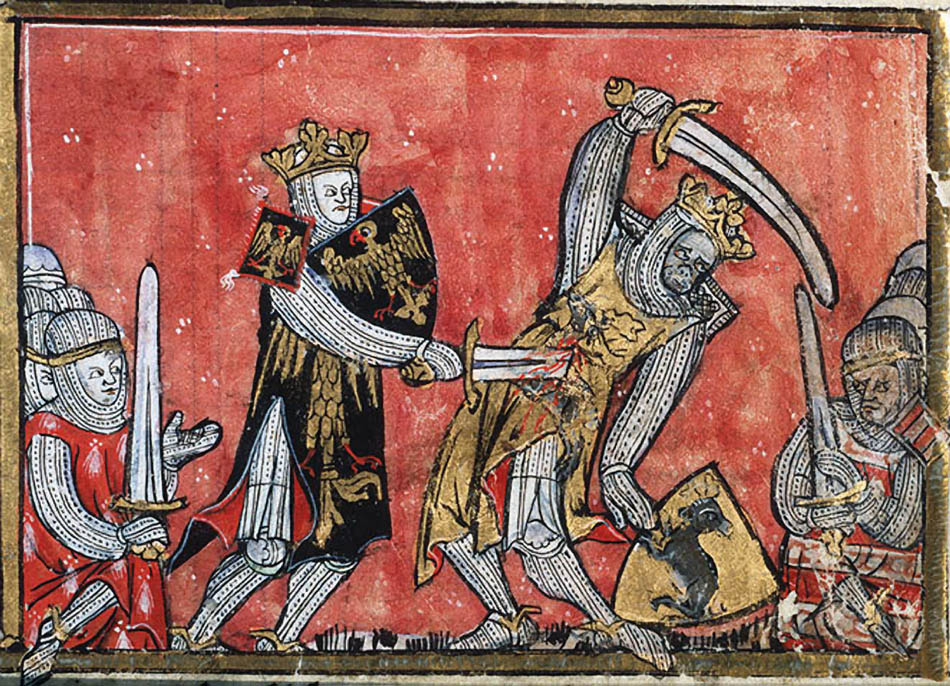
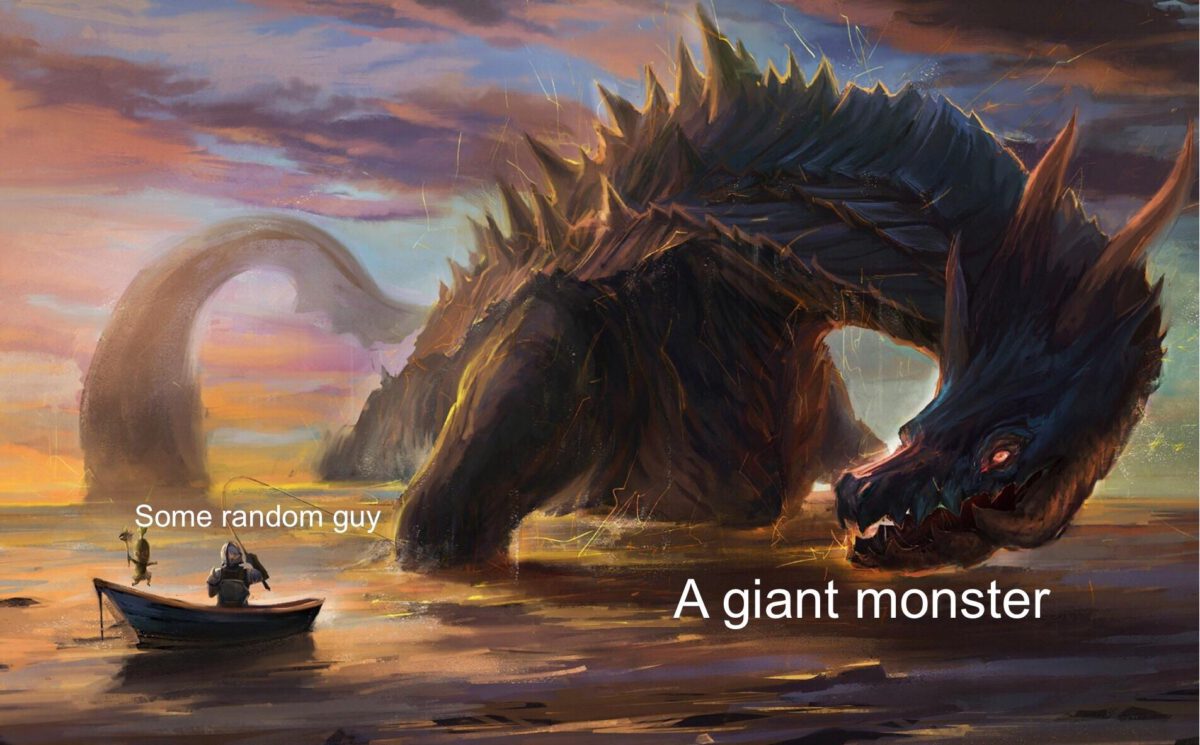
It boils down to a simple questions: Should Joe Shlub, the peasant, be able to hit Conan the Barbarian with his pocket knife?

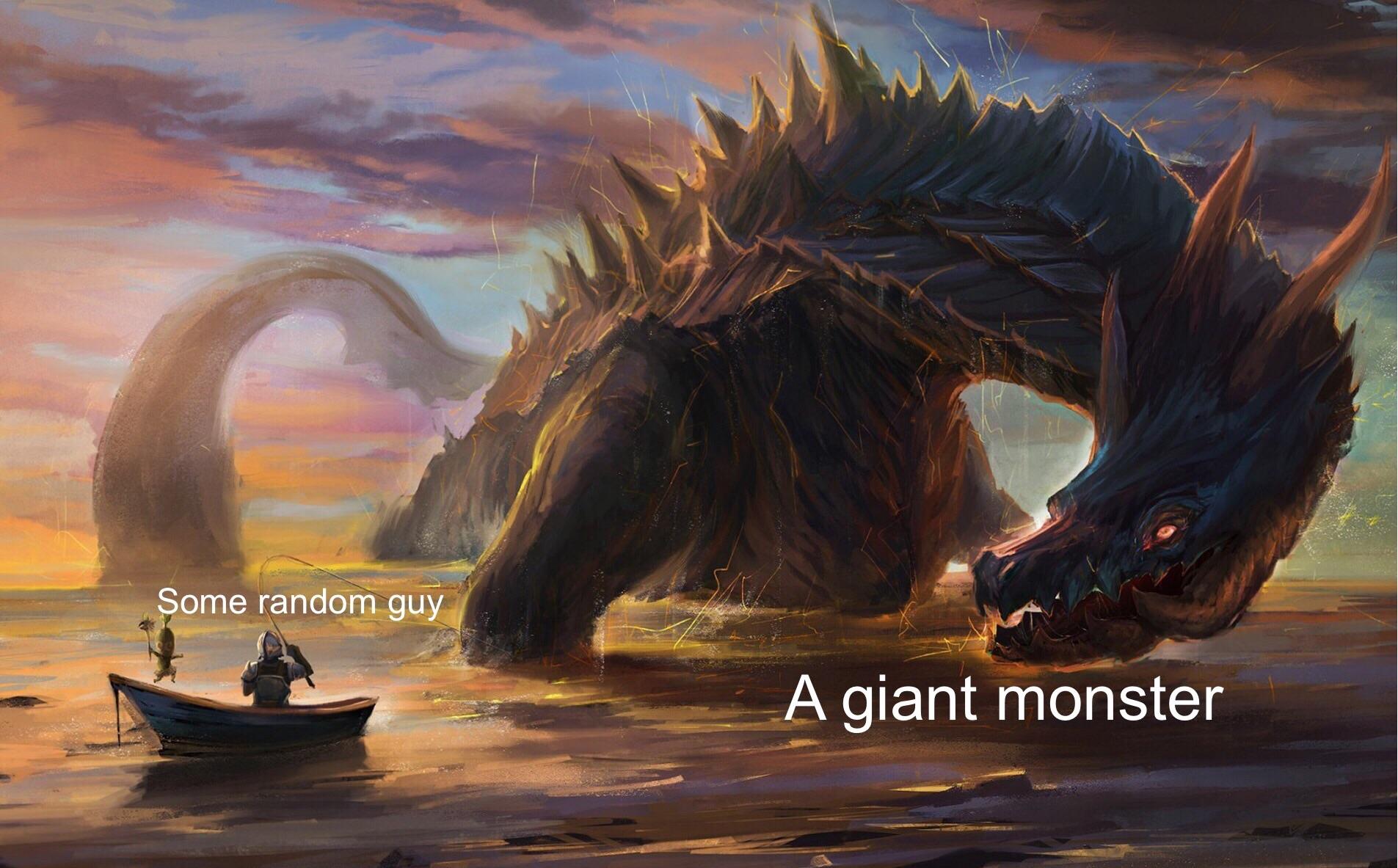
rando vs. giant monster
Or, put a little differently …

Earlier versions would have basically said no:

  • Conan’s AC should be waaaaaay too high for Joe Shlub to ever hit.
  • So that’s what advanced most when you rose in levels and experience: your AC (by attribute and by powers, esp. magic armor), and your To Hit to counter it (again, through advancement and through +N Swords of Incredible To Hit).
  • So Conan has great TH numbers, but he needs them to wrassle with the fantastic AC numbers of the Ancient Red Dragons he’s being thrown against.

5th Edition answers the Joe Shlub question with a yes.

  • The goal is that everyone always has a chance to hit.
  • So we focus, in advancement and balance, on essentially the other side of the combat equation: damage and HP, the ability to deal it out and the ability to take it.
  • So Conan does tremendous damage when he lands a blow … but the dragon has triple-digits of HP.

In short, what most goes up in a 5e game over time is not TH and AC (though they do slowly increase), but Damage and Hit Points. As an example, by the end of the previous campaign we were playing (which brought us to the 19-20 range), we all had a buttload of HP, and the Rogue was doing like 7d6 Sneak Attack damage on top of his weapon. Accuracy and the difficulty of hitting something, instead, stayed within well-guided bounds … i.e., “Bounded Accuracy.”

Joe Shlub can hit Conan — but it’s only ever going to be a scratch. (A mob of Joe Shlubs doing a lot of scratches, aggregating damage output higher than Conan can individually, though … can be a threat, due to the Action Economy.)

WotC has managed all this by putting some mathematical limits on things. Here are some articles that explain it well (the first gets into the not-difficult math, the second into the history):

The former in particular has the basic design table that drives everything, focused on difficulty to achieve something, and keeping strict caps on it.

DC or AC Difficulty To Break … Armor To Hit …
5 Very Easy a glass bottle an inanimate object
10 Easy a wooden chair No Armor a badger
15 Medium a simple door Leather Armor* a troll
20 Hard a small chest Plate Armor** a dragon***
25 Very Hard a treasure chest a tarrasque
30 Nearly Impossible a masonry wall(1 ft. thick) a deity
*with shield and +2 Dex modifier
**with shield
***Adult Red Dragon is AC 19

This is also why Advantage / Disadvantage is so powerful. It not only simplifies the unruly flocks of plusses-and-minuses that 4e (and earlier) had, it gives a massive jump (roughly +4 in effect) to hit, but temporarily.

The bottom lines:

  1. There is always a chance you can hit something (a nat 20, if nothing else). It can probably hit you back a whoooooole lot harder, but that’s not the point. As we’ve learned by doing, even a nassssty monster, surrounded by enemies, doesn’t have a long life expectancy (thus, even nassssty monsters are going to have minions to run interference).  Again, that’s because of the Action Economy.
  2. Things that affect TH/Armor are going to be relatively rare and limited. Older systems handed out +3, +4, +5 weapons/armor like door prizes. In 5e, a +1 TH weapon is an expensive and relatively rare thing, available only in big cities. +2 is incredible, and unlikely to be found for sale anywhere. +3 is a thing of legends. You’re a lot more likely to find a sword that bursts into flames and does an extra 1d6 damage than a +1 sword.

This has been your Game Design lecture for today. We now return to your normal programming.

Does 5.5e change anything with this?

Not as far as I can tell. The design foundation of Bounded Accuracy still applies with 5.5e (2024) rules.

D&D 5e/5.5e Rules – Bonus Actions!

A weird little mechanic that plays a huge role, once you figure out how they work

Know the RulesPart of an ongoing series of 5e (2014) Rules notes.  See the end of the post for notes on 5.5e (2024) rules.

Bonus Actions are actually pretty easy, but they are not well explained in the 5e Players Handbook.

When can you use a Bonus Action?

On your turn, one of the things you may be able to do is a Bonus Action. The trick to understanding it is that you only get Bonus Actions that the rules specifically say you get. Certain rules give you a Bonus Action. You can only ever use one Bonus Action on your turn, and it can only be on your turn (you can’t use a Bonus Action in an Opportunity Attack, for example).

If you aren’t using or eligible by the rules for a Bonus Action, you don’t get one. There isn’t a “Bonus Action phase” in the turn or something. What you can do as a (single) Bonus Action has to come from a rule or ability applicable to your character.

Note that some spells have their casting time as one Bonus Action. These spells can only be used as a BA. Also, you cannot cast a Bonus Action spell if you have cast anything more than a Cantrip as your regular action.

Bonus Action Cry
Though that isn’t specified by the rules. (Source)

An Example

So, for example, my Rogue, Tener, started off with only one thing I could do as a Bonus Action (the one available to everyone): a second melee attack using Two-Weapon Fighting (PHB 195).

At second level Rogue, he got the class ability Cunning Action (PHB 96), which meant I could use my Bonus Action to Dash, Disengage, or Hide.

At third level Rogue, he got the Thief archetype ability of Fast Hands (PHB 97), which meant I could use my Bonus Action for Sleight-of-Hand, disarm a trap, unlock a lock, or Use an Object.

But I couldn’t use my Bonus Action to, say, Help, because that wasn’t a Bonus Action defined for my character. I could only do those specific actions defined for my Bonus Action in my rules.

Does everyone have Bonus Actions?

Some characters don’t have any Bonus Actions, at least at lower levels (except the option of Two-Weapon Fighting, if they choose it).

When can I take a Bonus Action?

One more thing about Bonus Actions: some have prerequisites and some have none. For example:

  • Cunning Action has no prerequisites. Whatever else I do on my turn, whenever I want in my turn, I can use the Bonus Action to, for example, Dash.
  • Two-Weapon Fighting says “When you take the Attack action and attack with a light melee weapon that you’re holding in one hand, you can use a bonus action to attack with a different light melee weapon that you’re holding in the other hand.” Therefore, you need to, in sequence:
    (1) take an Attack action with one hand; then, later in your turn, you can
    (2) use the Bonus Action to attack with the other hand.
    You can do any other allowable things in between — chat with someone, Move, etc.  But you can’t use the Bonus Action first in this case.
  • Monk’s Flurry of Blows speficies “Immediately after you take the Attack action on your turn …” In order to use the FoB Bonus Action, you have to
    (1) take an Attack action, and then immediately (no Moving in-between)
    (2) use the FoB Bonus Action.

In short, if there is a prerequisite, it must be fulfilled first. If the Bonus Action says “when you do X, you can do Y,” you can’t do Y, then X.

In summary …

  • The only time you get a Bonus Action is if you have a rule (usually from a class, race, or feat) that says you have a Bonus Action, and then it’s only good for what the rule says you can do with it. (And you can only do a single BA on your turn.)
  • Everyone has a Bonus Action for Two-Handed Fighting (allowing you to do the second attack as a Bonus Action). That’s pretty much it.
  • As a Rogue, your Cunning Action allows you to take a Bonus Action, but only to do a Dash, Disengage, or Hide. (This is a “restriction,” yes, but it’s actually granting you Bonus Actions that nobody else necessarily has. Similarly, if you take Thief, at 3rd level you can do a Sleight of Hand, disarm/unlock, or Use an Object as your Bonus Action on a turn.)

Can I take a Bonus Action to Help someone?

This came up early in my campaign. In short, unless you have a Bonus Action that specifically says you can Help on your BA, you can’t.

That said, Help (PHB 192) is a great Action for a character to take on their turn when they’re not sure what to do or if they don’t think their own attack on the BBEG will be effective, or if someone else will have a great attack.

For Rogues (again as it came up in my campaign) it doesn’t really come into play for allowing a Sneak Attack, though, because to Help for combat (giving  Advantage) the Helper has to be adjacent to the target — which, if they are, means a Rogue can already Sneak Attack the target anyway (PHB 96) (though a Help would let you roll Advantage on the attack, which is not for nothing).

But, again, Help can’t be done in a Bonus Action unless someone has that specifically as something they can do as a BA.

So does any of this change in 5.5e?

dnd 5.5/2024Basically?  No, not really.  Bonus Actions per se work the same way in 5.5e (2024). Various skills and talents and spells and class features have been shifted into (or out of) being a Bonus Action.  The key here is not to assume anything — look it up before you take it for your new 5.5e character.

For example:

  • Druids can now all Wild Shape as a Bonus Action (previously only Circle of the Moon Druids could).
  • Paladins’ Lay On Hands is now a Bonus Action feature, not an Action one.
  • Drinking (or administering) a Potion of Healing is now a Bonus Action, not an Action. This has been a common house rule, but now it’s official.

D&D 5e Rules – Actions, Attacks, MultiAttack, Extra Attack, and Attacks of Opportunity!

There are some nuances in various attacks that aren’t immediately understandable in 5e

Know the RulesPart of an ongoing series of 5e (2014) Rules notes.  See the end of the post for notes on 5.5e (2024) rules.

These notes came from early on in my 5e experience, since the delineations of what you could do in a given turn wasn’t immediately clear.

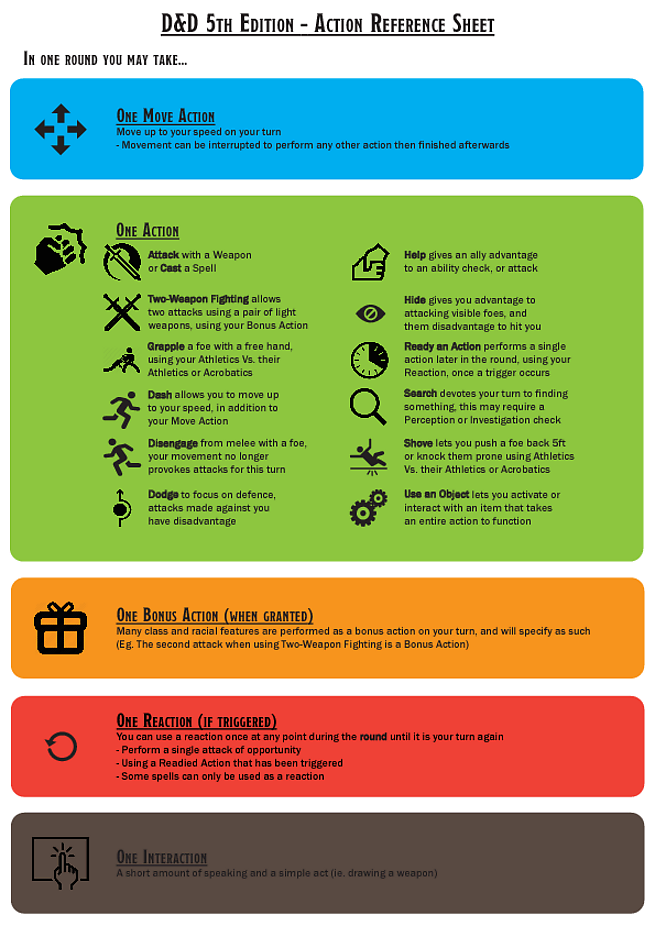
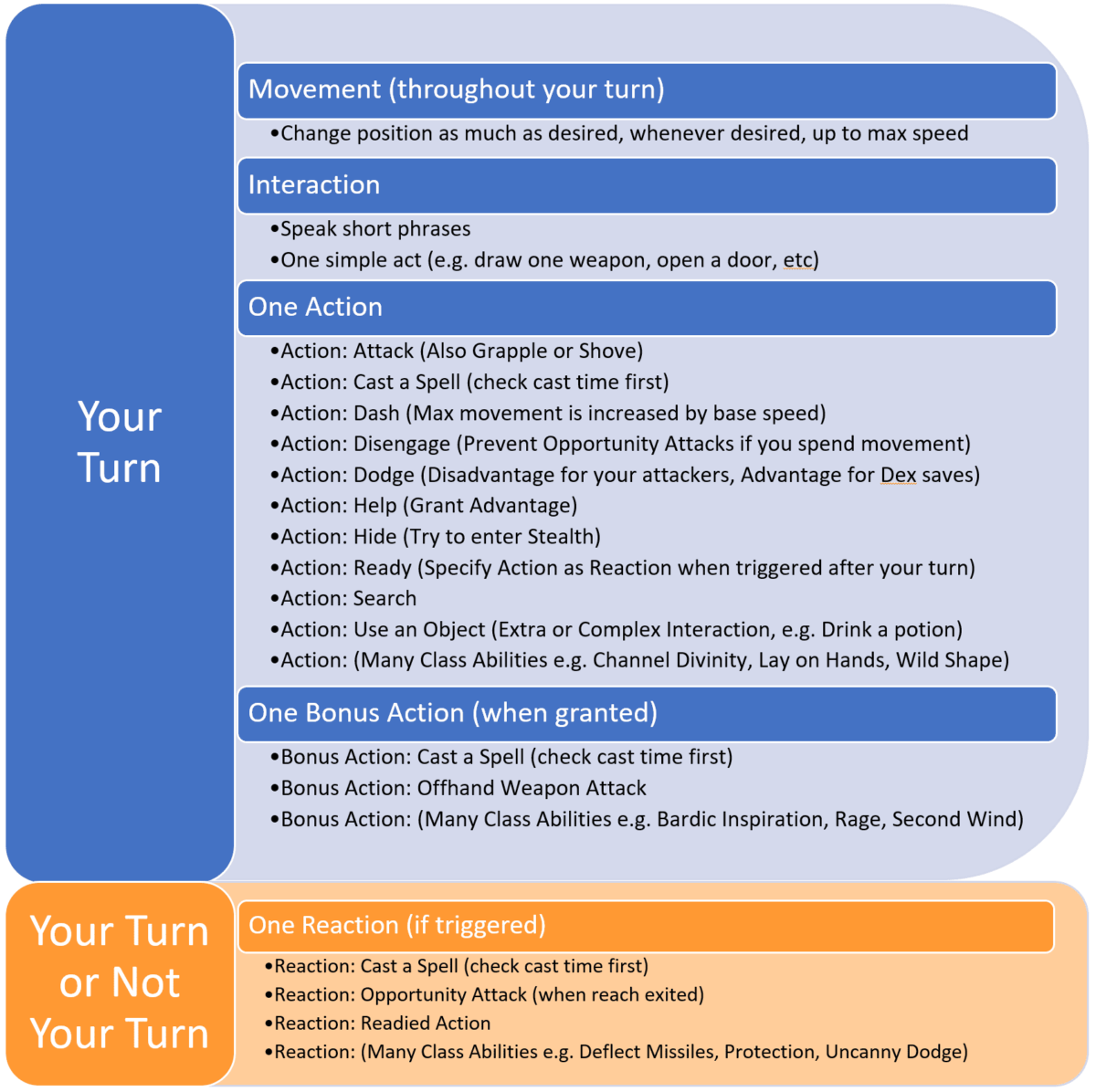
So, on your turn in a round of combat (which is basically when you need to be concerned about it), you can do the following, where/when your character is able to do so:

  1. A Move (this can be broken into parts around your other activities).
  2. An Action.
  3. (If you have one) a Bonus Action.
  4. A free interaction with the world around you.

Outside of your turn in the round, you may also take a Reaction.

Things you can do on your turn. (Source)

(See also my notes on the Action Economy about maximizing use of these elements.)

Actions

Actions include (PHB 192) Attack, Cast a Spell, Dash, Disengage, Dodge, Help, Hide, Ready, Search, Use an Object. Your class or a special feature may provide other Actions, and NPCs may have their own Action list as well.

It’s important to distinguish between an “attack” and the Attack Action.

  • An “attack” is when you roll a D20 (usually) to try to hit someone. Attacks may be made in the Attack Action, but they can occur at other times.
  • An Attack Action is one of your turn slots which may include one more more attacks in it.

Combat

Extra Attack vs. MultiAttack

Extra Attack” is something Fighters (etc.) get as a class advantage at various times. It means that when you take the Attack Action, you can do multiple attacks (e.g., instead of a single longsword blow on the orc, you take two, or even three).

(This is different from doing Two-Weapon Fighting (PHB 195) where the second attack is a Bonus Action).

“Multiattack” is something NPCs (and a few shapeshifting PCs) do — an animal’s claw-claw-bite, for example. It is its own Action, a Multiattack Action, not an Attack Action.  Each of those attacks is usually also available separately, which is important with Opportunity Attacks.

That all sounds picky, but it means that if rules refer to an Attack Action, a Multiattack Action does not count.

Reactions, Opportunity Attacks, and Readying

Opportunity Attack (PHB 195) allows, as a Reaction (not during your turn, but during someone else’s), “one melee attack” when the target tries to step out of reach. Extra Attack doesn’t come into play (because it’s not giving you an Attack Action, just an attack): the Paladin doesn’t get to swing twice against a retreating foe, just once. Neither does Multiattack: when you move away from the giant bear, it can claw at you, but not claw-claw-bite.

Readying lets you take a pre-specified Reaction (“if anyone steps in front of me, I will swing my sword at them”). You can only Ready a single attack, not an Extra Attack or a Multiattack, because Reactions don’t take place on your turn. E.g., the Monk (PHB 79) notes that the Extra Attack is only on their turn. Ditto Fighter (PHB 72). Multiattacks are also intended only on the attacker’s turn.

(More on Readying an action here.)

Similarly, you can only use a Bonus Action on your turn (PHB 189). A two-weapon fighter can Ready an attack (or take an Opportunity Attack) with their rapier, but not their Bonus Action attack with a dagger.

So does this change in 5.5e?

dnd 5.5/2024Very little about this changes in 5.5e (2024), from an overall structure of rules. Various special abilities (class features, feats) and circumstances (e.g., Surprise) make different use of Actions or Bonus Actions (or Reactions) than they did before.

Common Actions are much more carefully defined in 5.5e than in 5e.

The list of Actions is also changed a bit:

Action  Summary
Attack Attack with a weapon or an Unarmed Strike.
Dash For the rest of the turn, give yourself extra movement equal to your Speed.
Disengage Your movement doesn’t provoke Opportunity Attacks for the rest of the turn.
Dodge Until the start of your next turn, attack rolls against you have DISADvantage, and you make DEXterity saves with ADVantage. You lose this benefit if you have the Incapacitated condition or if your Speed is 0.
Help Help another creature’s ability check or attack roll, or administer first aid.
Hide Make a Dexterity (Stealth) check.
Influence Make a Charisma (Deception, Intimidation, Performance, or Persuasion) or Wisdom (Animal Handling) check to alter a creature’s attitude.
Magic Cast a spell, use a magic item, or use a magical feature.
Ready Prepare to take an action in response to a trigger you define.
Search Make a Wisdom (Insight, Medicine, Perception, or Survival) check.
Study Make an Intelligence (Arcana, History, Investigation, Nature, or Religion) check.
Utilize Use a nonmagical object.

 The most significant differences here:

  • There is now a Magic Action for, well, magic. Rather than have spellcasting be part of Attack, and using a magic item part of Use an Object, they have been separated.  This should allow for better refinement and definition of when what can (or cannot) be done, and differentiation between using spellcasting and sword-swinging.
  • There is now a specific Influence Action for CHArisma-based actions (and WISdom (Animal Handling).  The point here is to clarify that these are Actions that take a turn (an Action), not things that — maybe? — you can do while also  swinging your sword around.
  • Use an Object is now Utilizeand, as with the above, it is defined strictly for non-magical objects. At the same time, using Utilize with special tool kits (e.g., Thieves’ Tools) is much better defined; each tool kit has a Utilize action or two. That means that the previously poorly defined Pick Locks and Disarm Traps are clearer in what happens and how (specifically using Sleight of Hand and Thieves’ Tools against a DC 15).
  • Search used to include both WISdom rolls (e.g., Perception) and INTelligence rolls (e.g., Investigation). This has now been broken out between Search (WISdom) and Study (INTelligence).  We’ll cover that distinction more in the appropriate entry. Main outcome here is to group together like things for common effects and usage rules, and to (re)clarify that these sorts of things take an Action. 

D&D 5e/5.5e Rules – Athletics and Acrobatics!

Two valuable skills that sometimes get confused.

Know the RulesPart of an ongoing series of 5e (2014) Rules notes.  See the end of the post for notes on 5.5e (2024) rules.

Part of the confusion is … they are sometimes interchangeable, mechanically. But let’s first talk about the differences.

Strength (Athletics)

Succeeding in difficult situations while climbing, jumping, swimming, or other physical exertions. E.g.,

  • Climbing a cliff, or clinging to one while someone is trying to knock you off.
  • Jumping a long distance, or pulling a stunt mid-jump.
  • Struggling to swim or stay afloat in treacherous currents, or with something trying to interfere with you.
  • Forcing your way through something in your way.

Dexterity (Acrobatics)

Staying on your feet in a tricky situation. E.g.,

  • Running on a sheet of ice.
  • Balancing on a tightrope.
  • Staying upright on a rocking ship deck.
  • Performing acrobatic stunts (dives, rolls, somersaults, flips, tumbles)
  • Avoiding damage when falling. [Old school D&D, but not in 5e]

Using Athletics vs Acrobatics

In many way, you can narratively figure out which one makes sense, and different characters might use one or the other for the same action.  Consider how Aragorn (an Athlete) would do something, vs. how Legolas (an Acrobat) would do it. A crowd of orcs to get past? Aragorn bulls his way through, while Legolas tumbles and leaps and dodges past, but the final effect is the same.

In a couple of cases in the rules there are explicit options as to which you can  use.

Grappling: The Grappler rolls an Athletics check vs. the Grapplee rolling either with either Athletics (think “breaking free”) or Acrobatics (“slippling free”). If the Grapple succeeds, the Grapplee can repeat the contest as their action on their turn.

Shoving: Same as Grappling, only with a push-back or push-down as the result.

At the same time, the two skills are also quite different, something blurred by the Real Life fact that most Acrobats are also Athletes, and many Athletes have Acrobatic skills. People often think of Gymnastics as acrobatic (rolls and tumbles, and amazing acts on the balance beam). But those activities are also highly athletic. As has been commented, “Raw athleticism lets them climb things and jump through the air. It’s being acrobatic that allows them to do it gracefully or maintain their balance.” Or, as another person put it, “Athletics is when you’re going up, and Acrobatics is when you’re coming down.” The gymnast’s leap from the balance beam is clearly Strength (Athletics), but sticking the landing is Dexterity (Acrobatics).

Or if gymnastics isn’t your thing, consider a parkour routine; there are clearly both STR and DEX things going on there. (And CON, and INT, if not WIS, for that matter.)

To complicate things further, Abilities and Skills are not fixed in their combination. One can imagine a Strength (Acrobatics) roll being legitimately allowed, or a Dexterity (Athletics). Indeed, there is technically in 5e no such thing as a Skill check; everything is an Ability check, potentially modified by proficiency in a given Skill set.)

No huge conclusions here, just an observation about similarities and differences and what the fundamentals of two ambiguously-named skill sets are. Again, using the guidelines described above as guard rails, narratively figure out what it is that you’re doing. And, of course, note that both of these skills are good candidates for an occasional invocation of the “Rule of Cool.”

A House Rule

As noted above, in previous editions of D&D, Acrobatics could help save you from a fall by reducing its damage. That was explicitly left out of 5e, so I’m reluctant to re-insert it.

I would house-rule, though, that a successful Dexterity (Acrobatics) role might keep you from going prone after a fall, vs a DC equal to the damage you took (stick the landing!).

Bonus OneD&D Note:

(Not so fast! Things changed after that first play test. See below.)

According to the Character Generation playtest document, Grappling and Shoving are now part of the Unarmed Strike action — hit the target with an Unarmed Strike (D20 + STR mod + Proficiency) vs their AC.

  • If you were going for a Grapple, the target becomes Grappled, with a STR or DEX check each turn vs a DC of (8 + STR Mod + Proficiency) to break free.
  • If you were going for a Shove, you succeed.

This reduces the number of contests, but also reduces the use of Athletics and Acrobatics.

So, any changes in 5.5e?

dnd 5.5/2024A bit. 5.5e (2024) now defines Athletics as a pertaining to checks to

Jump farther than normal, stay afloat in rough water, or break something.

Acrobatics is defined as the skill to

Stay on your feet in a tricky situation, or perform an acrobatic stunt.

Also, in keeping with some of the initial playtest documents, these two skills have been made less essential, as part of 5.5e (2024)’s dislike of skill contests.

The most fundamental change is that Athletics (and sometimes Acrobatics) no longer play a role in Grappling and Shoving. Which seems a bit weird, to be honest.

Both of those are considered part of the Unarmed Strikes category of attacks.  The initial “to hit” is an Unarmed Strike against their AC. Then, to judge what the “damage” (effect) is, rather than doing an Athletics vs. Athletics/Acrobatics contest as 5e did, the target must make a

STRength or DEXterity Save (their choice)
vs.
DC = (8 + shover’s STRength mod + shover’s Proficiency Bonus)

If the target fails, then on a Grapple they are grappled, and on a Shove they are shoved back five feet or knocked Prone.

There is still no canonical use of either skill to mitigate Falling damage or its resulting Prone status, but you can use either as a Reaction, against a DC 15, to land head or feet first in liquid (like water) and take only half damage.

As in 5e, when taking a Long Jump, a DC 10 Acrobatics roll is needed if you land in Difficult Terrain and want to avoid going Prone.


D&D 5e/5.5e Rules – Advantage and Disadvantage!

Gone are the days of juggling a dozen plusses and minuses to a roll. And good riddance.

Know the RulesPart of an ongoing series of 5e (2014) Rules notes.  This also covers 5.5e (2024) rules.

One of the 5e design mission statements was to Keep It Simple, Stupid. This KISS principle was a response to the ultra-crunchy tactical game which was 4e. I like miniatures and tactics, so I liked 4e, but it did, by focusing on numbers and formulae so much, drain a lot of color from the game. As I started up my 5e campaign, I constantly found myself running head-smack into things that 4e did that 5e did not, by design, and having to figure out why.

So what is it?

Rather than having players maneuver a blizzard of plusses and minutes on attacks, 5e tries to reduce it down to a simple set of questions for any Attack, Save, or Action Check roll:

  1. Does the attacker (die roller) have, at the moment, an Advantage over the defender?
  2. Does the attacker have, at the moment, an Disadvantage, compared to the defender?

Then:

  • If there’s no Advantage nor Disadvantage, it’s a Normal attack — roll 1d20.
  • If there is both Advantage and Disadvantage, it’s a Normal attack — roll 1d20.
  • If there is just Advantage — roll 2d20 and take the higher die roll.
  • If there is just Disadvantage — roll 2d20 and take the lower die roll.

Note that (KISS) these are not additive. There is no “Super-Advantage,” and no “Well, you have one Advantage and two Disadvantages, so that comes out to Disadvantage.” There is either just Advantage, or just Disadvantage; otherwise it’s a Normal 1d20 roll.

So what impact does this have?

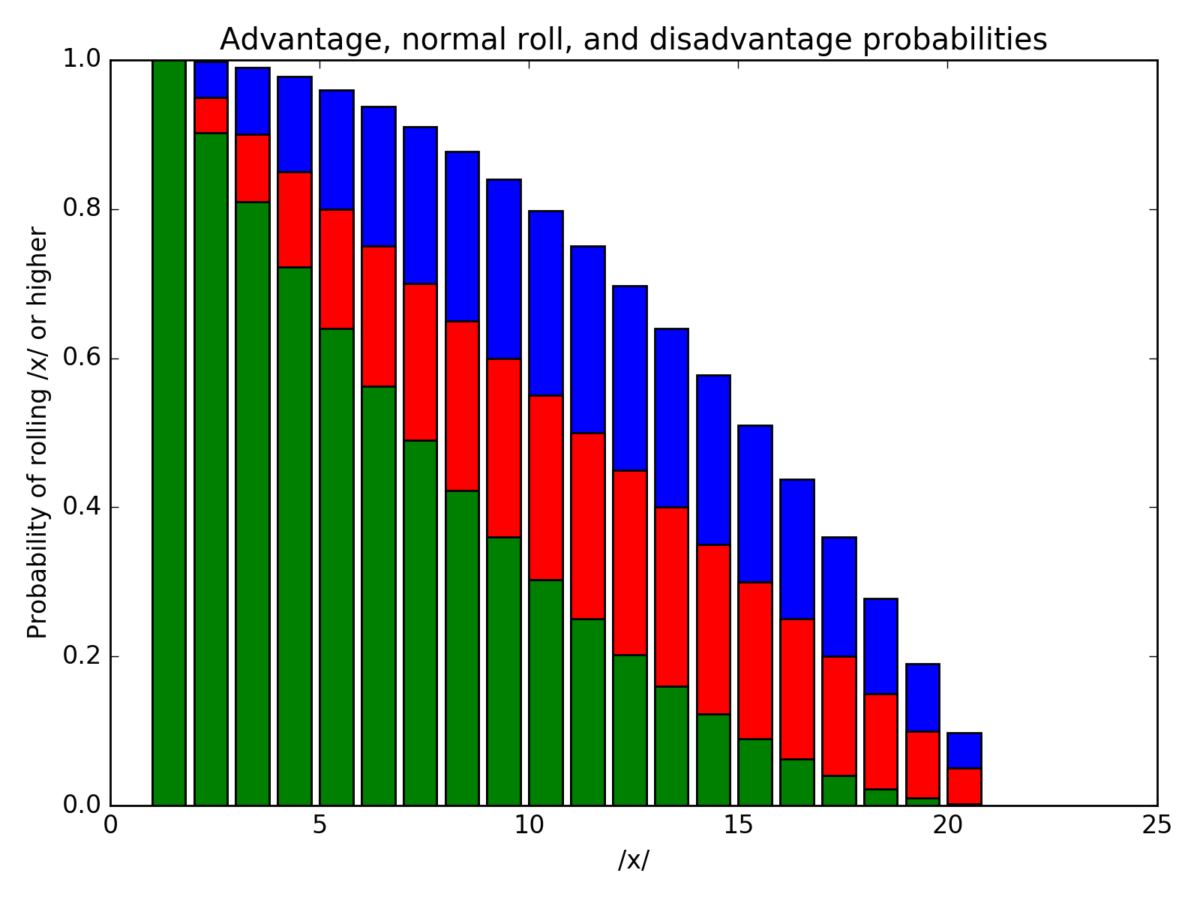
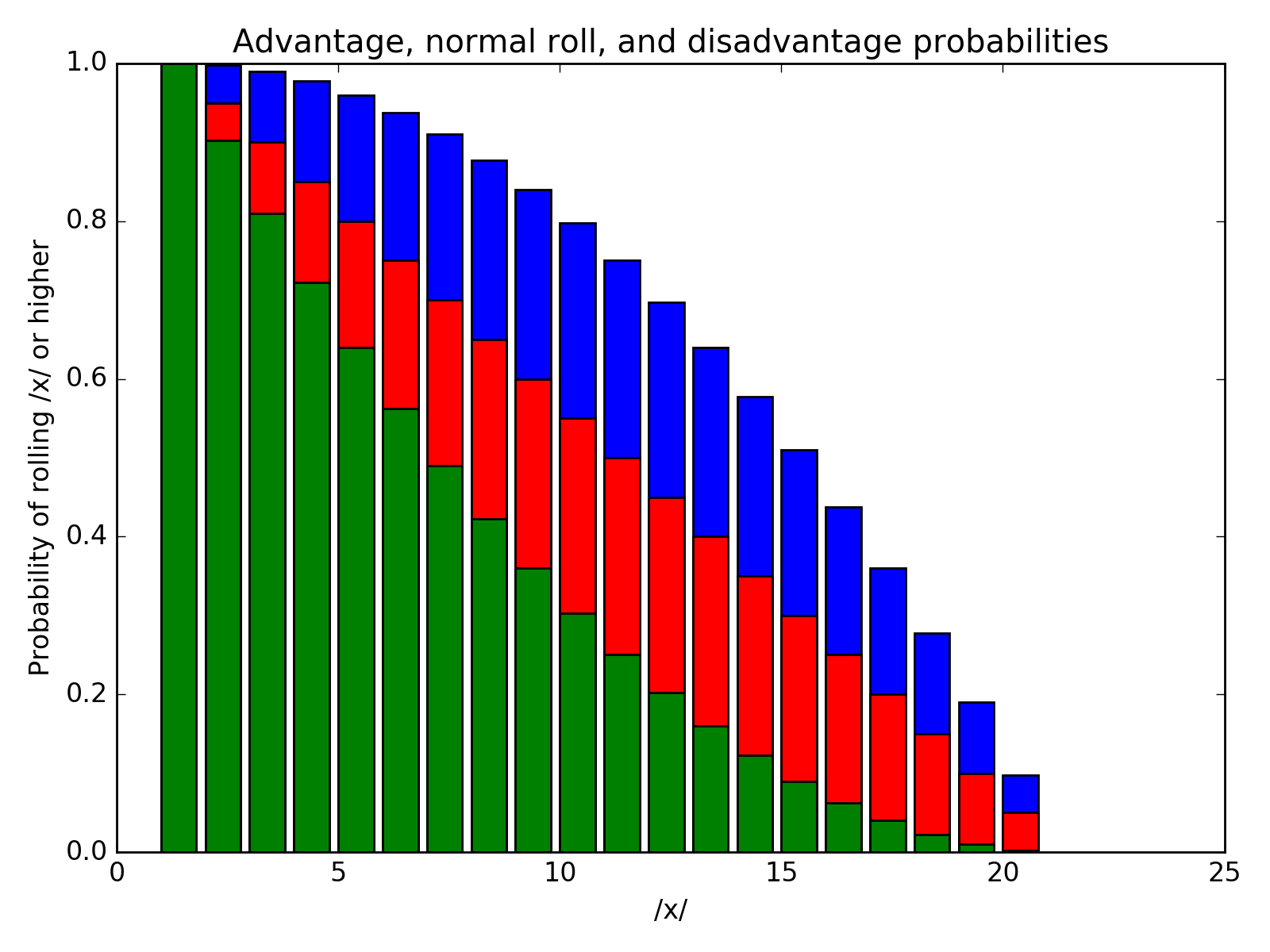
There are some fancy graphs out there, but Advantage is roughly a +4 on a d20, statistically. Or, as put another way, “Advantage is an enormous benefit that lands 13 or higher 50% of the time, is almost twice as likely to crit, and has 1/20th times as likely to botch.” So 5e doesn’t hand out the status lightly.

Or, put in pictures (please feel free to ignore if math makes you twitchy):

Advantage and Disadvantage, plotted
What Advantage/Disadvantage does. (Source)

Having Advantage (blue) boosts your numbers up a lot, esp. in the middle range (trying to hit at least an 8-16); having Disadvantage (green) drags your numbers way down.

When do you have Advantage or Disadvantage?

There are a lot of conditions that create Advantage or Disadvantage (since there are very few conditions any more, except cover, that throw numbers, not Ad/Disad). A good survey can be found here:

A few common ones for combat:

  • Using the Dodge action during combat has any attack roll against you made at a disadvantage until the start of your next turn (if you can see the attacker). DEX saving throws while Dodging are made with advantage. (Note to GMs: bad guys should Dodge a lot more than they do.)
  • Using the Help action during combat can give an ally advantage in one of their own ability checks before the start of your next turn (see “working together”). Alternatively, it can provide advantage on the first of an ally’s attack rolls against a monster.
  • Attacking an enemy while hidden (if they don’t detect you approaching) or otherwise unseen grants you advantage on attack rolls. Conversely, attacking an enemy you can’t see has you making the roll with disadvantage.
  • Ranged attacks whose target is within a weapon’s long range (but not within normal range) have a disadvantage on the attack roll.
  • Ranged attacks (including rolled spell attacks) in close combat (within 5 feet of a hostile creature who can see you and isn’t incapacitated) have a disadvantage on the attack roll. (Spells that require a Saving Throw don’t have this problem because they have no attack roll.)
  • Attacks made while prone are at a disadvantage.  Attacks at 5′ made on someone who is prone are at an advantage, but attacks beyond that are at a disadvantage.
  • You can spend a your point of Inspiration to make an attack, save, or action check at advantage.

Advantage also shows up as a balancer. Kobolds, for example, have a Mob Tactics ability; if a kobold is next to an ally in combat, they each get Advantage on their attack roll. Thugs and Wolves have analogous abilities. That makes them more of a threat than you might think.

How do I roll Ad/Disad?

Normal physical tabletop, just roll two D20s and pick the higher (or lower) one as need be.

The Roll20 VTT standard 5e character sheet provides multiple ways to roll advantage, set through the Settings (gear icon) on the sheet toggle (CORE|BIO|SPELL|cog):

  • Advantage Toggle — You’ll see a ADVANTAGE | NORMAL | DISADVANTAGE toggle at the top of the character sheet which you can adjust for each roll. [This is what I do, because I like to be sure I have all my settings right and am not throwing more dice than needed.]
  • Advantage Query — For each Attack/Save/Action Check roll, you’ll get as pop up window asking if you have Advantage or Disadvantage. [I find this annoying, myself — though in higher level campaigns it becomes more convenient, given the number of spells, buffs, and situations that impose ADV/DISAD]
  • Always Roll Advantage — This will roll 2d20 on everything, then you can apply the roll (higher number for Advantage, lower number for Disadvantage, left-hand number for Normal). [This is a very common way people do this, and for the DM the monsters are all done this way.]
  • Never Throw Advantage — Always just roll 1d20; if you need to roll a second die, do it again.

dnd 5.5/2024So how does this change in 5.5e?

The Advantage/Disadvantage mechanic is the same in 5.5e (2024).  This is the most persuasive (though not dispositive) argument that 5.5e is fundamentally the same as 5e.

Most of the changes here are about when ADV/DISAD are used (e.g., when Surprise occurs in a 5.5e game, the Surprised folk roll their Init at Disadvantage).

D&D 5e/5.5e Rules – Action Economy!

It’s a bit Inside Baseball, but understanding it can be the difference between PC Life or Death

Know the RulesPart of an ongoing series of 5e (2014) Rules notes.  This also covers 5.5e (2024) rules.

You will sometimes read about D&D and encounters and danger levels and rules imbalance and things like that, and you’ll hear the term “Action Economy.”

What’s that?

Essentially,

the larger your Action Economy ⇒
the more things you can do in a turn ⇒
the more powerful you are

And that’s true for individuals, as well as for groups.

  • A big part of character advances are adding more attacks, more Bonus Action options, etc. Similarly, more powerful monsters have more attacks and actions in a turn (including legendary and lair powers).
  • All things being equal, the side that has the greater numbers of combatants has an advantage in combat, because their cumulative Action Economy, the opportunities they have for success in combat, is greater.
  • Bounded Accuracy , as one person put it, “makes everybody dangerous no matter how weak but does so at the cost of making everyone vulnerable no matter how strong.” Which means, by implication, over time a bunch of weak (but dangerous) characters can overwhelm a strong (but vulnerable) one.
  • PCs often have advantage in combat because designed encounters often have more PCs vs fewer (but individually more powerful) enemies. Sure, that big monster there can do three physical attacks, or maybe a big spell effect. But the PCs together often get more Attacks, Spells, Bonus Action abilities, etc., than enemies, individually or (and this is important) in aggregate. They often also get specialized Reactions others than Opportunity Attack. This only starts to partially equalize when you get up to epic creatures that have legendary and lair actions, but even there, numbers tell.
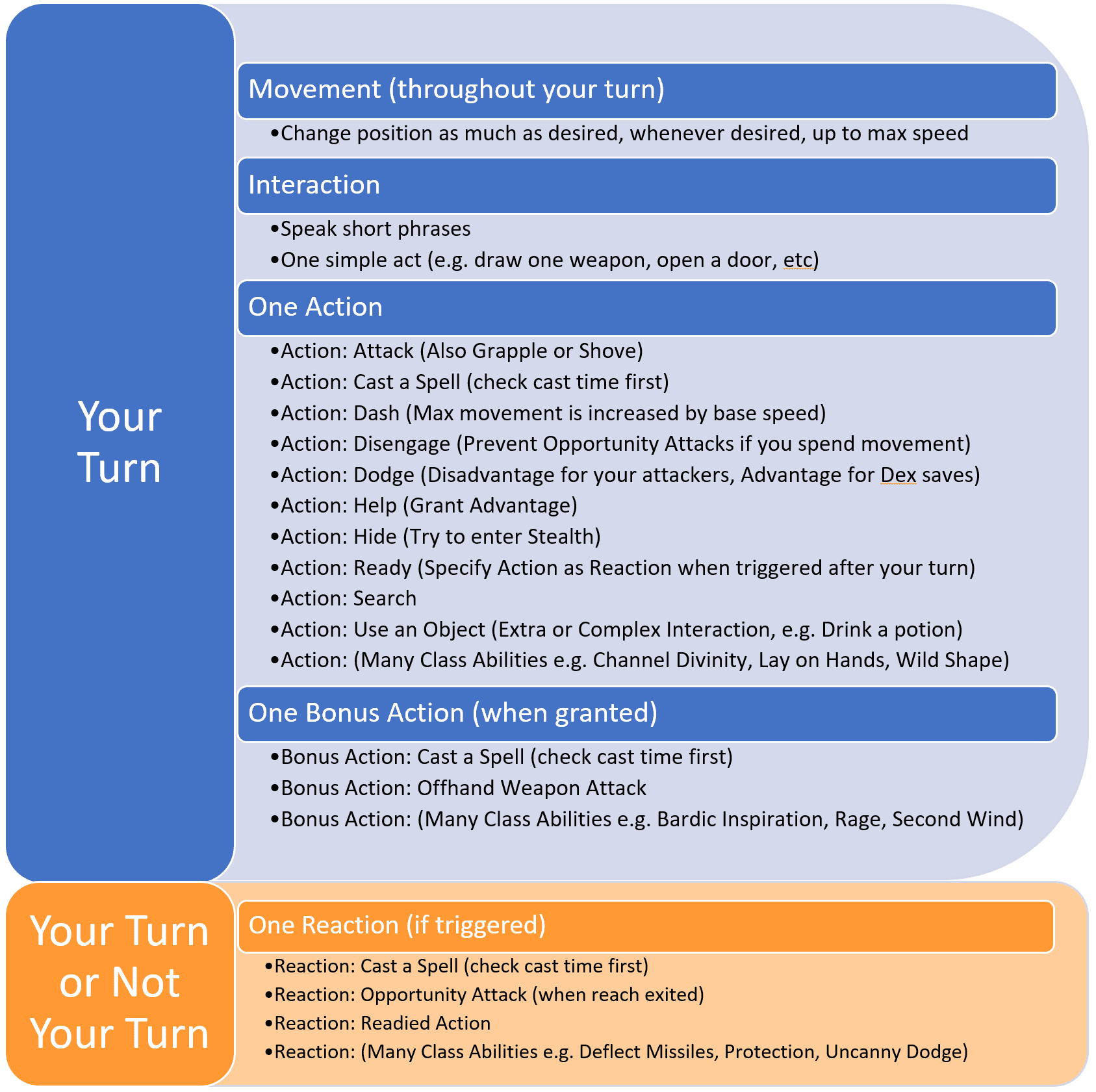
  • Everything you can do is part of your Action Economy: Actions, Bonus Actions, Reactions, and Moves. The more you can set yourself up (tactically, in a battle, or strategically, in your character design) to do something effective with all of those options in a turn, the more effective (and deadly) your character will be.
5e Player Action Economy
All the things you can do as a player. Source

In short, the Action Economy is your range and quantity of actions in a round (see above), and implies the need, by extension, to maximize your effectiveness by using as much of that economy as possible.

How do GMs cope?

GMs bitch a lot about this: the boss fight that’s got the arch-critter-demon you’ve had the players trembling about for months … ending with the boss going down in two rounds as the 15 attacks the party can generate per turn (action economy!) overwhelms the 4-5 the boss can. Yeah, the boss is hitting for 80 damage, but four players hitting for 20 damage each (which is kind of low at higher levels) do just as much, and six players hitting for that do even more.

What (just to offer notes) do GMs/module writers do in the face of this?

  1. They add Minions! They’re not just color text — they help balance the “overwhelming numbers vs very powerful foe” equation by mitigating the former so that the latter can get some licks in.  In general, the easiest way to make an encounter more difficult and dangers is not to make the BBEG more powerful, but add the number of minions and lieuts the players have to grind through (and defend against) to get to the boss.
  2. As mentioned, epic-level legendary creatures — dragons, liches, beholders, etc. — can get legendary and/or lair powers, which basically add to their Action Economy (and hurt like the dickens). GMs often add these non-canonically to other bosses, too.
  3. Do other things to add to a boss’s Action Economy. One suggestion I’ve seen that seems to have legs is making bosses, in a sense, multiple creatures (with different capabilities and HP pools and initiatives) presenting as a single creature.
  4. Split the Party.   If the party can’t bring all of its power to bear — because it’s split up (by its own choosing or through an external force), or maybe because the attack vectors are limited (a narrow hallway, perhaps), its Action Economy is restrained.

The converse to all of these can be used (usually by the GM) to weaken a boss that seems too big to tackle.

Does this change in 5.5e?

dnd 5.5/2024As a game design element, it doesn’t. The 5.5e (2024) rules lean on the Action Economy as much as 5e (2014) did.

That said, evaluating changes in 5.5e rules needs to be first and foremost done as considering how they impact the Action Economy. Letting people do more actions (or forcing people to do fewer actions) has a significant effect.

For example, 5e rules about Surprise meant that the surprising party got one to two attacks on the surprised party before the surprised party could attack.

  1. Everyone rolls Initiative.
  2. When a Surpriser comes up in the Init order, they get to do their attack(s).
  3. Until a Surprised comes up in the Init order, they cannot take an Action or a Reaction.
  4. When a Surprised first comes up in the Init order, they can take no Actions (or Bonus Actions), but can after that point take a Reaction.
  5. Surprised cannot take an Action (or Move) until they come up in the Init order a second time.

That’s a massive advantage in the Action Economy — it’s very easy for a Surprised party to be, if not wiped out before they can do anything, be crippled before they can do anything.

In 5.5e, this is (intentionally) changed to just give Surprised individuals Disadvantage in their Init roll. That means that, on average, the Surprisers will get to act first — but everyone will still act in that first round. At most the Surprisers will get one extra attack in, but if any of the Surprised have a high basic Init bonus and/or roll well, they might still wake up / become alert and attack the Surprisers even before they are themselves attacked.

The net impact on the Action Economy is that Surprise is not quite the disaster it was in 5e, though it still means that the Surprisers will usually get at least some of their licks in first.

There are a variety of other 5.5e changes that change that Action Economy, as an attempt to correct for perceived problems in 5e.

Tangential to this is further refinement in what is encompassed by an “Action” in 5.5e.  The changes here look bigger than they actually are, mostly rendering more clearly what can be done as an Action and how that Action is structured (usually by calling out things a character could do and clarifying that they are a full Action):

Action  Summary
Attack Attack with a weapon or an Unarmed Strike.
Dash For the rest of the turn, give yourself extra movement equal to your Speed.
Disengage Your movement doesn’t provoke Opportunity Attacks for the rest of the turn.
Dodge Until the start of your next turn, attack rolls against you have DISADvantage, and you make DEXterity saves with ADVantage. You lose this benefit if you have the Incapacitated condition or if your Speed is 0.
Help Help another creature’s ability check or attack roll, or administer first aid.
Hide Make a Dexterity (Stealth) check.
Influence Make a Charisma (Deception, Intimidation, Performance, or Persuasion) or Wisdom (Animal Handling) check to alter a creature’s attitude.
Magic Cast a spell, use a magic item, or use a magical feature.
Ready Prepare to take an action in response to a trigger you define.
Search Make a Wisdom (Insight, Medicine, Perception, or Survival) check.
Study Make an Intelligence (Arcana, History, Investigation, Nature, or Religion) check.
Utilize Use a nonmagical object.

Note that other Actions are possible, and NPCs may have defined Actions (like “Multi-Attack”) that aren’t listed above.

Again, this doesn’t affect the Action Economy, but does clarify that, yes, trying to Intimidate a creature takes a full Action, as does Searching for something. (This only applies while Actions are being tracked, i.e., after an Initiative roll for some sort of die-rolling conflict.)

Some good articles to check out:

GM counter-tactics (as, ahem, thought experiments):

D&D 5e/5.5e Rules – Overview and Table of Contents

I’m trying to make use of stuff I’ve researched and written up for my players to help the community at large.

I’ve been DMing D&D going back to the AD&D v1 era, and recently (not so recently, now) wrapped a 2½ year 5e campaign. One of the things I ended up doing for that was writing a lot of “rules summaries” explaining or exploring (or in some cases “house ruling“) on concepts or specifics that need a bit more explanation than what shows up in all those expensive D&D books.

We were using Roll20, so I’d been keeping those rules summaries in the Campaign Forum there for my players, but I think I’m going to start posting copies of them here on my blog, as a longer-term (and more searchable) resource. Know the Rules

A few caveats:

  1. This is not exhaustive of all the rules, just ones that folk (including myself) seemed confused by.
  2. I tend to try to go with Rules As Written (RAW) when given a choice. When I need something more clear than that, I lean heavily on the RPG Stackexchange, because those folk are rules lawyers in a very reasonable fashion.
  3. That said, this is still just me saying things, though I try to document what I say. If you, or your DM, think differently on any of this, that’s up to you and your table.
  4. There are cases where I go with house rules that I think make things easier, more sensible, more fun — without, I hope, gutting major gaming subsystems.
  5. dnd 5.5/2024These posts were originally written for D&D 5e (2014).  I have since updated them, best I could, to include notes on how things have changed in 5.5e (2024).

On that note, some good sources for changes from 5e to 5.5e:

Table of Contents

Reading through “Unearthed Arcana 2022 – Character Origins”

UA 2022 Character Origins is the first of the “OneD&D” playtest docs. My reactions to reading through the doc it fall into three categories (not exclusive):

1. Huh. Not a bad idea.
2. Ugh. That is a bad idea.
3. Yeah, this is 5.5e.

So … let’s take a look.
1. Huh. Not a Bad Idea

Simplifying Tool Proficiency and tool kits: This has always felt a bit fussy in 5e to me, to the extent that most folk I know engaged in these a little as possible. Sure, it’s unrealistic, but it smooths a bumpy area.

Orcs as Player Characters: I’m okay with that. I mean, at some point the number of intelligent races in the world starts to get a bit ridiculous, esp. if they can now all interbreed, but, hey, whatevs.

Making Backgrounds more important: I think that makes a lot of sense. I like getting a Feat out of it, at least. And getting a Language (with suggestions) makes some sense. Except … shifting the Ability bumps to this seems a bit weird, at least 3 points worth.

Level-associated Feats: Probably a good idea. While it begin to smack of feat trees from 3.5e, it does mean that trying to make Feats all fit the same level of power can be given more nuance. At the very least, it shakes up all of those “These are the best Feats to take” articles, but represents another awkward moment for backwards compatibility.

Natural 20s:  I don’t think it was necessary to make nat 20s and nat 1s auto-successes/failures for everything (I know people have said it was a common house rule, but it wasn’t at our house). But it’s not necessarily a bad thing, either, so fine. (As noted below, I’d be inclined to house rule that a nat 1 gets you Inspiration, rather than a nat 20.)

Having crits only double damage on weapon and unarmed attacks (but not attack spells) is … also okay. It balances Martials vs Spellcasters a bit.

Spell groups: Narrowing the groups of spells (Arcane, Divine, Primal) is a nice bit of efficiency, at least on the face of it.

Grappling:  The Grappled condition changes are interesting. I like the Disadvantage for non-Grappler attacks. It’s interesting that they’ve shifted to a Saving Throw with Dex or Str vs the Athletics/Acrobatics skill roll.

Unarmed Strikes: I haven’t done a lot with fisticuffs in the past, but the expansion here (combined with the Tavern Brawler feat) looks like some added detail that will be useful and handy.

2. Ugh. That’s a Bad Idea.

Half-races. “But I don’t wanna be a half-orc or a half-elf. I want to be an Orc-Gnome. I want to be an Ardling-Tiefling. I want to be a Halfling-Ent!” Ugh. I mean, maybe just as well that they came up with a standardized mechanic for it, but it just seems kind of silly to me. It’s not like there’s a shortage of races and demi-races already.

And, of course, that begs the question of quarter-races (“My character has a human-elf hybrid father and an orc-dwarf hybrid mother”), and how to handle them in the rules. “And so, ad infinitum.”

Muddying racial differences. This one is contentious, I know. I am very aware (admittedly from my cis-het-white-male perspective) of the very powerful arguments behind getting rid of race-based Ability Point tweaks. Human history is full of ugliness where different “races” of humans were (and by some still are) assumed to be fundamentally different from “normal,” physically and mentally. Tropes in the game that resonate to that should be examined critically, if not discouraged.

At the same time, it’s one thing to say that Black humans and White humans and Asian humans and whatever pseudo-racial classifications you want to come up with (because we are all, after all, one species) are really  the same, and quite another to continuously grind away the differences to say that Dwarves = Humans = Elves. In that case, why bother having those distinctions at all? (“Bob is a sentient who happens to have pointed ears, high cheekbones, and celebrated his 147th birthday last week.”)

Or, as one consders it, why keep the distinctions you are keeping or adding (lifespan, size, appearance, old and new innate abilities) vs. getting rid of the ones you aren’t (stat increases and decreases). Especially since a number of those special innate abilities are just stat bumps in disguise (lookin’ at you, Dwarves).

Or, put another way, nobody seems to have a problem with Vulcans being stronger and smarter than Humans in Star Trek, as long as there are countervailing disadvantages. Why is it wrong for an Elf to be more Dexterous than a Human, or even, given their ages, have a higher Intelligence. I mean, nothing in the old rules actually prevented a Half-Orc from becoming a powerful wizard; it was just a bit more difficult to min-max the stats that way. I don’t necessarily have a problem with that. People can do anything, but the Halfling basketball player is going to have some special, epic challenges.

In short, I’m quite fine with backing away from dictating cultural-biological absolutes (“Orcs are all evil! Evil, evil, evil! And they eat human babies, too!”), even with creatures of demonic origin (the convolutions over Tieflings are fascinating, even if they inadvertently let an actual alignment show up in one of the Lineages). But I’m also okay with saying “The physical differences we’re literally describing here are reflected in the Ability stats of characters of those races.” (Mental stats are a bit more dodgy; I’d be okay with leaving them out of the picture for races.)

Character Sizes: Small (2-4 foot) Humans? Even when we are talking about Pygmies or people with Dwarfism, that’s below average. I don’t object, it just seems an oddly specific call-out. (They also show up as an option only with Humans, Ardlings, and Tieflings; all other races are other Medium or Small only, which seems … racist? What about tall Halflings? What about diminutive Elves?)

Racial Spells: More races have literal spells that they get to use on a dailyish basis (once per Long Rest if you don’t have additional spell slots). That seems to muddy the magic waters some, giving spells to all classes. Especially with Feats that do the same thing.  I’m not sure creating a more magic-rich environment is actually needed.

Ubiquitous Inspiration: Inspiration is a mechanic that seems to be quite underutilized in 5e by too many DMs.  The “solution” to this in OneD&D is to make it pop up all over the place, robbing it of its RP-supporting intent.

True, it gets lost after a Long Rest now — except for uber-versatile Humans. But PCs get Inspiration from rolling a nat 20 (i.e., after 5% of all rolls). Players can get Inspiration as a group from someone with the Musician Feat. In short, everyone’s going to have and use plenty of Inspiration to gain Advantage on rolls.

That’s not necessarily bad, but I’m not sure it’s good. It certainly waters down the “Wow, that was an awesome bit of character play, so take an Inspiration,” because it increases the chance they already have some.

(Frankly, I’d house-rule-tweak at least one thing there, if nothing else: you gain Inspiration on a nat 1 — anger and determination to do better — rather than on a nat 20! That’s a very non-D&D idea, to be fair.)

Backgrounds and Ability Bumps: Are Acolytes really that much Wiser than the average person? Are Cultists that much more Intelligent? Not in my gameplay experience. I know the Ability Bumps need to somewhere if you can’t baldly do it with races, but allocating 3 points here seems a bit extreme.

Multi-Lingualism: I guess maybe it makes life easier, but everyone knowing three languages (Common, a Standard Language, and a language from your Background) does seem to be a lot of linguistic lore (and, if players cooperate in chargen, allows for covering pretty much all the languages they might need).

Long Rests: These are so baked into the game at present (even if they do ridiculous amounts of healing) that having it be interrupted by any Combat feels like a major shift.
3. Yeah, this is 5.5e.

There is a qualitative difference between characters generated under the present 5e rules, and characters generated under these rules. The two will not mesh well together, and efforts to run both types in any given campaign will lead to madness. If nothing else, automated character sheets and tools will have to choose one or the other (whether from WotC or a third party like Roll20).

By extension, that implies a difficult fit between existing 5e modules and the new system. That’s already true to a degree (just as the Genasi), but will continue to grow over time.

That does not mean the 5.5e changes are, per se, a disaster. There are a lot of good changes in the system already that have evolved it from the baseline 5e of 2014 to where it is today. All those changes in supplemental tomes (Volo’s, Tasha’s, Xanadar’s, Mordenkainen’s, etc.) have changed the game in mostly good ways.

And, to be fair, the changes discussed are not the 3.5 to 4, or 4 to 5, full-edition levels of significance. The basic underlying systems, action economy, etc., are there. But this is more than just “5e Forever, man!”

So why not bite the bullet and admit this is a new (or distinct sub-) edition? If WotC’s plans involve you buying a new set of hardcover books for “OneD&D” (and they do), then why not just call it 5.5e and be done with it? For the sake of marketing?

Because, really-truly, I guarantee that more supplemental books will come out after that. And every 5-10 years they’ll do a true-up of new PHB/DMG/MM tomes, “backwards-compatible” claims or not. If “OneD&D” in 2024 is not comfortably compatible with 5e, what will it be in 2028?

(Which argues the intent to pivot to a new direction and go to all-digital rules that you license on a regular basis. Want access to Xebulon’s Big Bucket o’ Game Mods? That’ll be $2/mo, or $20/year if you want it to plug into your official WotC modules and official WotC character generator. But I digress.)

I’ll continue to read the feedback (which is all over the map), and when 1 September rolls around, I’ll provide my feedback. If 5.5e came out like this, I would suck it up and play with it that way. But I would want WotC to admit this is not a backwards-compatible seamless evolution of 5e, from 2014 or 2022. This is something new that deserves to be recognized as such — and identified as such to WotC’s customers.
“One D&D” to rule them all (maybe)

So WotC has announced what they’re doing with D&D 6e. Or 5.5e. Or, maybe … no e.

Instead, they say, we will have “One D&D,” with the whole concept of “editions” becoming instantly obsolete, because WotC believes 5e doesn’t need complete revamping, just evolution.  Sort of like an OS being constantly patched, the baseline ruleset will be updated over time so that there is just “D&D the way it is today” and no need to ever, ever, roll out a new version.

How that will work with books isn’t clear. Will they keep coming out with “patch” books like Tasha’s Cauldron of Everything? Or will the core ruleset be republished (and rebought) every X number of months/year. In either case, that’s different from what we have now because …?

Of course, maybe the idea is that we won’t have “books” at all, but online rules that can be slipstreamed electronically to the current text (with some sort of versioning so that you figure out what’s going on), but that you have to subscribe to …

None of that was really discussed, just three broad pillars for “One D&D”:

  1. Ongoing updates to the current baseline 5e (ssshhh!) rules.
  2. Expansion of D&D Beyond, the compendium toolset they recently bought.
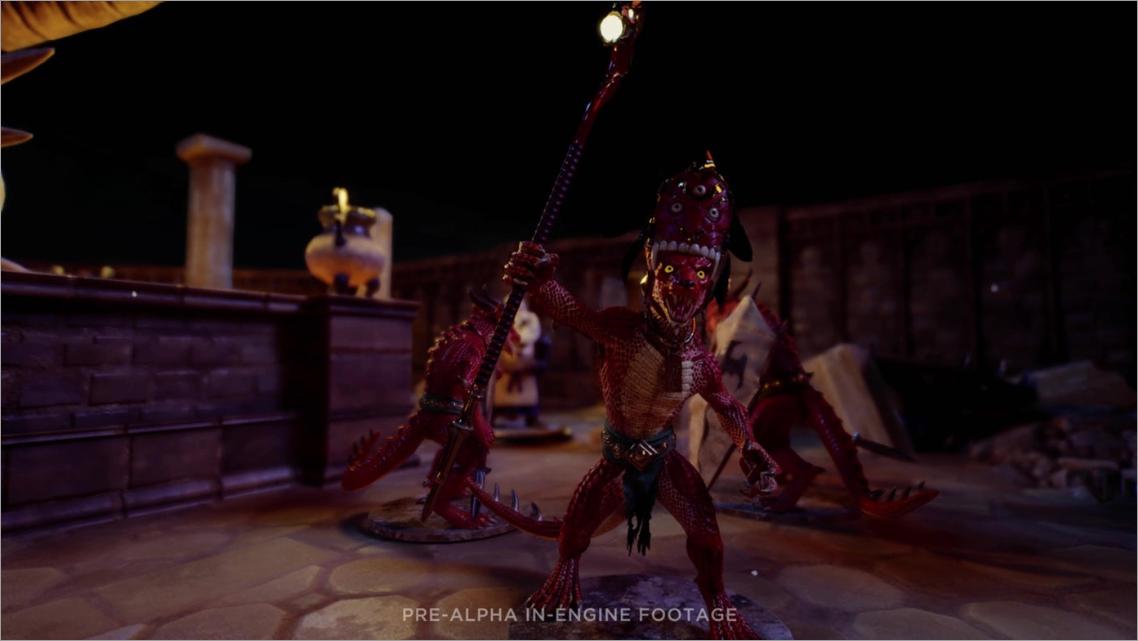
  3. Creating D&D Digital, apparently a 3D VTT, the pre-alpha version pictures for which look pretty impressive, and which will be both a content delivery tool (“Here’s the dungeon for this game”) and content creation tool.
One D&D vtt image
Kobolds on the attack in the 3D VTT

Now, just because they are dealing with the rules on a patch basis doesn’t mean there are potentially significant things coming out beyond additional content. For example, Backgrounds are being completely revamped, to give Ability score modifiers and feats, which does sound kind of keen.

Other changes already raised: simplification of spell lists, and making a Nat 1 a miss for any roll, not just attacks.

Color me … somewhat dubious.

I get the idea that completely revamping the rules every several years is increasingly more difficult. I even buy the idea that 5e is a pretty decent platform to build on, with caveats.

But one reason why D&D is still with us, several editions on, is because audiences and tastes change. What people want in terms of crunchiness vs simplicity, hack-and-slashery vs role-playing, not only changes with an individual over time, but with the industry.

If D&D doesn’t change, in its bones, every now and then, those changes in society and audience will lead people to go elsewhere.

Here are the dates for rule releases:

1974 – original
1977 – AD&D 1e
1989 – AD&D 2e
1995 – AD&D 2e Revised
2000 – D&D 3e
2003 – D&D 3.5
2008 – D&D 4e
2014 – D&D 5e

5e is already 8 years old — older than any except the longevity from the original AD&D to 2e, when the audience was much smaller.   It’ll be a decade old 2024 when One D&D is planned for release.

At what point will everything start to feel a little creaky, no matter how many patches and content packages are released?

So maybe — and if how rules changes are handled is well-planned and -executed — this extends the 5e platform another 5+ years, with the homebrew variations that we have today multiplied as various rules continue to evolve and change (and the similarity on the surface to the 5e of 2014 continues to dwindle, without, somehow, breaking the “backward compatibility that WotC has promised). When will whoever owns Hasbro decide what the world needs is to put out One D&D 2nd Edition?

Playtesting for the rule updates can be found here.

Game Review: “Dwindle”

Caro Asercion, 1-5+ players, 2-3 hours, $7.77

⚫⚫⚫⚫⚪ — Ease of Play
⚫⚫⚫⚪⚪ – Replayability
⚫⚫⚫⚫⚪ – Fun

Dwindle is a self-contained indie RPG designed to let you run an “occult cyberpunk” scenario in the dying tech metropolis of Vector City.

Dwindle cover art

VECTOR CITY used to gleam, its wireframe skylines shimmering against a perpetual pixel sunset. But the Vector’s heyday is long gone, and you — the ECHOES of this former metroscape — are left tending to the wreckage.

You’re no more special than any of the other stragglers stubborn enough to stick around; people here live hardscrabble lives full of risk and danger, and the difference between success and obliteration is as fickle as static in the wind. But without somebody to keep things running smoothly, it’s only a matter of time before the ghosts and the glitches and the corporate bastards eat away at every last bit of data and render this husk of a city entirely unrecognizable.

You won’t let it disappear without a fight.

Written by Caro Asercion, the game does a quite decent job of letting you generate characters (it can be played GMless if you like) and develop a scenario. Characters and the city are seeded (randomly, if you wish) by tables with interesting people, gadgets, goals, and problems to guide game play. There’s enough there I suspect for a number of replays before things might to seem repetitive.

One of the tables to help you build your character. Using an item from your pocket adds a die to your roll.

Dwindle’s most unique mechanic is its use of a grid to place seven dice into. The sum of dice for each row and column give you dice to roll for different actions/attributes (with bonus dice for reputation or use of a trinket in your pocket) — the highest die rolled provides a range of success or failure for the group to interpret.

The digital grid. I can see that one row means I have a Hack (modify tech) of 1 die, and the other column means I have a Heed (awareness) of 2 dice.

The trick is, those dice you rolled get removed from your grid, meaning, as the game name implies, your abilities and options dwindle over time, until you reach a situation where the highest die you roll (or, if you are at 0 dice available, the lower of two dice) scores a 1, at which point you can replenish the grid in whatever way you like.

It sounds a little complex, but it’s mechanically simple, esp. if you use the digital interface by Tim Busuttil.  The main thing is figuring out when best to shoot big dice, realizing you’ll be seriously weakened until you can figure out how to replenish.

The Good

  • Intriguing setting, neatly set up for a variety of adventures.
  • Clean and pretty rule set, plus a text-only version if that’s how you roll.
  • Interesting attribute / rolling grid (with digital tool).
  • Great for a one-off / fill-in session.
  • Can be run without a GM.
  • Can be played tabletop or virtually (if you trust your players’ rolling).

The Not-As-Good

  • Limited replays without brainstorming some new elements for the tables.
  • Characters may feel a little generic, as dice can replenished in whatever arrangement you wish.
  • Most die results are mixtures of success and failure, making it difficult to feel an unalloyed success.
  • Attribute tags sometimes drive, rather than guide, the action (“I have dice left in this, so that’s what I should do”).
  • In the session we played, we dwindled pretty quickly, and didn’t have a lot of luck replenishing.

It’s a fine one-night stand-in when a key player or the GM can’t make it for the regular session. I’m glad we played it, and I’d enjoy playing (or even GMing) it again.

Do you want to know more?

Game Review: “One Last Fight”

Superrobotbear, 2-6 players, 2 hours, $10
One Last Fight coverI ran this as a one-night fill-in when my normal D&D campaign couldn’t run because of absent players. We’ve been playing in Roll20 as a Virtual Tabletop, so I wanted something that would use that. I also wanted something I was pretty sure would fit into one evening; picking a “short” D&D crawl was a recipe for it spilling into multiple weeks.

I ended up with One Last Fight, by Ethan Hudgins, released back in late 2019. Ethan describes the game as “A GM-less Card-Prompt RPG for 2 to 6 players,” and that’s pretty accurate. I purchased and ran this through Roll20, which seems like a much superior choice to buying PDFs and printing up your own copy of the game.

I say “I ran this,” but that’s not quite right. OLF is technically GM-less (I was GM as far as Roll20 was concerned, which was helpful with some card mechanics, and I knew the rules better than the players, but I tried to keep a distance regarding creatively guiding the game).

OLF’s premise is that a party of 2-6 is ending a long campaign/quest against their nemesis: slowly approaching where the nemesis is located, fighting their way in, then engaging in final battle. All of this is guided by a structured card deck built from separate decks for each phase of the approach. Twenty-five cards are dealt, which doesn’t sound like a lot, but the games generally seem to take a couple of hours.

There are really two games in OLF. One is a structure for conflict resolution. Character cards have simple combat attributes, bolstered by items/treasure acquired. Those attributes represent the number of dice to be rolled vs the challenges on the Adventure Cards. The Adventure Cards are flipped from the deck, and may force a solo challenge (which can be passed on to another player) or a group challenge (faced by each individually). These could be a bad guy, a group of opponents, a trap, a challenging situation, etc.

One Last Fight - character card
Character card with questions, special powers, and conflict attributes. This character has one each of the Key, Crown, and (through a treasure item) Magic attributes.

So if the conflict has Swords and Magic as vulnerabilities, and I have two Swords and one Magic, that gives me three dice, plus the free one I get, so I am rolling 4d6. If the conflict shows “4 4” as the difficulty, then on the individual dice I’m rolling (sums make no difference), I have to have two dice that have 4, 5, or 6 on them.

While many conflicts have the stake of losing life vs gaining treasure, quite a number have a different win/lose effect, sometimes being a matter of “this helps the party a lot” vs “this helps the party a little.”

Conflicts get hairier as the adventure progresses, until you finally get to the nemesis, the titular Last Battle, where it is kill or be killed.

Additional variation in play — beyond the randomizing of the built deck — come from the characters chosen: a variety of archetypes with both different strengths (conflict attributes) and various ways they can break the rules, from changing die rolls to providing assistance to other players.

But that brings us to the second system present in OLF, because, beyond a solid conflict mechanic, OLF is first and foremost about storytelling.

A game can be set (as a collaborative decision) in any setting — high or low fantasy, science fiction, the Old West, spies, comic books, named franchises or generic pastiches. The cards and actions are set as archetypes, without any particular setting in mind — a character’s description as being able to tell the future could be magic, it could be psionics, it could be the Force, or it could be a powerful computer. This gets determined by the group defining the setting, and by every card — nemesis, characters, gear, and adventure cards — having a series of questions that describe the present or fill in the past.

One Last Fight - nemesis cards
Some of the Nemesis cards. Collaboratively answering the questions help create the game setting.

Those questions may be answered by individuals drawing the cards, or by group efforts. And while the story built by those questions and answers don’t actually affect the mechanics, they can influence how the individuals play, and, when all is said and done, the create the story that players will remember long after they recall a given die roll.

It’s those questions and answers in the end that make OLF special, from “What does this statue ask of you” to “For whom in the group would you take an arrow? Why?” to “How did you allow this enemy to escape before?” to “What does the nemesis mutter as they cling to life?” You could play without that storytelling, but ultimately they are what, to me, makes the game what it is.

And even when you reach the end, and the Nemesis is defeated (one hopes), there are final questions — the inevitable (and often most dramatic) where does you character go from here? (Or, if your character died — quite possible — how are they remembered?)

The Good

  • Well done storytelling prompts.
  • Good conflict resolution mechanic.
  • Pretty easy rules.

The Bad

  • Storytelling and conflict resolution don’t really link together.
  • Roll20’s card deck mechanics can be irksome.
  • No physical printed version available; printing PDFs would be painful.
  • Very indie, so not a lot of info out there about it (by no means the game’s fault).

Overall, One Last Fight is a flexible and entertaining and imagination-stretching game, perfect for fill-in sessions or killing a couple of hours. The rules setup (at least in Roll20) was a bit sketchy and disorganized, but the gaps are easily filled in; the game’s rules are picked up pretty quickly in play. It’s available on Roll20 for $10, or on the author page for the PDF version (same price).

Vigorously recommended.

Do you want to know more?