
D&D 5e Rules – (Heroic) Inspiration!

Inspiration can be used to reward good roleplay and memorable moments. I like it.

Know the RulesPart of an ongoing series of 5e (2014) Rules notes.  See the end of the post for notes on 5.5e (2024) rules.

So in addition to being a Tactical Guy, I’m a role-player, so I will likely emphasize those aspects in any game I can.

D&D is not a RP-heavy system by design; it’s originally derived from miniatures warfare gaming (which doesn’t reward someone running into the middle of the battlefield with a white flag to negotiate a truce), and the Experience Points that folk are incented after are for, frankly, killing things. This has “gotten better” over the years, but killing does still seem to be the best way to get XP. So, as a general rule, one does not hop into a D&D game expecting penetrating psycho-drama and lengthy inter-character dialogs.

Right. Got it.

There Will Be Role-Playing

I still encourage players to think about the personality aspects of their characters — 5e has rather clumsily loaded traits, ideals, bonds, and flaws into the character creation process, related to background. It’s a start, but I would hope players would come up with something a bit more organic, using those background-driven items as, well “inspiration.”

Role-playing is also important, in my games, when encountering people not in the party. The folk encountered, especially in town, are not pop-up clue dispensers.  I can’t promise Shakespeare, but there will be character interactions, so I expect something more than “I walk up to the Bartender and roll on Deceive.” 

All of which ties into the post topic: Inspiration [PHB 125]!

What is Inspiration?

Inspiration
Inspiration!

From a meta standpoint, Inspiration is an optional rule, based on whether the DM wants to use it. I’m not sure why they would not, but if your tables doesn’t use it … it’s worth asking why not.

Mechanically, here’s what the book say (emphasis mine):

Inspiration is a rule the game master can use to reward you for playing your character in a way that’s true to his or her personality traits, ideal, bond, and flaw.

By using inspiration, you can draw on your personality trait of compassion for the downtrodden to give you an edge in negotiating with the Beggar Prince. Or inspiration can let you call on your bond to the defense of your home village to push past the effect of a spell that has been laid on you.

Those examples given are a little misleading. You get Inspiration by (as a limited example) drawing on those personality traits in some fashion … and can then use Inspiration to do something better than usual. RP-wise, you can draw on that connection (“As I talk to the Beggar Prince, I remember that morning giving my last gold piece to that hungry child [for which I got Inspiration because it ties into my character origin], and I hold onto that insight as to what hunger really means as I negotiate for my friends’ release”), but it’s not completely necessary.

Gaining Inspiration

The 5e DMG (pg. 240) specifically suggests giving Inspiration for:

  • Roleplaying: A character does something notable and memorable that is consistent with their personality bonds, flaws, nature, etc.
  • Heroism: A character does something notably heroic — usually taking some sort of huge risk (with possible loss of life).
  • A Reward for Victory: Giving Inspiration when a character levels up is common at many tables. Other noteworthy goal achievements (slaying the BBEG, or even one of their powerful lieuts) can also qualify.
  • Genre Emulation: A character helps support the conventions and tropes of the genre — e.g., calling out that they are falling for a dame in a noirish setting because that’s what loner heroes do; leaning into the creepiness and fright of a horror -focused game.

That all seems pretty in line with my thoughts.  The PHB similarly says:

Your GM can choose to give you inspiration for a variety of reasons. Typically, GMs award it when you play out your personality traits, give in to the drawbacks presented by a flaw or bond, and otherwise portray your character in a compelling way. Your GM will tell you how you can earn inspiration in the game.

As noted, good role-play will (or should — see below) almost always net Inspiration at my table. Sometimes it might not happen until after the session when I’m doing the game logs, but …

I also give Inspiration for particularly fun, imaginative, or memorable action by a character.  If it’s the sort of thing you’d tell stories about afterwards in a tavern, or that might even be mentioned in the Saga of You that some bard will write someday — it’s worth Inspiration. If it’s something that made every player at the table cheer, laugh, or yelp with surprise (and will be told about at gaming tables to come) — it’s probably worth Inspiration as well.

Since the DM controls the reward of Inspiration, you can keep it from becoming too mechanical or from players “gaming” the system for it. Inspiration should feel like a real reward for doing something for doing something that makes the game more interesting, entertaining, or enjoyable for everyone at the table.

One last thing: the DMG also suggests the DM can dangle Inspiration out for someone when they are considering an action that might provide such a reward (e.g., playing Horatius at the bridge to let their friends escape).  That makes it feel a bit too transactional and mechanical to me, the sort of thing that deflates the value of Inspiration.

Using Inspiration

If you have inspiration, you can expend it when you make an attack roll, saving throw, or ability check. Spending your inspiration gives you Advantage on that roll.

Basically, any time you roll a D20, you can burn your Inspiration to gain Advantage. It’s not always a game-changer, but it’s a nifty little boost.

Some tables include house rules letting you burn Inspiration to give someone else Advantage, or even to given an enemy Disadvantage. Thematically that’s a bit more dubious; it’s also potentially imbalancing.

Something tangential to the that, though, is this:

Additionally, if you have inspiration, you can reward another player for good roleplaying, clever thinking, or simply doing something exciting in the game. When another player character does something that really contributes to the story in a fun and interesting way, you can give up your inspiration to give that character inspiration.

Don’t let this erode down to players just giving their own Inspiration at the very last second to someone else who badly needs to make a roll. It should most likely happen out of combat, and the giver should provide some justification. (Note, though, that some tables effectively pool their Inspiration together; to me, that robs it of some of its color.)

Use It Or Lose It

Inspiration is a binary — you either have it or you don’t. You can’t earn multiple “points” of Inspiration.

That means that if you do something Inspiration-worthy, and you still have your previous Inspiration, you don’t get anything.

The biggest problem I see with players (myself included, when in that role) is holding onto their Inspiration “just in case.” Better to use it at the first point where it would be useful, and work at earning more. Fireball coming down your throat and you used DEX as your dump stat? Time to spend that Inspiration die to get Advantage on that DEX Save …

The DMG [p. 240] suggests each character should get around one Inspiration a session. That seems a bit high to me (and I’m not wild about an Inspiration quota), but if you have players that are doing solid RP and coming up with interesting ideas, it’s certainly not an impossible rate for them.

Some GMs put some bounds as to how long Inspiration can hang around out there — resetting it at the time of a Rest of some sort, for example. I understand that thematically, and it certainly encourages people to use their Inspiration while they have it, but I tend to be more lenient than that.

Helping the DM

There are a couple of other ways (at my table) that helping the DM can also generate Inspiration.

A player who makes substantive contributions to the game outside of it (keeping game logs, posting lots of funnies in the campaign forum, etc.) might sometimes get Inspiration for their character. I don’t do this every time because I don’t want it to be quite so quid pro quo, but occasional Inspiration is a nice tip-o-the-hat to a helpful player.

I know as a GM that I often have a dozen balls in the air, and keeping an eye out for someone making the game “more exciting, amusing, or memorable” sometimes fails because I’m too busy trying to decide what spell the evil wizard is about to cast.

Because of that, I encourage players to let me know if someone deserves Inspiration. I rarely say no (largely because I’m rarely asked  for an unworthy cause).

Closing Thoughts

The DMG [p. 240]  has further suggestions of when and why to award Inspiration, and some variants on the rule. It’s worth a read.

Gold D20
Inspiring!

I find that players often forget they have Inspiration available when playing in a VTT like Roll20. A simple way around that is to create or designate a token Status Marker for Inspiration. Alternately, I use the Dealer API/Script by Keith Curtis (see here and here) with some simple macros to put (or take) a shiny gold D20 on the player IDs on the Roll20 desktop, complete with an inspiring message. Fun, and very visible so that it doesn’t get forgotten!

How does this change in 5.5e?

dnd 5.5/2024Pretty fundamentally.

First off, it’s called Heroic Inspiration now, probably to help distinguish from, say, Bardic Inspiration (a bardic class feature the lets the bard give another creature a D6 (rises with level) to use on any failed D20 Test in the next 24 hours).

Secondly, it’s no longer an Optional Rule, but baked into the system.

In addition to tweaking the name, the whole thing has evolved from top to bottom.

Using Heroic Inspiration

In the Vocabulary section of the 5.5e (2024) rules, it reads under “Heroic Inspiration“:

If you (a player character) have Heroic Inspiration, you can expend it to reroll any die immediately after rolling it, and you must use the new roll.

So two differences here:

  1. It’s providing a die reroll, rather than Advantage. Effectively that’s the same, but process-wise it means considering using it only after a failure, rather than “I’ll use my Inspiration, oh, look, I succeeded on both rolls, so that was a waste.” It also helps it stand out against all the other mechanisms that award Advantage.
  2. The reroll can be on any die roll, not just a D20 Test. Going up against that giant with your great axe and rolled a 1 on that D12 damage die? Now’s the time to try and improve on it!  Leveling up and rolling your new Hit Die and score a 2 rather than a 10? Give it another go! Trying to heal your buddy and rolled something crappy in healing HP? Heroic Inspiration to the rescue! Your Wild Magic just did something disastrous? Let’s try our luck again! Death Saving Throw got a Nat 1? No problem!

If you gain Heroic Inspiration but already have it, it’s lost unless you give it to a player character who lacks it.

So you are still limited to a single “on/off” of having Heroic Inspiration, but if you get another one, you can (through some metaphysical concept) pass it on to another player. That seems a little odd (and like a homebrew rule that got formal approval in 5.5e), but there you go.

Getting Heroic Inspiration

But … how do you get Heroic Inspiration in 5.5e? Well, it’s still allowed / encouraged for the DM to award it for good role-playing, as in 5e [DMG 46]

You can also use Heroic Inspiration to reward roleplaying, immersion in the game, and heroism. Use it to incentivize the kind of behavior you want to see in your game, such as acting in character, taking risks, thinking strategically, cooperating well, or embracing the tropes of a particular genre.

The DMG commentary about it has gone from about a full page down to a short sidebar, but it still hits the fundamentals.

There’s also a PHB (p. 13) description:

Typically, DMs reward it when you do something particularly heroic, in character, or entertaining. It’s a reward for making the game more fun for everyone playing.

That last bit is important. It’s not just about the Player, or even the Player impressing the DM, but how the Player’s actions make the game better.

That said, the biggest change here is that Heroic Inspiration is produced through rule mechanics, too, e.g.,

  • If you are of the Human species — you get Heroic Inspiration after each Long Rest.
  • The Fighter (Champion) subclass 10th level feature “Heroic Warrior” gives you Heroic Inspiration at the start of any turn when you don’t have it (!).
  • The Musician (Origin Feat) lets you play a song after any Short or Long Rest and give Heroic Inspiration to some of your allies who hear you.
  • Spending a Short Rest in your Bastion will net you Heroic Inspiration.

Those are the mechanics I found; no doubt there are others or, at the very least, others will show up in future source books. Heroic Inspiration is now a more unique tool to tweak new classes, spells, and feats; it will be used. But will it be overused (or, frankly, is it overused now)?

On one hand, giving so many ways to get Heroic Inspiration kind of cheapens it?  Charging the orcs to save the orphan you befriended? Epic!  Took a nap in your Bastion? Literally ho-hum.

Oh the other hand, people will be more likely to use Heroic Inspiration if they know there are ways they will get it back.  Which is no small thing.
D&D 5e/5/5e Rules – Insight!

It’s not mind reading, but it can be helpful to get some clue about what’s in an NPC’s head.

Know the RulesPart of an ongoing series of 5e (2014) Rules notes.  See the end of the post for notes on 5.5e (2024) rules.

I’ve found Insight rules terribly underutilized in the D&D games I’ve been in. Wisdom (Insight) [PHB 178] is essentially Perception for personalities.

Your Wisdom (Insight) check decides whether you can determine the true intentions of a creature, such as when searching out a lie or predicting someone’s next move. Doing so involves gleaning clues from body language, speech habits, and changes in mannerisms.

Examples of using Insight

Bob the Tailor is a town elder, who’s fluttering around trying to keep the party from the abandoned mine outside the town. It would be useful to know where his fear is oriented — toward the party, toward the town, toward a third party, or toward himself? Is he lying when he talks about the mysterious music people have heard in the area? If we we say we’re going to the mine anyway, does his fear spike — or is it anger? Is his smile when he sees the constable walking this way the confidence of seeing an approaching ally, or a deceptive cover for terror at being discovered?

Insight can help with all that.

In other cases, you might use Insight to figure out if the guy you’re gambling with is confident in his hand. How does he feel about that last card he drew?  Is your date having a good time? Sure, she says she likes that roast beast you ordered for her … but how is she really feeling?

If someone’s trying to actively resist others using their Insight against them, they usually roll Charisma (Deception). (This is a case where one could easily use other base states for the Deception role, however — an academic using Intelligence (Deception) in hiding their bias in a paper, for example, or someone using Strength (Deception) to hide how incredibly freaking heavy that chest of gold they’re showing off with is.)

But rather than Active rolls, this is also a case where Passive skills come into play — the GM can consider passive Insight (or another’s passive Deception) to give give unsolicited clues about “He’s behaving a little twitchy,” or “He seems genuinely worried about you,” or even “You notice she seems attracted to the barkeep.”

Limitations of Insight

It does have limitations. It can indicate that someone is lying — but not necessarily what they are lying about,  or why they are lying, or what the truth is. People lie, after all, for a lot of reasons. Insight might tell you that the city guard you’re talking with still seems highly suspicious of you after your story … but it won’t tell you if he’s going to let his friends know to keep an eye out on you, or that he’s going to try to ambush you later on.

In short, Insight gives you, well, insight into underlying feeling, reactions, etc., but not necessarily why they are reacting that way. Is the guard at the door speaking a bit flatly when he tells you about how great a guy the grand vizier is? Yeah, you can pick that up with Insight, but it’s going to be more difficult (i.e., take more time and questions and other actions) to tell if the change because of some sort of loyalty spell, or from fear that the vizier’s secret police are monitoring him, or even just boredom with people pumping him for information about the vizier.

Tells

Some DMs just provide the “tells” the player is seeing, and lets them draw conclusions. “The guy definitely has sweat beading on his forehead.” “Her eyes keep shifting around the room, never quite meeting yours.” “His voice is definitely rising in pitch and intensity.” “She’s tugging at her ear, the same way she was during that card game last night when she had a winning hand.”  Things like that.

Of course, “things like that” are actually sort of Perception things — something that can just come out of the DM’s color text or description of the interaction.  Insight seems to blend both Perception and Investigation (what is there, and what does it mean) for social interactions. If all the DM gave me was vague physical tics, I’d probably ask for more of what that means to me (and not trust that I the Player understand such things the same way as the DM or module writer).

The nature of Insight — picking up on tells, physical and verbal expressions, etc. — also requires up front you have a way of perceiving and interpreting such things. Dealing with the human barkeep at the tavern is one thing. Trying to read the body language of a gelatinous cube is another.
Even in less extreme situations, Insight might be hampered by unfamiliarity with the target’s customs and culture: shouting and waving around your spear might be an expression of hostility by this never-before-met humanoid, or it might be a ritualized greeting, or a mating display. Insight might still work, but less reliably.

Remote use of Insight

Finally, Insight can be used without the target standing in front of you — picking out a great gift for your girlfriend (or for the prince) based on what they’ve enjoyed in the past, or figuring out how likely the savage Orcish war leader you keep encountering is to attack the city or respond to various counters. I’d probably use a normal Difficulty DC as the opposition, and familiarity (or lack thereof) with the target would be a key in determining how difficult the estimate was.

Overusing Insight

Because it deals with interpersonal relationships, Insight can be easily abused or overused. Overuse of  Insight is a bit like overuse of Perception (“I evaluate every person in the bar” is like “I search every room thoroughly”); it’s doable, but should carry some costs (time being a major one, but also something like the likelihood someone is going to catch you staring at them — or their love interest — and take offense).

Overuse also takes away a bit from Role Playing. The DM should be able to use passives to feed needed clues to the players about how people are behaving without their insisting on active Insight rolls, just as they feed visual prompts in the normal course of things rather than  players requiring active Perception  roles as they walk through town.

Who rolls Insight?

Note: Insight is one of those skills (like Perception, etc.) where sometimes it makes more sense for for the DM to roll it for a character, to determine if you can figure out something, can’t figure out something, or are deceived in your insight about something.
I would suggest as well that, like Perception, Insight can be abused by having everyone gang up about it. “Well, Sue, you can try using Insight to tell whether the merchant is ripping you off.” “Okay, I’ll try that.” “Me, too!” “Rolling Insight.” “Wait, let me do it, too!”

Aside from the fact that everyone rolling Insight means it’s likely someone is going to hit the DC, it’s also unrealistic. Insight depends on observation, focus, and over some period of time. While it’s often invoked mid-encounter (“Is the barkeep being truthful about when the wizard left?”), in most cases it should take some time — some questions, some comments, some jokes, some interpersonal communications to baseline the subject’s reaction.  Having a party of 8 trying to do that to one target is unlikely (or suspicious). Aside from the person doing the actual talking, everyone else probably has something else to keep their attention (the guards, that guy in the corner, the gems in the idol, that meal last night, etc.).

Which is still more reason to let the DM do the rolling behind the screen. “Sue, you’re pretty sure he’s marking up the price outrageously, even though you don’t know him that well. Jeff, you think the merchant’s honest, but, to be fair, you were just talking with Mary about what supplies the group needs. Bob, you’ve been shopping for those potions you wanted, so I don’t think you’ve had a chance to figure out anything about how this guy ticks.” At the very least, the likely engagement of individual characters and the time they invest should go into the DC they have to beat with their Insight roll.

Do you want to know more?

Insight 5e: How to Use It Right in DnD (And Better!) – Awesome Dice

Any changes in 5.5e?

dnd 5.5/2024Are there changes in how Insight works in 5.5e (2024), rather than 5e?

Actually, for all that 5.5e zeroes in on social interactions (asserting Influence as its own Action, for example), Insight gets very little love, only showing up in the PHB in the 5.5e Skills list, which says only:

Discern a person’s mood and intentions.

Okay, it also shows up in the Search [Action] Vocabulary, where it’s sub-task in such actions is “Thing to Detect: Creature’s state of mind.”

I don’t find any other reference to it in the PHB or in the DMG.

It’s strange to have less information than the previous edition. Weird.

If anyone finds something more, please let me know.

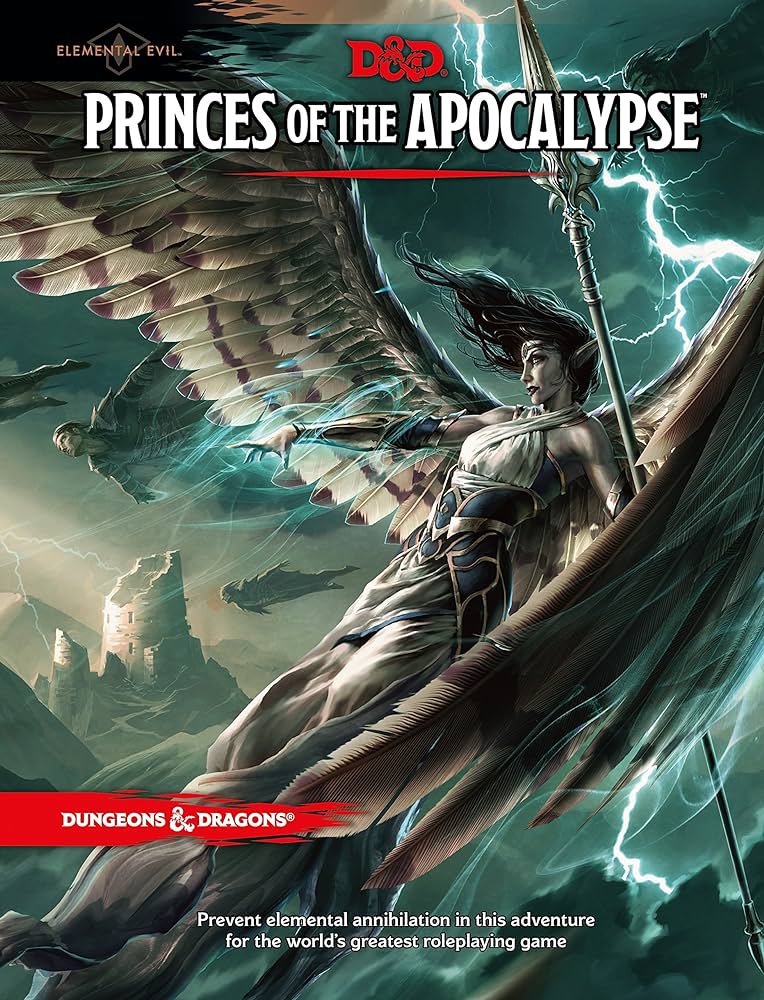
Princes of the Apocalypse, Session 0: “The Wake”

We kick off a game that’s going to last us the next 2½ years.

Princes of the Apocalypse

This is part of an a series my DMing Princes of the Apocalypse, a D&D 5e adventure by and copyright Wizards of the Coast.

Table of Contents. The Party.

There will be SPOILERS. If you are playing in a PotA game, please don’t read this. If you are DMing a PotA game, or are a DM who wants to see what the ride was like … read on!


So two recaps were kept per session. I had a short GM Recap — “When Last We Left Our Heroes” — available as a hypertexted Journal entry in Roll20 for the players to consult (I always started each session reading from it). There was also for much of the campaign a Player Recap kept by my lovely wife, which usually included a lot of color text. It was kept in the Roll20 forum for the campaign. I’m going to include both.

GM Recap

The party was summoned as individuals by Gemvocs Leofhyrn, an oracle of Waterdeep, and given the task of stopping some great evil arising in the Desserin Valley by saving The Mirabar Delegation.

Player Recap

The Invitation

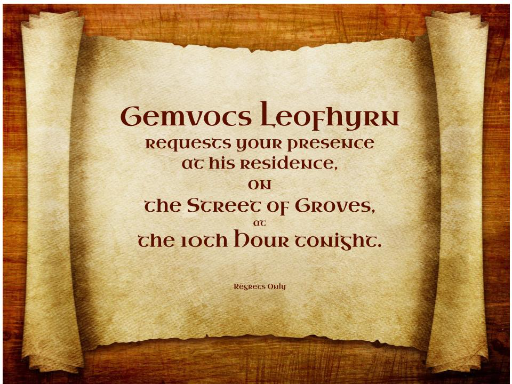
Theren: Comes to town for reagents. The halfling shop keeper hands him an envelope. Inside is a note on fine vellum, in a good hand, offering an invitation from Gemvocs Leofhyrn.

Faith: During her exit interview from the temple orphanage with Edgrid bids Faith farewell and wishes her solace and peace. A donor, one Gemvocs Leofhyrn, has made a small endowment for Faith and they send her off with travel goods and some spending money. There is also a note that arrived when you endowment was made. Faith shares the contents with Edgrid. 

Nala: In the mercenary hall, there is a steady flow of people in the hiring hall and the main hall is a swirl of merchants, runners, and members. An urchin comes in from the street and runs up to Nala. He delivers a high-quality envelope with a note in fine vellum, an invitation from Gemvocs Leofhyrn. Nala thinks they might know the name, but she can’t pull it from her memory, until she passes an apothecary. Early after their departure from the clan, her parents were very sick. The innkeeper brought medicine for them. What is odd is that the innkeeper had received the bottle before the Dragonborns had even arrived.

Moony: Wandering the markets and thinking of where to bed down, when an ornate carriage draped in white catches his eye. Random passerby points out the funereal nature of the carriage. Moony jumps onto the back of the carriage and slowly rides to the funeral until a guard shouts at him to get off. After he disembarks the carriage continues on. A slender man hands him an envelope from Gemvocs Leofhyrn. After some comedy Moony reads the note.

William: A women in peasant dress steps up and engages with William and similarly gives him an envelope. William knows the name Gemvocs Leofhyrn. At one point his father received a note from a stranger suggesting that he plant a different grain and included some money to purchase it. The next year the new plants thrived and the ordinary crop failed. It saved the homestead from a very hard winter. 

An invitation from Gemvocs.

Rumors:

Theren – Blue dragons have seen. (“Not again!”)

Nala – River levels are not what they should be. Either too high or too low. Also, a fortune teller has left town for Baldur’s Gate because it is safer.

William: Castle is buying a lot of supplies in preparation for a big treaty negotiation.

The House on the Street of the Groves

Valkh
Valkh – I loved this guy

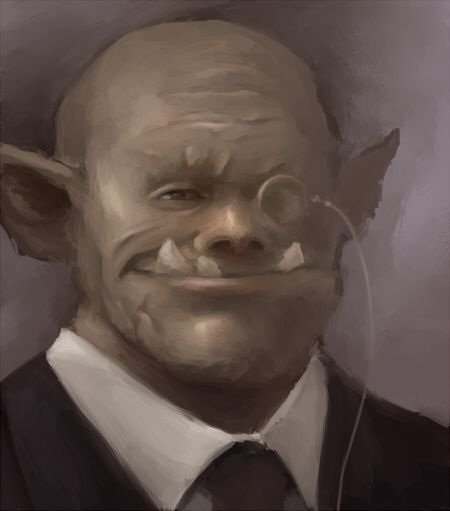
Valkh the half-orc majordomo for the late Gemvocs Leofhyrn

Richly appointed, the walls and shelves lined with odd curios from distant lands and books whose spines are often illegible with age, or with foreign script. Magical lighting above illuminates the room dimly. Plush chairs are on either side of a fireplace and a central table, where a small cask sits, an incense burner placed atop it it.

Smoky Ghost Host.  Speech [below].

Game Notes

The Party

The party, starting out, was five:

  • Moony – the Tabaxi rogue, constantly looking for shiny things and distractions. Having left his homeland for adventure, he’d sailed on merchant vessels before, getting bored, he’d just arrived in Waterdeep.
  • Nala – the Dragonborn fighter from a disgraced clan, a former Waterdeep city guard (leaving that group because of political and criminal corruption), searching for a noble cause but reluctant to become a leader. 
  • William – the Human druid from a rural community, seeking knowledge and growth, as well as the soothing balm of the forests (which he would get none of this campaign).
  • Theren – the Half-Elf sorcerer, a hermit afraid of the fire powers that nearly killed everyone around him. Anti-social but charismatic.
  • Faith – the Human cleric, a newly emancipated orphan in the midst of a crisis of faith between LG and LN.

In Session 11, a new occasional (between college terms) party member joined:

  • Aldrik — the Dwarf Barbarian, gruff and taciturn, and of odd interest to a number of the bad guys.

The Characters and Session 0

Prior to the above game log stuff, we did the standard Session 0 business. Everyone had been building, in light collaboration, their characters, prior to our get-together (virtual get-together, through Discord and Roll20). As mentioned previously, we’d not gamed together (TTRPG) as a group together before, but I’d gamed with all of them. Four of us had only just gotten back into D&D over the previous year during the Tyranny of Dragons campaign (including the GM of that saga). The other couple included someone who’d been out of D&D since the 3.5 days, and his wife, who’d done a lot of TTRPG in the college and post-college days, but not with D&D specifically and not for quite a few years.

My son, who also wanted to play, was dealing with that inconvenience of college, which meant I’d need to deal with his character on again and off again — which, in a sandbox environment like PotA, shouldn’t be a lot of trouble, right?

(It was, in fact, a lot of trouble, but it also let me add some additional layers and flavors into the campaign. I’ll talk about them later.)

We also spent some time touring Roll20, our VTT for the game. It’s what we’d used in Tyranny of Dragons, so most of us were familiar with it, but even there I’d discovered a few tweaks and wanted to establish some defaults as we got started. That included the main Roll20 screen, character sheets, token, and macros. 

I’d previously created in the Roll20 forum for the campaign separate threads for 

  • Character Builds (not much used after the initial activities)
  • Scheduling and Logistics (also not used much after early discussions)
  • Rules (house rulings on how things worked, and simplified explanation of 5e rules, often added in following a session where a question came up)
  • Fun (usually an excuse to post D&D memes)
  • Game Logs

We also decided who was taking notes for the game log (William’s player, my wife) and who was tracking treasure (Faith’s player).

Then I rolled into the session stuff described above and below, and we were off to the races.

Starting a PotA Campaign

Princes of the Apocalypse can be started  (per the book) in two ways.

  1. Players can begin as gathered, experienced adventurers in the town of Red Larch starting at Level 3, ready to head out into the Dessarin Valley and see what’s going on there. 
  2. Or they can begin as Level 1 characters and go through some preliminary adventures in and about Red Larch first before setting out.

I made the decision to go with the latter — I wanted people to get used to their characters, and the system, and, frankly, I wanted the padding of time and experience to make it all work and get back into the DM swing of things. Also, Red Larch as a setting, and some of the side quests off it, were fun (for me, at least). I think it was the right decision.

Oddly enough, the book sort of presumes you’ll do the Level 3 start. Chapters 1-2 are setting the strategic and tactical situation, including a bunch of info about Red Larch and other places in the Dessarin Valley. Then Chapter 3 starts you off at Level 3 going to the Keeps, Chapter 4 has you going through the Temples, Chapter 6 has the final fights in the Fane and the Nodes … then Chapter 7 has the Level 1 adventures in the Red Larch area, as well as side quests that can pop up anywhere. It’s definitely not how I would organize such things in a book, and it made the original distribution of material within Roll20 even awkward to use. I was already starting to reorganize things within those Roll20 journal entries.

(As a side note, the book clearly states on the back cover that this is an adventure for Levels 1-15. In Chapter 1, it clearly says, “This adventure is designed for 3rd-level characters.” And the last node is noted as being designed for Level 14 characters, presumably dinging up to 15 at the end.)

But all of that begs the question of how our party got together in the first place. The book offers two choices.

First, the campaign provides a number of hooks (mostly focused on those 3rd level sorts). There are a couple of pages of individual ties and hook suggestions — some friends of yours were kidnapped, one of the named NPCs killed your friend, someone hires you to break a loved one free of a cult, etc. These were pretty ho-hum once I looked at them, and all to a degree just hand-wavingly assume that after you succeed, you’ll be sucked into the great battle against Elemental Evil. Maybe.

Second, there’s some somewhat heavy-handed influence from the Factions, the groups in Faerun that run things behind the scenes (something that was sort of new in the 5e books and still sort of being worked on). But none of the players opted into any of the Factions in their character creation (though I suggested it was available), and much of the Factional material involves …

The Mirabar Delegation

This is a group that was traveling down from Mirabar (a dward/elf enclave away up north) down the Long Road to Waterdeep — three representatives from up there, plus a Waterdhavian noble (whose name is Deseyna Majarra in some campaign material, and Deseyna Norvael in other places, he said, rolling his editor eyes), plus some other hangers-on (a librarian, the body of a Knight of Samular being sent home for burial, etc.). 

The ambush of the delegation, and the kidnapping of their members by various cult factions, is supposedly the thing that really draws the attention of the powerful to the goings-on in the Dessarin Valley, and kicks off the proceedings.

But there are three problems with the whole Mirabar Delegation storyline:

  1. The map-drawing around the kidnapping of the Delegation just makes no sense. I had to layer a lot of extra story to explain why these kidnappers went way over here to be attacked by those cultists rather than just going to this other place and being safe.
  2. A lot of GMs writing about this campaign have said that the Delegation is just not that engaging, as written, to their players. In part, I think that’s due to those GMs not being engaged by it, but part of that may derive from the third problem.
  3. The Mirabar Delegation are MacGuffins (definitions here and here). I mean, there’s the mysterious coded message, and the important books, and the secret seeds, and there’s the undying gratitude of certain Factions if they get rescued. But ultimately the Delegation members themselves aren’t a dependent part of the story. If you never mentioned them, if they vanished without a trace, it would impact nothing. They are purely there to (a) attract the Factions’ attention, and (b) give the party something concrete to pursue before learning about the Real Menace.
I wanted something more — or at least I wanted to make more effective use of the Delegation.

The Ghost Host with the Most

Gemvocs
Spooky!

Enter Gemvocs Leofhyrn, the greatest Oracle of Faerun you’ve never heard of,  spoken of only in shadows and among the very powerful (and only in my campaign).

The first name was a play on “GM vox” or voice, and the last name an Old English version on my own name. Gemvocs was literally the voice of the GM, me, laying out the stakes and getting the action into play. 

So …

All the characters were starting in Waterdeep on the same day, doing business in accord with their characters’ story, and hearing various rumors about rising water levels, weird phenomena up north, a big meeting being scheduled by the Lords Alliance, etc.

All of them received, in various mysterious ways, an invitation to the home of Gemvocs — a figure who has in the past played a role in their lives (Gemvocs sent some seeds to the farm of one player’s family when a child, which saved them from famine; Gemvocs paid for a young orphaned girl’s education as a cleric, which she discovers as she leaves the orphanage today; etc.).

When they arrive, separately, at the person’s house at the appointed hour, they discover the gathering is a wake — Gemvocs died mysteriously a few days earlier (burned to death in his bathtub), and his half-orc majordomo, Valkh, had distributed the invitations as previously instructed. It’s good to be  the employee of an amazing Oracle.

It becomes clear, during all this, that Gemvocs has known about the approaching moment of crisis for decades, including observing / protecting / supporting / recruiting the individual party members, to bring them all there at that time. (That orphan girl discovered the invitation, addressed to her, was included with the endowment when she entered the orphanage years ago.)

They all get a big incense-driven vision presented to them — the equivalent of the videotape during the reading of the will:

Greetings, my friends.

It has been an honor to be of service, directly or indirectly, to each of you. I must confess, it has not been selfless of me. I knew that I would need to call on your service some day, though I had not expected under such belated circumstances.

I wish to hire you to a purpose. To the north of this city, in the Vale of the Dessarin River, a group of people — a delegation traveling from the great mining city of Mirabar — is lost. They were due here a week ago. I knew of their coming but … they fell into darkness, somewhere in the Dessarin River valley.

Over the last year or so, my vision of the future for that region has grown clouded. I have caught … glimpses, unfathomable, of ruin and light, of destruction and cleansing, of events that could shake the world — and destroy it.

I know it sounds alarming. Believe me, you get used to it.
I have arranged for you to travel to the town of Red Larch on a caravan that leaves on the morrow at Noon. Seek the caravan of Mistress Lela Linber. Your presence will be of assistance.

When you arrive, — I don’t know what you will do, which is an odd circumstance for me. You might speak to the constable, Harburk Tuthmarillar — an honest man who has been of service in the past. But … there are so many voices, some of fear, some of care, some of deceit, some of madness — it has all gotten very confusing.
Regardless, I beg you: find the delegation. I do not know what has happened to it, but I do know that finding it is essential to stopping the evil. And I do know yours — each of yours — presence there can do it, if it can be done. It is your fate, one way or another, just as this is mine.

You will be provided with 25 gold pieces for any last-minute supplies you need. And, once the threat has been resolved, there will be — (smile) — 30,000 gp for the survivors to divide amongst themselves. I’m not sure how many that will be, so I’ve picked a neatly divisible number.

Heh. Oracular Humor.

Be well, my friends. But be vigilant. I jest, but I can afford to do so, for I am dead now. You, amongst the living, face a far greater, more fraught challenge. Find the evil that lurks in the Dessarin Valley. Find those who are … who are lost … but do not delve too deeply … too quickly … Something, something is awakening — an Eye is about to open, and when it does, all will be cast to ruin!

(Shudders.) Ah, well. (Smiles sadly.) Time for my bath. Fare you well.

And it was in that bath that he died horribly, presumably from Fire Cultist jiggery-pokery.

What I tried to do with all this:

  1. Set up the party as a party. Give them a reason to be together, even as each has their own motivations for doing so.
  2. Convince them that Something Big Is Afoot. After all, Gemvocs said so. And has been preparing for this for decades. And his discussion is all laden with doomsaying and references to the Elemental Evil Eye,. 
  3. Provide that focus on the Delegation. But note that Gemvocs never says that the Delegation itself is all that important, just that “finding it is essential to stopping the evil.” Find the delegate members, and in doing so you’ll perforce be thwarting the real threat.
  4. Provide them with significant information and initial resources, but not give them someone they can run back to. They are on their own.

The players seemed to like it, enough to willingly step into the trope of “we are in this together” and not fight against it, which is all any GM can hope for.

And that was the first session, which, for being all-talk and no-combat, worked out pretty well.

<< Pre-Campaign Thoughts | Session 1 >>

D&D 5e/5.5e Rules – Initiative and Cunning Plans!

Not surprisingly, a bunch of heroes clustered in a corridor are not quite as coordinated as you might think.

Know the RulesPart of an ongoing series of 5e (2014) Rules notes.  See the end of the post for notes on 5.5e (2024) rules.

So something happened in the game the night before I wrote this up that, at the time, I kind of blew through, but  I wanted to give it some thought. This is, of course, just the sort of thing I have sometimes taken justified criticism for overthinking. But it’s a situation we’ve run into more than once, and I’d like to have figure out a rubric for myself to adjudicate against.

And, as a caveat, it’s always worth noting up front that time and combat in D&D are abstractions designed to turn the chaos of real-life combat into something manageable. While a level of verisimilitude is the goal, manageability always trumps that. Just as D&D is not a physics simulator, it’s not a great combat simulator (falling somewhere between an FPS and Chess).

When the slow guy is supposed to lead off the attack

So, here was the sitch: as the party crept up two different sets of stairs to the upper floor where the local BBEG had their throne room, the plan was that Theren the Sorcerer was going to begin combat by lobbing his Vitriolic Sphere into the center of the bad guys.

How should the combat have been sequenced? Even handwaving aside the question of whether anyone knew that Theren was going first (there was probably an excess of allowable coordination between the two subgroups, since they were going up two different sets of stairs and not using any sort of communication magic) …

  • Did Theren’s action take place outside of the Initiative order? Did his executing the attack start the combat so that’s when everyone rolls Init?
    • (Short answer: no.)
  • Did Theren’s Init get changed to the top of the Initiative order? Since he’s the one initiating the combat?
    • (Short answer: still no.)
  • Did everyone with Init rolls before Theren sort of get skipped over? (That’s what I did, but it effectively means that those higher Init rolls become low Init rolls, which is “unfair”.)
    • (Short answer: it should have been “voluntary”)
  • Did everyone before Theren in the Initiative order (ally and enemy) actually get to go in some fashion before Theren did?
    • (Short answer: it should have been that way, yes.)
  • And did it matter if the bad guys were surprised or not?
    • (Short answer: Yes and No. But in this case they were not — the Baroness had perceived you coming up the stairs and called for you to come in and play.)

Warriors! Come out to play!

In 5e, combat takes place with the Order of Combat:

  1. Determine Surprise.
  2. Establish positions.
  3. Roll Initiative.
  4. Take turns in rounds of combat.

In short:  Initiative is rolled when combat begins. You can not make an attack outside of Initiative

So, no, Theren doesn’t get to bypass the Initiative roll, or have his Init moved to the top of the order, or whatever. (Some folk have house rules for this, but that creates its own problems.)

So let’s simplify the situation a bit and say that the top Initiative order, when rolled, was (leaving out other players and bad guy mooks):

  1. 20 – William
  2. 15 – Baroness BBEG (the enemy)
  3. 10 – Theren

The first question is: is there Surprise? This is determined before Initiative is rolled, technically, though I don’t think it makes a difference.

If you’re surprised, you can’t move or take an action on your first turn of the combat, and you can’t take a reaction until that turn ends. A member of a group can be surprised even if the other members aren’t.

So if Baroness BBEG were surprised by this attack out of nowhere in her throne room (ignoring the previous sounds of the battles below), it counters her Initiative to a large degree. The beginning of the combat can be handled this way:

  1. William says he is choosing to Ready an attack if anyone runs up to the top of the stairwell before his next turn. He’s doing this to let Theren get that shot off as agreed, rather than running into the middle of the room and spoil the AoE plans. It’s essentially giving up his turn, but there you go.
  2. Baroness BBEG is Surprised — she’ll effectively see Theren coming, but will be unable to act on her turn. After her turn occurs, she would be able to take a Reaction (if she had Counterspell, she could then use it against Theren’s impending attack), and she will be able to act normally at the beginning of her next turn.
  3. Theren pops up and acid bombs everyone’s ass.

So Surprise mechanics make things simple(r), because they provide for higher-Init enemies to be locked in place (but ready to go next time).

But in the case of the game that triggered this discussion, there was no Surprise (the party simply wasn’t stealthy climbing those stairs). Which means that there is a disconnect between Intent (lob an Vitriolic Sphere before they can act) and Execution (oh, they acted before I could lob my Vitriolic Sphere, because they had better rolls on Initiative). Or, as one site I saw put it:

“If your player wants to stab the bandit in the face before he has time to act, that’s what a high Initiative roll is for, not a Surprise round.”

Without Surprise, it’s Theren starting to move for his guns first, but the other folk outdrawing him.

“But Dave,” you may say, “she couldn’t see Theren before he came up the stairs.” That’s true, but because she isn’t Surprised (i.e., she was aware of a threat, and so ready to act/react), she still is able to act first as she chooses, because her Initiative is higher.

This gets into the whole idea that 6-second Rounds are themselves an abstraction — if there are six people in the room it’s not that Person 1 literally goes in the first second, Person 2 in the second second, etc. It means that within that six second timeframe, Person 1 acts before Person 2, who acts before Person 3, etc. That doesn’t completely match reality, because not everyone is declaring their actions before they happen as in some games (so that higher Initiative folk know what is coming), but it is essentially how 5e abstracts “People running around and into each other with intent to do mayhem.”

So here’s what should happen (should have happened in this simplification of last night):

  1. William does whatever he’s doing — Dodging, Readying an action, casting Spike Growth in the middle of the room to make sure that nobody runs away before Theren can act, whatever. He’s choosing to back Theren’s play, but still moves faster/before Theren does, because he has higher Initiative.
  2. Baroness BBEG Readies an action.” Because I’m the GM, you don’t get to know what it is (“Chuck my magic spear at the first person atop the stairs over there”). Neener-neener. But she declares this (whispering in the GM’s head) before Theren because she isn’t Surprised and has higher Initiative.
  3. Theren reaches the top of the stairs and turns to cast his spell …
    … and Baroness BBEG executes her Readied action (throwing her spear at the first person atop the stairs, Theren, which hits) …
    … and, if still alive, Theren throws his Vitriolic Sphere.

(Note: one of the players reminded me afterwards that Theren was Invisible. This gets into Perception checks, Active vs Passive, etc., to deal with his footsteps and verbal components, etc.  In which case she might have been Surprised or she might have been aware something screwing was going on and still chucked her spear with Disadvantage against an Invisible foe before Theren could cast his spell (which would then drop his Invis).

Note that Theren could have said, “Well, heck, they aren’t Surprised so someone might plan to attack me” and change his plans from what had been intended. Or maybe, despite his intent and the team’s plans, William might have taken their Action to attack or distract the Baroness, which might have led to another change of plans by Theren. While Initiative lets people act first, the structure of the game from that point means that people are aware of the actions taken previously by people with better Init, allowing them to revise their plans accordingly.

(In the Action Economy, there’s a significant advantage in going first … but after that, Initiative is like Time: just a way to keep everything from happening at once.)

The bottom line is

  1. You can’t easily plan your way into something that is the equivalent of Surprise (“I go before anyone else does”) if there is no Surprise present and you roll a low Initiative. That’s what Initiative is kind of for — if you roll poorly, you go later in the round.
  2. If the other players who would have gone first want to effectively skip/delay their turn (do a Dodge or a Ready or maybe even a Help), that’s their prerogative for the tactical situation.
  3. The enemy is under no such obligation, and if any of them have higher Init than the “this is how I am starting this combat” attacker, they get to do their thing first (which may be standing there in Surprise, or may be shooting you under the table).
Han rolled higher initiative
Even if Greedo intended to fire first.

Here are some articles that touch on this — which, given the volume, shows this is something a lot of GMs fret about, though most of the scenarios here involve Surprise, which, as noted, simplifies the question a lot.

“We get ready to enter the room”

So there’s one more area where this kind of thing has come frequently into play, the “We arrange ourselves at the door and charge in” scenario, when the Doughty Fighters at front roll crap Init (because they used DEX as a dump stat) and everyone queued up behind them rolls better Init than them and basically have to:

  • Move through the Doughty Fighters (as Difficult Terrain, and potentially exposing themselves to attack, which is kind of why you wanted the Doughty Fighters to run in first).
  • Ready an Action to move in when the Doughty Fighters have and the space is clear (but not then being able to attack or anything, because Ready only lets you take a single Action or a Move).
  • Fire ranged attacks past the Doughty Fighters (if the angle through the door cooperates).
  • Waste their turn.

The bottom line there is: yup, those are kind of your choices when everyone in front of you is slower. Hopefully the bad guys inside the room are Surprised!

So what’s different in 5.5e?

dnd 5.5/2024The new 5.5e (2024) rules are fundamentally the same, but with a few differences that can affect the above conversation.

First, Surprise is handled differently. Rather than the sort of complex (and deadly) “Everyone rolls Initiative, but Surprised folk don’t get any sort of actions until their first turn, and then they only get Reaction(s) until their second turn,” instead, it’s “Everyone rolls Initiative, but Surprised folk do so at Disadvantage.”

Much simpler, and it still means Surprised folk may get badly hurt unless they have a very high Init modifier or roll really well. Especially if the folk on the Surprising side have managed their Stealth, successfully Hidden, and therefore get Advantage on their Init rolls.

5.5e also addresses the question discussed above: “How do we let the guy who’s going to initiative combat actually do so?” While still insisting on keeping everything inside the Initiative framework for combat, the new PHB and Basic Rules favor the combat initiator by allowing the DM to give them Advantage on their Initiative roll. The problem can still happen, especially if the party wants to give the first shot to someone who used DEX as a dump stat, but it doesn’t hurt.

Second,  squares containing Allies/Friendlies on a grid map are no longer considered Difficult Terrain. That makes clearing the corridor into the room a lot easier, even if folk are not lined up by Initiative (which, technically, they can’t be anyway).

The Once and Future D&D

WotC’s latest announcements on where the new D&D not-an-edition is going are … interesting.

If I read this article correctly …

OneD&DWell, first, begone “One D&D”!  Welcome “D&D 2024”! The concept is, I think, kind of the same, but now they are adding a year on there so that it will sound out of date at some point.

The new core books will be … a thousand pages long? Crikey.

The reason for that length?  All the old stuff (“D&D 2014”) will still be in there, alongside the new stuff (“D&D 2024”).  You don’t have to choose! You can mix and match and blend and use it all, because it will all be backwards compatible, in all directions! Fun for all, especially the GM (who has to keep all these things in mind) and various software systems that have to keep track of double the rules and selected options.

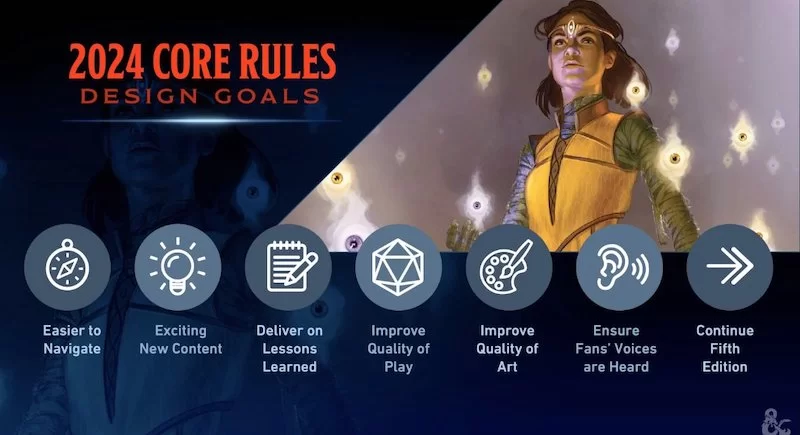
New DnD2024 Design Goals
Also, free puppies in every box!

WotC is trying to have it both ways:  a new system to be excited about (and to buy books for), but not obsoleting the old stuff (though you’ll really want the new stuff because some players will want the new stuff).  So all that money you invested in D&D 2014 stuff is still a good investment, except that you’ll want to buy the 1000-page core books for the new version because that’s what all the cool kids will be doing.

I’m fine with their sticking with the basic 5e mechanics, which are sound. But the forward-backward compatibility stuff is dodgy. I still would rather they just call it 6e or 5.5e and be honest about it.


D&D 5e House Rules

I tend to be rule-abiding. But sometimes the rules just aren’t fun. So … sometimes the rules need to change.

So here are the house rules we play with at my table.

I tend to follow the Rules as Written (RAW), sometimes the Rules as Intended (RAI), as makes sense. I’m not big into whole-hog replacing play-tested sub-systems, if only because I’ve seen how easily that can send things heterodyning all over the place.

That said, not all rules are created equal, and things that make for grinding busy-work and management by the player or GM can usually be elided or adjusted when playing with mature individuals who are there for fun.

My House Rules

  1. I use Inspiration. I also encourage players to nominate each other’s characters (or call out their own character to me) to receive Inspiration. It’s a fun mechanic to reward special moments of RP or action.
  2. Bookkeeping that is no fun is no fun.
    1. I tend to be loosey-goosey about Material spell components, except for expensive ones. (Verbal and Somatic I do pay attention to.)
    2. I tend to be loosey-goosey about encumbrance, unless things look ridiculous.
    3. Keep track of your arrows. I mean, it’s not that big a deal. When guidance is needed, I use the “you can recover half your missiles from any combat.”
  3. Dead bodies constitute Difficult Terrain.
  4. We play on a square grid. We use the basic “1 square vertical, horizontal, or diagonal = 5 feet” variant in the PHB 192, rather than the someone more accurate “the first diagonal square is 5 feet, the second is 10, the next is 5, etc.” variant in DMG 252, because it’s just simpler.
  5. Leveling takes place during a Long Rest. Unless for meta purposes it makes sense to do it some other time. But, in general, “I just realized, I know more spells” seems more suitable to happen overnight than while walking down a path.
  6. I prefer Milestone Leveling to getting finicky about XP, dealing with absences from encounters or the table, etc., in ways that leave players unbalanced. Defining adventure goals as the basis for leveling just makes more narrative sense to me, and makes it easier for me and the players.
  7. You take a Short Rest as you Long Rest.  So you can be back up some HP if attacked before the end of your Long Rest.
  8. I tend to Roll Actives vs use Passives, since VTTs make it trivial to do so.
  9. You can use a successful Dexterity (Acrobatics) roll to keep you from going prone when you land from a fall, vs a DC equal to the damage you took (stick the landing!).
  10. Flashing Before Your Eyes: Any time you are dying during your turn (other profound incapacitations might apply), the DM (if he remembers or is reminded) will ask you a question about your character or their history. If you answer the question, you get Inspiration.
  11. If an obstacle to your ranged weapon is closer to you than to what you are shooting, you can ignore the obstacle (no cover); otherwise, use the cover rules (usually half-cover, AC+2). I.e., a close obstacle can be easily shot around.
  12. Ranged attacks with altitude difference: (Discussion)
    1. thrown/twanged weapon at a higher altitude target: the effective range is the sum of the horizontal and vertical distance
    2. thrown/twanged weapon at a lower altitude target: the effective range is the greater of the horizontal or vertical
    3. spell: the range is the sum of horizontal and 1/2 the vertical.  
  13. People may be assumed to be sleeping in their armor, unless humor or the DM who has a specific reason for it otherwise make a note that it is not so. Changing out of or into armor is time-consuming and Not Fun. If there are no 5e rules penalizing swimming in armor, we can assume that in this world armor is lightweight and comfortable to wear and sleep in.
    1. In a similar fashion, it’s assumed peoples’ weapons are always with them, unless it is noted otherwise by players or DMs. That would be socially (and logistically) awkward most of the time, but the alternative is a lot of Not Fun moments.

Concluding Notes

Finally, I always try (though sometimes fail) to remember two things about Rules and D&D:

  1. D&D 5e is not a physics simulator. It’s not even a great combat simulator. Appeals to reality are less important than verisimilitude (feeling like reality), and both of those are less important than keeping the game rolling along smoothly.
  2. The Rule of Cool should always have a place at the table. If someone proposes doing something one-off that is going to be one of those cool moments in a movie that people will talk about for ages … don’t worry about RAW, but remember why you’re all gathered around the table to begin with.

D&D 5e/5.5e Rules – Help!

You can, in fact, get by with a little Help from your friends.

Know the RulesPart of an ongoing series of 5e (2014) Rules notes.  See the end of the post for notes on 5.5e (2024) rules.

Everybody wants to be the hero.

Every character wants to be the one to land the killing blow.

But sometimes, it’s better to ask for — or give — some help.

A lot of player characters, especially in the support classes, have spells that will enhance other people’s rolls, which is very cool.

But in a sense, everyone has that ability, through the Help action (PHB 192):

Helping with Ability Checks

You can lend your aid to another creature in the completion of a task. When you take the Help action, the creature you aid gains Advantage on the next ability check it makes to perform the task you are helping with, provided that it makes the check before the start of your next turn.

This mechanic is explained more under “Working Together.”

Sometimes two or more characters team up to attempt a task. The character who’s leading the effort–or the one with the highest ability modifier–can make an ability check with advantage, reflecting the help provided by the other characters. In combat, this requires the Help action.

A character can only provide help if the task is one that he or she could attempt alone. For example, trying to open a lock requires proficiency with thieves’ tools, so a character who lacks that proficiency can’t help another character in that task.

Moreover, a character can help only when two or more individuals working together would actually be productive. Some tasks, such as threading a needle, are no easier with help.

So it’s not enough to Help by holding the thief’s tool kit while they are picking the lock, or shouting encouragement to the guy trying to climb a cliff wall. You have to be able to do the thing you are assisting, and describe how you are helping.

What is the difference between Help and Working Together? The former is an action type during combat. As GM, I might be a little lenient on combat-setting “how are you helping?” actions, e.g., “I stand there, looking menacing at the attacking goblins, while screening the Rogue from view as she tries to pick the lock so we can get out of here” (you’re not directly assisting with the lockpicking, but you are sacrificing your action to let the Rogue focus on their without worrying about being stabbed = Advantage!).

Helping with Combat Rolls

More frequently, Help is applied directly to combat situations.

Alternatively, you can aid a friendly creature in attacking a creature within 5 feet of you. You feint, distract the target, or in some other way team up to make your ally’s Attack more effective. If your ally attacks the target before your next turn, the first att⁠ack roll is made with Advantage.

This might be a way, for example …

  • If you know the opponent has resistance or immunity to your flaming sword, maybe you can be more effective Helping the other fighter who uses a cold-based weapon.
  • If you know the opponent will be hit harder and more effectively by an ally (because of the nature of their weapon, or just because they have a huge damage bonus on strength), you might consider whether its worth effectively giving up your attack(s) for them to get an attack at Advantage.
  • If your Rogue wants to get Advantage for their Sneak Attack.  Your standing within 5 feet of the target automatically allows the Rogue to Sneak Attack for extra damage; giving them Advantage on the roll through Help is icing on the cake. (See also below, “A Moving Distraction.”)

Note that this not a matter of Reach, but a 5 foot limit. So if someone with a Glaive (a Reach weapon that can attack at 10 feet) wants to provide Help, they need to step in to 5 feet from the opponent.

Also note that Help is just for the first attack (To Hit) roll. That makes it somewhat more useful at lower levels, when you are only sacrificing one attack to make that happen, and the bonus is going to the only attack the attacker has to use.

Help is also usable to assist with spell attacks, granting Advantage on any sort of spell attack roll against that target. Again, the Helper needs to call whom they are helping.

Finally, Help is an action frequently assigned to familiars and animal companions and the like — these often cannot attack, but can be commanded (or urged) to “Help the Fighter!” (“Bark bark!”)

As a GM, I like to encourage players to give me some idea of what they are doing to “help” in this way. “I wave my hands and attract the orc’s attention.” “I feint toward her to grab her attention.” “I shout, ‘Ashtuk, is that you?'” No mechanical effect is applied except the Advantage it provides, but it’s nice color regardless.

Am I Helping a specific attacker?

Yes. Probably. “I am going to Help the Rogue with their attack on the goblin I’m next to,” Not “I’m going to help someone on our side attack the goblin, whoever gets in their blow first.” That seems to be the standard read.  In which case, if the Paladin goes after the goblin first, they do not get the Advantage bonus. And if the Rogue decides on a different target, the Help has been wasted.

This has been a matter of dispute, though, even among the game designers, with Jeremy Crawford asserting that you don’t have to identify a specific ally to Help, and Mike Mearls suggesting you do.  I read the language (above) as being about “a friendly creature” and “an ally,” which I interpret as being “in particular”; I could see, though, interpreting it “in general.” … so ask your DM!

A Moving Distraction

One final note:  It is quite arguably the case that you don’t need to end your movement next to a target in order to use the Help action. You could, in theory, run up to the  monster, “Help,” then backpedal away. This has been confirmed by a WotC Sage Advice Compendium:

If you use the Help action to distract a foe, do you have to stay within 5 feet of it for the action to work?
No, you can take the action and then move away. The action itself is what grants advantage to your ally, not your staying next to the foe.

How does that work? Because each round is 6 seconds long, and a lot happens in that 6 seconds. You don’t need to keep standing next to someone to have effectively distracted or feinted toward them within that six seconds.

True, you’ll still an Opportunity Attack unless you can get a Disengage in there some way, like through a Rogue’s Cunning Action.  But this can be a handy tactic for Helpers like a familiar owl using its Flyby ability.

(Note that Sneak Attack makes it very clear that the 5-foot proximity alternative to getting Advantage, to allow a Sneak Attack, needs to be measured at the time the Rogue is attacking.  So you can’t just run by a target and have them suited for a Sneak Attack on the Rogue’s later turn … but you can run by, doing as Help as you pass, and the Rogue will then have Advantage and therefore be able to Sneak Attack the target even if nobody is standing next to them.)

So is this different in 5.5e?

dnd 5.5/2024Why, yes, yes it is.

The basics are much the same in 5.5e (2024) as in 5e.  Info on the Help action can be found under Actions in the PHB and Basic Rules “Playing the Game.” The Summary for Help is short, sweet, and to the point:

Help another creature’s ability check or attack roll, or administer first aid.

In more detail, in the Vocabulary “Help [Action]” item talks about these.

Helping on a task

Assist an Ability Check. Choose one of your skill or tool proficiencies and one ally who is near enough for you to assist verbally or physically when they make an ability check. That ally has Advantage on the next ability check they make with the chosen skill or tool. This benefit expires if the ally doesn’t use it before the start of your next turn. The DM has final say on whether your assistance is possible.

The main difference here from 5e is being more precise about when you are qualified to Help someone — the answer being, if you have Proficiency with the skill or tool they are using (rolling on).

Again, you don’t have to be standing next to them: you can yell advice to someone using Athletics to climb that rock wall (“Don’t grab that brown rock — go for the black one next to it!”) as well as help your Rogue pick a lock … if you have Proficiency in doing the activity yourself.

Helping in Combat

Assist an Attack Roll. You momentarily distract an enemy within 5 feet of you, giving Advantage to the next attack roll by one of your allies against that enemy. This benefit expires at the start of your next turn.

The notes written about 5e above still pertain except that you are clearly not helping a specific ally with the attack, but any “one of your allies” (the next one who attacks that target).

That might in turn argue that if you are playing in 5e (2014) still, this new, clearer read should be treated as a clarification of, not a change to, the 5e ambiguity about this. Ask your DM.

Anything else?

It’s not mentioned in the Vocabulary, but the Summary mentions “administer first aid”. This actually refers to Stabilizing a Character, which reads:

You can take the Help action to try to stabilize a creature with 0 Hit Points, which requires a successful DC 10 Wisdom (Medicine) check.

Stabilizing is the lowest level of medical care, basically stopping the still-unconscious person to stop bleeding out. Using a medical kit or or administering first aid (which will bring someone back to consciousness) takes more time.

There’s additional (or parallel) information in the Group Checks article.


D&D 5e/5.5e Rules – Grappling and Restraint!

Grappling and Restraint sound similar, but aren’t. How do you make them work for you?

Know the RulesPart of an ongoing series of 5e (2014) Rules notes.  Notes on 5.5e (2024) rules are included below.

Questions about this pop up sooner or later in every campaign, as it’s an area that 5e either does fine or poorly, depending on which online forum you go to or  specific question you examine.

So what happens when instead of bashing each other with hunks of steel or eldritch energies, you get up-close and personal

You can attack to Grapple

This is discussed on PHB 195. Essentially you use one of your Attacks to make a skill contest:

  • Attacker: roll Strength (Athletics)
  • Defender: roll Strength (Athletics) or Dexterity (Acrobatics)

In other words, Grapplers need to be a lot better at that skill, or be pretty darned strong.

If you win, the target is Grappled (technically, has the Grappled condition, PHB 290).

Which, honestly, doesn’t do much.  It basically reduces Speed to 0, even if the target has other features that increase its speed beyond base.

But a grappled target can still punch grappler, stab them, etc. They are more restrained by being within 5′ of their grappler (which gives them Disadvantage on spell attacks or ranged attacks), but melee attacks are just fine.

Grappling does keep the grappled target from running away until help arrives or until the target breaks the Grapple. They can try that by  taking their Action to roll Strength (Athletics) or Dexterity (Acrobatics) vs the grappler’s Strength (Athletics) again

The grappler can also slowly (half speed) drag a grappled target with them — or continue attacking them at close range (with no particular advantage, and with the same disadvantages).

Note:

  • When you have Grappled someone, you are not yourself considered Grappled.
  • When you have Grappled someone, you are using up one hand (the other hand is considered free for attacks, etc.)

Aside from breaking free of the Grapple through a contest, it can also be broken by:

  • The grappler being Incapacitated.
  • An effect knocking the grappled target out of the reach of the grappler or the Grappling effect, e.g., being knocked away by a Thunderwave.

Note there is a Grappler feat you can take. This gives you Advantage on attack rolls against someone you are grappling, and the opportunity to pin (restrain) someone (through another grapple check).

5.5e handles this a little more simply.

dnd 5.5/2024Grappling is part of the Unarmed Strike category, but instead of doing damage on a hit, and rather than an Athletics/Acrobatics contest (5.5e hates contests), the target has to make a Strength or Dexterity save vs a DC of (8 + attacker’s STR mod + attacker’s Proficiency Bonus). It’s simpler dice rolling, though the attacker will need to provide some numbers to make it work.

Once grappled, a player can keep the grapple, attack the target (with a hand not in use), move the target, or release.

The target can escape by using their action for a Strength (Athletics) or Dexterity (Acrobatics) check vs. that same DC.

The Grappled condition in 5.5e adds to it:

  • Grappled creatures have Disadvantage to attack rolls against anyone other than their grappler.
  • If you move someone you have grappled, instead of halving your speed, each foot costs an extra foot of speed — similar to difficult terrain, which means it stacks with it. (This doesn’t apply when the Grappler is two sizes or more larger than the Grappled.)

Once Grappled, someone can use a Utilize and a pair of manacles to bind a Small/Medium Grappled (or Incapacitated, or Restrained) creature on a Dexterity (Sleight of Hand) check against DC 13.

The Grappler feat is also rewritten. Once per turn if you hit with an Unarmed Strike, you can both do damage and try to Grapple them. You have Advantage to attack creatures you have grappled, and you can move them around at normal speed (if your size or smaller). (It also gives you +1 ASI for Strength or Dexterity.)

What if more than one person at a time is Grappling you?

While executing a Grapple takes one Attack (of however many you have within your Attack action), escaping a Grapple takes an entire Action. If more than one person has you Grappled, you can only escape one Grapple per turn … which means tag-teaming Grapplers can seriously cause you a problem.

Monster and Spell Grapples and Restraints

This is where things get a little tricky. Or more straightforward. You decide. The Grappled and Restrained conditions are quite separate, but come up a lot in spell and monster attacks: e.g., a Giant Octopus you Grappled with its tentacles; a Web spell causes the Restrained condition (PHB 292).

  • Just like with a Grapple, a Restrained creature’s speed becomes 0, and it can’t use any bonus to its speed.
  • Attack rolls against the Restrained  target have Advantage, and the their attack rolls have Disadvantage.
  • The Restrained target also has Disadvantage on Dexterity saving throws.

(5.5e does the same thing with its Restrained condition.)

(Note that the Grappler feat lets the grappler get Advantage on the Grappled target — but, more interestingly, it lets a grappler roll a second Grapple attack, which, if it succeeds, means both the grappler and the grappled target are both Restrained. Which actually seems kinda sucky.)

So, Dave, how do I do something useful with this?

Grappling by itself is kind of limited in what it can do. But with a little work, it can make an effective attack.  So  how do you grab an opponent and actually subdue him.

The vast consensus I’ve read on this is Grapple them (so they can’t get away) and then do a Shove attack (PHB 195, same Ability checks as the Grapple) to knock them Prone …

…  at which point they get the Prone condition’s effects (PHB 292), and as Prone:

  • they can only crawl (but not if they’re Grappled and at speed 0!)
  • or they can get up (but not if they’re Grappled and at speed 0!)
  • they are at a Disadvantage to attack (Prone!)
  • attacks on them have Advantage (Prone!)
  • … and they probably have to use their whole Action to try to desperately break the Grapple.

People have created whole builds around this.

Are you, the attacker, also Prone at that point? A good question. Consensus seems to be “No, but describe what you are doing to your DM.” I’d think of it as the arm twist behind the guy on the ground; you’re enough on your feet that you are not considered Prone, and can defend attacks normally (albeit with one hand), etc.

Given that, as long as you maintain this, you can continue attacking the Grappled+Prone guy and other folk can attack them, too, with Advantage, and that should distract them from attacking you back (as they desperately try to break the Grapple).

Consensus is that Grappling is much better (when by the players) in 5.5e (2024) than 5e. Monks, especially, are seen as natural beneficiaries of this.


Princes of the Apocalypse – Pre-Campaign Thoughts

On D&D, me, my DMing philosophy, my home rules, and why I ran PotA.

Princes of the Apocalypse

This is part of a series about my DMing Princes of the Apocalypse, a D&D 5e adventure by and copyright Wizards of the Coast.

Table of Contents. The Party.

There will be SPOILERS. If you are playing in a PotA game, please don’t read this. If you are DMing a PotA game, or are a DM who wants to see what the ride was like … read on!


Our group’s previous game was winding up — the whole big Tyranny of Dragons two-fer, GMed by a friend of ours — and I was hankering to do some DMing myself.

This is that story.

So who am I?

I’ve been playing FRPGs (as Fantasy TTRPGs used to be called, back before being Table-Top was a minority position) for over four decades — but rarely actual D&D.

  • In college my gaming group did a lot of homebrew FRPGs. Mine was loosely based on mechanics from Runequest. While other students were spending their Saturday nights getting blitzed, I was reworking my spell books and setting up errata for the following Friday’s game. Or hand-drawing elaborate invitations for same. I had no life, but it was good. (It was especially good because it was in a friend’s game that I met my future wife, so huzzah for gaming!)
  • Post-college, I got heavily into GURPS (oh, the crunchiness!), a variety of Super-Hero RPG rules, and Amber Diceless Roleplaying (oh, the non-crunchiness!).
  • In the early 00s through 10s, the gaming group I was in got pulled into the D&D 3.5 orbit, and we did a lot of different games and settings. I myself DMed a number of campaigns, including some fun spy-based stuff (run both under FATE and using the D20 Spycraft rules). We also did a lot of indie RPGs — Sorcerer, Nobilis, and the like.
  • The 20s brought the Virtual Tabletop — an answer to “How do we, as adults with kids, drive to a game after work, play a game, drink beer during the game, then drive home safely after the game?”  We were eventually doing Roll20 stuff well before COVID, and loving it. Sure, it meant much less of an excuse to binge on Nacho Cheese Doritos, but it meant a lot more opportunity to game, and with people outside the geographical area.  We did a lot of gaming in that context, but some of my favorite used Powered by the Apocalypse (PbtA) rulesets, esp. Masks.
  • And then a friend of ours offered to DM a game for his wife, and me, and my wife (the same one as see first bullet above) — the whole Tyranny of Dragons D&D 5e campaign. And this led to much buying of 5e books. And we would do it over Roll20 (even though we lived just 5 minutes away from each other) because (a) parenting and then (b) COVID. And it all worked beautifully.

Which, again, once it came to a close, was my cue to step up and be the DM for the first time in a decade-plus. No small trepidations there, but, rather than rolling my own scenarios, I’d be using modules, which … for better or worse … I thought I could deal with. But what would I DM …?

The Campaign’s the Thing

My criteria for what we were going to play?

  1. I wanted an official WotC campaign. That seemed the safest bet. It was limiting, but I figured it had the biggest resource base (producer and players) and so would be the best errata’d and “fixed” through both the company and the community. 
  2. I wanted something that would run characters up through most of their potential levels. In other words, a long game. Going from 1-5 would then mean looking for something more. If I could find a game, like the Tyranny of Dragons, that would take the characters up toward the max, I’d be quite happy.
  3. I wanted something supported by Roll20, our VTT of choice (or at least what we were used to, and that’s a debate for another forum). I mean, I was sure I could scan something in and build maps and things like that, but I didn’t want to bite off more than I could chew. (Ha!)

So I read through reviews, weighing things that looked cool vs. things that looked daunting. And finally decided on Princes of the Apocalypse — a wide-ranging, level 1-15ish (13, actually, but some of the lit says 15) romp across open terrain and underground and fighting against the end of the world as we know it. 

And, overall, it was a good choice. It’s a complex project, lots of moving parts, and very sandboxy (or, rather, non-railroady). In ToD, it all felt like “Okay, you have done X, now on to do Y.” In PotA, it’s much more, “Okay, you have done X … what are you doing now. Oh, yeah, there’s Y, Z, Q, and any other direction one might want to go.”

Let me do a quick eval of PotA and some of its strengths and weaknesses.

PotA Writing and Age and Support

PotA came out in 2015, one of the earliest 5e campaigns (though post-ToD), which means lots of folk have played it and DMed it. While this could mean spoilers, etc., it also means that there’s a lot of advice for things to do/not do, supplemental home-brewed materials, and so forth. I drew on that a lot, and will highlight materials I used further down the line.

It is, though, an “older” game, meaning that a lot of the lessons that WotC (and others) have learned in module construction in 5e since the system went live aren’t here. There are places where it plays more straightforwardly than it might, and places were it’s not quite as sophisticated a story as possible. A good DM, though, will be ready to apply appropriate scalpel and spackle to make those rough edges work.

There are also some weird disconnects between the artwork and the text — due, from what I’ve read, to a months-long gap between when the illustrations (including maps) were due and the text of the module finally pinned down. As a result, there are rooms that have content that doesn’t match the description, places where maps are mislabeled, or where imagery in the book doesn’t match up with the story which doesn’t line up with the maps (the layout of Feathergale Spire and Sighing Valley and the larger scale maps and where the compass points are and so forth is nuts).

For that matter, the book has a big appendix of “here’s some crazy concepts we had about what these sorts of characters look like, but rejected as too crazy,” which is awesome, but they don’t always have what they actually settled on. 

There were also way too many places that were significant settings, but with no maps to go with them. Beliard? Womford? Summit Hall? Sorry, we blew our budget on Red Larch. A lot of the side missions, especially out of Red Larch are similarly short-changed.

(Note: between the time I started the campaign and the time I ended, 2½ years later, I discovered a minor industry on Etsy that filled in some of those gaps that I filled in myself. The Internet can be your friend.)

Similarly, I’m a believer that if you, as a module, are going to name an individual, you should give us, the players and DM, an image of them — even if it’s a stock image, or not all that complex. PotA continuously let me down here, and that got compounded once we got into Roll20.

The Virtual Tabletop

The Roll20 support of PotA was huge factor, and it made a tremendous difference. I never want to do a non-VTT D&D game again. And the Roll20 adaption itself was … not bad. Indeed, in places, it was invaluable, with the dynamic lighting already mapped out (halfway decently, and as time went on, I did a lot of remapping of that dynamic lighting).

In other places it was also not good — or not as good as I wanted. Most of the dungeon maps were done at half-scale, blown up to the point of fuzziness, and didn’t align to a 5-foot grid (in the book they have a 10-foot grid and are really set up for that, but that’s not how 5e works). Light sources were also inconsistently applied (compared to the text descriptions). 

There wasn’t a single map I didn’t end up tweaking in one place or another — adding in a detail that was described but not illustrated, changing the light/shadow barriers, changing the token layout, etc.

Bad Token
I paid money for this token?

Speaking of tokens, aside from some mediocre token art or cropping suggestions in too many places, there were also way too many cases where named characters (characters with backstory and motivation and so forth) either didn’t get their own tokens (e.g., these two NPCs are merchant traders with names, but we’re going to use the same “Noble” token to represent each of them), or else tokens with just their name in text.

This drove me nuts, and I spent a lot of time redoing or creating new tokens. (Tokenstamp is your friend!)

Another area I found frustrating with the Roll20 adaptation out of the box is that they had too coarse a granularity in how text was broken down into journal entries. Too many things (or people!) that should have been in in their own entries came lumped together, making both sharing material or using it (or even finding it with the simple title search engine!) a big pain. I ended up, again, investing a lot of time into breaking stuff up into logical chunks and vastly reorganizing it to my use and way of looking for things. While this helped me understand the material a lot better, it still felt like I was gamma testing the whole module

Overall, the Roll20 implementation of PotA is a huge time-saver for VTT users (beyond just the value of VTT systems themselves). What was provided was far better than my having to start with a PDF or hardcopy module and adapting it into the VTT. But the fit and finish were … not up to snuff for my taste. WotC needed to supply more art resources; Roll20 needed to improvise where WotC didn’t.

The PotA Sandbox

There were plenty of warnings that this was a difficult campaign to DM — and, to a degree, play — because of the openness of the world. Railroading is a cardinal sin for D&D; as a player, I like an indication of where the story wants me to go, but an option to outflank it. 

PotA commits the opposite sin of railroading — lack of guidanceThere are usually prompts of things that are brewing that the players can choose be guided by, but often multiple prompts, in multiple directions, with multiple ways of getting to them. There are a thousand different courses one might take, and very few guard rails to keep your characters from (a) skipping stuff that they really shouldn’t be skipped, or (b) getting into over-their-heads trouble too early.

Part of dealing with that is just DM management (putting up guard rails, hidden or not), part of it is learning to let go a bit.

The other thing the sandbox meant as we got into it was that prep for me as DM was much more … holistic. “Where are they going next” became “Where might they go next, and where might they go that I’m not thinking of.” That had an upside because it meant I had to read (and regularly re-read) a lot of material ahead of time (letting me come up with interesting ways to tie it together that aren’t in the book), but it also meant always feeling like I was running the Red Queen’s Race to stay ahead of my players — or calling to mind in The Fugitive Deputy Marshall Gerard’s comment about Richard Kimball’s flight:

All right, listen up, ladies and gentlemen, our fugitive has been on the run for ninety minutes. Average foot speed over uneven ground, barring injuries, is 4 miles per hour. That gives us a radius of six miles. What I want from each and every one of you is a hard-target search of every gas station, residence, warehouse, farmhouse, henhouse, outhouse and doghouse in that area.

That’s what it took to consider where the players might go next.

All that said, there is a delicate balance between players being led by the nose from encounter to encounter, and players being clueless as to what to do next. PotA leans toward the latter a bit too much, which makes more work for the GM if the players are not to be frustrated.

Storytelling

There’s a metric ton of stories going on in PotA, both side bits (Red Larch alone could support a campaign) and in the overall saga. The number of types of “dungeons” one encounters is extraordinary. Each of the four Keeps feels very different, for example, as do the elemental Nodes. And the underlying epic — the history of the Dessarin Valley and Tyar-Besil, the battle between evil elemental princes and how it’s played out in the Keeps and Temples, the characters in the Keeps and Temples and Nodes — it’s all very rich, and a lot to play with.

Unfortunately, a lot of it gets thrown away, unseen. Unless the GM really digs into their imagination, there’s little opportunity for the players to learn much of anything about most of the oppo characters encountered, aside from some brief monologuing by the bosses before they get gacked. If you rotated the Prophets in the Temples (Aerisi as Prophet of Fire, Marlos as Prophet of Air, etc.), it really wouldn’t significantly change the story, because there isn’t really an opportunity to interact with them (or their followers) in a meaningful way.

(For all we get descriptions about the different mentalities of each cult’s membership and motivation, when it comes to a wave of mooks charging at you at 5th Level, its really doesn’t seem to matter much which cult they are from.)

There are also a few places where the story makes little sense. Mapping out the course of the Mirabar Delegation, when/where they were taken, and their later travels as captives of the Black Earth cult (e.g., the basis for the Shallow Graves encounter) makes absolutely no sense. Or, rather, you can handwave some sense into it, but it’s a rough haul, and the book blithely ignores / underexplains it.  It’s up to the GM to papier mâché something that will hold together.

That all said, it’s still a rollicking adventure that presents challenges and increasing pressure for the players to avert the rise of the Princes. Whether a group is a hack-and-slasher, or leans heavily into role playing, a GM can tailor the campaign accordingly with what’s given.

It’s a long haul, and not an easy one, but it can all work out out well.

Essential Resources

These sites and links were really useful to me when I was starting off:

A Guide to Princes of the Apocalypse – A tonne of discussion and notes and summaries chapter analyses and observations and maps and links. Worth reading and re-reading at strategic points of the game. 

Walkthrough and notes on PotA – Good overview of the campaign.

Outline and notes for the campaign – great DM reference material on how to run the campaign.

Outline/flow chart of the campaign, showing suggested player levels and how places/dungeons are geographically and narratively connected.

Index to the PotA book – Places and Dungeons, at least. Still, better than what WotC provides.

Reference Sheet of characters, places, connections, in the early/Red Larchy days of the campaign.

Advice on running Chapter 6 (Level 1) — Good early-days advice from SlyFlourish.

Advice on running from Red Larch through Rivergard Keep – good discussion of sandbox vs linear play in the early levels of PotA.

Update:  Here are my House Rules.

This Series

So I kept extensive notes through most of this campaign. My goal is to share them here in this blog, covering the 84 sessions of play we had over a couple-plus years. It may provide some insights over how to run the game, or just some general DM notes.

We had fun with this campaign. I hope you do, too.


Session 0 >>

D&D 5e/5.5e Rules – Flanking, Facing, and Fumbling!

And now some rules I DON’T use

Know the RulesPart of an ongoing series of 5e (2014) Rules notes.  Also included are for notes on 5.5e (2024) rules.

One of D&D 5e’s strengths is trying to keep things simple. There’s a fair amount of complexity, but after 4e’s highly tactical structure, 5e leans on the KISS principle where it can.

That said, the DMG provides all sorts of optional rules that can add in a bit of crunchiness to things, or a bit of complexity (fun fact: Feats are optional rules.). Early on in my Princes of the Apocalypse campaign, I decided the following would not be part of my game, and I had no regrets.

Flanking

I gave some very serious thought to using the optional Flanking rules from the DMG (p. 251):

Flanking on Squares. When a creature and at least one of its allies are adjacent to an enemy and on opposite sides or corners of the enemy’s space, they flank that enemy, and each of them has advantage on melee attack rolls against that enemy.

When in doubt about whether two creatures flank an enemy on a grid, trace an imaginary line between the centers of the creatures’ spaces. If the line passes through opposite sides or corners of the enemy’s space, the enemy is flanked.

I’ve been playing D&D with miniatures my entire gaming career (hex and squares), so the whole “Theater of the Mind” that 5e tries to get back to after the uber-tactical 4e is, for me, just not something I can do. As such, Flanking (which was big in 3, 3.5, and 4) feels natural. “Get on either side of that dude; he can’t protect himself from all directions.”

The consensus (though not unanimous) conclusion of the Internet is that the 5e Flanking rule doesn’t work well:

  • Advantage is too big of an, um, advantage for this (“Advantage is an enormous benefit that lands 13 or higher 50% of the time, is almost twice as likely to crit, and has 1/20th times as likely to botch.”).
  • Maneuverability in combat is now easy enough (previous editions allowed Opportunity Attacks when walking around an opponent) that Flanking allows Advantage to come up too often, unbalancing everything (and deprecating a lot of other rules / Feats / actions that provide Advantage).

It’s been suggested that, as a house rule, rather than Advantage, a small uptick in the To Hit could be given (e.g., +1 or +2). This, though, flies in the face of 5e’s philosophy to avoid those endless kind of plusses/minuses that became overwhelming (it’s thought) in 4e and slowed everything down; that was the point of the Advantage/Disadvantage rules. (Roll20 makes it a little easier, but I understand their point.)

One suggestion I’ve also seen is that the Help move (PHB 192) takes the place of Flanking:

Alternatively, you can aid a friendly creature in attacking a creature within 5 feet of you. You feint, distract the target, or in some other way team up to make your ally’s attack more effective. If your ally attacks the target before your next turn, the first attack roll is made with advantage.

Help is way-underutilized as a move; for player characters, there’s always a “But I want to be the one to hit him!” feeling. But the suggestion has been made that, esp. against a powerful opponent, this maneuver actually does more net good by helping a high-damage person hit more reliably, and its use doesn’t break anything.

So, for the time being, I don’t do the optional Flanking rules.

(Flanking was not included in the new PHB or DMG for 5.5e, even as an optional rule.)

Facing

I am also don’t using the optional Facing rules (DMG 252), which are pretty crunchy and, honestly, are more of a PitA on a VTT because of the need to define facing of, and perform rotation on, the tokens. 5e has a sort of situational awareness vibe going on, and, as an Ease of Use rule, I’m fine with that.

(Facing was also not included in the new PHB or DMG for 5.5e, even as an optional rule. 5.5e dropped a lot of optional rule suggestions from the new DMG.)

Fumbling

This isn’t actually a 5e optional rule, but I grew up with Fumbling — having some sort of ill effect happen on a Nat 1, beyond just missing — being a Big Thing, and everyone sill always laughs about what happens when someone (preferably not them) rolls really poorly.

(A Nat 1 in combat is an automatic miss, which is about as Fumbly as 5e is willing to go.)

I eventually ran accross a ThinkDM article with the best reason for not having Fumbles (Nat 1 rolls) “do something bad,” especially in combat.

As characters advance, they get (in most classes) the ability to make multiple attacks each turn. This is particularly true with Fighters, who eventually can be making four attacks in a turn.But if you have a 5% (1/20) chance of fumbling in any given attack, the cumulative chances of fumbling in a round begin to climb …

Fumble chances with multiple attacks
Wait, what?

Missing is bad enough; a more disastrous effect becomes counterintuitive. Or, as the article notes, “A level 20 Fighter shouldn’t be dropping their weapon every 30 seconds.”

(A thought that comes to mind is having the “fumble” effect/table kick in only on the last attack of someone’s chain. So our intrepid fighter still only has a 5% chance in any given round, and if they want to play it uber-safe, they can sacrifice their last attack as they “take their time.” I’m not going to do that, but it would ameliorate a lot of the concern.)

Of course, a lot of that depends on the fumble table one uses. This was a matrix that described the “special effect” that came with a fumble — not just a miss, but a humiliating miss. This one, from the Arduin Grimoire, was all the rage back in my college days (though in those distant times it was rendered in cuneiform on clay tablets):

Arduin Grimoire Hargraves Fumble Table
Ouch

It was a simpler, more blood-thirsty time.

Still, at the level of abstraction 5e runs at, there’s really no good cause for this that can’t be covered by color text or, in case of a real run of bad luck, a symbolic penalty of some sort. That’s up to the GM to adjudicate.

Anyway, math.

ADDENDUM: Here’s an additional ThinkDM rule idea: a Fumble only occurs if you fumble all of your attacks on your turn. That means that higher-level folk are much, much less likely, though it can be, um, very unfortunate for a 1st level fighter.

An even better alternative raised in the comments there would be to have a Crit or a Fumble provide Advantage/Disadvantage for the next roll for 1 turn. If I were going to adopt anything as a house rule (which I don’t think I am), it would probably be this last one.

Dungeoneering 101

Have the rules for dungeon survival changed much over the years?

Read an article at CBR.com on “How to Survive an Old-Fashioned Dungeon,” by Jennifer Melzer, and it made me think of how my group is doing in the somewhat-old-fashioned Princes of the Apocalypse campaign.

So … let’s take look!

Carry a Light Whenever Possible

Old school, yes, this was essential. It still is — key races don’t have Darkvision (etc.). On the other hand, in my opinion, this quickly gets into logistical annoyance. How many torches are you carrying? How much longer will your torch last? How’s the lamp oil supply doing? Do you have to drop your torch to use your weapon? Did the torch get left behind when you fled? Is the DM keeping track of that stuff, or the players?

Speaking as a player, that was never fun. In our college homebrews, we just figured that “Continual Light batons” were SOP at the magic markets and left it at that. (We also called them “Continual Light begonias,” which was much funnier after a few beers.)

In PotA, between an early light-emitting artifact the party found (per the module) and light spells the party has, this has not been a real issue. Indeed, it’s often been the opposite, with my occasionally having to warn the party (before or after they are bushwhacked) that wandering down dark halls while brightly lit up will probably not help their Stealth rolls.

(Side note here: VTTs that manage lighting / vision, like Roll20, can be fussy and fiddly, but, damn, the effect is awesome.)

Never Separate the D&D Party

A general truism, even today. Technically speaking, encounters  are scaled for the full party — splitting the party means you’re going to run into things you are not ranked up for. Similarly, challenges of various sorts are often keyed to abilities or knowledge that only a subset of the party has; if a different subset encounter them, frustration ensues.

That said, sometimes it makes logistical sense to split things up, especially if it’s to send someone on an errand back through already-cleared terrain. As a GM, I try to play it fairly: no intentional piling on a wandering warrior, but no pulling punches, either. Random encounters can be a thing, though they can also be more easily scaled down to fit the people who are off in another direction.

The worst part about a split party is that it makes keeping the multiple groups all engaged and interested a greater challenge. I’ve played as a player in games where a split meant sitting around, bored, for 45 minutes while the DM did side quest stuff with their favorite players. Not good show.

Create a Dungeon and Map As You Go

Wow. I remember when we had to do that. Always bringing graph paper to the game– “You said the room was left three squares and up four squares from the door?” Especially pre-battle maps, this was always a PitA, and a guarantee of error-filled “Wait, how can this room be here, that would overlap this other room” time-wastage.

Again, VTTs can solve this problem quite neatly. In Roll20, our party can easily see where on the level they’ve been, its contours, etc. It’s a bit of realism compromise that works.

Note that this is most important if you are playing on a grid (my preference). If you are doing “Theater of the Mind,” it’s a lot easier to abstract out this kind of stuff, even if the picture-is-a-thousand-words aspect of maps is more difficult to handle that way.

Don’t Underestimate the Dungeon’s Environment

Environmental challenges can make things interesting, and different from endless corridors and rooms. Different dungeons should have different feels. PotA has been good at this, aided thematically by the elemental cults involved, and the nodes have been particularly strong this way, leading to environments that are not just window dressing, but actual challenges in and of themselves. Fighting a melee in a wind that requires a STR save each round to avoid being pushed back, or exploring a realm of underground rivers and lakes and waterfalls exercises different mental muscles, and gives the DM different tools to make encounters more challenging than just adding more mooks.

Having the environment — breezes, smells, sounds, even tastes in the air — changing and giving clues (some legitimately misleading) can and should keep people on their toes.

Exercise Caution with Everything in the Dungeon

I’m not a believer, at all, in the Killer Dungeon. It quite quickly turns into Not-Fun, and for me, D&D is about story-telling, not body count. Tapping every floor tile, checking for traps at every door, getting killed by gold slime masquerading as a door knob … that’s just not my cuppa, as player or GM. Being hypercautious all the time slows the story down, and gets repetitive, and disasters meted out by such things then feel arbitrary and unfair.

That said, the occasional trap, deadfall, Mimic, etc., where it makes sense, can keep people on their toes. Complaisance should not necessarily kill, but some good woundings are reasonable.

PotA is pretty good here. There are a few puzzles, a few traps, but not so many that it becomes a drag. In fact, I might have asked that it be a bit more challenging — people, esp. our Rogue, sometimes are sometimes a bit blasé about scouting things out, and a few more traps might worth inserting.

Avoid Unnecessary Enemy Encounters

Define “unnecessary”.

I agree that full-dungeon sweeps aren’t necessary. They might not even be fun. But if the encounters (and their treasure) have been well designed, skipping some of them can also mean missing out on some fun things, even under the rubric of We’ve beaten the Big Bad in this zone, let’s get out of Dodge before our spell slots run out. And, again, if things have been written well, the treasure or other clues that drop from an encounter might be useful, or even necessary, later on in the campaign.

That said, not all enemy encounters need be combat, either. Trickery or even honest negotiation can be useful, and it’s up to the DM to figure out when this might actually make sense. Allied but rival factions might step aside; outnumbered mooks might surrender (and then maybe fight another day). Murder hoboes can be fun to play … for a while. But they make it hard to tell a good story.

PotA provides a lot of hooks here — distinctive costumes to wear, passwords, competitive enemy factions you can play against each other, and material pre-written that you can use if the party decides to bluff its way in rather than just leave pools of enemy blood on the floor. The players in my game have tended to under-utilize this option, sometimes to my frustration, but it’s good that possibility was considered.

Don’t Give the DM Ideas to Use Against You

We once had an informal rule at our table: if the player suggested an terrifying explanation for something that was worse than what the GM originally had in mind … it was off limits. For a while, at least.

The advantage of playing with a canned module is there’s not that kind of temptation.

In sum …

The article in question shows how much hasn’t changed in the world of FRPGs. Most of these rules still apply, as moderated by the quality of the DM, the module (as applicable), and the players. Some of the old school grinds — mapping things out, torch logistics, etc. — are easily (and, to my mind, properly) avoided. Others — don’t split the party! — are evergreen. A word to the wise is sufficient.

D&D 5e/5.5E Rules – Falling!

Into every game some character must fall.

Know the RulesPart of an ongoing series of 5e (2014) Rules notes.  I have also added notes on 5.5e (2024) rules.

Sooner or later, a question of falling comes up. Maybe it’s a pit trap, or a shove off a bridge, or an unsuccessful jump, or an expired flying spell, or …

It’s (always) a good time to remember that the goal of 5e is not to recreate actual physics, but to provide easy, quick, workable verisimilitude, generally favoring the players. The falling rules are  a good example of this.

The basics

The basic rule is simple:

  • At the end of a fall, a creature takes 1d6 bludgeoning damage for every 10 feet it fell, to a maximum of 20d6.
  • The creature lands Prone, unless it avoids taking damage from the fall.

(In 5.5e, the Falling (Hazard) is similar.)

It can’t be that simple, right?

Hans Gruber falling in Die Hard
Fun Fact: Alan Rickman was dropped before he was expecting it, leading to some great facial expressions as he fell.

Of course, that raises other questions, many of which are answered in optional DMG/XGE/TCE rules.

  • You will “instantly” fall up to 500 feet in the turn you begin falling. You then fall an additional 500 feet at the end of each succeeding turn.
    • This mean no intervention by self or others during that first 500 feet if you don’t have a Reaction ability (such as Featherfall).
    • But after that everyone, including yourself, may be able to do something.
    • Note that though you fall 500 feet, you reach terminal velocity (so to speak) after only 200, given a max damage of 20d6.
    • From a physics perspective, in five seconds you will fall 180m, or 590 feet, so this is actually pretty realistic, at least that first turn.
  • Flying creatures that need to actively move to fly will fall if they are (a) knocked prone, (b) have speed reduced to 0, or (c) lose the ability to move. If the creature is noted as being able to hover, or is being held aloft by some spell effect, this doesn’t apply.
    (In 5.5e, this is framed, “While flying, you fall if you have the Incapacitated or Prone condition or your Fly Speed is reduced to 0. You can stay aloft in those circumstances if you can hover.”)

    • The first round they will fall 500 feet minus their current flying speed.
    • In the case of the “prone” condition, they can on their next turn (if the ground doesn’t intervene) “get up” (using half their movement) to recover.
  • If you fall into water, make a Strength (Athletics) or Dexterity (Acrobatics) check; if you succeed, damage is reduced by half, per TCE. (Ditto for 5.5e.)
  • If you fall onto another creature, per TCE, the target must succeed on a DC 15 Dexterity save to avoid being impacted by the falling creature:
    • Any damage resulting from the fall is divided evenly.
    • The impacted creature is knocked Prone, unless it is 2+ sizes larger than the falling creature.
    • I’d rule that intentionally falling onto another creature probably takes an Dexterity (Acrobatics) check (perhaps against their AC?).
    • This is different from creatures that attack by dropping onto their targets or leaping onto them from above. They will often have specific rules about damage they might take when doing so (e.g., the Piercer).

How do you avoid falling damage?

A number of ways.

  • The Featherfall spell is cheap and easy and is cast as a Reaction, reducing falling speed to 60 feet/round, and landing you gently on your feet. It can affect up to 5 targets within 60 feet, including yourself, and lasts for a minute. (Pretty much ditto in 5.5e.)
  • The Monk ability Slow Fall feature is possibly a bit misnamed, but essentially you can use it as a Reaction to reduce falling damage by an amount of Monk Level x 5 hp. (Pretty much ditto in 5.5e.)
    • Earlier editions required something to slow you down (grabbing the wall, tree branches, etc.), but 5e does not; think of it as a three-point “hero landing.”


  • The Enhance Ability spell lets you pick “Cat’s Grace” as its DEX version. Among other things, it means the recipient “doesn’t take damage from Falling 20 feet or less if it isn’t Incapacitated.” (The 5.5e version of this does not include this ability.)
  • Using a Fly spell (etc.) will help, but only if it’s a fall of over 500 feet, otherwise you won’t have a chance to cast it before hitting the ground (unless you can cast it as a Reaction). (The 5.5e version does the same.)
  • There are a variety of abilities that let you reduce damage to yourself or others that seem to apply here, e.g., Spirit Shield, Bastion of Law, Guardian Coil, Song of Defense.
  • Anything that gives you resistance/immunity to bludgeoning damage will likely help here, depending on how it operates.
  • Note that someone else using a Slow spell won’t help, as the falling creature‘s speed isn’t a factor in the damage or distance. (It doesn’t completely make sense, but them’s the rules).
  • Note that Athletics/Acrobatics do not, by RAW, do anything around reducing falling damage, though they have in previous editions. That’s all physics, baby. (Ditto in 5.5e.)
    • I would, though, support a house rule that a successful Dexterity (Acrobatics) roll vs. a DC equal to the damage you took might keep you from going Prone (sticking the landing!).

Game Review: For the Queen

An imaginative, prompt-driven, story-generating fun time

We needed to fill in for a Friday D&D night where we wouldn’t be at full strength. So …

For the Queen billboard

I’ve played For the Queen a few times before — with actual cards and a table-top — and enjoyed it. In this case, with our band of friends, it was still easier to do in Roll20 on a VTT, and it so happens that the game has a Roll20 version.

The Basics

The game is GM-less (except for someone to kind of help with rules, VTT oddities, etc.), so everybody plays. That’s a bonus for me.

The group decides on a queen from a deck of pictures, all of them interesting and with possibilities just visually.

The story setting is literally this simple:

  1. The land you live in has been at war for as long as any of you have been alive.
  2. The Queen has decided to undertake a long and perilous journey to broker an alliance with a distant power.
  3. The Queen has chosen all of you, and no one else, to be her retinue, and accompany her on this journey.
  4. She chose you because she knows that you love her.

And that’s it. The setting, the war, the journey, the time period, the nature of the queen, the nature and roles of the characters, all come out from the players as, one at a time, they draw Prompt cards that ask questions. E.g.,

  • You were summoned to a private meeting with the Queen once. Why did you feel disappointed afterward?
  • What do you do for the Queen that no one else can do?
  • Who is this distant power you are travleing to, and why do they make you uneasy?

Other players can expand on those questions with suggestions or follow-ups. A player can also pass a card on if they can’t think of an answer … or they can use an X-Card option to delete a card (or answer) that is problematic or that they simply don’t want to see in the game.

Players can give their answers in whatever tone or voice they like (“Jason was really upset when …” or “I always look forward to …” or “Dear Diary …”). Most folk (in my limited experience) to third person.

The focus of most of the cards (explicitly or implicitly) is the character’s relationship with the Queen. We know the Queen has chosen you for this trip because she knows you love her. But … is she correct? Do you? Why? Why not? Is that feeling pragmatic? Romantic? Dutiful? A clever (or desperate) facade? How unalloyed is that love? What, if any, are its limits?

And how does each further answer given by someone else color what you think?

All that’s going to be tested, at the very end …

The Queen is Under AttackPlay goes around the table, slowly building up and riffing off of each other’s answers and what facts (or opinions) have been established. This goes for 30-120 minutes until the game-ending card is drawn:

The Queen is under attack. Do you defend her?

At which point play proceeds around the table one more time, with all the players/characters each answering that question. It could be a description of a staunch defense. It could be a sketchy partial defense short of death. Heck, I’ve seen videos of games where one of the players was the attacker, taking their vengeance with a knife to the back.

I.e., just like everything else, the nature, and possibly the result, of the attack is dependent on the story being told. The aftermath may never be known (or may be discussed later over beers). But at that point the game is over.

Playing on a VTT

This game works very neatly in Roll20 (you can buy it from the Roll20 store) because it’s rules-light and functions on card decks — an instructions deck, a deck of queens to select from, and a deck of 46 prompts.

(You could, if you have a boxed set, actually recreate it in Roll20, but it might not be worth the effort.)

Roll20’s card deck mechanics can be a little wonky, but the pre-settings of the mechanics worked neatly for players drawing Prompt cards, and the GM can take care of the shuffling and bringing out and hiding the decks, which is really all you need.

The other advantage that Roll20 provides, to my mind, is a desktop to write down notes as people expand the mythos of their characters, the world, and the Queen.

Our Game

We ran in Roll20 with a group of five (was to be six, but someone was under the weather at the last moment).

I decided it would be more expeditious to simply pull the rules into a single handout, rather than walk through people reading each individual rule card. That’s a charming mechanism, and would work well getting a group of players used to talking aloud with card draws, but it seemed unnecessary. Plus I was busy tweaking some of the rule actions and notes (e.g., just asserting that the GM would flip three Queen cards and that the players could then choose).

The standard timing mechanism is to slide the “The Queen Is Under Attack” card into the Prompt deck manually — about halfway down for a 30 minute game, or lower down for something longer (as the canon established become more elaborate, the game slows down some). I used a suggestion I saw from the game’s creator and simply set a timer for the group-desired time (an hour). When the “The Queen Is Under Attack” card came up, I simply pulled it aside until the time went off (in retrospect, I should have just dealt it to myself to hold until then).

I had pre-randomized the players to establish play order, putting their names on the edges of the tabletop  as a place to scribble notes. I also added a couple of areas for lore about The Queen and The Realm.

I made extensive use of those note areas, and, in fact, wrote the notes for most of the characters myself — because that’s me, and because I can type quickly and could do it while people were talking.

Though there was a lot of lore casting aspersions on the Queen (indeed, one of the players started off with a card that she’d planned an assassination attempt on her), only two of the characters ended up not really defending her. The exchequer whose dog the Queen had killed took advantage of the final attack to try and kill her, and the tax collector moved off to protect the treasure they were carrying. Two of the defenders were half-hearted, still wanting something from the Queen but not willing to lay down their lives if it came to it.

It having been established that the Queen knew black magic (which was how she had held off that first assassination attempt), it was only when the knight of the realm (me) assured her he’d give his life for her that she said, “Yep, that’s what I need for my spell, thanks, O Knight,” and drained said life. He willingly, if a bit disappointedly, fell back into the darkness of death, and as I was the last player around the table, we left it with a freeze frame of character reaction shots as her big spell to “smite her enemies” went off, Butch & Sundance-style.

Fun times!

I loved how the players, from the get-go, were willing to both lean into tweaking the story in unexpected ways (the Queen used magic to thwart the first attack! The Queen killed my dog! The Queen imprisoned Character J’s father because Character J is more beautiful than her own daughter. Oh, the Queen is blind — was that a cost of losing magic? Or was the cost her occasionally homicidal rages?) that everyone else could riff on for their own next card. Sometimes that was due to a suggestion, sometimes it came organically.

Everyone seemed to enjoy themselves. Here’s the tabletop we ended with.

For the Queen 2022-11-11
Click to embiggen.

The Verdict

This is a great pickup game that requires minimal prep (I did some, not for the campaign, but to smooth out the rules and make sure the tabletop was how I wanted it — again, that’s my kink). It could also be a targeted destination for an evening, scalable from a half to two hours (suggestion: take a break after an hour or so).

The game is designed for 2-6, and I suspect that the number of players will vary things a lot. More players create more hooks, but also make it take longer before things come back around to you, so each character is, in a sense, more shallow the more players there are around the table, unless you make the game longer. (Going over five also creates some group dynamic changes, letting some players fade more into the background.) Our five-for-an-hour worked well.

I can’t say how having someone who is not into RP (“I like to roll dice and hit things with my sword”) would affect the gameplay. It’s not necessary improv theater RP, but storytelling about a character, and since any prompt question can be answered centered around a dagger or fireball as easily as around any emotion, it should work out okay, especially with other players offering suggestions or questions to flesh things out.

The game is definitely replayable, as players define everything through the prompt questions. For example, you can really choose any setting. Our defaulting to vague Medieval fantasy is common, and a lot of the queen images support that — but this really could be set in a modern era (political, business), in space opera, among anthropomorphic woodland creatures, in the Old West, etc. For example, the queen might be the CEO, the journey a critical business trip to meet with execs from a third corporation, the players the business team she chose to bring along because she knows they are all fiercely loyal to her.

Indeed, Evil Hat, the company that produces the game, has put out an SRD that lets people come up with their own overarching story setting and prompt questions in distinctly different settings — because the setting is just a backdrop., the game being about exploring a relationship, a character, and a final decision.

In retrospect, this game sort of hit the sweet spot between the most recent games we’ve done on non-D&D nights: Fiasco (which seems much more demanding of the imagination and of live-RPing skills) and Killer Ratings (where the GM has to do more heavy lifting of the setting). For the Queen instead uses some occasionally gobsmacking questions to draw out that creativity, avoiding the heavy worldbuilding because the game is not about that, but about the characters building themselves through their relationship to the Queen. Very neatly done.

For the Queen deserves its very positive reputation.

For the Queen queens

D&D 5e/5.5e Rules – Element vs Element!

When magic attacks “opposite” magic, things can get a little weird.

Know the RulesPart of an ongoing series of 5e (2014) Rules notes.  Notes on 5.5e (2024) rules are interwoven in this discussion.

Okay, this is going to meander a bit.

Magical Water vs Magical Fire.

Can a magical water spell (or magical air/gust spell) drown (blow out) a magical fire spell?

The idea of this sort of encounter is natural, but the guidance from the rules is unclear.

Suggestion: Things can be countered unless it says they can’t be.

Take Continual Flame spell:

The effect looks like a regular flame, but it creates no heat and doesn’t use oxygen. A continual flame can be covered or hidden but not smothered or quenched.

There is explicit text here saying that such flames cannot be smothered or quenched (largely because it seems that this is not a true flame, but an illusory flame light source). Fine. If something is written with such an immunity, they are immune. If not, they are as quenchable as normal flames.

5.5e (2024):  The same text is used.

Suggestion: Things are only countered if it says they are.

Rules As Written (RAW) philosophy is pretty literal. If a spell has an effect, the spell spells that out in its description. If it’s not mentioned, it’s not an actual effect.

So, for example, Gust of Wind, Create/Destroy Water, and Prestidigitation all explicitly state they can snuff flame. If a spell doesn’t mention that as an effect, it doesn’t happen.

(Note that these often specify “unprotected flames” — not drawing a distinction between a magical vs natural flame.)

5.5e (2024): The same is true for the write-ups in the new edition spells.

Suggestion: Things can be countered if the counter-spell is a higher level than the original spell.

This is inspired by the Light/Dark setup. Darkness (2nd level) notes:

Nonmagical light can’t illuminate it. … If any of this spell’s area overlaps with an area of light created by a spell of 2nd level or lower, the spell that created the light is dispelled.

5.5e (2024): The Darkness spell reads:

If any of this spell’s area overlaps with an area of Bright Light or Dim Light created by a spell of level 2 or lower, that other spell is dispelled.

So there’s (in this case) some sort of “This quashing power is equal or greater to the power being quashed, so score” effect. This is a potential problem, though, because …

Curse you, Magic Items!

Magical items (or magical features of dungeon rooms) are often written without any indication of what spell effect they use, or what they are/aren’t immune to, or what level such a spell would be.

Take the case of the magical burning spears wielded by Razorblasts in the Princes of the Apocalypse campaign. The Razorblasts can turn them on or off (though it isn’t indicated how), but there’s not even instruction on what would happen if a party member picked one up and wanted to use it. Some of the Earth Cult weaponry in that module is explicitly Earth Cult magic-specific, but that’s not the case with the fire effects noted. Are the flames an attribute of the Razorblasts, derived from the worship of Imyx, or enchantments on the spears themselves? Only the DM know for sure (or guesses quickly).

There isn’t even a canonical weapon rule or example to draw from for something like those spears. The Flame Tongue weapons do more damage than the spears did. The Flame Blade 2nd level spell does as well (and is a weapon substitute, not enhancement).

Based on the above, the magical effect on the spears (which was +1d6 fire) is some sort of specialized elemental 1st level effect.

Okay, so it should be arguably easy to quench them, right?

But magic fire is not the same as physical fire. If you throw a bucket of water on a torch, the torch goes out, and trying to re-light it will be a pain because the fuel (the torch) is wet. But a blade that can have a magical fire turned on — well, the bucket of water will arguably quench it, but once the water is gone, it can be retriggered, unless the item’s rules have some weird “once a day” rule.

So what does this all mean?

It means doing some quick vamping as GM when someone creates one of these conflicts.

For example, you are in a room that has magical columns that, on a command word, begin to glow with a fiery heat, doing damage to anyone nearby. The amount of damage is spelled out. Nothing else is. (This, too, is from Princes of the Apocalypse).  Jackie the Cleric casts a Big Wall of Water Spell (whatever) at the opponents  in the in a room with magical columns.

It should have no direct effect on the magical columns, though, because  those aren’t a flame source. Color text of special effects of steam and maybe therefore vision obscuring occurs. (Indeed, “I want to cover our withdrawal by shooting a big wall of water at the magma pillars” is a Rule-of-Cool clever idea that would probably net some Inspiration.)

It also knocks out the flames of the magical spears. But as of the opponents’ next turn start, they can reignite them because the water is not existing in perpetuity about their spearheads, and the momentary spell only overrides the permanent enchantment temporarily.

What, by the way, makes damage “magical”?

Slight digression, though it’s related to the topic.  Let’s say William drops a Tidal Wave on people’s heads. Is that magical damage?

I mean, obviously, manifesting a huge block of water in the middle of a room is a magical effort (it’s a magical spell, in fact), but is the bludgeoning damage produced “magical”? Or is it effectively the same as produced by a mechanical trap that dumps a similar huge block of water over people?

5e goes with the following rubric to determine if something (including damage) is magical (via the Sage Advice Compendium):

Determining whether a game feature is magical is straightforward. Ask yourself these questions about the feature:

  • Is it a magic item?
  • Is it a spell? Or does it let you create the effects of a spell that’s mentioned in its description?
  • Is it a spell attack?
  • Is it fueled by the use of spell slots?
  • Does its description say it’s magical?

If your answer to any of those questions is yes, the feature is magical.

So is a Tidal Wave‘s attack is considered magical for purposes of “immune to bludgeoning damage not from a magical attack?” The answer is, it seems, “Yes,” because, for example, it is fueled by the use of spell slots. Even though, yes, there is no functional difference between it and a ceiling trap that drops a similar amount of water in a similar pattern.

5.5e (2024):  The definition for “Magical Effect” is:

An effect is magical if it is created by a spell, a magic item, or a phenomenon that a rule labels as magical.

What about the Infamous Tidal Wave vs Fire Elemental debate?

What happens if you cast a Tidal Wave at a Fire Elemental?

This is a debate only because

  • Tidal Wave has a calculable volume (but weird physics and dynamics to figure out impacts on surface areas, etc., which means you only take a fraction of that), and
  • Fire Elementals have a unique vulnerability / damage accrual measured by gallon and/or depth of water.

I have seen Reddit calculations from 6 hp damage to 25,000ish hp damage from such an attack, depending on the estimated surface area of a Fire Elemental and assertions as to how TW attacks work.

Rather than a bunch of crazy calculations (which are anathema to 5e), I as the DM would likely say, “It does its normal Bludgeoning damage (4d8), which the Fire Elemental Resists. However, it does double that amount (8d8) in Cold damage because the Fire Elemental is made of fire and is vulnerable to water. Also, the Fire Elemental doesn’t go Prone because they are immune to that Condition.”

So probably no insta-kill for a 3rd level spell, sorry, but a butt-load of insta-damage, multiplied by every Fire Elemental in the area.

A OneD&D Note

One D&D logoThis isn’t actually confirmed, but looking at the materials released so far regarding race-based magic, it looks like those rules may address some of the above, not just because it’s all kind of confusing, but because rather than arbitrary magical effects, documented magical spells are being used instead. That’s actually a good thing. Hopefully they will follow through with clearer answers and mechanics for all this.

5.5e (2024):  Things actually ended up the opposite of what was mooted in early “OneD&D” playtest material. Creatures (including Player Character races) that previously had spell-based powers now get those powers laid out and a recharge die roll given for them.

On one level, that’s a good thing: it keeps the DM from having to quick consult spell information and keep track of spell slots. On another, it does create problems with consistent rulings on various forms of magic.

Game Review: “Fiasco” (2nd Ed.)

Widely, and properly, lauded for RP improv and fun scenarios … but not always a hit.

Our regular Friday night D&D game needed a couple of fill-ins while a chunk of the folk were out of town. So, after last week’s Killer Ratings game, I thought we finally try Fiasco.

It didn’t work out great for us, but I think that was more on us than on the game. So let’s take a look.

The Game

Fiasco is a key — and one of the oldest — player in the “RPG as Improv with Light Rule Structure” games. It’s designed to give us  the opportunity to play ordinary people with big ambitions and weak impulse control getting themselves into trouble and ending up in a likely very bad place … but with plenty of dark humor along the way. As many people have put it, it’s like playing a Coen Bros. movie in the time it would take to watch one.

The newest incarnation of the game has replaced stacks of dice and lookup tables with “engine” card sets, which seems to work well. You start out with a set of “playset” cards which are used to (a) establish the general parameters of the setting (a suburban town, a shopping mall, a D&D village), and (b) start building the relationships between the player’s characters. These include some key locations, maybe some objects, and definitely some needs that will drive things forward.

Once relationship et al. cards have been played down, you have a conversation around the table about what they all really mean. That Family Member relationship, is that biological, or adopted, or ritual? That Bully and Victim card — which person is which? Who’s actually jonesing for the WW2 pistol, and why? Start fleshing out those relationships to get things started — but allow for some discovery during the game, too. I wouldn’t necessary suggest keeping secrets (others can’t play to your story if you have it hidden), but new facets of the relationships, characters, and situation should come up during play.

scenes
The scene mechanic is at the heart of the game.

Once the setting and players have been established, then we get two Acts of two spotlight Scenes per player each (so each character will end up in a spotlight Scene four times during the game, plus playing a supporting role in other Scenes). In a spotlight Scene, a player can either Establish the Scene (declare who’s there besides themselves, what’s the setting, and what are they trying to get out of it), or Resolve the scene (take a Scene devised by the other players involving their character, and determine as it goes along if it’s going to have a Positive or Negative Outcome). Scenes should last a few minutes, draw from the story set so far and the relationship elements on the board, and go from there.

Between the two Acts there is a Tilt, which brings in some new elements to make a hopefully already shaky outcome explode even more spectacularly.

At the end of Act Two, each player, based on the Outcome cards they have collected, get an Aftermath card of lesser or greater disaster, and narrates whatever happened to their character, short- or long-term.

The three playsets that come in the box (or at least my virtual box) are:

  • Poppleton Mall (fun and drama and maybe drug dealing and Satanism at a local shopping mall)
  • Tales from Suburbia (fun and drama in the burbs, with still more drug dealing and crime and infidelity simmering beneath the BBQ-friendly surface)
  • Dragonslayers (post-D&D quest adventurers back at the tavern, eyeing that gold they just picked up).

Playsets are not a one-and-done. Depending on the characters, the cards that come out, and the mix and imagination of the players, a given playset could be used many times — though not as an ongoing campaign, mind you (rarely, I sense, is there enough of the setting or the characters left standing after a game to make that viable).

The rules themselves are relatively simple, but was a little difficult to get a good feel for how the game actually worked without actually watching some play videos. Three I recommend:

The game also comes with a “Let’s Not” safety card, in case action starts going down directions that make any player a bit too uncomfortable.

Players are definitely urged to lean into the dark humor and risk-taking and ignoring of possibly bad consequences to decisions being made. While the story may be about the characters competing with each other (even ones that are allies), the game itself seems to almost be the players vs. the characters — trying to get folk into trouble, not in a mean way to other players, but in a way that would make a good film.

(The film model is useful in framing scenes, too. A scene should not be, “Bob goes to the store to buy milk,” because that’s boring. “Bill goes to the store to buy milk he’s gonna see Susan and decide to confront her about Pat” is a lot more interesting, and has the stakes built into it.)

Fiasco is deservedly famous for its groundbreaking use of the players and their character interactions to drive the story. It’s GMless, though “The Person with the Game” will probably need to help explain it and guide players through the first time.

Definitely something you should consider for your gaming group if you’ve not already, and if it’s a group that loves the RP part of RPGs.

The home page for the game can be found here, but it’s available in a lot of places, including as a VTT implementation on Roll20 …

Roll20 Implementation — Fiasco for VTT

The core game (with the three playsets mentioned above) runs $20 in the Roll20 Marketplace. Expansion sets of eight additional playsets are available for $35 (there is a Starter Bundle with a total of 11 playsets for $33).

As a card deck game, the Roll20 implementation should work well. It comes packaged with play mats (on the map level) for three, four, and five players (thought the spacing on the five player mat was pretty uneven).

You also get a deck for each playset, and then separate decks for Positive Outcome, Negative Outcome, and Aftermath cards.

The (tabletop-based) game rules get loaded into the Compendium (a manual step you have to take to include it), and there are some stub handouts in the Journal as an outline for differences in Roll20. Most of these have to do with the card-playing mechanics of the VTT. If you’ve not done card decks in Roll20, do some practicing beforehand to see how dealing, viewing, playing, and clearing cards actually works.

Fiasco Roll20 Journal
It’s not you, Fiasco. It’s me.

I actually wasn’t wowed by the rules breakout — Roll20’s compendium is not always easy to use, and their organization is not great — so I ended up copying the (limited rules) over into the Journal, broken out more logically (to me), cross-referenced, and basically supporting all the information I got from the rules and from watching gameplay videos. Took me a couple of hours, so not a huge hill to climb there for GMs who want to do similarly.

Within the bounds of Roll20’s cardplay mechanics, the game worked well. Those mechanics are sometimes a bit awkward, and limitations on what Players vs GMs can do meant I got a suggestion from a friend that I make everyone a GM. I didn’t (because I thought that would make for more potential mechanics chaos), and it didn’t bite us — but, then, we didn’t actually get a full game completed, so it may have been more of a problem later.

One element that a VTT lends itself to is scribbling notes on the board itself — character names, info about them, discovered motivations, what the cards mean in this context, etc. I highly encourage the practice.

I would also add a recommendation, if playing on a VTT, that if you don’t use video normally you find a way to do so for Fiasco. So much of the game is bound up in personal interaction that the additional “data channel” of facial expressions and the like are even more important. It can also help see if people are quiet because they are nodding off, not engaged, or just unsure what to say.

How did it go for us?

Not … as well as I would have liked. Here’s a capture of the tabletop when we got as far as we’d gotten.

Dragonslayers 2022-10-22 desktop
Whole lotta ritual stuff going on there

One problem we had was that the game just ran too long. We took close to 3 hours to get to the end of Act One, which became problematic for our East Coast player. While I would expect (and was warned) that the game could run longer than usual the first time out, that seemed excessive. But I’m unsure that’s actually the game’s fault.

  • Did I talk too much, going through rules? Maybe.
  • The players struggled a bit with the whole Scenes mechanic: coming up with a scene idea in the first place, limiting (or not) the other players involved, identifying what they wanted (in a meaningful fashion). People tended to come up with mechanical scene ideas (“I want to get everyone together for dinner”) rather than the emotional stakes (“My family never ate together, and if I can just get my friends around the table it will all be great.”). (Again, framed another way, is the Scene worth a scene in a movie?)
  • Some Scenes ran on too long. If the goal is really a few minutes each, we had some that were several.
  • We had a bit of difficulty determining Positive vs Negative Outcomes, especially when a player was doing the Resolving, and went in wanting that result.
  • I have a sense that, even though we threw around a lot of great relationship ideas, we didn’t necessarily have a sufficient grounding in them by the time we started play, so that some of those encounters and ideas never paid off, and others got changed at the last moment.
  • We play on Friday nights, and that’s always a rough call — end of a long week and, again, one player off two time zones deeper into the night. that might have lowered the energy level for a game that really encourages energy.
  • Our group is mostly introverted and, to a large degree, conflict-averse. Not so pathologically that a game like Fiasco — which desires big characters and getting ourselves and each other into trouble — is impossible, but it is a bit more of a lift.

We played the Dragonslayers playset. I thought that would work well as we were doing this in lieu of D&D, but in retrospect I wonder if it added one more layer of worldbuilding that we needed to struggle through.

Ultimately, we ended up with a D&D party that was actually an offshoot of an evil cult, with a goal to raise an army of the undead for the edgelord type I was playing (we were an offshoot because, obviously, the cult didn’t want just any Tom, Dick, or Grimdar to be raising armies of the undead). I was supported in that goal (kind of?) by the cult’s recruiter/cheerleader (who had an unrequited love for me), an eager young hero recently joined to the cult, and a sorcerer and his apprentice and their one-charge-left staff of resurrection. So some real possibilities there.

And that said, we did come up with some good bits — flashbacks, and a dream sequence, all of which had some interesting elements to them. One player also made a good move and framed a scene, not as our sitting down to dinner, or doing a dress rehearsal for the forbidden ritual after dinner, but our post-dress rehearsal review around the table — which allowed us just to vamp ideas about what happened and our reaction to them.

As it was, we pulled the plug at the end of Act One, due to time and no immediate opportunity to finish the game over the weekend. Players did indicate they could see how this all (raising an army of the dead on behalf of one of the players) was going to play out very poorly for all concerned. So that was something.

Definitely want to try it again, though, maybe with one of the other playsets. With the holiday season coming up, we may get the opportunity.

D&D 5e/5.5e Rules – Death (and Unconsciousness)!

Death comes for us all. But not necessarily this battle.

Know the RulesPart of an ongoing series of 5e (2014) Rules notes.  See the end of the post for notes on 5.5e (2024) rules.

The point (very generally speaking) of D&D is to make the opponent worry about death. But it’s important for players to know about the rules, too, especially as they’ve changed since editions gone by.

Death (and Unconsciousness)

It’s important to understand a bit how down-and-out damage works in 5e. There’s no such thing as “going negative” here. When you drop to 0 HP (the bottom, you can’t go lower), you fall Unconscious (PHB 292): you’re Incapacitated, can’t move, can’t speak, are unaware, drop anything being carried, fail all Strength and Dexterity Saves … and Attacks against you have Advantage, and any hit is considered a Crit if attacked from 5 feet away.

But that’s the least worry you have. Because one of two things happen:

  1. If the damage was so massive that the extra damage (theoretically beyond 0) equals or exceeds your HP maximum, you are dead, dead, dead.
  2. death spear hourglass
    Tick-tock …

    If not, then you are “just” bleeding out, and need to start making Death Saves each turn (PHB 197). If you start a turn at 0 HP and are not yet stabilized, roll 1d20.

    • On 10+, you succeed. Three total success, you become stable and will live.
    • On 1-9, you fail (a nat 1 counts as two fails). Three total fails, you are dead, dead, dead.
    • On a nat 20, you immediately gain back 1 HP and can regain consciousness.

If someone intervenes with a DC 10 Wisdom (Medicine) check, it will stabilize you, ending the Death Save checks.

Note that if someone inflicts further damage on you while unconscious, it counts as a Death Save failure; a crit (which is the auto-result of a hit from within 5′) counts as two fails. This also restarts the Death Save process. And if you take damage at 0 that is equal or greater than your normal number of HP, you die.

Memento Mori
It’s only a flesh wound!

A stable creature stays at 0, Unconscious. It will heal 1 hp (and regain consciousness) in 1d4 hours (this does not count as a Short Rest). Healing spells are, of course, welcome to accelerate this process.

Note that this technically happens to the bad guys as well; the presumption, though, is hitting 0 kills a bad guy (they either fail their Death Saves, or you go around slitting throats after the battle). Best not to dwell on it.  Powerful / significant enemies might get a Death Save process.

Taking Advantage on Death Saves
“Wait, I need to roll an additional D20 on this!”

It seems clear that you can use Inspiration to gain Advantage on a Death Save (as it is, in fact, a saving throw, just not one associated with any Ability).

Indeed, as people can gift each other with their Inspiration, other folk could feed their Inspiration to a dying party member (“Don’t you die on me, man! Don’t you die on me!”)

As far as that goes, anything that helps on saving throws helps on a Death Save. So a Bless spell would work, too.

Knocking someone unconscious

Whether you want to avoid being a murder-hobo, or want to interrogate a prisoner who won’t surrender, you can intentionally knock someone out instead of death on opponents. (Vice-versa, too.)

“No, I’m just knocking him out. Hard.”

You simply declare, on any melee (martial or spell) attack that would have killed someone, that you are instead knocking them Unconscious (PHP 292) at the moment when the DM would say they’re dead. You don’t have to proclaim “subduing” damage in advance or anything; beating someone into unconsciousness is very much the same as beating them to death: it’s all in what you do after they fall down.

A foe rendered Unconscious this way is considered stable. They will wake up (regaining 1 hp) in 1d4 hours. You can leave them behind, bind them and leave them behind, or change your mind and gack them. If you want to interrogate them, then you either need to wait, or use some healing magic on them.

Raising the Dead

There are a variety of spells that can bring back dead folk. There’s a good article here on it. In summary:

The Time Limit is how long after death the spell can be used. Note that Gentle Repose (Cleric or Paladin, 3rd lvl spell) can extend the time limit for a raise spell by 10 days if cast within the time limit for that raise spell.

1200px-Nuremberg_chronicles_-_Dance_of_Death_(CCLXIIIIv)
Dancing with Death

As implied under Spellcasting Services (PHB 159), these revivifying spells are not the sort of thing that you find being cranked out at your local temple, and even in a Big City they’re not a commodity service. Stolen souls, headless bodies, lack of bodies, death by fire, being turned undead, can all block some of these spells. Missing body parts can be an issue. Finding a 500gp diamond might not be easy, either. And many of these spells have consequences — limits on what they can restore (see article), being Necromantic in nature (ew), or the services that will be requested in return. (And clerical spells, esp. high level ones, have to be cast to a purpose sanctioned by the deity involved.)

Which isn’t to say it can’t happen, but don’t think of all this as the wild and wooly AD&D days when raising up dead PCs garnered as little consideration as murder-hoboing a complex (if wholly illogical) underground ecosystem.

So does any of this change under 5.5e?

dnd 5.5/2024The basic progression of 0 HP –> Death Saves and how all that works is mostly the same

There are minor changes in death-undoing spells.  Reincarnate incorporates the updated species options in the PHB. Resurrection no longer cures non-magical diseases.

Game Review: “Killer Ratings”

A fun one-shot, high-improv, collaborational “ghost hunters” reality show simulation

So here’s a combo review, description, and run-through of Killer Ratings, a game by Ken Lowery.

The Outline

Killer Ratings LogoPlayers (and, to a degree, the GM) are members of a third-rate ghost hunting “reality” show, desperate for ratings salvation before they get canceled, which they figure they can get through finding the holy grail of such shows: solid proof of life after death. Luck for them, they’re going to get that proof. Unlucky for them, they might get first-hand experience in the “death” part of it …

Here’s the official IndieGoGo description:

KILLER RATINGS is a one-shot, zero-prep, rules-light tabletop roleplaying game for 3 to 5 players and a Director. The players are the cast and crew of a terrible paranormal investigation show on the verge of cancellation. The good news is you’ve secured the rights to film the season finale in “the most haunted location in America.” The bad news is the place is actually really haunted, and you may well be completely boned.

As loud, campy reality TV stars, your gift for melodrama will be all you need to wake the dead – and may well be your key to survival once the haunting goes sideways. If it doesn’t get you killed first.

In short, you play some of the worst people on earth as they blithely walk into one of the worst places on earth, and most of you won’t survive. But however it shakes out, it should make for great TV.

Killer Ratings is highly narrative and RP-driven. There are die rolls, but those mechanics are way in the background — important, but infrequent until the very end.

Instead, the group as a whole “builds” a haunted setting, inventing clues and set pieces (“Features”) that slowly, collaboratively begin to tell a story about What Happened Here and How To Summon the Ghost. At the end, of course, they realize the horrible mistake they’ve made, and flee for their lives, as the Ghost tries to take them.

The Gameplay

I started an X-Card style safety talk at the beginning of the game, which I’ve never done with any other game I’ve run — largely because some of the play-throughs I’ve watched/listened to have leaned into the horror. We never got near that point, I think.

The game rules call for figuring out the characters, first, but I decided to start with the show and the haunt/setting first, as that would provide some context for the players to be built in.

The rules have nice guidelines for coming up with a fun show title, and then I drew from the players further details (Where do viewers go to see this show? Why have ratings been so bad?). We ended up with Fiend Highway, a show on its third, faltering season on History Channel … but it’s History Channel 3, which most cable packages don’t cover.

The rules also have suggestions to collaboratively develop the setting and triggering event of the haunt — in our case, a College, the site of a Forbidden Ritual. With further discussion, the players decided that rumors on the internet told a sorority house on the campus of Holy Ghost College (originally a Lutheran-sponsored school in the middle of nowhere in the Midwest), where the sisters had tried to summon the ghost of their Founding President, in order to find where a treasure had been hidden in the place. No big deal, except one of the sorority sisters had vanished, and the survivors — who had been cleared of the place as a possible crime scene — had told conflicting tales about what happened to her, all of which seemed to be innocent …

Then I had the (four) players come up with characters within one of the five preset roles in the game — the Face (the star of the reality show), the Camera Person, the Face’s Buddy (co-star / rival / enabler), the Academic, or the Charlatan.

That netted us a Face who was an enthusiastic True Believer in a car salesman sort of manner; a gruff veteran Camera Person quietly bemused by the things they ran across; an Academic who was kicked out of the academy for pursuing fringe science about the afterlife; and a Charlatan Elvira-esque psychic, complete with deep cleavage.

(Some of this didn’t precisely align with the roll descriptions, but as it’s all just guidelines for RP, who cares?)

All characters have two attributes: Provoke (ability/willingness to stir things up, including the Haunt) and Survive (hit points, essentially). You get a total of 5, and need a minimum of 1 in each, so that means 4/1 or 3/2 in one combo or another.

The GM was Bob, the Director, out in the van keeping the recording gear running and chatting over the remote communications gear. My role there was to prompt people to find or describe information they were coming up with, provoke some conversations or reactions, and make occasional references to fiascos during earlier episodes.

After an initial arrival, description of the outside of the ΓΟΣΤ sorority house, some RP-establishing discussion with the Assistant Deputy Dean of Students who was, unapproving, there to meet them, the team went in …

Going Room to Room

Each room (and the game comes with suggestions as to what rooms one might find in a given setting) is named and initially described by the GM, complete with creepy vibe and unusual features (the game also has suggestions for these, broken apart between Act 1, the unsettling stuff, and Act 2, the actively freaky but not quite yet unbelievable bits).

That then gives the players the opportunity to interact with the room, the show, and each other: seeking camera time, establishing Features themselves, wondering aloud about what they are seeing, theorizing for the viewers, acting out any drama they feel inclined to, etc.

In so doing they are not only fleshing out their characters and the show, but beginning to build a more detailed story around the haunt — what actually happened, and why.

At the end of each room (whenever it feels like a proper amount of discovery and activity has taken place, the GM calls for a Provoke roll, to see how much each character may have provoked the Haunt into manifesting. Rolling 1d6 below or at the character’s Provoke level means a Provocation has happened. As GM, I kept track of those, comparing them to a value suggested by the rules …

And then it’s on to the next room, as described by the GM. The same sorts of activities occur, with the GM leaning into spookiness that seems to tie into the theories of the players (or the GM, if need be) as to what is going on. Once the total of end-of-room Provocations reaches the “secret” number, then the Act is over. Have the Face give us a sing-out to commercial …

After Act 1, the GM coordinates a brief discussion about (a) how the character interplay is working, (b) what the characters think is going on, and then (c) what would punch up the drama.

Act 2 works just like Act 1, only the suggested Features and Vibes are ramped up and creepier — going from weird stains on the ceiling to blood dripping off the walls. Not a bingo sufficient to make it a day, but enough to further guide the tale (i.e., inspire the players to do so), build a mood, and, once enough Provokes have again been scored, have an unmistakable supernatural occurrence. Sing out to commercials, leading to Act 3.

Between acts this time, the players finalize their theory as to what is actually going on, and where and how they are going to act to cause the Ghost/Haunt to fully manifest. That is, of course, their goal, even if we, the GM and Players, know that is a terrible idea.

In our case, the understanding of the Haunt had morphed over many rooms. There was still a focus on the spirit of the founder of the sorority, Agatha Spenser-Reede. The Face kept commenting on how poorly the place was being kept up, the strange smells, the unwashed dishes, narratively trying to provoke the Haunt. But between me and the players, we also started building a tale of a sorority gone wrong, of bad behavior and debauchery and worse. In the end, the players “realized” that the effort by the sorority girls that fateful night was to lay the spirit an angry Agatha to rest, not to summon her up. So clearly they need to find the orgy room / sex gym as the site where Agatha would be most likely to be summoned up.

Bear in mind that it’s the players who eventually put that jigsaw puzzle together. I amplified their ideas as they came up, sometimes tried to give a little extra spin in a sympathetic direction (e.g., some mysteriously marked DVDs hidden in the TV room), etc. But I was quite happy what they found, even if it veered off from my original idea.

(So Agatha was a big freak about being physically and morally clean. The idea that the current generation of sisters maybe were not, and that the haunting was all about features of filth and sin and blood, all fit together quite neatly.)

My original thought was that they were going to go to the President’s Room (so marked with a plaque), which doors they’d seen Agatha slamming shut, to find that as the place where the sorority “forbidden ritual” ceremony had been held. Instead, they found the “Workout Room,” which looked just like you’d expect, except with various supernatural trappings, indications of strange brackets and hooks and places where things could be mounted, and a shattered mirror by the dance bar behind which was a broken video camera (where the girls had been photographing either their own pornos or creating blackmail videos for fun and profit).

Blood flowing down the mirror, corner of the eye figures humping on the floor, weird distortions in the room — yup, that was the place.

The Face tried to be the center of the final provocation but suddenly started missing his rolls. The Academic was the one who tried/said something that triggered …

Provoked
This is literally Act 4

… well, the giant, spectral, decayed-and-filth-ridden remains of Agatha Spenser-Reede, rising up out of the floor and chastising them as NAUGHTY GIRLS WHO MUST BE PUNISHED! And the characters suddenly realize how pear-shaped this has gotten.

Act 4 is the flight from the Haunt, retracing their steps. This time they are rolling 1d6 plus their Provoke, the high score being the one who gets attacked by the Ghost. There are mechanisms to simply take it (lose Survive), or redirect it to someone else (by sacrificing a Provoke), or just (once a game) negating it. On analysis, it’s not a particularly onerous setup, but it is designed for backbiting or selfish characters to screw with each other while fleeing for their lives.

Ew.

This act goes fast — run back to the previous room, only to find out that the spooky effects from the way in are now cranked up to 12. The running washing machines that seemed to be filled with soap and blood before? They’re now vomiting soap and blood all over the room, as the Hair Drying seats that were clearly non-operational are now bellowing flame and howling like the damned.

In our case, Paul, the Face and True Believer, actually sacrificed himself (took a hit from the Ghost with only 1 Survival to his name) in order to make sure that the video taken would get to the public. Everyone else managed to make it out, in time for a final wrap session for the episode, where memorials for Paul and descriptions of What We Learned Today were had, including a final pre-videoed sign-off for the episode by the late, great, Paul Peterson was run, with cheesy “IN MEMORIAM, 1990-2022” text video-overlaid atop it.

We hardly knew ye. Nor can we spell.

Curtain, and applause.

Good game. The mechanics worked well. There is more than enough call for the GM to improvise a constantly shifting set of next steps and story elements, while letting the players drive the plot. And it clearly would play differently with different characters and settings. Fun times.

Playing with Roll20

Killer Rating is not sold as a Roll20/VTT game, and, if necessary, it needn’t be. Everything can be Theater of the Mind, the GM can scribble notes to one side, rolling can be trust-based, and everyone could be just talking by telephone, if need be. Indeed, the trial game I found there was no sort of VTT use involved.

That said, it occured to me that in a real game, you’d have public notes. You’d have a way of easily seeing people’s Provoke and Score, identities, and, of course, clues and rooms.

So even though it is a “zero prep” game, I spent a bunch of time to prep a (reusable) Roll20 tabletop, essentially to be used as a whiteboard. I had Provoke and Survive tokens. I had room outlines — not for maps, but for notes.

Killer Ratings 2022-10-14
Screen cap of the Roll20 board I made, with notes.

I also moved a bunch of tables and rules outlines from the rulebook to Roll20 journal entries. That made it a lot easier to juggle things and present them to players. And as people rolled for the initial setup or for various Provokes, having the die rolls up in the chat was handy (not for trust, but just for being able to reference them). I also pulled in some graphics for “And now a word from our sponsor” and “We are having technical difficulties, please stand by.”

(And I spent a few hours posting lots of “Ghost Hunter” memes to the game Discussion Board in Roll20, to set the tone and/or amuse.)

I don’t know if the players thought it was necessary, but it worked pretty well for me. Anyone could add notes to the tabletop, though only one player did (as color commentary on the way out).

What would I do differently?

I thought the game went pretty well, and I had players both telling me they were getting the wiggins at times, and that they had a good time, so I take them at their word.

There are only a couple of things I might frame or nudge a bit differently on the next go-around (which I think will happen).

First, the game really leans, for fun, on the rivalry and backstabbing of the party. “Terrible people,” the rules say. My son noted that this wasn’t necessarily the best group for that — we are all pretty consciously nice to each other (and are, in fact, nice people). There was minimal elbowing for camera time, verbal sniping, or rerouting ghost attacks in the finale (and the one that there was was (1) for a Higher Cause, and (2) blocked by the Face, who had previously sacrificed himself during an attack and so was allowed to do so).

So I would probably try to instruct the players to be a bit more aggressive — all in the name of hilarity (and to make soft provocation by the GM easier).

Second, I probably didn’t rein in Features (clues) found by the players quite enough. They were introducing supernatural elements too early. That weakened the reveal at the end of Act 1, and even a bit for Act 2. Not a huge problem, but I’d likely lay out, as I suggest people spotlight things, appropriate levels of weird. (That may be my CDO working, though.)

Oh, and I (and they) also forgot about poor Carolyne Merrill, the sorority sister whose disappearance made this a cause célèbre.   She may have been killed by the first manifestation of Agatha  (probably for spilling blood all over the originally-expensive rug in the President’s suite), or she might have been possessed by Agatha and used as her anchor here in the world. In either case, RIP.

And that’s a wrap

Game cover

A fun one-off, “zero prep” game. I strongly suspect it would be a very different beast, even with the same players. I really loved that the players drove a lot of the narrative elements of the game, including “Aha! That’s what’s going on here!” It’s not a matter of the GM trying to get them to guess the pre-written story, but adapting to the story as it evolves. We came out with something better than I would have thought of.

We ran about 3.5 hours, with a bio break during one of the commercials. We could have moved faster than that, if I’d pushed the accelerator — one of the big purposes of the GM here is to keep the pace going forward at a reasonable clip — but I think it was pretty okay except for the player who was two timezones later.

Overall, a good time, and I’m ready to go back for more.

Killer Ratings is by Ken Lowery at Bannerless Games, and is available at $10 for PDFs, or $20 with a hardcopy thrown in. It comes with a lighter-tone (and lighter-weight) variation called TargMarg, about people sneaking drinks into an open-all-night Super Target and having drunken shenanigans.

D&D 5e/5.5e Rules – Cover!

Hiding behind things is natural in combat. The rules are sometimes not so natural.

Know the RulesPart of an ongoing series of 5e (2014) Rules notes.  See the end of the post for notes on 5.5e (2024) rules.

Like all things 5e, WotC set out to simplify the mechanics of how people were protected out on the battlefield by various objects.

5e set up basically four conditions:

  1. no cover / uncovered (the default)
  2. half cover
  3. three-quarters cover
  4. total cover.

The first and last usually get treated separately. It’s the partial covers in the middle that are of most interest here.

It’s difficult to talk about cover separated from a battle-map. Or, rather, if you are just running Theater of the Mind, cover is a matter of the GM asserting it (or agreeing to player assertions about it) by fiat. A lot of the below will depend on working on a square grid (extensible to a hex grid, if one likes; check out the DMG pages referenced below).

How about a drawing and a table?

Half and Three-Quarters Cover
Cover diagram from the DMG, p. 250 (Source)

The key here as to what cover a target has is counting the points on any one of their squares from any of the points in your square to see how many are blocked.

So here are the effects of cover on attacks, based on the rules here. This most often comes into play with Ranged attacks (including Spells), but

Points Blocked Cover Type AC and DEX Saves Examples
1-2 Half +2 Low wall, large furniture, narrow tree trunk, or a creature* (friend or enemy) directly in front of them
3-4 Three-Quarter +5 Portcullis, arrow slit, thick tree trunk. Any of the target visible.

*A creature at least half as large as the target standing next to them.  But … see my House Rules below.

Points Blocked: As in the diagram above, on a grid, choose a (most favorable) corner of the attacker’s space. Trace a line from that corner to each of the corners of a square (any one) the target occupies. Based on how many of those points are blocked, you can determine the level of cover.

So if any of the points are blocked, there is at least Half Cover. But also note that, even if the all the corners are blocked (e.g., the target is behind an arrow slit), if you can see any of the target, it’s in Three-Quarter cover.

Total Cover:  A target that cannot at all be seen / is completely concealed cannot be targeted by an attack or spell (though some spells can reach it in an Area of Effect — Fireballs, for example). Total Cover also starts to invoke rules for Hiding and the like.

Sizes of the characters involved can affect this (Small creatures behind larger creatures, etc.).

Multiple Covers provide the most difficult cover level. Arguably shooting an arrow past four people is more difficult than shooting an arrow past one person, but the KISS principle applies. As GM you can rule a cluster of Half Covers equal a Three-Quarters Cover, but the Rules As Written say that it’s still only Half Cover.

Combat and Cover at Corners

Combat and Cover at Corners

Consider the case in the picture — Fighter and Kenku squaring off (so to speak) at an architectural corner. Do the have cover from each other?

It might seem so, especially since the Move rules for grids indicate you can’t move through such a corner (PHB 192):

Corners. Diagonal movement can’t cross the corner of a wall, large tree, or other terrain feature that fills its space.

But for combat purposes, there’s no cover, because the kenku can take his top two corners (or the fighter his right two) and see (allowing for map/grid irregularities) along the wall all the other points of the opponent’s square.

It seems counter-intuitive, but there you are. Similar rulings can be made around doorways (the three squares on the other side of a 5-foot door have no cover from someone standing in the doorway on the other side, treating walls has having no thickness).

House Rule: Proximity to the Obstacle

Proximity to the Obstacle:  Rules as Written say that obstacle are obstacles. My House Rule is a little more nuanced:

The attacker can ignore Half or Three-Quarter Cover if the attacker is closer to the obstacle than the target.

It’s all a matter of perspective. If an ally is right in front of me, I can weave around in my 5-foot square to get a clear shot; if they are right in front of the target, they provide much better cover for that target.

Take three examples that I will, for no particular reason, label as William (W) and Moony (M) dealing with a Goblin (G).

1) W---------->MG
2) WM---------->G
3) W-----M----->G

The normal use case is #1, where Moony is up there whomping on the Goblin, and William is behind, shooting a bow at the Goblin. That’s pretty clear; the Goblin gets Half Cover from Moony against William’s bow shot.

Consider case #2, where Moony was right in front of William. The penalty shouldn’t count here; it’s easy in a 5-foot space for William to shoot past Moony at the Goblin, adjust to shoot over Moony’s shoulder or to one side or the other. Assuming Moony isn’t doing jumping jacks in front of William, and is of a comparable size, that makes sense.

Use case #3 — where Moony is midway between William and the Rat is a bit more dodgy (so to speak). The angle to shoot around Moony is more difficult, though not as difficult as when Moony is right in front of the Rat.

So, what’s the ruling here? 5e would treat all three circumstances as providing cover, but I don’t like that. So I’ll borrow from the 3.5e rules:

Attacker can ignore the cover if he’s closer to the obstacle than his target.

At least as applies to Half and Three-Quarter Cover. In case #1, cover rules apply; in case #2, they do not; in case #3, William would need to take a step forward to fire and ignore the cover.

Some Other Notes

  • Note this is one of the few cases were 5e bakes in bonuses (vs using Advantage/Disadvantage). Assuming Advantage gives you about a +4 on a roll (it varies), that becomes too crude a measure for this.
  • There is a Variant Rule (DMG 272) about the chances of hitting the cover if you miss your target. KISS, man. Also, we’ll assume that people are being particularly careful not hit their allies.
  • Note that the Sharpshooter and Spell Sniper feats basically do away with Cover for their user. That’s pretty cool.

Update: OneD&D

In “Unearthed Arcana 2022 – Expert Classes,” the Hide action is allowed when behind Three-Quarters or Total Cover.  The Sharpshooter and Spell Sniper feats ignore Half and Three-Quarters Cover, as in 5e.

dnd 5.5/2024But what about 5.5e?

Things are pretty much the same in 5.5e (2024), with just a few things different.

5.5e doesn’t like pretty pictures of grids or counting points. Instead it provides a table and some very generic definitions (vs. examples).

Cover now works against Fireballs, rather than those flooding through any opening. There are also some changes in other spells (check your spell list!).

In 5e, Fireball reads:

A bright streak flashes from your pointing finger to a point you choose within range and then blossoms with a low roar into an explosion of flame. Each creature in a 20-foot-radius sphere centered on that point must make a Dexterity saving throw. […] The fire spreads around corners. 

In 5.5e, the spell says:

A bright streak flashes from you to a point you choose within range and then blossoms with a low roar into a fiery explosion. Each creature in a 20-foot-radius Sphere centered on that point makes a Dexterity saving throw.

Nothing there about it spreading around corners … or around Total Cover.

The Optional Rule about hitting the cover if you miss your target is no long there, in part because a lot of objects now have AC defined for them.

D&D 5e/5.5e Rules – Cone Attacks!

Cones are a D&D standard, but they don’t work well with battle maps.

Know the RulesPart of an ongoing series of 5e (2014) Rules notes.  See the end of the post for notes on 5.5e (2024) rules.

This one is pretty straightforward, but also gets into complexities from how earlier versions of D&D have done it, and how some other systems do it, too.

Cones are not 90° angles

So that’s the main thing to remember. It was a mistake our group made in our first game, and an easy one to because that’s how some other systems do it (like 3.5e and Pathfinder). But not 5e.

When playing on a battle map (if you are doing Theater of the Mind, then just do what the GM says), here are rules for cones:

  1. The come from one of the corners of your square. (If you are running on a hex map, then cones are one of the few things that are easier that way, and please look it up yourself.) They don’t come from the middle of the square. They come from the corner. This is true for most spellcasting in 5e (DMG 251), and missile weapons, and line of sight — though the difference does not stand out in most cases.
  2. The width of the cone equals the range from that corner. So the first five feet (square) the cone is one square wide. At two squares away, the cone is two squares wide. At three squares (the classic 15-foot cone), the cone is three squares wide. Etc.

Or, to quote rules:

Starting point, as the rules put it (DMG 251):

Choose an intersection of squares or hexes as the point of origin or an area of effect, then follow its rules as normal. If an area of effect is circular and covers at least half a square, it affects that square.

Width,  as the rules put it (PHB 204):

A cone’s width at a given point along its length is equal to that point’s distance from the point of origin.

That comes out, I am told, as a 53° angled cone, not 90°.

Which all seems simple until you try to map it out on squares, because squares suck.

If you want to be really technical, you could use (whether on a real life mat or in a VTT) an actual cone template that is X feet wide when it is X feet out, and then pick squares that have a majority of their space included in the cone. But I find it easier to just say “Pick a single square, now pick two beyond that, now pick three along the same angle beyond that,” and let the player figure it out.

(I also have some square templates that can be dragged onto the VTT map which can sometimes help. But most cones are short enough that it’s not necessary.)

So, for example …

What does that look like, practically? Here is a simple drawing, which can be rotated in 90° increments:

AoE 15ft cone orth - example

So a straight cone on a square grid map. The question marks indicate a choice — pick one or the other to be in the cone (arguably, based on whichever corner you are casting from). As noted, at 5 feet the effect is 5 feet across. At 10 feet, the effect is 10 feet across (two squares). At 15 feet, the effect is 15 feet across.

Here’s another:

AoE 15ft cone diag - example

This one’s at an angle, and is serving double duty.

The red mage is doing a cone at an angle downward (remember this can be rotated in 90° increments). At 5 feet, it’s 5 feet wide. At 10 feet it’s 10 feet. At 15 feet, it’s 15 feet wide.

(While cones emanate from a corner, they don’t necessarily target a corner.)

The yellow mage is shooting at a straight 45° angle down and right. This gets a bit more complex because of 5 foot increments and how you calculate diagonals on a square grid in D&D, but again, 1=1, 2=2,. 3=3

Player’s choice. As long as you are starting from a corner, following a line of some sort, and are X squares wide for an X square length of the spell cone, you’re golden.

If that’s still confusing … maybe go for non-cone spells. 🙂 (Though, to be honest, cubical spells have their own weirdities …)

Meanwhile, on the Virtual Table Top …

It’s worth noting that the VTT we use in our group, Roll20, has created under its rules some nice cone (and other shapes) drawing tools that you can also do for drawing purposes. You can configure them to snap to a corner (though you have to do it each time, irritatingly), to have a given arc (though there is an option you can set for making width and length equivalent, as 5e wants), and to either vanish when you let loose of the mouse button, or persist until you click elsewhere.

All well and good, but its still giving you fractions of squares. (The same is true with a template on a physical battle map).  How do you count those? If the cone touches any part it gets counted in? That can significantly increase the AoE.  Only include fully-covered squares? That can significantly decrease the AoE.  Require a square to be at least 50% covered to be included in the cone? That’s what the rules (DMG 251) suggest.  Fine, but that requires irritating adjudication and then fiddling about by the spell-caster (“If I just tweak the angle a bit, I’ll be able to get this guy, but not that guy … what if I …?”). Bah.

Note that these same questions come up with any AoE.  Circles cut through (at an arc!) squares.  Line spells, if they start from a corner, cut through partial squares if not orthogonal, but also touch on two rows of squares if they are.

dnd 5.5/2024Does 5.5e change any of this?

Nope.  The text in the 5.5e (2024) DMG (p. 44) for cones says pretty much the same thing as in 5e (2014). 

All of the Areas of Effect are treated similarly, except for adding in a new AoE: Emanation, which as far as I can tell, is a spherical effect that comes from character / object emanating the effect, and moves with them.

Reading through “Unearthed Arcana 2022 – Expert Classes”

Overall, good and/or interesting ideas. But let’s agree that it’s not 5e-compatible.

So we now have the second “OneD&D” playtest doc, UA 2022 Expert Classes. Interesting stuff, both because we see what they are doing with character classes (in this case, the group of classes titled “Experts”: Bard, Ranger, Rogue, and kinda, technically, Artificer).

As with my previous UA 2022 look, I’m going to break my notes up into three categories (not exclusive):

1. Huh. Not a bad idea.
2. Ugh. That is a bad idea.
3. Yeah, this is 5.5e

OneD&D

Just as an overview:

  1. There are a lot of not-bad ideas in this UA. More importantly, there’s a lot of thoughtful reframing and stating of D&D concepts and rules from 5e that will help bring clarity to the game no matter where it goes.
  2. There are still some bad ideas.
  3. And, no, this is not a seamless backwards-compatible eternal edition of D&D. This is D&D 5.5e .

Huh. Not a Bad Idea

Class Groups: So now we’ll have Class Groups that mean more than just convenient generalizations. And that’s not a bad thing, as they actually use the idea within the rules — Feats with certain Class Groups as prerequisites, for example. It means when new Classes are introduced, they slot more easily into the rules (e.g., by knowing that Artificer is an “Expert” Class, we already know a bunch of rules that apply to it without having to write those rules out with it). And, yeah, it will also help starter groups cover all the bases.

It was an odd choice to start with the “Experts” Class Group (martials, er, “Warriors” would seem more straightforward). But, then, this lets them trot out the new Ranger, as the old one was generally considered underpowered by a lot of people.

Suggestions: I think it’s a good idea for a lot of things (e.g., Spell Lists) to be offered with suggestions as to what a given Class would most likely do with it. Especially Spell lists, I should say. Given the relative ease of swapping out a lot of those things (but even when you can’t), it reduces decision-making during character creation or leveling without actually forestalling options.

I’d recommend some guidance on Feats, too (including Attribute Bumps vs other Feat options).

Increasing Highest Level Powers: Class 20th level features are now moved to 18th Level, with new Epic Boon Feats opened up at 20th. Okay, that’s cool.

Better Bardic Inspiration: Rather than giving Bardic Inspiration to someone for 10 minutes and have them remember to use it and to do so before the GM says that a roll was a failure — the new rules suggest the Bard actively React to the failure and then give the character the extra die to roll.

This same kind of efficiency shows up in a number of places. For example, Guidance is now not a Concentration cantrip that you cast before someone makes a check, but a Reaction to cast afterward. The Bard’s Cutting Words similarly does away with the “use it before the GM announces the results” stuff, which is always a pain. This sort of thing will make these kind of bonuses easier.

Scaling on Proficiency: A number of spells and powers (e.g., again, Bardic Inspiration) use Proficiency Bonus as a modifier or a “how many times you get to use it” counter. That means the abilities will improve over time much more quickly than an Attribute modifier, though they may start out at lower numbers.

Use of Spells instead of Special Abilities: The Bard’s Song of Rest(oration) now provides access to specific healing spells (which trend upward, going from Healing Word up to Greater Restoration) that are considered permanently prepared, rather than specialized mechanics that have to be spelled out for the reader. This shows up in a number of places, and it’s a nice way of using an established effect (a spell) rather than making shit up.

Rangers and Hunter’s Mark: Favored Enemy was kind of weird and weak, much more focused on information than actual action. It helped you track, know stuff about, and understand the language of a given monster type. Now it gives the Ranger Hunter’s Mark for a specific enemy, always prepped, and without need of Concentrating. Nice, esp. when used by the Hunter subclass (which restores the lore component).

Clearer Writing: Even when rules aren’t changing, the UA present them in language that is clearer and easier to parse. There is also more Capitalization of Things to make them easier to see and key off of.

Expanded Actions: The new rules add additional Actions to the 5e list, drawing that whole Actions thing out of just being combat-focused, but providing a stronger framework. Some of these Actions won’t necessarily take place in the realm of an Initiative-based conflict (though they could),m but that’s all right.

That includes carving out “Actions” for Influence, Search, Study, even Jumping. They’re not all good, but I think it’s a cleaner way to present some of these rules.

Conditional Love: 5e had a pretty good framework for Conditions, and the new rules build on that, giving additional considerations as to how different Conditions might affect you, e.g., Incapacitation clearly breaking Concentration and impacting Initiative, which is especially important when you remember that when you Sleep you are Incapacitated. Similarly, the new Hidden condition clarifies a bunch of sealth-related things. The Slowed condition consolidates multiple places where the effect previously occurred to a single point of explanation. Overall, I applaud the effort.

Thief’s Reflexes: Rather than 17th Level Thieves adding an additional turn on the first round (which makes the whole Initiative backup even worse), 14th Level Thieves get an additional Bonus Action from the Cunning Action list.

Thieves and Magic: Rather than the vaguely-worded Use Magic Device abilities for Thieves at 13, now at there are a fixed set of bonus abilities given at 10 that make very little narrative sense, but are quite nice. (It also includes a Scrolls aspect which points to some clarification coming there.)

Double-Weapon Fighting Changes: The current rules on fighting with a weapon in each hand — which is a very cool thing that everyone wants to do sooner or later — are pretty complex, between the dual-handed and double-weapon and the etc. The pivot to having it all be enabled by using a Light weapon (or two) make it all work a bit more cleanly now, with or without the Feats that assist it. At the very least, giving it some thought is a positive in my book.

Nice bonus to the players, too, to have the second attack be part of the same Attack action, rather than a Bonus Action. I worry that’s going to create some higher-level imbalance, but it’s cool.

Searching and Studying: This is an effort to untangle the “Perception” vs “Investigation” perennial confusion. Since that baffles a lot of people (including some GMs), doing so is a good thing, especially as they formally bundle Insight / Medicine / Perception / Survival as “Search” actions and Arcana / History / Investigation / Nature / Religion as the “Study” items, pointing out their conceptual similarities and providing better guidance as to how to use them. Good.

Drawing and Stowing Weapons: This is now called out as part of the Attack action, rather than casually in the generic Use an Object one. That aspect, at least, is good. (See below.)

It’s Magic!:  Rather than the Cast a Spell action, we now have a Magic action that includes using magic items. Nice added clarity there.

Barkskin!: This was one of those spells that should have been better, and now is. Rather than merely giving you a basement AC of 16, it now gives Temporary HP (which cale) and is a Bonus Action, making it more likely someone will cast it in combat. Still a Concentration spell, though, which kinda sucks.

Inspiration Exploration!: I can’t take credit here (because according to the videos, this UA was built before they had closed and started reviewing the results of the first one), but I’m tickled to see that one of the ideas they are playing with for Inspiration is giving it on a Nat 1 rather than a Nat 20. I think it would take the sting out of a flat failure (“Well, at least I got Inspiration!”), and is perfectly RPish.

Also, when you receive Inspiration (or “Heroic Inspiration,” maybe to distinguish it from the Bardic type), you can, if you already have a point in it (still the max) pass it on to another player.

Not much Help: The new rules propose only allowing Help on an Skill check if you have Proficiency in the Skill in question. I.e., the Barbarian can’t offer the Rogue Help in picking a lock if they don’t have Proficiency in that skill as well. That’s net a restriction, but it’s a logical one. I might house-rule it to allow someone to convince me that how they are Helping.

Hiding and Hidden: Without parsing things here too carefully, it looks like they are trying to clarify how and when the Hide action works, and what the Hidden condition does for you. I don’t see any significant difference per se, just clarification, which is awesome.

Influence Actions: This was previously optional RP-related stuff in the DMG, but now it’s getting PHB treatment, which I think is net-net good. A lot of these sorts of CHArisma-based things (Deception, Intimidation, Persuasion, and, nice, Animal Handling) can and should be done through roleplay, usually, but illuminating mechanics for them is a good thing, too.

That said, some tuning is called for. As written, the rules use a flat DC regardless of whether you are talking to Wembly the Aggravated Kobold, or DreadLord EdgeBlack the Master of Demons; it draws a distinction in how Hostile the Hostile Attitude is, but if DreadLord EdgeBlack is willing to humor himself listening to your request, you might stand a shot. GMs need to keep hard control over this mechanic.

Jumping Jehozaphat: The new Jumping rules seem clearer and less fiddly than the old ones. That’s good. (But see below.)

Resting Revision: It’s now explicitly called out that the first hour of a Long Rest, if then interrupted, still counts as a Short Rest. That only makes sense.

Rituals: You don’t need a special feature on your character class to cast a Ritual spell. That’s a nice decomplication.

Ugh. That Is a Bad Idea

Poof! I’m Invisible: The current hiding-related things for Rangers in 5e are a bit goofy — Hide in Plain Sight has a bunch of specialized rules with practical restrictions related to them, and Vanish is set at 14th level when it should be a lot lower. But the replacement in the new rules of a one-turn Invisible spell for hand-waving magical reasons seems silly. I like the use of spells instead of customized powers, but this is less useful than the existing rules (one turn?) and a lot less colorful.

Feats and Prerequisites: One of the things that 5e did was really flatten out Feats. After the 3e/3.5e feat trees (I don’t recall how 4e ran them), this was a refreshing way to get cool stuff, character-concept stuff, early days. The introduction of additional pre-reqs — levels, Class Groups, etc. — is starting to complicate that some. I would want to actually see how that works out, and it does have the advantage of allowing more powerful feats for higher level characters, but I’m still a bit concerned. Maybe less of a bad idea than an idea I am wary of.

Drawing and Stowing Weapons: I think one of the biggest heartburns people have in play is juggling weapons, and the way the 5e and the new rules still work, you can’t trade off easily within a turn without dropping something on the ground. I’m sure there are all sorts of good verisimilitude reasons for this, but from a player/GM aspect, it’s Not Fun. (I remain about this close to house-ruling about this.)

Movement Muddling: So there are more explicit rules for different Speed types (Climb Speed, Fly Speed, etc.). That’s cool, but rather than being able to switch out between them on a given turn like you can now, you can now only use one speed type during a given Move. That seems like it will be potentially awkward and limiting, though I’m not sure I can articulate a reason for that off the top of my head. It may be, though, a reason why Dash now doesn’t increase your Speed, it gives you a second Move.

Also, Jumping is now an Action instead of part of Movement. That seems restrictive. If I’m charging that ogre and jumping over a five foot gap along the way, it shouldn’t interfere with my laying some some swordwork on his head.

Exhaustion: Now more clearly a Condition (it was previously in a sidebar of the Conditions appendix in the PHB), which is good, it is given 10 levels rather than 5 (making it much less of a threat, given the mechanics of when it’s imposed), and basically starts subtracting the level from your D20 rolls and the Save DCs on spells you throw. That’s conceptually easier than the different effects in the current rules, but feels, maybe, a bit too smooth (and there’s no movement reduction, which doesn’t seem quite right). Maybe okay, but could use some tuning.

Resting: Long Rests, it is suggested, restore all your Hit Dice, rather than half of them. Also, any reduced Ability Scores are returned to normal. Both of those seem over-powered. This is “balanced” by still canceling out any Long Rest that is interrupted by combat, which gives the GM too many opportunities to screw around with the characters. Blah.

But, Yeah, This is 5.5E

WotC continues to insist that this is all basically the current D&D (5th Edition), but better, and that everything is backwards compatible, and so “editions” are out, and that people can still use their 5e stuff, but that isn’t a 5th Edition PHB it’s the 2014 PHB, and this isn’t a playtest 5.5e, we’re all playing OneD&D now.

Except this is patently untrue.

Okay, it’s true to the extent that this new-and-improved system isn’t a scrape, but a massive remodel. The foundation, the basic structure, most of the plumbing, is all there; they’re just replacing most of the walls and flooring and appliances with bigger, brighter, better bits.

But, let’s be real. You don’t remodel your house and put all the old furniture back in place. People with Rangers built with PHB 2014 will not want to play them as built, with the old rules. They just won’t, esp. if it’s in a shiny new campaign. And GMs probably won’t want them to, if it means one more rulebook to consult against.

And, in fact, they shouldn’t still use the old rules. New material will be written with the assumption that Rangers have Hunter’s Mark and this and that and the other thing. And it should be written that way.

Similarly, the new Feats structure only works one way or the other. Spells like Barkskin and Guidance (let alone others) are one or the other. Mixing and matching characters in an existing campaign, or bringing old characters into a new “OneD&D” game, simply won’t work.

That implies that people will update/rebuild those characters for 5.5  OneD&D. Character sheet designs will need to be changed / reprogrammed. Old modules will need errata for them to reflect that NPCs and various other challenges require updating, etc.

I get that WotC doesn’t want to scare people off by calling it a new edition. A new edition means learning new rules, new concepts, and forking over for new books. But, fergoshsakes, they’re going to be selling everyone new books in 2024 anyway, so what the heck? And in another 5-10 years, they’ll do it again.

(An interesting side note here is that the Artificer is considered an Expert class, but isn’t included in this write-up because they are only focusing on PHB 2014 material, and ignoring expansions in later books like Tasha’s and Xanathar’s. That both does and doesn’t make sense, but it makes me wonder what the final strategy is here: will the new OneD&D PHB include revisions of all the previous material? Or just the core three books? How “aged” does material have to be? Or will we then get updated TCE and XGE books, too (ch-ching)?)

(The question will always be “How does Hasbro think it can most maximize its profits?”)

Call it 5.5e and be done with it, people.