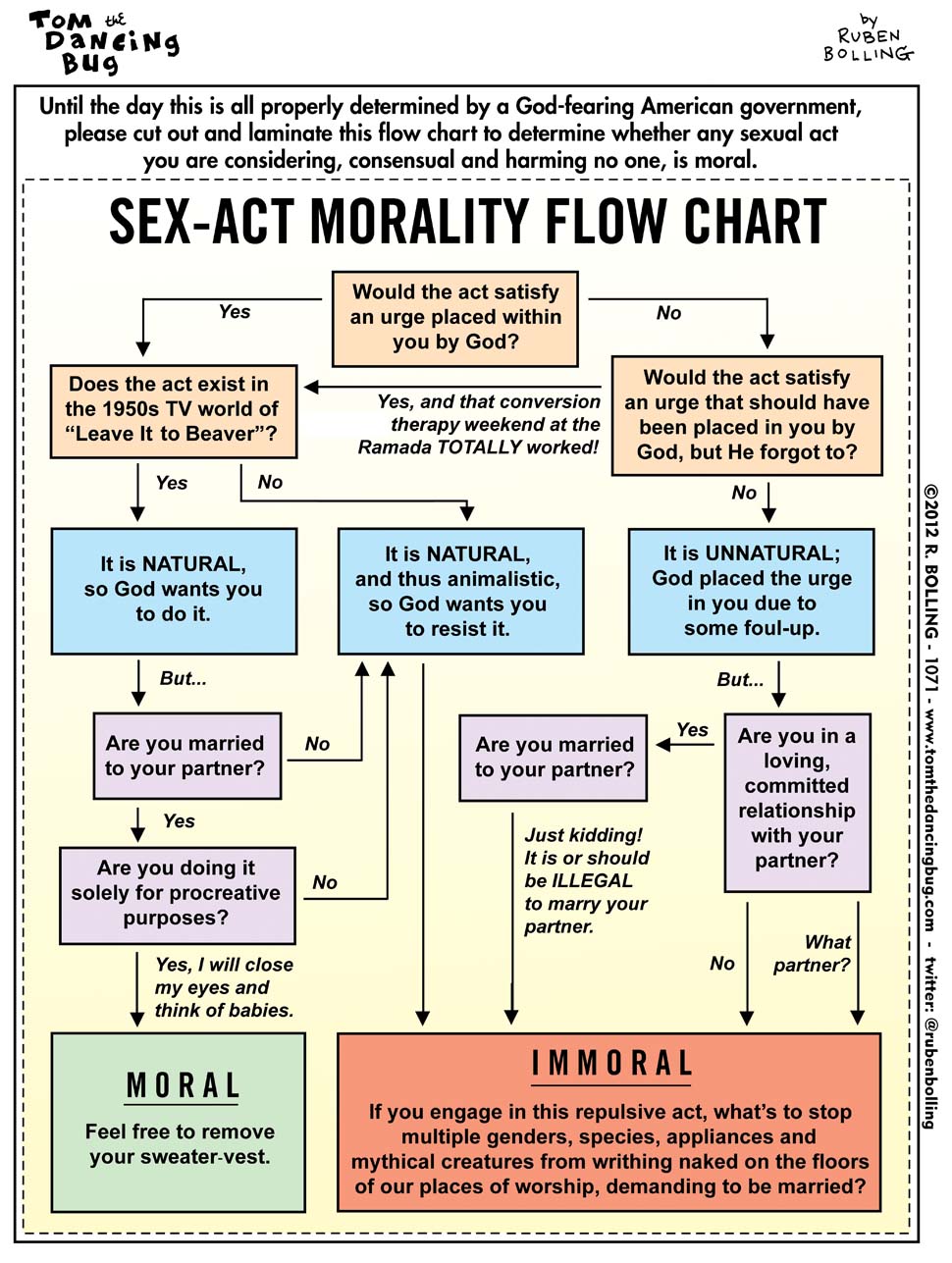
Why exercise your conscience and cognition when this convenient flow chart can evaluate your situation and tell you whether it's okay, under the circumstances, to Do the Deed?
It's been long known that marriage makes for healthier individuals, overall. Life expectancy is higher among married couples than singles, etc. Whether it's a matter of general happiness, or having someone else to care for you, or whatever, it's a pretty clear effect.
So it's not at all surprising that the same would pertain to gays who marry. Which adds a whole new humanitarian wrinkle to the question of marriage equality. Is it morally defensible to deny gays the same demonstrable health benefits that marriage provides to straight couples? #ddtb
Embedded Link
Gay marriage 'improves health'
Legalising same-sex marriage may create a healthier environment for gay men, say US researchers.
"In my opinion, our obsessive focus on virginity and sexual purity doesn’t serve anyone. Losing one’s virginity is not an event; it’s a process. Similarly, weddings are events, and signing your marriage license is an event, but marriages are not events. They are processes."
To my mind, the only key factor in "sex" prior to "marriage" (subject to definition of both terms) is the willingness to address responsibly and maturely any potential offspring of same. I.e., to my rather old-fashioned mind, once kids are involved, that becomes your number one commitment, other plans and expectations notwithstanding.
Outside of that, it's subject to the same social rules and constructs that address any human relationship. Some of the consequences may be more intense, profound, even life-threatening than some other human relationship issues, but those are more difference sin degree, not in kind.
(Note: None of the above applies to my daughter, who I expect will remain virginal and chaste until she is 30.)
(Further Note: No, of course I don't. It's up to her. No matter what I say or do or preach.) #ddtb
Embedded Link
do you believe in saving sex for marriage? – John Green's tumblr
Anonymous asked: do you believe in saving sex for marriage? Answer: I can’t answer that question unless I answer the question of what constitutes marriage. And none of the definitions I have for…
Ah, Dennis Prager. I will confess, Dennis, that I have listened to you on the radio before. And some of your study of theological topics can be pretty darned interesting. But as soon as you start applying those topics to contemporary social topics, you tend to go off the deep Right end.
Hmmmm. Well, that’s a provocative subtitle. Let’s see why you think that, Dennis.
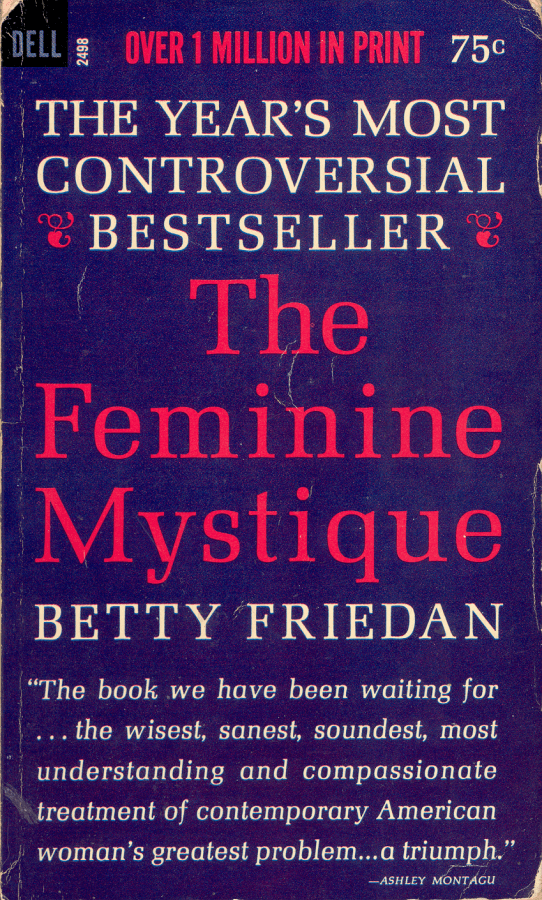
As we approach the 50th anniversary of the publication of Betty Friedan’s feminist magnum opus, The Feminine Mystique, we can have a perspective on feminism that was largely unavailable heretofore.
True. As time goes by, we can see how feminism as a movement has evolved, how the role of women in society has changed, etc.
Of course, with the longer-term perspective, we tend to lose sight of how things were before the feminist movement. Approximately a third of the US population is 50 years of age or older. Assuming 65 as the cutoff (i.e., 15 years old when Friedan’s book came out, and so able to remember something coherent about the pre-feminist society), that drops down to about 15% of the population.
So for most people, remembering how things were back then is more of an academic study.
Dennis Prager is 63.
And that perspective doesn’t make feminism look good.
Ruh-roh!
Yes, women have more opportunities to achieve career success; …
Though still fewer than men.
… they are now members of most Jewish and Christian clergy; …
Though notably not in some denominations, particularly in conservative ones, and in some there are still glass ceilings as to how high they can go.
… women’s college sports teams are given huge amounts of money; …
Though less than men’s college sports teams.
and there are far more women in political positions of power.
Though fewer than there are men. For example, they make up 17% of the House of Representatives and, coincidentally, of the US Senate.
But the prices paid for these changes — four in particular — have been great, and outweigh the gains for women, let alone for men and for society.
So I guess we should limit their careers, kick them out of the clergy, marginalize their sports teams, and boot ’em from Congress. For their own good, let alone for the good of men and society.
(Is it okay if they keep the vote, Dennis?)
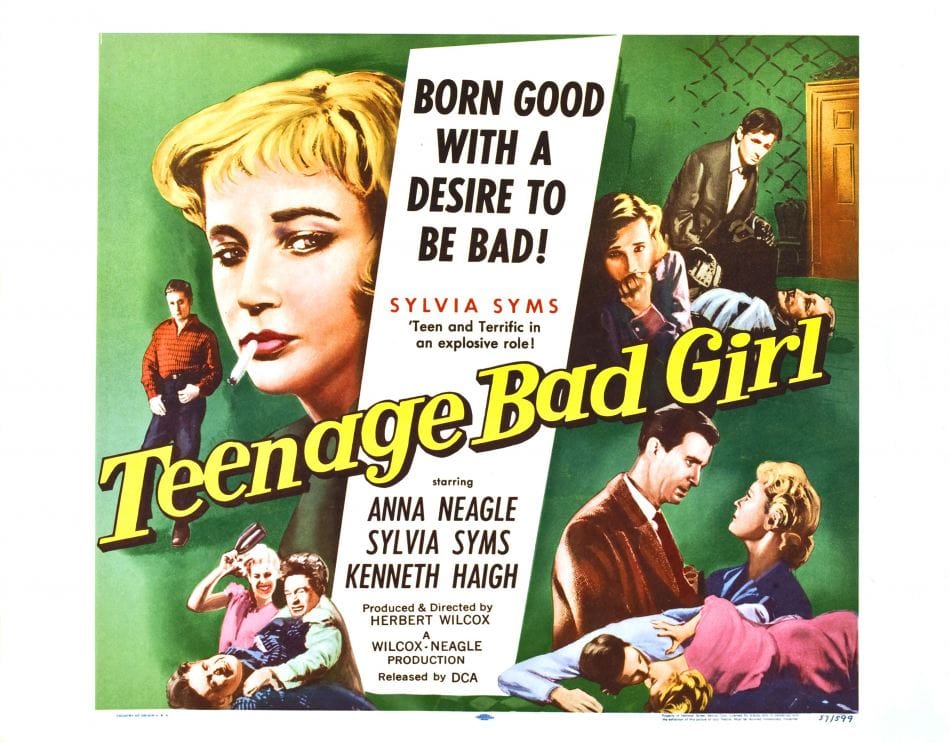
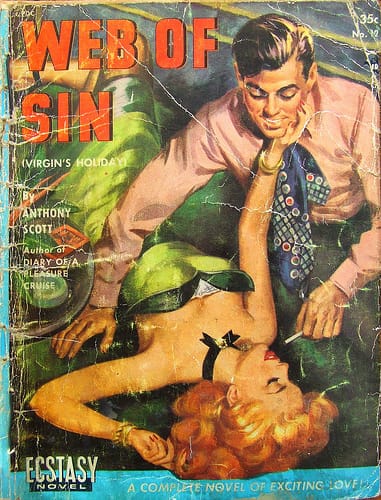
By "bad" we mean "slutty," of course.
The first was the feminist message to young women to have sex just as men do. There is no reason for them to lead a different sexual life than men, they were told. Just as men can have sex with any woman solely for the sake of physical pleasure, so, too, women ought to enjoy sex with any man just for the fun of it.
Dennis conflates a number of threads in the feminist movement together into something a bit simplistic. The feminist view of gender roles for sex is, to simplify it a different, “What’s sauce for the goose is sauce for the gander.” If it’s okay for men to sleep around, then it’s okay for women, too.
She is, of course, a feminist.
One may question the pros and cons of sexual promiscuity, but the rejection here was the pre-feminist idea that women needed to stay wholesome and virginal (and ignorant and apprehensive about sex), while it was nudge-nudge-wink-wink for guys to sow their wild oats (but only with women who were thus, by definition, “loose” and certainly not someone you’d bring home to your parents).
The notion that the nature of women is to hope for at least the possibility of a long-term commitment from a man they sleep with has been dismissed as sexist nonsense.
It’s not clear to me that all or most women are more fundamentally yearning for a long-term commitment than, say, men are, or that where that’s so it’s not still a sign that our society, fifty years after Friedan’s book, doesn’t still have an influence on what women expect (and what is expected of them) vs. men.
She's terribly depressed by the end of the book.
(One analogy that comes to mind is that black slaves were freed roughly 150 years ago. The Civil Rights movement welled up 50 years ago. Anyone who thinks we have shed the cultural and subcultural trappings of black/white racial prejudice and conflict, and have entered a post-racial era, has blinders on. Cultural changes don’t happen over night, no matter how dramatic the differences are for women today vs. the early 60s.)
As a result, vast numbers of young American women had, and continue to have, what are called “hookups”; and for some of them it is quite possible that no psychological or emotional price has been paid. But the majority of women who are promiscuous do pay prices. One is depression. New York Times columnist Ross Douthat recently summarized an academic study on the subject: “A young woman’s likelihood of depression rose steadily as her number of partners climbed and the present stability of her sex life diminished.”
What’s the basis of that depression, Dennis? Is it exclusive to women? Is it driven by some inherent genetic factor, or some spiritual difference between men and women, or is it a result of a culture that still expects women to be less promiscuious than men and to be seeking long-term relationships.
Hubby's sexual overtures would have been received better if it weren't for that tie.
You note that some women “quite possibly” aren’t affected. Does that mean they get a pass from you on their behavior?
Long before this study, I had learned from women callers to my radio show (an hour each week — the “Male-Female Hour” — is devoted to very honest discussion of sexual and other man-woman issues) that not only did female promiscuity coincide with depression, it also often had lasting effects on women’s ability to enjoy sex. Many married women told me that in order to have a normal sexual relationship with their husband, they had to work through the negative aftereffects of early promiscuity — not trusting men, feeling used, seeing sex as unrelated to love, and disdaining their husband’s sexual overtures. And many said they still couldn’t have a normal sex life with their husband.
Aside from noting that callers to your radio show might be a self-selected group (of folks who believe as you do, who have similar cultural and religious values as you do, and thus might have more baggage in this area), I would offer up in contrast the pre-feminist model of women who ought have no experience in sex before marriage, who in fact ought to see it primarily as a marital duty, and for whom, in fact, any pleasure taken in marital sexual acts would be seen as sinful, a negative, or unthinkable.
Is that a preferable attitude to foster?
Are there differences, broadly speaking, between men and women in this area? I’ll also say “quite possibly,” though it’s clearly not a clear-cut XX vs XY trait. There is obviously variation, especially since sex and relationships are not solely an autonomic activity but involve human cognition, judgment, and emotions. It may be that it is advisable, in broad terms, for women to be less promiscuous than men — but, if so, that’s a pragmatic judgment.
And, honestly, I’m way too leery of those on the Right in the “culture wars” driving the point forward, as then the tendency is not only to turn it from the pragmatic to the moral, but to use that as a club for making other distinctions about how women “ought” to behave and how what they “should” be allowed to do.
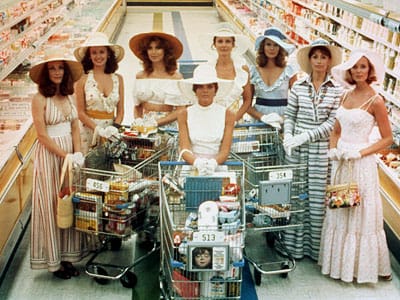
Who needs careers, when we can serve our husbands as perfect wives here in Stepford?
Yes, I’m looking at you, Dennis. Because, as we move on …
The second awful legacy of feminism has been the belief among women that they could and should postpone marriage until they developed their careers. Only then should they seriously consider looking for a husband. Thus, the decade or more during which women have the best chance to attract men is spent being preoccupied with developing a career. Again, I cite woman callers to my radio show over the past 20 years who have sadly looked back at what they now, at age 40, regard as 20 wasted years. Sure, these frequently bright and talented women have a fine career. But most women are not programmed to prefer a great career to a great man and a family. They feel they were sold a bill of goods at college and by the media. And they were. It turns out that most women without a man do worse in life than fish without bicycles.
She can't help but follow you, dude ... it's the programming
And there we go. Women are “programmed” (I gather genetically) to prefer a “great man and a family,” so the suggestion that they might seek a career is against their “programming” and can only lead to heart-ache and empty lives. That’s a lovely sentiment, Dennis.
I don’t take away from the angst and unhappiness of those women in their 40s who suddenly think that perhaps life has passed them by and that they need to find a mate. I would suggest that there are men who are in the same boat. I would also suggest that people got depressed and unhappy with their life choices (or lack thereof) before The Feminine Mystique.
I would also suggest that 50 years is a short time to have reached a new balance point in this area, and that we as a culture are continuing to figure out different life courses to take. We may see more early marriage again some day, with a commitment to mutual careers. We may see more house husbands as the Baby Boomers who grew up with “Father Knows Best” and “The Brady Bunch” pass into their elder years. We may see more couples looking for ways to have it all.
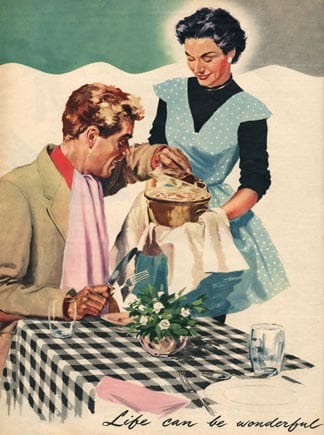
Life can be wonderful! If you have a choice in it, that is.
What I don’t think is that we’ll return to that “Father Knows Best” and “Brady Bunch” time when the vast majority of women went to college (if they went to college) primarily for their MRS. degree, settled down, kept house and produced babies, while hubby went to the factory or the office.
And I think that’s a good thing. It might have been simpler, but it was also stultifying. If a woman chooses that as the arc of her life, I think that’s fine if it fulfills her and makes her happy — even if there’s a chance that, like the women described above, she gets into her 40s and thinks of paths not taken.
But you’ve done nothing to convince me, Dennis, that the “old-fashioned way” is best, or should be the primary (let alone sole) option women should see for their lives.
And, by the way, Dennis, what to your mind is the ideal age for women to marry. If they’re not going to pursue a career, should they go to college, anyway? Or perhaps they should get married straight out of high school. Is high school even necessary, Dennis?
Who true mother wouldn't rather cook donuts for the kids all day?
The third sad feminist legacy is that so many women — and men — have bought the notion that women should work outside the home that for the first time in American history, and perhaps world history, vast numbers of children are not primarily raised by their mothers or even by an extended family member. Instead they are raised for a significant part of their childhood by nannies and by workers at daycare centers. Whatever feminists may say about their only advocating choices, everyone knows the truth: Feminism regards work outside the home as more elevating, honorable, and personally productive than full-time mothering and making a home.
I think that there have been feminists who have seen home-making / mothering as a less “elevating, honorable, and personally productive” option. I think those feminists are wrong. But I think they are right if it’s the only option that’s being offered, or that society is willing to accept.
If a woman chooses to be a home-maker and full-time mother, more power to her. If she chooses not to, more power to her, too.
Look, kids! I shopped! Celery for everyone!
If she and her mate have kids, then they have some hard decisions to make. Day care and nannies and the like aren’t ideal, and I do believe that parenthood has to be the first career of all parents. It’s something Margie and I have struggled with — and been able to find some ways to make it work. At least, our daughter doesn’t seem to be damaged goods from our decisions in that area.
The other thing I’ll note, Dennis, is that it is increasingly difficult in our society to make do with just a single income, both from a stability standpoint (one paycheck is much more fragile a lifeline in our current economic clime) and from a cultural aspect in terms of the costs of things. Of course, what things we consider necessary in our lives is a lot fancier than lived with in the early 60s, and it’s arguable that maybe we should seek a simpler, less expensive life if it means that one or the other parent can stay home with the young’uns.
I just don’t agree that parent has to be, by default and design and cultural diktat the mother.
Which, of course brings us to your last “awful legacy, Dennis …
And the fourth awful legacy of feminism has been the demasculinization of men. For all of higher civilization’s recorded history, becoming a man was defined overwhelmingly as taking responsibility for a family. That notion — indeed the notion of masculinity itself — is regarded by feminism as the worst of sins: patriarchy.
I gotcher masculine role right here, babe!
There are some zany feminists out there, Dennis, who consider holding a door open for someone to be an attack by the patriarchy. If we’re going to bring them into the debate, then we should bring some of the conservative “Quiver-full” types as counter-arguments for your appeal to tradition.
We may debate over whether “taking responsibility for a family” has been the classic tradition foor being a man “for all of higher civilization’s recorded history.” But I’ll suggest that taking responsibility for a family doesn’t have to mean patriarchy — unless by “taking responsiblity” you mean “taking control.”
Men need a role, or they become, as the title of George Gilder’s classic book on single men describes them: Naked Nomads. In little more than a generation, feminism has obliterated roles. If you wonder why so many men choose not to get married, the answer lies in large part in the contemporary devaluation of the husband and of the father — of men as men, in other words. Most men want to be honored in some way — as a husband, a father, a provider, as an accomplished something; they don’t want merely to be “equal partners” with a wife.
That’s … lovely, Dennis. Men don’t want to “merely” be an “equal partner”? Gee, I guess that does sound like patriarchy. If they can’t be in charge, in control, the paterfamilias, then they’re going to take their cultural ball and go and sulk?
Equal Partnership: She serves the kids, I close the fridge door.
Let me clue you in on something, Dennis. I love being an equal partner with my wife. I don’t command her (even lovingly), nor does she command me. We collaborate. We help each other. We nag each other. We honor each other as spouses, as parents, as providers, as accomplished and participating in our family and in our raising of a fine daughter.
There are things we each take a primary lead in, but that’s based on personal inclination and physical capability and compromise. It’s not built on Men Do This, Women Do That, and That’s What Higher Civilization Is All About.
And, somehow, I don’t feel devalued. I don’t feel like a “naked nomad,” bereft of any role that includes my being the head honcho, the big cheese, the sole breadwinner, the king on his throne.
Does that mean I’m a demasculinized victim of feminism, Dennis?
... if that's okay with our husbands and you, Dennis!
In sum, thanks to feminism, very many women slept with too many men for their own happiness; postponed marriage too long to find the right man to marry; are having hired hands do much of the raising of their children; and find they are dating boy-men because manly men are so rare.
Feminism exemplifies the truth of the saying, “Be careful what you wish for — you may get it.”
In sum, Dennis, you think that women should be innocent virgins when they marry their husbands at a suitably young age, devote themselves to home-making and rearing the kids, and let their husbands control them and the household.
Dennis, you exemplify the truth that feminism was not only desperately needed when Betty Friedan published her book, but it still has a long way to go, baby.
Panel: Healthy men shouldn’t get prostate test – The Denver Post – Very, very interesting. The question is not whether folks have had their lives saved by PSA testing, but whether more lives have been lost (and others injured) by the follow-up activities from such testing.
So let me set up the disclaimer here that might well render my opinions here completely uninformed and moot. I do not have a spouse with Alzheimer’s, nor have I. I have had a spouse (not my present one) with significant mental / emotional issues, but it’s definitely not the same thing. So, having said that …
Pat Robertson has come under a lot of fire, from a number of different directions over remarks he made on his 700 Club program. A married man whose wife has advanced Alzheimer’s is beginning to date other ladies, and concerned friend of the family wants some guidance from Pat as to what the right course of action is.
Pat’s advice is that dude should get a divorce. Which, obviously, has set a number of eyebrows askance, mine included. He’s drawing criticism from advocates for sufferers from Alzheimer’s, as well as from a number of Christians commenters.
Now, in Pat Robertson’s defense (not words I often string together), there’s method to his madness. He clearly recognizes the difficulty of the situation for the man in question (it’s “a terribly hard thing” — though I wonder how he would feel were the gender roles reversed). He recognizes, if not from his own life then from stories he’s been told by others, how much advanced Alzheimer’s can change someone (“This is a kind of death … it’s like a walking death”). He’s not really advocating throwing the wife here off the back of the sleigh, sort of (“… make sure she has custodial care and somebody looking after her”). And he even confesses on a couple of occasions that this, unlike his many, many, many other moral judgments, may be beyond him (“This is an ethical question that’s beyond my ken”).
His focus, though, is on how the man in question can seek “companionship” without breaking the marriage vows (and, reading between the lines, committing adultery). As Robertson couches it (emphasis mine), “If he’s going to do something [i.e., date], he should divorce her and start all over again.”
Robertson’s clumsy approach is to get a divorce, justifying it as the partner that was married being, effectively, “dead.” That’s an interesting variant on Paul’s “it’s better to marry than to burn” (1 Cor 7:9), but I think is wrong-headed and the wrong way to approach it.
First off, it seems a glib, sloppy excuse-making of the kind that Robertson, and other conservative Christian pundits, would lambaste were it to come from a more liberal or less Religious Right figure. After all, on this basis, someone who was in an irreversible coma could be divorced on the same basis (and, as I noted earlier, Robertson was at the forefront in the “judicial murder” charges regarding Terri Schiavo who was far more “dead” than the wife in this case).
But it’s not just the hypocrisy here that bothers me. From a practical standpoint, this is simply unworkable. The woman involved is far more likely to be able to get custodial care and so forth if she remains married to the man (assuming their pooled resources are greater). Divorce her, and, what, she becomes a ward of the state, or the responsibility of her other kin? That’s not going to go well for her, nor is it a good act toward anyone else.
Unlike Pat, I’m not willing to let the husband here off the hook. That vow about “better and worse … in sickness and in health, until death do us part” doesn’t have an escape clause for Alzheimer’s, nor is “death” footnoted as “including permanent, tragic dementia.” It’s a commitment, mutually reached, mutually binding. If the husband chooses to terminate it, that’s between him and his wife and God (and, perhaps, the next person he marries or “commits” to), but giving him a pass isn’t the right approach.
I would say, if he’s dating others, seeking companionship (including, yes, sex), then fine, understandable, even arguably positive and healthy. It doesn’t remove from him the obligation to care for his wife, to treat her with humanity and compassion and dignity … but if it helps him through the day (or night), then I’d think it better and easier and less of a rules lawyering twist to forgive him adultery (with or without sex) than to okay his dumping his wife because she doesn’t recognize him any more.
There are no good answers here because it’s not a good situation. As noted above, I can’t pretend to know what the husband in this case is going through. But Robertson’s answer is far less than good, and is focused on the wrong thing. He’s willing to destroy a marriage in order to save it some technical denting, to protect the letter of the law rather than its spirit. I can’t think that’s would Jesus would do, nor is it a kindness to anyone involved, husband or wife.
The reason the left has gone after same-sex marriage is because it’s a two-fer. When you redefine marriage, you cheapen marriage. You make it into something less valuable, less special … [and] it is a sure bet that will undermine faith.
As a someone who identifies on “the left,” let me just say that you are a dolt.
I am a person of faith. Granted, I’m Episcopalian, and you know how those people are … but I still consider myself a Christian, a believer in God, and someone who tries to follow the teachings of Christ as I understand them. I have no desire to force my faith on others, but I am not antagonistic toward folks for their faith, even where I might disagree with where it takes them. I believe that, as long as it doesn’t harm those around them, people should be free to exercise their faith.
So, for example, I think people who believe that marriage is morally right (and blessed by God) between two people of the same gender should be allowed to live that faith without those of other faith beliefs wielding the power of Caesar to stop them.
I’m a big believer in marriage, too. I think it’s a keen institution. I’m married, myself, to a wonderful woman, and that legal (and moral) bond is a hugely important part of my life.
I do believe that society is strengthened by marriage (though I don’t believe folks should be forced to marry, any more than they should be forced into any legal contract or religious oath). I believe the cheapening of marriage into a simple transaction of convenience and social advantage (see: any number of Hollywood celebrities and Washington politicians) is, indeed, a societal problem — it, in your words, “cheapens” marriage, makes it into “something less valuable, less special.” It’s not a problem that I believe lends itself to legal fixes (making divorce significantly more difficult, for example); it’s a cultural issue that is best approached culturally — influencing hearts and minds, not compelling bodies. Sort of like, y’know, how Jesus tried to tell His good news.
To summarize, then, I am a person of faith. And I’m a married person who believes the institution of marriage is special and valuable.
So where the hell do you come off, Senator, saying that I’m part of some vast conspiracy of “the left” out to undermine faith and to cheapen marriage?
Now, granted, you don’t think “marriage” should, by light of your faith (I presume you are sincere in this), include same-gender couples. I disagree, but, then, we probably disagree on a number of theological issues. I would certainly never suggest that you be compelled to marry someone of the same gender, Senator. Nor would I suggest that your church be compelled to give its spiritual blessing to anyone it thinks are not worthy of it — whether because of gender, or race, or criminal background, or age, or whatever. That’s between you, your church, and God.
But marriage is not simply a religious sacrament. It’s also a civil procedure. People can get married without any sort of churchly blessing, and have for ages. Your interpretation of the Old Testament or the epistles of Paul as to what God approves of regarding homosexuality have nothing to do with what the county clerk or justice of the peace (or legal recognition of common law marriages) can or should be doing, any more than those governmental and legal institutions have a say in other sacraments, such as baptism.
To me, two consenting adults who choose to bind themselves as partners before society, obligating themselves to “love, honor, and cherish” each other in such a formal way, whether blessed in a church of their choosing or not, deserve to be recognized as married by the law. That’s not “redefining marriage” — that’s recognizing that the definition of marriage is more than what plumbing the individuals involve sport, or what they do in bed (if anything) with said plumbing.
I don’t know about you, Senator, but while the marriage bed is a lot of fun, it’s not the main reason why I got, or remain, married.
Now, I’m sure, based on what you say, you don’t approve of gays getting married. Well, to be honest, Senator, there are a number of folks who get married whose marriages I don’t approve of — and yet, remarkably, I don’t choose to try and prevent them doing so by force of law, simply based on my disapproval. Why do you think you should get that privilege?
I don’t expect this to change your mind, Senator, even on the off chance you read it. If nothing else, this is an election year, you’re vying for President, and dropping your anti-gay appeal to your “base” amongst the citizenry would be politically inconvenient.
But I did feel the need, on the record, to disagree with your little quip about “the left” going for a “two-fer” against marriage and against faith. I’m sure it draws chuckle, or applause, or donations. But it’s insulting and, worse, simply wrong, and obviously so. To make such an argument would thus require, I’d think, either a brazen ability to lie through your teeth in order to garner money and votes, or a willful ignorance of why people support gay marriage as part of (not a “redefinition” of) the institution of marriage.
I will be charitable and assume it’s the latter, Sen. Santorum. Which makes you, instead of a lying dog, merely a dolt.
Some words of possible wisdom, from a variety of sources.
A journey is like marriage. The certain way to be wrong is to think you control it.
John Steinbeck (1902-1968) American writer Travels With Charley: In Search of America, Part 1 (1962)
Marriage resembles a pair of shears, so joined that they can not be separated; often moving in opposite directions, yet always punishing anyone who comes between them.
Sydney Smith (1771-1845) English clergyman, essayist, wit Lady Holland’s Memoir, Vol. I, ch. 11 (1855)
Full text.
The most important thing a man can know is that, as he approaches his own door, someone on the other side is listening for the sound of his footsteps.
Clark Gable (1901-1960) American film actor [b. William Clark Goebel]
(Attributed)
In Ronald Reagan, Where’s the Rest of Me?, ch. 18 (1965). Quoted as something Reagan wrote to his first son, Michael, before his marriage
No long-term marriage is made easily, and there have been times when I’ve been so angry or so hurt that I thought my love would never recover. And then, in the midst of near despair, something has happened beneath the surface. A bright little flashing fish of hope has flicked silver fins and the water is bright and suddenly I am returned to a state of love again — till next time. I’ve learned that there will always be a next time, and that I will submerge in darkness and misery, but that I won’t stay submerged. And each time something has been learned under the waters; something has been gained; and a new kind of love has grown. The best I can ask for is that this love, which has been built on countless failures, will continue to grow. I can say no more than that this is mystery, and gift, and that somehow or other, through grace, our failures can be redeemed and blessed.
Madeleine L’Engle (1918-2007) American writer
“The Irrational Season” (1977)
I used to believe that marriage would diminish me, reduce my options. That you had to be someone less to live with someone else when, of course, you have to be someone more.
Candice Bergen (b. 1946) American actress
(Attributed)
Marriage is a coming together for better or for worse, hopefully enduring, and intimate to the degree of being sacred.
Justice William O. Douglas (1898-1980) US Supreme Court (1939-75) Griswold v. Connecticut, 381 US 470 (1965) (7 Jun 1965)
Marriage is a lot like life, only with more fun parts …. The only secret is showing up every day with an open heart.
Jon Carroll (b. 1943) San Francisco Chronicle, “New Ideas on the Culture War” (6 Jul. 1999)
1. Don’t, don’t nag.
2. Don’t try to make your partner over.
3. Don’t criticize.
4. Give honest appreciation.
5. Pay little attentions.
6. Be courteous.
7. Read a good book on the sexual side of marriage.
Dale Carnegie (1888-1955) American writer, lecturer How to Win Friends and Influence People, “Seven Rules for Making Your Home Life Happier” (1936)
Marriage has no guarantees. If that’s what you’re looking for, go live with a Sears battery.
Erma Bombeck (1927-1996) American humorist
(Attributed)
The pride of the peacock is the glory of God.
The lust of the goat is the bounty of God.
The wrath of the lion is the wisdom of God.
The nakedness of a woman is the work of God.
William Blake (1757-1827) English poet, mystic, artist
“The Marriage of Heaven and Hell” (1790 – 1793)
Marriage must continually vanquish the monster that devours everything, the monster of habit.
Honoré de Balzac (1799-1850) French novelist, playwright Physiology of Marriage (1829)
Companionship, partnership, mutual reassurance, someone to laugh with and grieve with, loyalty that accepts foibles, someone to touch, someone to hold your hand — these things are marriage, and sex is but the icing on the cake.
Robert A. Heinlein (1909-1988) American writer Time Enough for Love [Lazarus] (1973)
It is not lack of love but lack of friendship that makes unhappy marriages.
Friedrich Nietzsche (1844-1900) German philosopher and poet
Chains do not hold a marriage together. It is threads, hundreds of tiny threads which sew people together through the years. That is what makes a marriage last — more than passion or even sex!
What makes a marriage last is for a man and a woman to continue to have things to argue about.
Rex Stout (1886-1975) American writer
One advantage of marriage, it seems to me, is that when you fall out of love with him, or he falls out of love with you, it keeps you together until maybe you fall in again.
Judith Viorst (b. 1931) American writer
This is why you get married. You run into a difficult situation, can’t seem to find a way out and — TAG — your partner jumps in and fixes everything. A good marriage isn’t just about love and friendship, it’s about sharing your talents and making the struggle of life a little bit easier.
Okay. That sounds like a load of crap. So I’ll just say that even if life is a constant mess, you’ve got some company to kill the time. Better?
Michael Jantze (b. 1962) American cartoonist The Norm, “Norm’s Daily Journal” (7 Sep. 2003)
Let your fountain be blessed, and rejoice in the wife of your youth, a lovely deer, a graceful doe. May her breasts satisfy you at all times; may you be intoxicated always by her love.
The Bible (14th C BC – 2nd C AD) Christian sacred scripture
Proverbs 5:18-19
Two are better than one, because they have a good return for their labor: If either of them falls down, one can help the other up. But pity anyone who falls and has no one to help them up. Also, if two lie down together, they will keep warm. But how can one keep warm alone? Though one may be overpowered, two can defend themselves. A cord of three strands is not quickly broken.
The Bible (14th C BC – 2nd C AD) Christian sacred scripture Ecclesiastes 4:9-12
I had rather live and love where death is king, than have eternal life where love is not.
Robert Green Ingersoll (1833-1899) American lawyer and orator
“At A Child’s Grave” (eulogy) (8 Jan 1882)
It is a splendid thing to think that the woman you really love will never grow old to you. Through the wrinkles of time, through the mask of years, if you really love her, you will always see the face you loved and won. And a woman who really loves a man does not see that he grows old; he is not decrepit to her; he does not tremble; he is not old; she always sees the same gallant gentleman who won her hand and heart. I like to think of it in that way; I like to think that love is eternal.
Robert Green Ingersoll (1833-1899) American lawyer and orator
“The Liberty of Man, Woman, and Child” (1877)
It is not necessary to be great to be happy; it is not necessary to be rich to be just and generous and to have a heart filled with divine affection. No matter whether you are rich or poor, treat your wife as though she were a splendid flower, and she will fill your life with perfume and with joy.
Robert Green Ingersoll (1833-1899) American lawyer and orator
“The Liberty of Man, Woman, and Child” (1877)
You had better be the emperor of one loving and tender heart, and she the empress of yours, than to be king of the world. The man who has really won the love of one good woman in this world, I do not care if he dies in the ditch a beggar, his life has been a success.
Robert Green Ingersoll (1833-1899) American lawyer and orator
“The Liberty of Man, Woman, and Child” (1877)
Of the various forms of government which have prevailed in the world, an hereditary monarchy seems to present the fairest scope for ridicule.
Edward Gibbon (1737-1794) English historian The Decline and Fall of the Roman Empire, ch. 7 (1776-88)
I mean, if heredity were all that perfect of a system, one would expect the Brits to be ruled by a race of super-geniuses by now, right?
Actually, in all seriousness, congratulations to the happy couple. While they obviously have a lot of advantages going into a marriage, they also have a lot of challenges, so my heartiest felicitations to them both.
Sixteen years ago today … I got married to Margie.
And there’s not been a single moment I’ve ever regretted it. Not a day goes by, or a time I’m with her ever passes, without my being utterly and completely grateful, feeling wonderfully blessed, that she chose to share her life with me.
(Yeah, yeah, she says the same thing — but trust me, I got the better end of this deal. And I’ve thought that way for a long time.)
Let your fountain be blessed, and rejoice in the wife of your youth, a lovely deer, a graceful doe. May her breasts satisfy you at all times; may you be intoxicated always by her love.
— Proverbs 5:18-19
It is not necessary to be great to be happy; it is not necessary to be rich to be just and generous and to have a heart filled with divine affection. No matter whether you are rich or poor, treat your wife as though she were a splendid flower, and she will fill your life with perfume and with joy.
— Robert Green Ingersoll, “The Liberty of Man, Woman, and Child” (1877)
To Joanna,
My brilliant and beautiful wife without whom I would be nothing. She always comforts and consoles, never complains or interferes, asks nothing and endures all, and writes my dedications.
— Albert Paul Malvino, Electrical Principles, dedication (1993)
The allegory "Abbodanza" by Cavaliere d’Arpino (1603)
My wife. I think I’ll keep her.
Now, we are not above eating (good) store-bought pasta sauce for a quick and easy dinner.
But we were out tonight. And the leftovers weren’t defrosted.
So Margie took some crushed tomatoes.
And pan-seared some sausage from the fridge.
Oh, and tossed them together with a bit of pesto. Oh, and, hey, there’s some feta cheese crumbles. And probably three other random items from fridge, pantry, or spice cabinet.
I think there was some sliced zucchini in there.
Simmer.
Cooked up some pasta.
Put it all into a big baking dish, throw it in the oven. Cook until bubbly.
And it’s the kind of thing that you’d pay $20 or $25, a la carte, at a good Italian restaurant. Easy.
She rocks. And she pooh-pooh’s the whole thing.
(My contribution: serving up and washing dishes. And more than happy to do so.)
Cella Energy claims breakthrough that would result in $1.50 per gallon gasoline alternative. – “If this is real you can expect the Oil Industry to have an absolute shit fit over it. I’d like to be optimistic about it, but the cynic in me can’t help but think that even if it does work as well as claimed that there’ll be some wicked trade-off like it causes cancer in everything that comes in contact with it or something else equally horrible.” Or at least that’s what some with a vested interest in the status quo will CLAIM … [/conspiracymode]
A note to the Teapartiers… – But … but … if they had guns, they’d automatically have freedom! Plus, they’re Muslims! You can’t trust them with guns!
Again with ‘exceptionalism’? – I’d like to think that “exceptional” is meant as “unique” or “unanticipated” or somehow particularly wonderful. But “exceptional” also seems a lazy way of excusing our behavior: nobody should be allowed to torture prisoners “except” the US (because we’re “exceptional”); nobody should overthrow governments “except” the US (because we’re “exceptional”), etc. That this word has become a ginned-up synonym for “patriotic” is all the more lousy.
The serious flaws in the GOP’s anti-abortion bill – Not only does it block Medicaid funding for abortions when rapes aren’t “forcible” enough, it effectively does the same for private insurance under the Affordable Care Act. But remember, the GOP is steadfastly against imposing the government’s tyrannical health insurance rules on private individuals!
Frank Rich: The Tea Party wags the dog – The GOP establishment is potentially in a lot of trouble. Unfortunately, that has consequences for the nation as a whole, too.
GOP Priorities: Redefining Rape – While abortion is an option I’ll never be happy about, this, right here, is precisely why I will never make that decision for someone else, for the person, individual, citizen, woman, who is ultimately having to make that choice. That there are those who are so enamored of the abstract that they would deign to decide who “qualifies,” whose rape was “forcible” enough to “merit” coverage of abortion services, is itself sickening enough.
I Me Mine: The Unholy Trinity Of Ayn Rand « Tomfoolery – Rand appeals to the high school / college period of self-discovery by saying, “You are the only person in the world who matters. Pursue your own self-interest because that is the highest good.” Most people grow out of that, fortunately. Randians never seem to. And way too many of them are now in the halls of our government.
Building a Better Word Cloud – An interesting analysis (esp. if you compare the most frequent words and compare them to the person usually considered more “aloof” and “analyitical” and out of touch, vs. the person who it’s often claimed is “one of us”).
HOWTO make health-care cheaper by spending more on patients who need it – ” In other words, providing excellent, personalized care to the small number of patients who don’t fit the system’s model saves far more money than making the system more stringent, with more paperwork, higher co-pays and other punitive measures. It’s a win-win.” The problem with systems is that they are rarely dynamic enough to deal with those outside the system. And they usually do everything they can to defend themselves from change.
Neil Barofsky: Credit ratings for banks now include assurance of government bailouts – Imagine the brouhaha if social activists were stating that any individual should feel free to take whatever risk they want because the government would always bail them out with a security net. But, then, the banks are “too big to fail,” and too many individuals are “too small to matter.”
For better or worse (and for richer or poorer) I was not in the dating scene back in the 80s. Probably just as well, because I shudder to think of what my contribution to the following would have been.
Hopefully I would NOT have said anything about “data processing” …










 Dear Senator Santorum: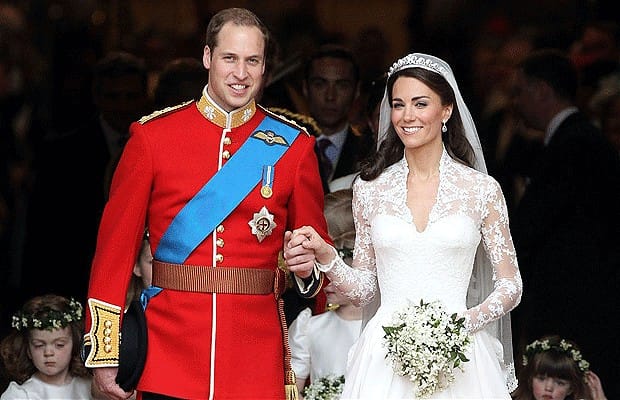
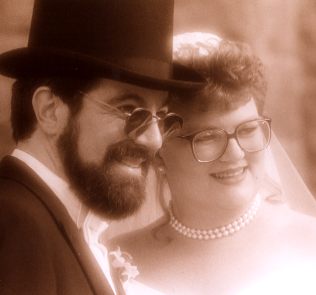 Sixteen years ago today … I got married to Margie.