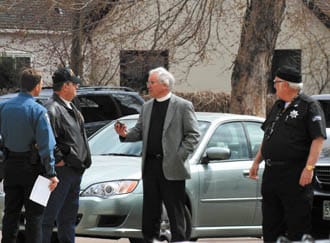
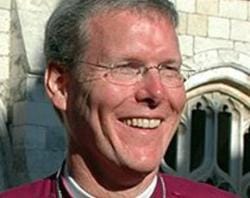
For those just tuning in, Don Armstrong was an Episcopal priest here in Colorado who:
… ran Grace & St Stephens Episcopal in Colorado Springs.
… served as the Shadow Bishop of Colorado for many, many years, acting as the spokesman for Episcopal conservatives in the state and unofficial leader of the opposition to the diocese.
… despite leading the largest church and congregation in the state, never paid any of the canonically required dues to the diocese as a whole (because, y’know, they were all a bunch of liberals).
… ran his parish as a little fiefdom, and a personally enriching one as well, drawing in a very comfortable salary.
… pulled his parish out of the Episcopal Church in May 2007, one jump ahead of the diocese indicting him in a church court for being a bad priest (my paraphrase of the charges, which included financial malfeasance and theft of $400K).
… denied any charges as to same, and, when defrocked by the diocese, basically gave them the finger and a loud “neener-neener.”
… tried to hold onto Grace & St Stephens property, even though church law and Colorado legal precedent indicated he couldn’t.
… loaded said property with a huge mortgage debt as a “poison pill” against the diocese suing to take it back.
… was finally forced to vacate the property in April 2009 in favor of the Episcopal faithful who were worshiping elsewhere in the interim. His portion of the congregation moved to a new church.
… was indicted by a grand jury on 20 counts of felony theft in 2009, including misappropriating a seminary scholarship fund to pay his own kids’ way to school.
… is under investigation by the IRS for similar shenanigans.
… was stoutly defended by his followers as a martyr who was being persecuted for his beliefs.
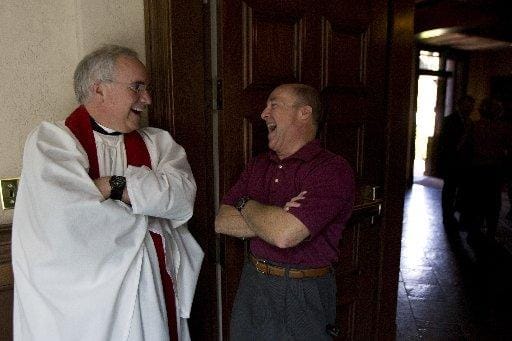
Don Armstrong laughing all the way to the bank (in happier times)
Pueblo special prosecutor Stephen Jones announced Friday that former Episcopal priest Donald Armstrong, ex-pastor of Grace Church in Colorado Springs, has entered a “no-contest” plea to felony theft in exchange for a deferred judgment and sentence.
Armstrong, 61, indicted by a 4th Judicial District grand jury in 2009 on 20 counts of felony theft, was accused of embezzling almost $300,000 from church and trust funds over eight years to pay for his two children’s college.
Donald Armstrong, a former Episcopal priest and former rector of Grace and St. Stephen’s Church, has pleaded no contest to a felony theft charge and guilty to a misdemeanor theft charge involving the historic downtown Colorado Springs church, according to a Sept. 17 statement released by the Episcopal Diocese of Colorado.
Armstrong had been charged with 20 counts of felony theft, stemming from financial improprieties during his tenure at the $17 million church, an architectural and social icon in southern Colorado for more than a century.
Larry Hitt, chancellor of the Denver-based diocese, said … “We believe that Armstrong’s entry of a ‘no contest’ plea to a class 3 felony theft charge [deferred judgment and sentence] and his effective guilty plea to a class 1 misdemeanor theft charge constitute a tacit acknowledgment of the truth of the criminal charges against him,” Hitt said in the statement.
[…] In Colorado, felony charges are categorized in six different classes, with class 1 being the most serious charge carrying the harshest penalty. Class 3 felony convictions may carry a sentence of at least four to 12 years and/or fines ranging from $3,000 to $750,000. Misdemeanors are lesser charges and carry lesser sentencing recommendations.
Hitt said “Armstrong’s theft constituted an abuse of trust and a betrayal by a priest of the church. His unlawful actions and efforts to divert the focus of the dispute away from his own behavior caused harm and suffering for the church, its clergy, its membership and the poor whom we are called to serve.”
But, he added, “We pray for healing for all affected by his actions, including Armstrong and his family. We also hope that he will be sentenced to make full restitution of the money he took from the church.”
Fr. Don Armstrong, rector of St. George’s Anglican Church and formerly rector of Grace & St. Stephen’s Episcopal Church, pled no contest to a single misdemeanor charge on Friday in Colorado Fourth Judicial Court, bringing to a conclusion an almost five year investigation and prosecution of Armstrong, the former Executive Director of the Anglican Communion Institute.
“The plea to which I agreed is an Alford plea which is for the purpose of accepting an offer of a plea agreement without admission of guilt, which was in this case essentially to drop twenty felony counts in exchange for a single misdemeanor.” Armstrong told VOL in an e-mail from his home.”
“This misdemeanor, which includes a restitution phase in which I am confident we will also be able to find an appropriate way forward, brings an end to my own criminal prosecution and spares both Colorado Springs congregations, St. George’s Anglican and Grace Episcopal, and the Episcopal Diocese from a lengthy trial that would serve only to diminish all of our witness.”
“Certainly we believe this sudden conclusion was Divine intervention. The Lord has blessed our congregation in so many ways, purging resentment and contempt for our persecutors from our hearts, instilling us with a renewed spirit of mission and outreach, and giving us a growing and deepening love for our Lord and one another. We have experienced a wonderful flourishing of faith under Bishops Minns and Bena in the midst of this intense and expensive persecution.”
He did it all for the congregation. How nice of him.
Alford plea (also referred to as Alford guilty plea and Alford doctrine) in the law of the United States is a guilty plea in criminal court, where the defendant does not admit the act and asserts innocence. Under the Alford plea the defendant admits that sufficient evidence exists with which the prosecution could likely convince a judge or jury to find the defendant guilty beyond a reasonable doubt.
It’s also referred to as a nolo contendere or “no contest” plea.
The official parish statement (no doubt written, or least vetted, by Armstrong) says:
In preparation for the now canceled trial we have become convinced even more strongly that controversies within the larger denominational church were the catalyst for the Diocese’s investigation and complaint, for the purpose of silencing our bold and successful defense of orthodoxy through our parish’s life, discipline, and teaching ministry. .
We believe that the courts are not the place to deal with theological differences, and that to have allowed this dispute to continue to be played out in the news by going to trial would have served only to diminish all Christian witness. With this plea offer now in place such further harm to the entire church in this already difficult age for Christianity will be prevented. .
We further believe the disparity between the magnitude of charges made against Father Armstrong by the Episcopal Diocese and the final content of the plea agreement vindicates not only Father Armstrong, but also clearly affirms our confidence that we ran an effective and well managed church in our days at the helm of Grace & St. Stephen’s Episcopal Church, and continue to do so at St. George’s Anglican Church.
Got that? Because he took a plea, it demonstrates he’s really innocent.
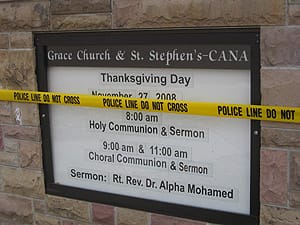
Grace & St Stephen's during the police raid of the church
Oh, and, by the way, the charges in question were made by the grand jury, not the diocese of Colorado (though they brought the matter to the DA’s attention), and based on a very lengthy investigation, carting off of crates of paper, etc.
Armstrong added later:
Plea agreements are always slightly messy and always a matter of give and take. Bottom line here is that they started with 20 Felony counts and we walked out of the court room with a misdemeanor, not to mention avoiding a trial in which no wins from the slug fest, and in which you risk the jury spitting the baby no matter how rock solid your case is, just because they like the prosecutor or something.
Yeah … plea out because the jury might “like the prosecutor or something.” Nice, but not quite what an Alford plea means.
So,on Friday a fictitious 21st felony count that had no basis in fact or history was created and added to address the original grand jury indictment and to assure proper jurisdiction. I plead no contest to that and it was differed.
I think that’s supposed to be “deferred.”
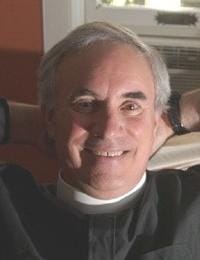
Don Armstrong kicks back, unconcerned (well, in 2003)
That was a procedural means to get to the real end, a misdemeanor. A fictitious misdemeanor was added, also without content-basis in fact or history, to which I entered an Alford plea…in other words, not an admission of any guilt but to accept the offer to reduce 20 felony counts to single misdemeanor.
So, long story short: 20 felony counts reduced to a single misdemeanor. I still maintain my total innocence, but have avoided a lengthy trial in which everyone looses, and put an end to this religious embarrassment.
Alas, the religious embarrassment continues …
Note, by the way, that as much as I dislike both Armstrong’s theology and his comity whilst he was a priest in the dicoese, the bottom line is that this was not some sort of liberal-vs-conservative debate, or persecution of someone speaking the orthodox truth. There are and have been much more conservative voices within the diocese, and many other opportunities that a vindictive bishop could have used to slap down Armstrong had one chosen to do so. Financial malfeasance within a parish, though, cannot be tolerated (nor can other non-theological crimes, of course).
Don Armstrong and security, making sure the church property was turned over still intact.
Note also that this criminal case, by local civil authorities, was completely separate from the civil case (also lost by Armstrong and his parish) over ownership of Grace & St Stephen’s Church. While the latter could conceivably be considered “persecution” by the diocese (just as any law suit to recover absconded property could be considered “persecution”), the former certainly is not.
So there’s still plenty of confusion about the whole outcome, so far as I can see. There is (or isn’t?) a felony theft conviction (to which the punishment has, perhaps, been “deferred” to the “distant (?) future” — but that can mean, in Colorado, that the charge will be dropped if Armstrong keeps his nose clean in the future). There is also a misdemeanor conviction for which restitution may have to be made (at some future point). These were plead to without admitting guilt, but admitting that the state had a case where guilt could have been found (hand-waving away of prosecutor-loving juries notwithstanding). Because there was no admission of guilt, the existing G&StS parish would have a more difficult time suing for restitution.
(More discussion of what an Alford plea might mean in the comments here.)
Note that the current Anglican body Armstrong belongs to, ACNA (Anglican Church in North America), does allow a priest to be defrocked for “A conviction by a court of competent jurisdiction for felony or other serious offenses.” Not that I expect it to happen, but it will be interesting to read the press release on the subject. (If the Alford plea allows the charges to be dropped, then arguably the “felony” never happened, in which case nobody will have to do anything about it.)
I’ll keep folks posted if/when I hear anything else.
(I’d crosslink back to various earlier stories on the subject, but there have been so many. I’ll just point to a search link here.)
Y’know, whatever sort of church service floats your boat (if you’re in the boat-floating church serving frame of mind), go for it. I, former Catholic and current Episcopalian, obviously am into traditional liturgy and “bells & smells” and all that jazz. But I realize some folks like something a bit more … contemporary.
Actually, I have no problem with anyone who chooses to change from an Anglican denomination to the Catholic side of the Tiber. I’m not sure that folks who have defined themselves as chafing against decisions made by higher-ups in their church will be very comfortable in, um, a more strictly hierarchical church that requires obedience to decisions made by higher-ups. And how Catholic priests will feel about their new Anglican brethren being able to bring their wives with them on an organized basis (it’s always been one of those one-off kind of decisions that could be made) remains to be seen (Catholic bishops will be spared the concern).
“It is not best that we should all think alike; it is differences of opinion that make horse races.” — Mark Twain
Mozilla’s Raindrop Looks To Make Your Inbox Personal Again – I think aggregation of messaging streams in this fashion is going to become a real battle in coming years — as individual messaging systems add features and aggregators try to demonstrate their (very real) value in pulling together this sort of data.
BBC NEWS | Technology | Universal phone charger approved – Unfortunately, it’s not likely to be a primary reason for phone selection, but hopefully it will be a factor. Esp. if governments put a surcharge on those phones that don’t use it (to cover waste/energy costs).
Badass Quote of the Day [Dispatches from the Culture Wars] – There are some very cool things about our country, things worth protecting and even worth promoting. But, yeah, American Exceptionalism is not only bad diplomacy, it’s a great way to deny the many things about our country that are not “the greatest* (and to deny the difference between the best and the best that could be). If no human can be perfect, how can any society of humans be perfect?
Links (most recent first) that caught my eye, but did not warrant full-blown blog entries ….
A Swift view of Andromeda – Whenever I see lovely pics of galaxies, the end titles music for the (original) Outer Limits always plays in my head.
HAPPY Days or, Should Pets Be Tax Deductible? – Everyone has sacred cows — and when you’re a Congresscritter, of whatever party, you get to vote in tax advantages to them. I have pets, but I’d just as soon not get a tax deduction for them.
Why American Credit Cards Suck [Travel Tips] – Yeah, we’re going to be the greatest country in the world right until we turn around one day and realize everyone else has left us behind.
Product Ideas for Google Reader – Google Product Ideas – A great way to solicit (and vote on) feature ideas. Of the 2,000 ideas received, they’ve come up with responses (“Answered Ideas”) on a dozen … none of mine, alas.
Busted burglar – I guess if you’re going to be burgled, it’s good to have a burglar with a sense of humor.
The Men’s Room at Grace & St Stephen’s Episcopal Church, Colorado Springs. Lovely, lavish use of etched glass, not to mention fine polished red granite floor tiles and backsplash. Not only did it add to the material splendor of Don Armstrong‘s “cathedral,” but it let Don piss on (or around) the Episcopal Church seal and be part of his saddling the parish with a massive mortgage as a(n unsuccessful) poison pill against a diocesan take-over.
No, really.
I’ve seen restrooms in high-end hotels and executive offices that were less well-appointed.
Well, at least the rightful parishioners can now enjoy it (if, no doubt, being a bit embarrassed by the opulence).
So among the very early morning activities at the Diocesan Convention today were hearings on proposed legislation. I wandered into the room about halfway through, to find that there was a resolution proposed that said:
Resolved: That the Episcopal Diocese of Colorado call upon its parishes and members to encourage constructive dialogue and otherwise support the establishment of accessible, affordable, appropriate, and sustainable health care for all the people of our country.
The supporting text to the proposal, noted as having no fiscal impact, was that this was a moral values issue. This follows onto a resolution passed by the national church at the General Convention this past summer.
(And bless you, Episcopal proposal-makers, for using the Oxford comma.)
Well, okay, so it’s a relatively feel-good resolution saying, “Yeah, this is a moral issue, we want to get ahead of it, and preach the right and wrong of the matter.” Nothing earth-shattering, any more than a proposal that the hungry should be fed or the naked clothed would be. One would think.
During the morning session, someone suggested that this needed some “accountability” in it, so recommended that the proposal be amended to include a paragraph directing the Bishop to name a task force to the matter. I shrugged — appointing “task forces” can sometimes be meaningful, but as often they simply end up getting together, nodding a lot, and then producing a report in a year that says, “Yup, this is something we should do.”
After lunch, we all had on our chairs little slips of paper with the revised task force verbiage, as noted above.
When we actually started discussing the measure, though, something odd happened. We were told to disregard the little slips of paper because a further change had been made by the committee, to wit:
Resolved, that the Episcopal Diocese of Colorado call upon its parishes and members to encourage constructive dialog regarding the establishment of accessible, affordable, appropriate, and sustainable health care for all the people of our country.
Plus the paragraph calling for a task force.
I did some quick copy comparisons, and discovered that while the Oxford comma was still in place, “regarding” had replaced the words “and otherwise support.” In other words, the resolution had gone from supporting health care for all to supporting constructive dialog about the matter.
Say what?
Okay, so there is nobody out there more in favor of constructive dialog than me. But this made a radical change in what the resolution was all about. It had become something that recommended appointing a task force to facilitate congregations in talking constructively about health care. No doubt to report back at the next convention. Which seemed … not all that useful, let alone bold or an example of moral leadership toward social justice.
I asked a couple of people beside me what they thought, and the consensus seemed to be that the idea was the task force would somehow turn this into something that pushed for support. But I really didn’t read it that way.
Meanwhile, people were getting up to talk in favor of the resolution because of a litany of health care woes they saw in their congregations, in their poor communities that they served, in their health and healing ministries, etc. And with each one, I felt more and more strongly that they were missing this point, because the current version of the resolution would do nothing to fix the problems and pain and death they described — it would just request that we discuss it more constructively.
I reluctantly (because it was inconvenient to get there, plus I really didn’t want to get mixed up in a brouhaha) slid down to the end of my aisle, and circled around the room to one of the microphones set up to take comments / arguments from the floor.
While doing this, an amendment to get rid of the task force (because it might cost money) was very narrowly defeated; I wouldn’t have minded, not because of the cost, but because I wasn’t sanguine that a task force would do much.
So we were back to discussing the current resolution, and I was at the mic, when someone stepped to the other mic and offered an amendment. “Ah,” I thought to myself. “Someone has the same idea. Whew.”
No. The person was proposing to replace the word “people” with “citizens.”
Say what?
I was flabbergasted. It was nativist rhetoric (though not offered with any argument beyond its existence) at its worst, and seemed wildly inappropriate for a religious setting. I mean, yeah, it’s the sort of Limbavian “us vs. them” thing I hear and read about, but I was very surprised to run into it in this situation. The rather loud mutterings of the audience seemed to support that.
The Bishop asked if I was going to speak to the amendment, since that’s what was now under discussion, having been moved and seconded.
A small digression. I can speak in front of crowds. I’ve done so on many occasions. Give me a script, or a written or memorized speech, or even a scribbled outline, and I can do so very comfortably. Heck, give me a friendly audience, and I can ad lib quite well.
Put me in front of (a) a conference room with several hundred people in it, (b) no script or notes or outline, (c) the potential for hostile and divisive moral debate, (d) over a subject that I’m very emotionally committed about, with (d) the requirement that I address myself to the Bishop in front of all those people … and the glibness, not so much.
So I failed to address the bishop, per custom, as “Right Reverend, sir.” I also failed to start with, per convention rules, my name and parish and city. *sigh*
Now, what I meant to say was something along the lines of:
I oppose the proposed amendment. This is a moral issue, and to the best of my recollection, when Jesus spoke of ‘who is the neighbor’ in the parable of the Good Samaritan, citizenship not only had nothing to do with it, it was explicitly denied as a reason to neglect neighborly love.
What I actually said covered that, more or less, but not nearly as well. My throat was dry, my vision was tunneled, and I kept … well, it was shorter than that, but hit the high points.
I got applause, fergoshsakes.
The bishop, rightly, noted that demonstrations, of approval or disapproval, were not allowed following comments from the floor. I went and sat down at a nearby chair, in case I needed to speak again.
The debate continued back and forth for a few minutes, then the amendment was put to a vote. It was soundly defeated.
So now we were back to the baseline proposal. I headed for the mic again (since it was, per conference rules, a new matter).
I remembered to address the bishop as “Right Reverend, sir,” but forgot to give my name / parish / city. Again. *sigh*
After that, what I meant to say was:
Point of information, please. I’m not sure the best way to get this info, whether I can just ask or if I need to offer up an amendment regarding it, but can we be told the reasons for the difference between this morning’s version of this resolution and the one before the convention? The removal of “support” for health care seems to me a significant change, and I’d like to know the reasoning behind this.
I said something like that, only, well, you get the idea.
The answer, from the bishop, was that it was his understanding the proposal was modified so as not to get the diocese involved with any specific legislative solution.
I replied:
In that case, Right Reverend, sir, I’d like to propose an amendment, to restore the “support” language to the resolution as it was this morning.
After working through what that verbiage would actually work out to be, it was moved and seconded.
I spoke to my amendment.
The provision of ‘accessible, affordable, appropriate, and sustainable health care for all the people of our country’ is not a political issue, but a moral one. It is incumbent upon us, as followers of Christ and his teaching to care for the sick, to love our neighbor, to treat the least of our brethren the way we would treat him, to support this moral principle. This has nothing to do with specific legislation — any legislation that would enact this goal would be fine, no matter from what party or source. It is our duty as moral teachers that demands we support this principle, for all the very human, painful reasons that have been brought to the convention’s attention.
Only, again, not quite so coherently. I may have babbled a bit. I honestly don’t remember the fine details, which may be a blessing.
Others got up during the limited debate (three speakers for, three against, 2 minutes each statement max) to speak against my amendment, suggesting that (a) we shouldn’t get involved in the political brouhaha, or (b) this issue wouldn’t be resolved any time soon so waiting until next diocesan convention to make sure that we’re all talking politely about it seemed the best thing to do.
Others spoke for it, reiterating my points in a much better and calmer fashion.
Ultimately, the bishop called for a vote. It was close, but my amendment actually passed. Which, once again, changed the game.
Thus we were back to debating the full bill, with my amended language. Aside from more concerns about how much a task force would cost (answer: that was up to the bishop), there weren’t many more comments.
And it went to a vote.
And it passed.
So, yes — I actually affected, through my actions and speech, legislation passed by the annual convention of the Episcopal Diocese of Colorado. I helped defeat a bad amendment (I’ll not characterize it less charitably), and managed to change the nature of the resolution to actually call for the diocese to support some measure of health care reform.
And I got quiet attaboys from our parish delegation, and from some others at the convention after it let out this evening — both folks I knew (and respect) and some I didn’t.
Not a bad day’s work.
But will it make any real difference? No way to tell. I don’t expect it to grab headlines, or change legislators’ minds overnight. I don’t expect the diocese will hire a squad of lobbyists and send them out to DC to waylay Max Baucus. It may very well be just what I originally thought of it this morning — a bit of social justice drama, a feel-good resolution that says the right things but doesn’t translate to any particular action.
Or maybe not. Maybe it might have some small influence — even if it’s just to put the diocese formally on the (to my mind) right side of this debate. And, regardless, it’s now a small part of diocesan history. And, regardless as well of whether it makes any overall difference in the outcome, it was the right thing for me to do. And I did it. I don’t mean that to sound like a brag, just internal satisfaction that I lived up to my principles. Semi-incoherently, perhaps, but I overcame my intense personal discomfort with the situation and made an actual stand on moral principles.
So tomorrow afternoon I am off as a delegate from our parish to the 122nd Convention of the Episcopal Diocese of Colorado, held this year in beeyooteeful Pueblo, CO.
I’ve done the diocesan convention thing multiple times before, but it’s been a few years. If the reports from the General Convention are any indication, it should go more smoothly due to the conservative factions that have departed, but also be somewhat less rich (or at least intriguing) for the loss of some of those departed voices.
The original plan was that Margie and Katherine were going to come along, too, but flu outages and school and work sort of put the kibosh on that.
There’s basically three parts to the convention: the plenary sessions (all the legislative bits, which are not likely to be all that exciting this year), the workshops (which should be moderately interesting), and the vendor room (which is often fascinating).
The high point of the journey may be the first night — the convention church service is being held up the road in Colorado Springs, at the litigationally-liberated Grace & St Stephens Church. It will be both a celebration (of the convention, and of the restoration of the building to the diocese) and a sadness (over the division that took place there).
I should be back sometime Saturday, so there will be at least some weekend for me. 🙂 The timing sucks, in terms of being away from the family, but that’s how it worked out.
It’s an honor to be asked to be a delegate — to help do the “business” of the church. There’s a certain measure of sausage-making in any such endeavor, but I tend to think that’s part of the human condition in any organization, religious or otherwise. And seeing how the church operates up close can be as uplifting and educational as it is sometimes disappointing or disillusioning.
More to report on as it happens (or, more likely, the evening after it happens). Hotel wi-fi willing, that is.
“VirtueOnline” is a conservative religious site (“The Voice for Global Orthodox Anglicanism”) headed up by David Virtue. “Global Orthodox Anglicanism” usually seems to mean “We don’t like the Episcopal Church because they don’t stone gays — oh, and they kinda dabble with having women in the priesthood, too, and most of us don’t like that very much, either.”
In the DIOCESE OF COLORADO, Bishop O’Neill is making good on his policy to punish the orthodox and reward the apostate. While ripping and tearing Grace & St. Stephens apart and trying to jail the Rev. Don Armstrong, …
Actual, Rev. Armstrong did the “ripping and tearing” by strong-arming his parish out of the Episcopal Church, property and all. Rev. Armstrong also managed to set himself up for jail time, based on the indictments the DA has filed against him.
… he announced a new rector, a lesbian, for St. Paul’s in Fort Collins. “The Coloradoan” reported on the new rector Bonnie Sarah Spencer and her partner, Catherine Anderson, who are coming to Fort Collins from Somerset, Massachusetts, where Spencer served as rector at Our Saviour Episcopal Church. She described St. Paul’s styles as “an inclusive church welcoming all people.” Lesbian Integrity leader (the Rev.) Susan Russell wrote at her blog, “Under Bonnie’s leadership, St. Paul’s will continue to be a safe haven for everyone, no matter where they are in their spiritual journey.”
Yes, that’s our Rev. Bonnie, whose installation we attended. I’m surprised Virtue skipped over all her past “notorious” history.
This is not the first time O’Neill has allowed a lesbian into the diocese.
Eek! Katy, bar the door! No, wait, Katy, lock yourself in your room — better let a man bar the door!
In January of this year Mary Catherine Volland, a longtime resident of Colorado and a partnered lesbian, was ordained in St. John’s Cathedral in Denver as the Episcopal Diocese of Colorado ended its moratorium on ordaining gay priests. Volland had been a candidate for ordination by the Diocese of Minnesota. She will serve as an assistant priest at St. Thomas Episcopal Church in Denver.
Egads! And … from Minnesota, no less! What next? Lutherans?
Beckett Stokes, a spokeswoman for the Colorado diocese, said Bishop Robert O’Neill had originally suspended gay ordination out of sensitivity to churches that had strongly opposed it. Stokes said O’Neill will now decide the matter on a case-by-case basis. Several Colorado congregations are and have been served by gay and lesbian priests.
Exactly. Bp Rob bent over backward to avoid offending conservatives in the diocese who were uncomfortable with gays, or gay clergy. This didn’t actually make anyone any happier, nor did it keep conservatives who were going to leave from … well … leaving.
So now he’s judging on an individual basis whether gays should be ordained. Sort of like he does with straights. Shocking, I tell you … shocking!
Interpretation. If you are gay or lesbian, you are welcome into the diocese. If you are orthodox in faith and morals, don’t bother applying.
Um … say what? I mean, yeah, gays and lesbians are welcome into the diocese. As far as I know, the “orthodox” are, too. certainly there are “orthodox” folks in our parish.
But, Mr Virtue might ask, how can can the “orthodox” exist side by side with those “gays and lesbians”? Don’t they, like, explode, sort of like godly matter and anti-christ-matter?
Amazingly enough, if you belong to a Christian church and focus on the stuff that Christ actually talked about — y’know, serving rather than ruling, taking care of the poor and feeding the hungry, treating one another with dignity, all that good stuff — you find that it’s possible for lots of people to get along, and even love their neighbors as themselves and all that squishy stuff.
“The Diocese of Colorado is perhaps the most politically and theologically diverse diocese in The Episcopal Church. I am grateful to all in this diocese who faithfully come to the table to offer their many gifts to God’s service, including the gay and lesbian Christians among us who so generously contribute to our common life and ministry,” said O’Neill.
Good heavens! How … how … unorthodox. And un-Virtuous!
Bonnie was a deacon at our parish, Good Shepherd Episcopal, when we started attending there. She was ordained to the priesthood while at Good Shepherd — and Katherine was the first child she baptized as a priest.
She left our parish at an ostensibly appropriate time — after our rector left — but her move out of the diocese to back East was a good opportunity for her but driven by a sad reason: the bishop (the “oft accused of being a running-dog ultra-liberal” Rob O’Neill) had decided that openly gay priests could not become rectors (pastors) of churches in the diocese whilst the matter was (all the way back in 2004-2005) so tumultuous and divisive. If Bonnie was to move on to the next rung up the ladder of her clerical career, she had to go elsewhere. So she did. Which was right for her, but Colorado’s loss.
And that, of course, there was all ofthefall-outfrom the brouhaha over Bonnie’s coming out and participating in a private commitment ceremony at our church. Or, at least, that kerfuffle was part of the tensions at the time within the national church in general and the diocese in particular. In a very real sense, the departure of the most fractious conservatives from the diocese (e.g., Rev. Don Armstrong) has opened the door to not having to compromise by placating them. Which, all things considered, is a good thing. (I’ll be interested to see if her installation garners any negative headlines.)
I think it’s worth noting that we were not the only Good Shepherd folks in attendance at Bonnie’s installation. I’m guessing there were at least 40 of us there, a substantial percentage of the attendees. Bonnie seemed very touched to see us, and it was great seeing her — and seeing her back in Colorado (with the Bishop’s blessing) was pretty cool, too.
She’s good people. I’m glad we were able to attend. Mazel tov!
If you think the Episcopal Church General Convention opening the door to ordaining more gay bishops* was going to cause a furor in some conservative Anglican quarters, get a load of this:
Today (Wednesday) the House of Bishops passed C056 by a vote of 104 to 30. Here is what that resolution said:
Resolved,the House of Deputies concurring,That the 76th General Convention acknowledge the changing circumstances in the United States and in other nations, as legislation authorizing or forbidding marriage, civil unions or domestic partnerships for gay and lesbian persons is passed in various civil jurisdictions that call forth a renewed pastoral response from this Church, and for an open process for the consideration of theological and liturgical resources for the blessing of same gender relationships; and be it further
Resolved, That the Standing Commission on Liturgy and Music, in consultation with the House of Bishops, collect and develop theological, andliturgical resources and report to the 77th General Convention;and be it further
Resolved, That the Standing Commission on Liturgy and Music, in consultation with the House of Bishops, devise an open process for the conduct of its work inviting participation from provinces, dioceses, congregations, and individuals who are engaged in such theological work, and inviting theological reflection from throughout the Anglican Communion; and be it further
Resolved, That bishops, particularly those in dioceses within civil jurisdictions where same-gender marriage, civil unions, or domestic partnerships are legal, may provide generous pastoral response to meet the needs of members of this Church; and be it further
Resolved, That this Convention honor the theological diversity of this Church in regard to matters of human sexuality; and be it further
Resolved, That the members of this Church be encouraged to engage in this effort.
Resolution C056 has now been passed by the House of Deputies. The voting was Lay: 78 yes, 23 no, 7 divided. Clergy: 74 yes, 27 no, 7 divided. The text is here.
That’s not quite blessing of gay marriage in the Episcopal Church … yet. But we’re a liturgical denomination, and when we start studying liturgy and music for same-sex blessings, that means we’re darned serious about it. The canons may still define marriage as “one man with one woman,” but that’s another battle for another day — that whole “generous pastoral response” gives a lot of leeway for bishops to do what they see fit in blessing or supporting same-sex unions, in conjunction with local civil law.
Much good here, and, perhaps, an end to the dithering on the subject by the church.** I’m glad to see it, and I look for forward to seeing what happens in the coming months and years, both in the Episcopal Church as a whole, and in the Diocese of Colorado in particular.
* The growing consensus about D025 is that it did not so much raise any moratorium — which didn’t really exist — but that the call for “restraint” and consideration from the previous General Convention’s B033 is now down at the local level, rather than being imposed from above, and with the understanding that, dagnabbit, gays and lesbians aren’t pariahs but part and parcel of our congregations and God’s church. Imagine that.
** The oddest set of arguments — from many on opposition to C056 — was that conservatives are leaving the church, “voting with their feet.” Funny — I had no idea that virtue and justice and God’s will were a popularity contest. If we become a smaller church by doing right — we’ll still be doing right. If the cost of growth or even keeping to our current numbers is injustice and turning our backs on our gay and lesbian brethren, then it’s not worth it.
So I posted the other day about D025, the resolution from the Episcopal General Convention that says, “Yeah, we like being Anglican, but we think gays in committed monogamous relationships (which would be marriage if we, y’know, let them get married) should be eligible to be bishops and priests if they meet the requirements and go through the discernment process.”
Reactions are filtering in.
As BD noted at the time, as has been commented upon elsewhere, the Archbishop of Canterbury (ABC, in Anglican-slang) was not amused, calling it all regretable. He seems not to have read the resolution as a whole (esp. the parts where it says, “We really, truly, ooly, like being part of the Anglican Communion, which is why we title the bill, ‘Commitment and Witness to Anglican Communion’“), and further seems to think that the resolution means TEC is going to be ordaining a veritable army of gay and lesbian priests and bishops, all of them blowing raspberries at Nigeria’s Abp. Akinola.
Interestingly enough, even though the ABC made his uninformed statement prior to the bishops voting on the resolution, or its final confirmation in the House of Deputies (since the bishops wordsmithed it a bit), it stopped neither house from proceeding. It appears they saw his statement less as a considered theological opinion than as part of his increasingly frantic efforts to maintain an already unstable status quo.
Interestingly, some folks don’t see this as a repudiation of 2006’s B033, which called for TEC to use “restraint” in ordaining folks whose “manner of life” (nice phrase) might cause the rest of the Communion heartburn. Whether B033 played a role in no further gays being elected by dioceses as bishops over the last three years is uncertain, but, yes, in theory you can argue that B033’s call for restraint and sensitivity (not an actual moratorium) remains intact, while D025’s basically says that it’s up to God who gets chosen (the latter may be theologically true, but there’s still a very human process at work).
It is possible to maintain that the Episcopal Church has been impolitic in its vote, but still maintain that it is right. A united Anglican witness to the nation and to the world is a valuable civic as well as religious resource. Those member Churches, including many in Africa, who conscientiously cannot accept homosexual bishops, should not have appointments forced upon them. But the issue is not one of denominational preference alone. It is also a matter of justice.
Kendall Harmon, a vocal conservative Episcopal theologian, is not pleased.
The passage of Resolution D025 by the General Convention of 2009 is a repudiation of Holy Scripture as the church has received and understood it ecumenically in the East and West. It is also a clear rejection of the mutual responsibility and interdependence to which we are called as Anglicans. That it is also a snub to the Archbishop of Canterbury this week while General Synod is occurring in York only adds insult to injury.
I don’t recall seeing much “mutual responsibility and interdependence” from various foreign provinces over the past several years, fomenting schism within the Episcopal Church.
The conservative Anglican Communion Institute is already trying to use the as-yet-unadopted (and now we see why) “Anglican Covenant” as a club to show that those nasssssty Episcopalians ought to be booted from the club.
It is noteworthy that Section 3.1.4 of the final text of the Anglican Communion Covenant, which was contained in the section approved overwhelmingly by the Anglican Consultative Council and no longer subject to revision, gives each of the Communion Instruments the authority to “initiate and commend a process of discernment and a direction for the Communion and its Churches.” Speaking at the close of the Council’s meeting, the Archbishop of Canterbury anticipated yesterday’s action and spoke directly to The Episcopal Church on its place in the Anglican Covenant when he said “Action to negate that resolution [the moratorium] would instantly suggest to many people in the communion that The Episcopal Church would prefer not to go down the route of closer structural bonds and that particular kind of mutual responsibility.”
Oh, and they support anyone who wants to break from the Episcopal Church, too.
Honestly, though, I don’t see much further drama within TEC in terms of parishes or dioceses trying to leave; those folks have already sailed, and bon voyage to them (as long as they didn’t try to take the family silver as they left).
While it all sounds like a bunch of legislative hoo-hah at a boring church synod, the actions yesterday by the Episcopal Church (TEC) are a big leap forward for it, and perhaps for Christianity as a whole if we serve as an example. The House of Deputies of the Episcopal Church’s General Convention (a triennial meeting, occurring this year in Anaheim, California) wrote and passed H025 earlier in the week, and now it’s beenadopted, as amended by the House of Bishops, overturning the bill B033 passed in the waning hours of the previous GC.
Resolved, the House of Bishops concurring, That the 76th General Convention reaffirm the continued participation of The Episcopal Church as a constituent member of the Anglican Communion; give thanks for the work of the bishops at the Lambeth Conference of 2008; reaffirm the abiding commitment of The Episcopal Church to the fellowship of churches that constitute the Anglican Communion and seek to live into the highest degree of communion possible; and be it further
Resolved, That the 76th General Convention encourage dioceses, congregations, and members of The Episcopal Church to participate to the fullest extent possible in the many instruments, networks and relationships of the Anglican Communion; and be it further
Resolved, That the 76th General Convention reaffirm its financial commitment to the Anglican Communion and pledge to participate fully in the Inter-Anglican Budget; and be it further
Resolved, That the 76th General Convention affirm the value of “listening to the experience of homosexual persons,” as called for by the Lambeth Conferences of 1978, 1988, and 1998, and acknowledge that through our own listening the General Convention has come to recognize that the baptized membership of The Episcopal Church includes same-sex couples living in lifelong committed relationships “characterized by fidelity, monogamy, mutual affection and respect, careful, honest communication, and the holy love which enables those in such relationships to see in each other the image of God” (2000-D039); and be it further
Resolved, That the 76th General Convention recognize that gay and lesbian persons who are part of such relationships have responded to God’s call and have exercised various ministries in and on behalf of God’s One, Holy, Catholic and Apostolic Church and are currently doing so in our midst; and be it further
Resolved, That the 76th General Convention affirm that God has called and may call such individuals, to any ordained ministry in The Episcopal Church,; and that God’s call to the ordained ministry in The Episcopal Church is a mystery which the Church attempts to discern for all people through our discernment processes acting in accordance with the Constitution and Canons of The Episcopal Church; and be it further
Resolved, That the 76th General Convention acknowledge that members of The Episcopal Church as of the Anglican Communion, based on careful study of the Holy Scriptures, and in light of tradition and reason, are not of one mind, and Christians of good conscience disagree about some of these matters.
So what does all that mean?
Boiled down:
We like being Anglicans. We want to be remain part of the broader Anglican communion of churches. That relationship is important to us.
We’re not going to do it on the backs gays and lesbians. If they want to be ordained in our church, as deacons, priests, or bishops, we’re going to treat them the same as anyone else.
Yeah, we know some folks, inside and outside the Episcopal Church, will disagree with us. We don’t think they’re evil, just that we disagree.
In some ways, this recognizes the de facto situation on the ground: some bishops have been ordaining gay and lesbian priests as they’ve seen fit, as those individuals have come through the discernment process. But the ordination of Gene Robinson in 2003 as Bishop of New Hampshire, which brought all this fracas to the forefront, has been a one-off exception. Faced with pressure from Canterbury and the much of the Anglican Communion, the Episcopal Church in 2006, through B033, agreed to not stir the waters on gay ordination, esp. of bishops, as part of the 2004 Windsor Report process.
Of course, the Windsor Report not only asked the Episcopal Church to exercise restraint, but also other Anglican Churches to keep their paws off of Episcopal territory. That part has been widely ignored by conservatives inside and outside TEC, and the passage of B033 was seen as a caving into conservative interests at the expense of faithful gays and lesbians. “Wait a bit longer.”
D025 changes that. It basically says that, all other considerations aside, gays and lesbians in committed lifelong relationships ought to be considered equally with heterosexual individuals in discernment processes for the diaconate, priesthood, or the episcopacy. And we’re really sorry if we ruffle feathers (no, really), but that’s where we believe God is calling us.
Good for the folks who moved this forward. I’m proud to be a part of this church.
The criminal investigation side of the whole Don Armstrong mess in Colorado Springs has moved to the next stage. His supporters pooh-poohed as nasssssty liberal church politics the Episcopal Diocese finding him guilty (in an ecclesiastical court) of fraud and financial malfeasance. This was after a long diocesan investigation, but Armstrong’s supporters applauded his fleeing the Episcopal Church before he could be booted out, dragging much of his parish with him (and, until this past Easter, the parish property, too).
After a two-year investigation by the Colorado Springs Police, a Grand Jury has indicted Armstrong on twenty counts of felony theft.
I’m charitable enough to both consider him innocent until proven guilty, and to not take untoward pleasure in his misfortune (or on the general scandal of it all) … but I’ll confess that I’m pleased to see some egg on the faces of all of those people who were sooooooo sure that the duration of the investigation proved that the Episcopal Diocese of Colorado was full of vindictive, evil, non-Biblical, nasssssty sorts who were out to smear Armstrong’s name.
The foofoorah over the Swine Flue comes to church — the Episcopal Church, at least, where various dioceses and the national church have been discussing measures related to possible pandemics that have a particularly religious flavor to them.
“Swine flu is currently being handled by the health authorities. We are, however, prepared to respond through our church networks should we be needed,” said Abagail Nelson, senior vice president for programs at the New York headquarters of Episcopal Relief and Development, the church’s disaster-relief and economic-development agency.
About 1,600 people have been sickened in Mexico and 50 cases have been reported so far in the United States, but no deaths. After the outbreak was confirmed on April 24, a number of churches in Mexico City on Sunday, April 26 canceled services.
The Diocese of Colorado has sent a brochure to various parishes on preparedness, but for all we Episcopalian are Intensely Proper and, well, English, there’s all sorts of ways that sickness could be passed on.
Churches — like other public places where people gather regularly — could be sites of disease transmission. During previous outbreaks of illness, such as the incidence of Severe Acute Respiratory Syndrome (SARS) in 2003 in 37 countries, the U.S. and Canada, certain worship practices also came under scrutiny. During Episcopal Sunday services, many people shake hands or hug during part of the service called the “passing of the peace,” sip wine from the same communion chalice or dip the communion wafer in the wine.
Interestingly, a lot of folks think it’s safer to intinct the communion bread (dip it in one of the cups) than to eat the bread then drink from the cup. As someone who frequently mans the chalice at Sunday services, I’ve long known that’s not true — the “drinkers” just sip (and the chalice bearer then wipes the rim with a cloth), whereas some of the “dunkers” dunk their bread down to the second knuckle. Ick.
Episcopal Church diocesan bishops have the authority to order changes in worship, said Clay Morris, program officer for worship and spirituality, at the church center in New York. Research collected at his office, he said, shows that the practice of sharing the chalice, called the “common cup,” generally carries a very low risk of infection. “We are told repeatedly that the common cup is not a health hazard,” he said in an interview. Usually, the cup bearer wipes the rim and turns the cup after each person sips.
However, he said, the practice of dipping the wafer, called intinction, may carry a higher risk since fingers are also often dipped into the wine. During the SARS outbreak in Canada, at least one diocese, the Diocese of Niagara (Ontario), banned intinction in its churches. The Anglican Church of Canada published on its website a research report on risks of infection and communion practices.
From an Anglican theological standpoint, there’s no requirement to take communion in both “species” (bread and wine); indeed, most Catholics (at least when I was growing up) never get near the chalice. But it’s a tradition, and, as such, is both difficult to see around and important to examine in light of (realistic) health concerns.
Hmmm. I am the chair of our parish Worship Commission, and we have a meeting Wednesday night. Maybe I’ll print off that report and bring it up there.
Bishops in the Episcopal church are obliged to visit each of their parishes once every few years, and this past week was our church’s turn to get a Sunday morning of Bp. Rob O’Neill’s time — appropriate, as it is Good Shepherd Episcopal Church, it was the day for readings about the Good Shepherd, Psalm 23, etc.
Bp. Rob’s an interesting guy. He walked into the job here about five and a half years ago (I was privileged to be one of the voting delegates from our parish), just in time for the fall-out from the 2003 General Convention (where New Hampshire’s election of a bishop who happened to be openly gay was confirmed) to hit the ground, coupled with other brouhaha within the diocese, from the big brouhaha at our church to the whole Don Armstrong thang, as well as national and international turmoil.
But for someone who keep being portrayed by the conservatives in the Episcopal Church and splinters thereof as Teh Evil Running-Dog Liberal Lackey and Button Man of That Woman (our Presiding Bishop, Katharine Jefferts-Schori), Rob doesn’t come off as some wild-eyed lunatic or cunning madman or disingenuous tearer down of all that is right and holy in favor of rudderless libertinism. Instead, he taught. He engaged the congregation both during his sermon and in an hour-long session afterward, talking about the challenges in our own lives to follow the path of service down which Christ … well, shepherds us.
It was a good Sunday experience, meaning it’s one that I can take out beyond Sunday. There have been times when I’ve wished for a more visible leader as bishop, someone actively confronting injustice and wrong, but whenever I get a chance to meet or listen to him, it’s a reminder that there’s more than one way to lead.
(His sermon’s not online, but some of Bp. Rob’s other writings are here.)
Ironically, it’s forty (!!!) years ago today that I received First Communion, at St Joseph’s Catholic Church in Pomona, CA. I remember the date because I got a St Christopher medallion as a gift, and the date was engraved on the back.
What a long, strange journey it’s been, faithwise.
Ownership has been in dispute since March 2007, when some members and leaders of Grace Church and St. Stephen’s left the national body over theological differences. The breakaway group aligned itself with the conservative Convocation of Anglicans in Virginia but continued to worship in the building.
Rev. Alan R. Crippen, spokesman for the breakaway parish, said the group probably won’t appeal. […] The breakaway parish will lose the building, trade name and Web domain. The congregation plans to meet elsewhere.
The Episcopal faithful will begin worship at the church again on Palm Sunday, 5 April.
One of the aspects of the Anglican Communion that is potentially so uplifting and powerful is the opportunity it provides for folks, bound together by a common tradition, even if separated by particular beliefs, to come together to the table to worship together. One of the more annoying acts by the hard conservatives in the Communion has been their pointed refusal in the past few years to do this with the Godless Heathen American Episcopalian (et al.) crowd — declining to take communion with Bp Katharine Jefferts Schori (presiding bishop of the Episcopal Church), as well in some cases with others who voted to accept the election of Bp Gene Robinson (let alone, of course, letting Bp Robinson get anywhere near them, no doubt in fear of getting gay cooties).
So I take fellowship very seriously. I hold to the example set by Jesus, who didn’t hang out with just people who agreed with him, or who were “orthodox.” He didn’t just break bread with the accepted crowd, even at (especially at) the Last Supper. If he could reach out and engage and simply be with those who were sinners, those who would betray him, etc., how can someone who claims to follow him do any less?
But it’s hard, very hard, to consider myself in fellowship with Abp Peter Akinola, head of the (Anglican) Church of Nigeria. Last year, the Nigerian legislature was considering a bill that would imprison Nigerian gays, and even imprison those who support gay rights. Word on the street was that Abp Akinola was strongly in favor of, and actively supporting the bill, but all sorts of feeble denials were issued that, no, that simply wasn’t true.
But it’s another year, and another bill, and evidently now Abp Akinola, speaking for the Church of Nigeria, actively supports proposed legislation to criminalizes gay marriage (which is already not legal in Nigeria), as witnessed in this position paper put forward in public hearings on the bill (to which hearings the Church actually bussed supporters).
Among other things, Akinola calls for those engaging in same-sex marriage (again, already illegal in Nigeria) to be thrown in prison for five years (higher than the bill currently calls for); those who witness such a marriage (or “aid and abet” it) should be imprisoned for three years; organizations involved should not be simply fined, but members thrown in jail for a year.
(Note that the “aid and abet” language doesn’t just mean renting out a hall for the reception; arguably, it’s a back door hunting license for action against anyone in the country who speaks out in favor of gay marriage.)
Akinola’s letter concludes:
Same sex marriage apart from being ungodly is also unscriptural, unnatural, unprofitable, unhealthy, uncultural, un-African and un-Nigerian. It is a perversion, a deviation and an aberration that is capable of engendering moral and social holocaust in this country. It is also capable of existincting [sic] mankind and as such should never be allowed to take root in Nigeria. Outlawing it is to ensure the continued existence of this nation. The need for doing this is urgent, compelling and imperative. The time is now.
For all of Abp Akinola’s fulminations about how the Episcopal Church is betraying Christianity, it strikes me that the malice, politicking, condemnation and prejudice that he displays is far less Christ-like than any questions the Episcopal Church is raising re orthodox teaching on homosexuality.
It’s difficult for me to consider myself out of fellowship with a fellow Anglican, given all my posturing at the top of this post. But maybe I finally understand the conservatives’ stand, if not agreeing with what’s brought them to it: it’s difficult to maintain a dialog, or come to table, with someone whose views and actions are so abhorrent to you, and who shows no sign of even wanting to discuss it.
The Nigerian legislation is horrible. Akinola’s hitching of the Church of Nigeria to the cause is even worse.
 For those just tuning in, Don Armstrong was an Episcopal priest here in Colorado who: