It’s not always possible (or best idea) to just attack-attack-attack. Sometimes you want to … take some time, to seize the right moment, to make sure you understand the situation and can best act on it.
That’s what the Ready Action is for, probably one of the most confusing actions for new (or new, veteran) players.
So, what is the Ready action?
Part of the confusion here is that previous D&D versions have had the concept of “holding” or (4e) “delaying” a turn (“I’m going to hold until the wizard lightning bolts that guy to see if I need to hit him again or go over and help the rogue”). 5e reframes and reduces that concept to Readying an Action. It’s much more constrained as (a) it requires defining a trigger-response pairing, and (b) if the trigger doesn’t happen, your Action for that turn is lost.
Sometimes you want to get the jump on a foe or wait for a particular circumstance before you act. To do so, you can take the Ready Action on your turn, which lets you act using your Reaction before the start of your next turn.
So an important couple of things here. First you are waiting for a particular circumstance, and second, you are not only using your turn’s action for Ready, but it will depend on you having your Reaction left in order to use it. And if the circumstance doesn’t occur … you’ve essentially “wasted” your actions for the turn. (Yes, “they also serve who stand and wait,” but it’s still kind of disappointing.)
A different way of looking at a Readied Action is that it’s a called Reaction to a specific circumstance (vs a canned Reaction such as an Opportunity Attack or a spell that can be cast as a Reaction). You don’t so much declare an Action as declare a Reaction you are going to take before your next turn. (I wonder if it would be a bit less confusing if they called it “Ready Reaction” rather than “Ready Action”.)
First, you decide what perceivable circumstance will trigger your Reaction. Then, you choose the Action you will take in response to that trigger, or you choose to move up to your speed in response to it. Examples include “If the cultist steps on the trapdoor, I’ll pull the lever that opens it,” and “If the goblin steps to me, I move away.”
So the trigger has to be a perceivable circumstance. You can’t Ready an Action in response to something you are unaware of.
(Can you make some sort of Perception / Investigation / Insight check as part of that? Good question. The answer is no as an Active check, because that’s an Action (the Search Action, to be specific); the DM could let you do a Passive check, because that’s automatic. But, then, that whole Active/Passive check thing gets complicated, especially when combined with Hidden stuff.)
The Reaction to that perceived circumstance is then to either:
Take a single Action (if you are a high enough level fighter to have multiple Attack Actions, you can still take only one, because that feature can only be used on your turn, not elsewhere in the round), or
Move.
(Note: don’t wait until the goblin steps up to you to Move, or else they will get an Opportunity Attack on you; wait until the step within ten feet of you.)
When the trigger occurs, you can either take your Reaction right after the trigger finishes or ignore the trigger. Remember that you can take only one Reaction per round.
A Readied Action is binary: when the trigger occurs you must decide to take that Reaction right then, or decide to ignore it and the Readied Action goes away (though it doesn’t count as having lost your Reaction for purposes of other types of Reactions).
If you say, “If a goblin steps out of cover over there, I will throw my javelin,” then once the goblin charges out of cover, you can’t wait until it gets to as closer range to shoot: you have to take the shot right then and there.
When you Ready a Spell, you cast it as normal but hold its energy, which you release with your reaction when the trigger occurs.
To be Readied, a spell must have a casting time of 1 action, and holding onto the spell’s magic requires Concentration. If your Concentration is broken, the spell dissipates without taking effect.
For example, if you are Concentrating on the Web spell and Ready Magic Missile, your Web spell ends, and if you take damage before you release Magic Missile with your reaction, your Concentration might be broken.
This is also important; a Readied spell burns thespell slot, whether or not the Reaction is triggered or you choose to let it be triggered. For this reason, a lot of magic-users only Ready cantrips, since nothing is “lost” if it isn’t used.
It only allows Movement or an Action (not a Bonus Action, as Bonus Actions only occur on your turn).
That said, even if you are using Ready for your turn’s action, you can still also Move and take a Bonus Action. So it doesn’t mean you are completely paralyzed.
You only get one Reaction between turns. If you make an Opportunity Attack, or any other Reaction (like Counterspell) before your Readied Action triggers, you lose your Readied Action (and vice-versa). Conversely, if you managed to use your Readied Action, you cannot take another Reaction.
Readied spells actually burn the spell slot (if any) upon Readying, and require Concentration to hold onto until the trigger occurs (if it ever does), interrupting any other Concentrated-upon spells and possibly being lost if you fail a required Concentration check before it’s triggered.
What conditions can you Ready for?
To my mind, the “perceivable circumstances” for the Readied action require a something you can focus on — a place, a person, a proximity.
Examples that seem to me to be legit Readied (Re)actions
(beyond the ones mentioned in the actual Ready text above):
If an opponent steps into the doorway, I will Flamebolt them. [place]
When that archer steps back out from behind the tree to shoot me, I will shoot them. [place]
If an opponent steps next to me, I will hit them. [proximity]
Once the paladin engages an opponent, I will shoot their opponent. [person] [Rogues, this could allow a Sneak Attack, as that is allowed on any turn, not just yours.]
If an opponent steps onto the trap door, I will pull the lever. [place]
If an opponent gets within ten feet of me, I will run toward the door. [proximity]
Whichever of the two people I am standing next to first has someone step next them I will attack their attacker them. [person]
If Bob gets out of that cluster of bad guys, I’ll drop a Fireball there. [place]
If the guard pulls out her sword, I’ll stab her. [person]
Examples that seem to be to be too broad or complex or rule-bending to be an Readied action:
If an opponent steps next to me then I will Disengage and Move toward the door. [You can act or you can Move. Disengage is an action, and does not include actual movement]
If an Orc comes through the door, I will Flamebolt them. But if it’s an Orcish captain, I’ll Fireball them. [You can only prep one spell, and discernment as to Orcish rank is probably more complex than than you can take as a Reaction.]
When the Orcs arrive, if I am attacked I will Dodge, but if not, then I will Help my neighbor [You can’t plan more than one action or circumstance. Just Dodge instead.]
If an opponent gets within ten feet of me, I will Dash away. [Movement from a Ready is only up to your normal full movement, and is an alternative to taking an Action; Dash would be an Action, but it doesn’t actually move you, it just changes how far you can move.]
If people come out of one of the other three doors into the room, I shoot them. [Unless the doors are right next to each other, that’s too much to keep track of for a trigger; I tend to rule that focus of that sort is, at most, across a 90 degree arc, or about how broadly you can really see without moving your head.]
Remember that you are not obliged to follow through on a Readied action; you have enough Reaction time to either do the Readied action or to abort it (which, for a spell, means the slot has still been used up).
Spells
Also note that, for Readying a spell, that takes Concentration to maintain the readiness (you basically casting but holding the spell), so any Concentration spell you have running would drop when you do so. This is true:
Even if the spell you are casting doesn’t normally require Concentration — it’s the Readying and holding of it that requires the Concentration.
Even if you don’t eventually fire the spell — it’s the Readying that burns the spell and starts the Concentration.
There is an interesting extrapolation that since a Readied spell is actually cast on the player’s turn, not on the Ready-triggered release toward an enemy, then Counterspell would need to be cast as a Reaction on the casting, not the release. Which is really weird as it implies that the attacker knows you’ve cast (say) Fireball before it actually goes off, and is especially pernicious with an attack of Readying / casting a spell outside of Counterspell range, then running close enough to be able to actually release it as the trigger condition. Counterspell already makes my head hurt with its causality issues, so I’m going to try not to think about it.
So why does Ready work this way?
The Sage Advice Compendium goes into a bit of detail as to why things were designed this way, vs. previous editions (esp. 4e) that allowed folk to simply delay their position on the Initiative list in a round. It doesn’t change gameplay, but it’s still kind of interesting to understand the design goals.
For a variety of reasons, we didn’t include the option to delay your turn:
Your turn involves several decisions, including where to move and what action to take. If you could delay your turn, your decision-making would possibly become slower, since you would have to consider whether you wanted to take your turn at all. Multiply that extra analysis by the number of characters and monsters in a combat, and you have the potential for many slowdowns in play.
The ability to delay your turn can make initiative meaningless, as characters and monsters bounce around in the initiative order. If combatants can change their place in the initiative order at will, why use initiative at all? On top of that, changing initiative can easily turn into an unwelcome chore, especially for the DM, who might have to change the initiative list over and over during a fight.
Being able to delay your turn can let you wreak havoc on the durations of spells and other effects, particularly any of them that last until your next turn. Simply by changing when your turn happens, you could change the length of certain spells. The way to guard against such abuse would be to create a set of additional rules that would limit your ability to change durations. The net effect? More complexity would be added to the game, and with more complexity, there is greater potential for slower play.
Two of our goals for combat were for it to be speedy and for initiative to matter. We didn’t want to start every combat by rolling initiative and then undermine turn order with a delay option. Moreover, we felt that toying with initiative wasn’t where the focus should be in battle. Instead, the dramatic actions of the combatants should be the focus, with turns that happen as quickly as possible
In short, the 5e designers decided that somewhat more elaborate, and limited, rules for Readying Actions would actually make the game flow more smoothly, quicker, and in a less complicated fashion. I can’t say that I disagree.
Does any of this change in 5.5e?
Not really, no. The text in the 5.5e (2024) Vocabulary is practically identical to the 5e rules quoted above.
This discussion has very little Rules-as-Written (RAW) basis; RAW really don’t address this.
This actually doesn’t come up very often, unless you have flying characters (insert cat hissing here). But sooner or later, at the very least you will encounter flying enemies — or else you’ll have people shooting down (or up) at you from a ledge in a big chamber, or things like that.
And inevitably the question will be asked: “How far away are you?”
D&D 5e has, as a design goal, relative simplicity, at least from older editions. It’s very easy to add a lot of complexity over a relatively niche cases, but this really does feel like something that we should be able to come up with a way to approach it. It strains (my) suspension of disbelief to ignore altitude differences, and it’s just the sort of thing that players will raise at the moment it becomes contentious that you probably don’t want to improv.
So let’s consider a couple of home-brew approaches, since the question of how to deal with it is, again, not addressed in RAW that I’ve been able to find.
How far away are you?
Let’s assume you are:
shooting at something that is
A feet away from you horizontally, and
B feet above you (or below you) vertically.
For range purposes, what is the actual distance C you are firing/throwing?
1. Pythagoras
Huzzah for ancient Greek geometers! The actual distance C is the square root of (A2 + B2 ).
This is geometrically accurate, but also requires a pocket calculator (or an online right angle calculator).
2. Diagonals
This is actually a pretty clever workaround: C = (A + (B/2)).
This “works” from extending the grid system and using the DMG 252 optional rules for diagonal movement (treat the first diagonal as 5 feet, the second as 10 feet, etc.).
In my games, we don’t use that style of movement because it’s a PitA and the basic grid rules on PHB 192 are fine enough — but for these purposes it makes for an easy head calculation.
But there’s a problem here we’re not talking about (yet)
This is all cool if you are just shooting lasers (or firing spells) — weapons that ignore gravity.
But a lot of these use cases are for when you twang with your bow, or throw something (often pointy).
Gravity is your enemy if you are twanging/throwing upward. It’s your friend, to a degree, when twanging/throwing downward.
Amusing memes aside, the high ground does carry an advantage. But beyond that, aiming at things above you (or below you) isn’t something that most people train on.
So that brings us another suggestion:
3. Simple Math
If you are twanging/throwing at something higher than you, the effective distance C is (A + B).
If you are twanging/throwing at something lower than you, the effective distance C is the greater of A or B.
This takes into account that gravity is a bitch (harder uphill ranges), while keeping things easy and rewarding the high ground.
4. Just fudge something
We’ve focused on figuring out range. A lot of tables just ignore that aspect, count the horizontal squares/hexes/distance (to see how it fits into the weapon range factors), and then apply a modifier to the attack based on high ground or low ground. In 3.5e, height advantage provided a +1. Some tables, in 5e, just apply Advantage for being higher, or Disadvantage for being lower (a rather extreme plus/minus, but 5e is about simplicity).
That’s a bit of a fudge that gives some feel and is easy to do, but it strikes me as a little too simple.
Let’s Test It
Target
1. Pythagoras
2. Diagonals
3. Simple Math
100 ft away, 30 ft up
104
115
130
30 ft away, 100 ft up
104
115
130
100 ft away, 80 ft up
128
140
180
100 ft away, 100 ft down
141
150
100
Which is “best”? Whichever one is easiest and feels right. My house rule inclination is to go with Option 3 for everything, or, if you are feeling a bit more adventuresome, use Option 3 for thrown/twanged attacks, Option 2 for magic attacks.
Note that this affects the Bad Guys as much as it does you.
So what do you do, Dave?
I’ve mostly adopted the Simple Math approach, with one add-on.
This hasn’t hit my campaign much, but I recently ran a combat where the players were going up against a flying dragon, and being able to quickly determine how far away they were, how far things would shoot, etc., was helpful.
Test Case: The target (destination) is 100 feet away and 30 feet higher/lower than you.
Case
Angle
Formula
Result from the test case
Ranged weapon or Flight
upward
sum of horizontal and vertical
100+30 = 130
Ranged weapon or Flight
downward
larger of horizontal or vertical
MAX(100,30) = 100
Ranged spell (no gravity)
either
sum of larger part + half smaller part
100 + 30/2 = 115
Note that in this example, the actual hypotenuse of a=100 and b=30 is c=104. So, esp. since we want to factor in gravity, that’s not bad. The Ranged spell case uses the diagonals math from above, since gravity doesn’t affect it.
One added case or application I came up during that session. It’s one thing to say, “Hey, that dragon is 40 feet away vertically and 50 feet in the air, so how far is that to shoot my bow?” (90 feet). It’s a bit different to day, “Hey, that dragon is 20 feet in the air and wants to zap that guy with his 60 foot ray attack — how close does he have to get?”
This works much the same, except you end up subtracting. Using the ranged spell formula, the 60 foot ray would extend (60 – 20/2) = 50 feet along the ground.
This gets a bit weirder when you get to cone attacks (sigh), since if your dragon has a 30 foot cone attack, what does that look like on the ground? If it’s 20 feet up, then its 30 foot cone goes (30 – 20/2) = 20 feet along the ground — but since it’s still a cone, it’s still 30 feet wide at the end (which will give VTTs fits to portray) and, theoretically, the person in the first 10 feet of that cone is probably under it and not affected as it passes over their head.
Sorry, I’m outta shortcuts for that. The DM handwaves a call as to who’s in that cone, and we move on.
How about 5.5e?
The 5.5e (2024) rules really don’t change any of this. You can find plenty of discussion about house rules for this through your favorite search engine.
There will be SPOILERS. If you are playing in a PotA game, please don’t read this. If you are DMing a PotA game, or are a DM who wants to see what the ride was like … read on!
GM Recap
Session 12 (Day 19-20)
Faith had a dream about the missing Narl Elrok.
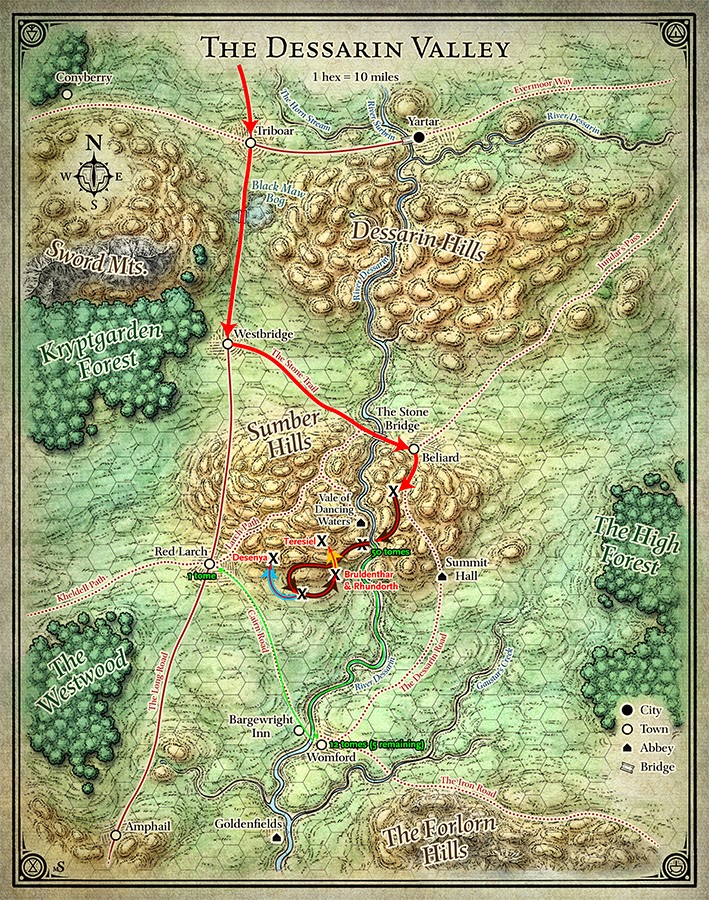
The party follows the trail of the ambushers of the Mirabar Delegation, an estimated thirty bugbears and humanoids, along a long-desolate roadway in the hills. The roadway ended at a broken bridge over the Dessarin River, but the party tracked the raiders south, camping overnight once they reached the southern edge of the Dessarin Hills.
The next day the trail picked up south, then curving west to the river. They found where the raiders had apparently been picked up in boat(s) — and, by coincidence, a small ship came along, the Rivermaid, commanded by a genasi gentleman, Shoalar Quanderil. He agreed, for a fee, to transport them upriver to where they could get to the Sacred Stone Monastery. He did so, as everyone ducked down as they passed Rivergard Keep. There were no problems, though Shoalar did have some interestingly-labeled shipping crates in the hold.
After a treacherous climb from the rubble at river water level to the broken bridge, the party advanced into the hills, following the vague directions given by Thurl Merosska. They walked into a waiting ambush by a party from Rivergard Keep, but managed it handily. Half the assailants fled, but the water priestess Drosnin was gleefully taken out by Faith.
As they searched the bodies, William was confronted by a bloody-eyed dwarf, coming up the road in a most threatening fashion.
Player Recap
Faith dreams. You’re soaring above the cloud wrapped snowy peaks, your wings uplifted by great winds, the incipient lightning in the sky tingling along your feathertips. Something catches your eye, of more importance than any rabbit or squirrel or wolf cub might be. You circle, stoop, dive, and You land on a battlefield, the battle long since past, crows cawing at you angrily for your intrusion.
A gaunt figure, vacant-eyed creature cringes before you holding up its arms to ward you off. (Handout: Ghoul) “I surrender!” the ghoul hisses, voice distorted. “I give up. It burns. Stop it from burning. I gave up. I surrendered. I surrendered, I said uncle.”
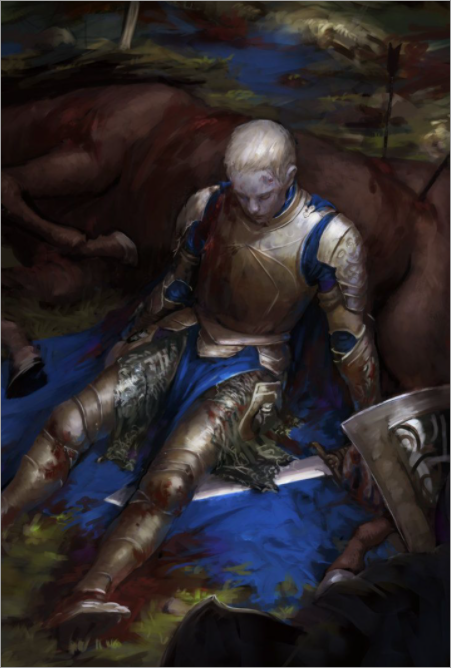
And it’s not a ghoul, but a young man (Narl Elrok), lying on the snowy ground before you, near death, the blood, too much blood, oozing through the rents in his armor. . On his tabard is the symbol of the Knights of Samular, the crossed sword and torch. He lifts his head, looking at you. “I was sore beset. I cried uncle,” he says, “but they didn’t listen. But he did, he heard, I cried uncle, and he heard. I’m just … so very cold. A fire would be nice. A bright, warm fire, not this cold, dead, tomb, twice dead tomb, not dead tomb. I cried … to the brother … uncle –!”
And the young man’s head lies back down, flops limply to the side in a way that looks very uncomfortable, and your neck hurts, too, and you realize you’ve rolled off of the pillow you formed out of your pack, and it’s morning, and there’s a rock digging into your cheek, and your friends are getting up and fixing breakfast.
William gathers some twigs and bits and bobs then finds a quiet spot to divine the success of our path. A silvery raven pops out of air in front of him and say “Weal of fortune,” Confirming the path forward. As the head out, William easily follows the path of the combatants, occasionally seeing the prints of bugbears mixed in with the humanoids. It dawns on him that this may have once been a road.
Dessarin Road, Dessarin Hills (or so I envisioned)
The trail goes south that roughly parallels the Dessarin Road. After a few hours it begins to turn a bit west towards the river. About four hours of travel, the trail suddenly becomes muddled. The path splits into two routes, one going south on a rougher path and the other continuing west along the smoother path. The group continues towards the river. They break through the scrub brush to see a gorge with the remains of an ancient bridge. The slope is steep. There is also a slight signs of a trail going down the cliff on the opposite side. After noting the surroundings, the group backtracks and heads south. After the split, the path turns difficult.
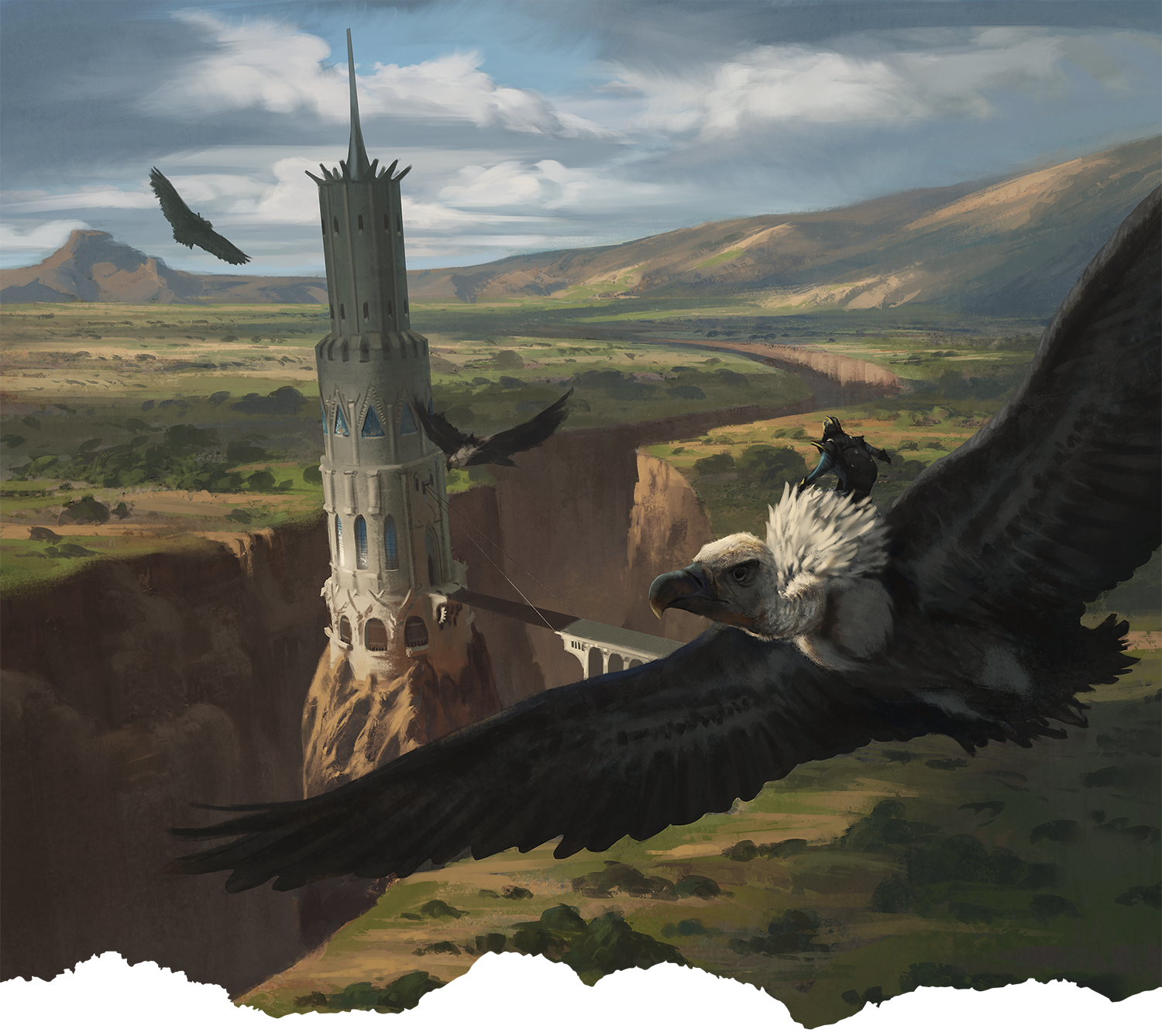
When the group finally moves out of the difficult terrain, the group spots the river as the sun is setting. Faith notices that the vulture overhead is actually a giant vulture high above them. There may be a rider on the vulture. Moony finds a pleasant campsite and the group rests through the uneventful night.
Once again William gathers some leaves, pebbles, and seedpods. This time he adds his Raven token then finds a quiet spot to divine the success of their path. A silvery raven pops out of the air in front of him and says “Weal”. They break camp and continue on their way south. Soon the path curves west towards the river. They are now well south of Rivergard. It look like the some boats have were pulled up here. The trail ends at the river. While they try and decide what to do next. Faith notices a large boat heading up the river. The boat is about 30 feet long. Several sailors are working on deck and a halfling is shouting orders. There are fine ornate fish designs on the sails. A nattily dressed blue-green gentleman calls to group. Are you stranded, lost, or in trouble? We are carrying cargo to Yartar. Moony asks if they can take us up river. For the sake of good conversation and company, let’s say 25 gold apiece. Theren persuades him to lower his price to 15.
He carefully maneuvers the ship closer to the shore and the crew rows over a dingy to pick them up. Once everyone gets aboard, he introduces himself as Shoalar Quanderil, a well-dressed water Genasi armed with a jovial manner, captain of the Rivermaid, along with Pyx his first mate. He asks a few pointed questions, wondering why the group didn’t know that the bridge was out and why we didn’t ask Rivergard for help. Moony derails him with a steady stream of questions about the boat and the river trade. Nala is keeping an eye on the river to spot the Rivergard Keep. She mentions to Shoalar that the group had an encounter with ghouls the night before and asked if they might rest for a bit. He offers the hammocks below deck and Nala and Moony follow Pyx below. Faith curls up in a cloak on deck. Theren stays on deck looking at the horizon. William sits on a crate on the poop deck with his back to the West side of the river. He talks about trade with Shoalar.
As they approach the keep, William notices some palisades on the East bank of the river. When they go by, Shoalar says, “When we pass this bend in the river, the keep will be out of site, if your friends would like to walk the deck more freely.” William, “That obvious is it?” “Well, most folks don’t go below deck unless it’s raining.” Nala notices some crates marked with the Water elemental symbol on her way back up deck. As they approach the broken bridge the group asks Shoalar if there is anything concerning in the area. He mentions the weather, river pirates, and Dwarf pilgrims. They disembark and say farewell.
The path up is steep and challenging. Moony offers to bring a rope to the top to help the others. Part way up he stumbles. William warns the group and then changes into a giant wolf spider. He easily reaches the summit with the rope. When it is secure, Faith and Nala successfully ascend. Theren starts up the rope and slips a bit, recovers himself, and then slips again falling down the slope. After making sure Theren is okay, Moony heads to the top with only a slight bobble. Finally, Theren ties the rope on and the group pulls him up to the top of the trail.
The party continues ahead to the remains of the bridge. The stones are very worn. Faith notices some design features that look Dwarvish. William studies the path and finds signs of recent travel up the canyon road. A largish group passed by within the last week or so. The path forward looks narrow and smoothed out a bit like the old road on the opposite side. The adventurers make their way up the canyon on high alert. Moony takes the lead stealthily making his way ahead. He spots an old wagon ahead in the middle of the path. When the others approach it is obvious that the cart has been here a very long time. The path splits at this point.
Drosnin. Art source unknown.
William hears something off to the right and sees only rock until a figure steps out “Wash this canyon with their blood!” Drosnin is obviously still pissed. The group focuses on Drosnin. Moony plunking her with arrows, William pulling her off the cliff face with a thorn whip, Theren tosses off a fireball that takes the cart, two Reavers, and singes Drosnin. She throws magic missiles at Theren, who deflects them with a shield spell. Faith provokes an attack of opportunity from the Bugbears and races towards Drosnin. She tosses off a lightning bolt and smashes her divine might. That puts an end to Drosnin. Nala, Theren, and Moony take on of the remaining Bugbears and Reavers. At least one enemy flees over the escarpment. William calls forth a Moonbeam to shine radiant light on two of the remaining Bugbears.
After the last two combatants take off, Faith finds a Black Earth symbol carved into one of the rocks. Moony and William notice some rocks sliding down from the cliff near the body of Drosnin. While several people in the party spot the rocks, no one can find the escaping source of the noise. As they search the area, they find the campsite of Drosnin and the party from Rivergard Keep. There is not much worth looting. There is some camping gear. Drosnin had an obsidian dagger and a knob shaped like a fist. Nala notices that Drosnin and the Reavers have Water element tattoos. The disturbing tattoos on Drosnin appear to be moving. They decide to burn the bodies.
A Dwarf in tattered black and red livery approaches William, brandishing a branch. “Alright you assassin, let try that again!”
Faith and her dreams are always a good time. In this case I began to weave in elements of the story of Narl Elrok (the missing Knight of Samular) and the fact that his body is in the care of his “uncle,” or, rather, the brother of Samular Caradoon, the founder of his order: Renwick Caradoon, the lich living at Sacred Stone Monastery, where the party was headed.
(I don’t recall now where the flying bird or ghoul imagery came from; the latter might have been a reference to liches and the undead, or just a bit of memory of the previous night’s encounter.)
Somewhere in here I realized I had been throwing a lot of dreams at people, so I created a set of Journal pages in Roll20 to hold the dreams, by episode number, that people had had. I don’t know if it helped the players, but it helped me in later days.
I can’t find much of the preliminary information that might have been in the book but I think I ended writing up an entire several pages about tracking the delegation and their captors, including:
Dessarin River crossing
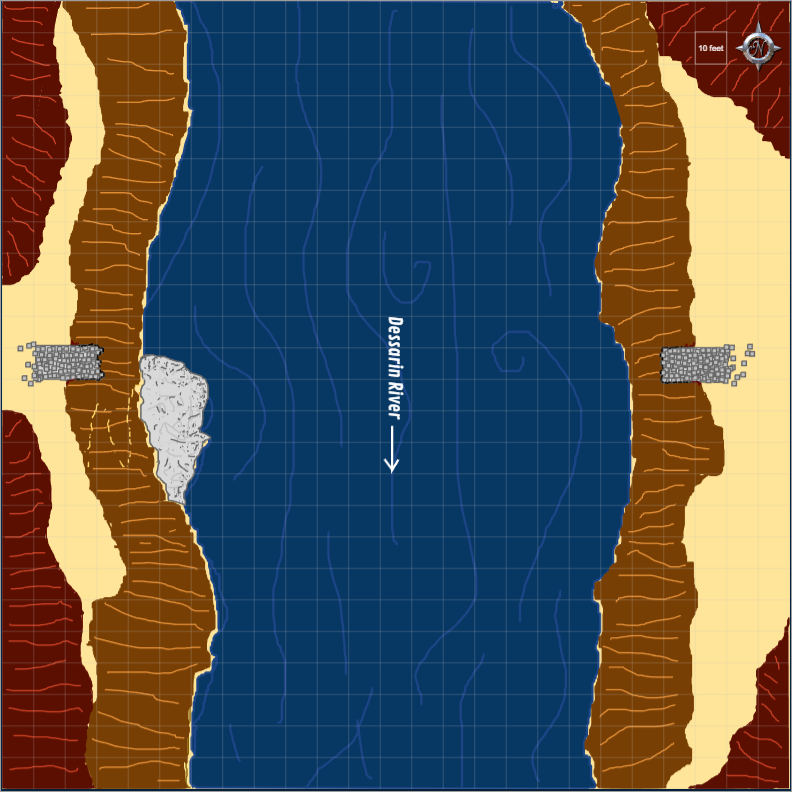
A broken dwarvish bridge across the Dessarin River, very difficult to cross from the east (so blocking the Black Earth raiders from getting to the Monastery), but with a rubble-strewn jetty on the west side of the river (for visitors coming up from Rivergard Keep); getting from river level to the path was also non-trivial, involving Athletics challenges.
A map of the site, complete with bridge, river, jetty, etc.
I really felt I needed all that in order to understand in my own head how all this worked.
The party eventually gets to the river. They spot a Feathergale Knight overhead — Thurl is watching for his “agents.”
My Shoalar token
And finally they get to meet Shoalar Quanderil, the Genasi pirate (Genasi were first developed for this module, though they’ve been modified a bit since). He kept under cover during the initial visit to Rivergard, and the encounter with him in Womford never happened. I figured he would be a perfect tool to get the players upstream toward Sacred Stone Monastery, as well as dropping a few further clues about various goings-on.
The party’s efforts not to be seen by any guards at Rivergard were quite amusing. I considered having Shoalar pull in there, regardless, but decided that created complications I didn’t want the party to have to deal with (a long battle on the ship, for one). And Shoalar — who knew who they were — was happy to simply observe and take notes of where he let them off. Oh, and turn a nice profit off of ferrying them.
Shoalar is also, I decided, the guy who ferried the Black Earth raiders across the river. Which put him in possession of Bruldenthar’s books, some of them at least. That clue comes up in the future.
Symbol of the Crushing Wave
Also in the cargo hold were some supplies that were, for some reason, branded with the mark of the Crushing Wave cult. But why? It’s not like some supplier is marking the cargo for shipment to Rivergard with that symbol. It wouldn’t make any sense to add the symbol to goods which Shoalar had pirated, either.
(The real reason, of course, is to show Shoalar’s allegiance, or maybe to learn more about the cult and its activities, or stuff like that. Just go along for the pirate ship ride.)
The Revenge of the Rivergard
Drosnin. I always thought she looked kind of bad-ass. Or someone you’d want to punch in the snoot.
I decided, leading up to this episode, that if the party wasn’t going to tackle Rivergard, Rivergard would tackle them. In this case, the antagonist was the deeply, deeply offended Water Priestess, Drosnin, whom our cleric Faith had punched in the snoot after being disrespectful. She brought with her half the force at Rivergard and, knowing that the party was after the Sacred Stone Monastery (they’d asked Jolliver about passage there), set up an ambush for our heroes. Who had leveled at least once at that point, so it was clear the ambush was not going to go well.
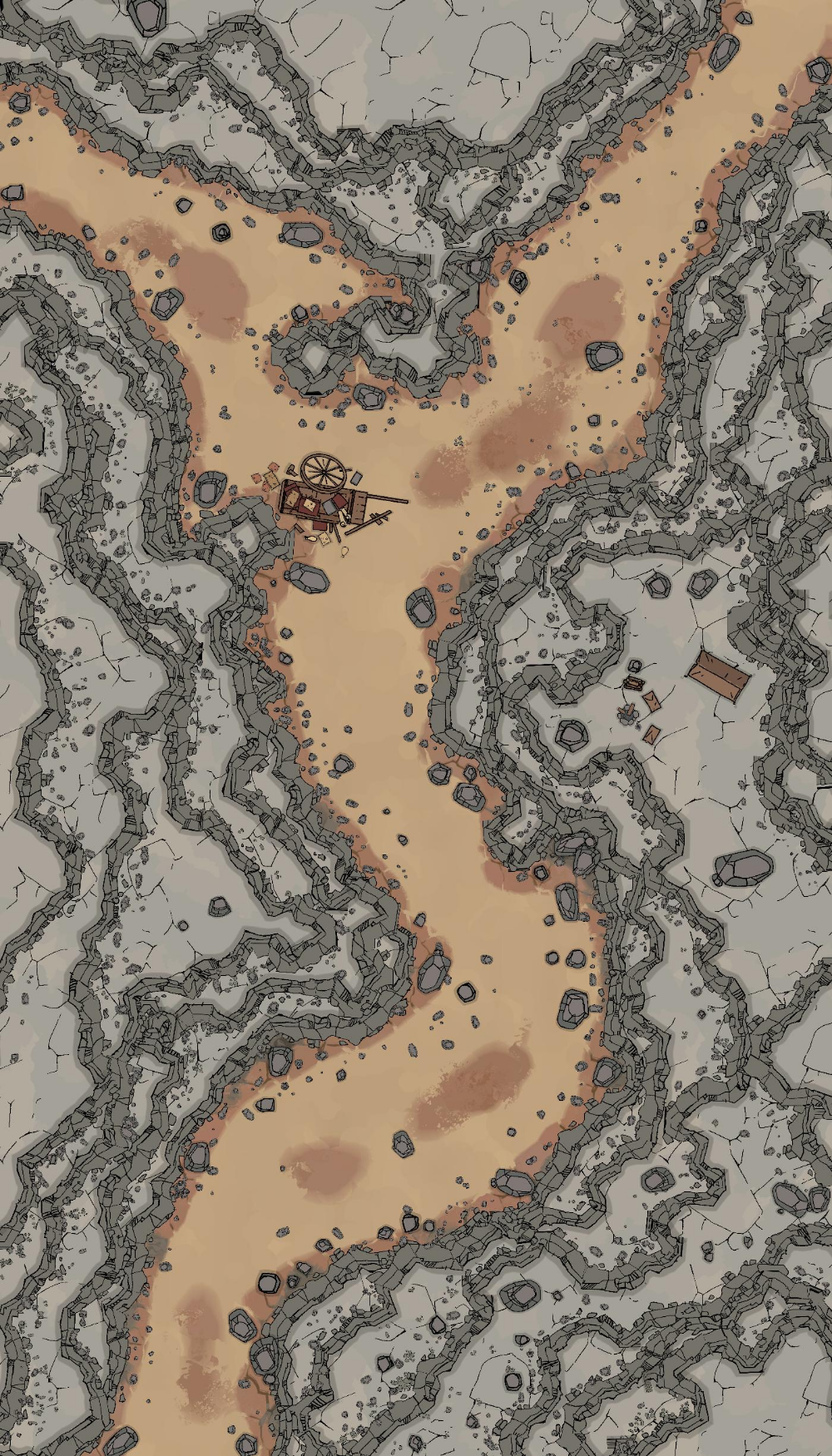
Ambush map, with lots of fun ridges and rocks to hide behind
Since this was all made up, I dug up a generic battle map of a valley with a junction in the middle of it. Perfect. I think this was one of the first maps that I played with Roll20’s dynamic lighting to any degree — and, setting a precedent, spent a lot of time controlling what could or could not be seen behind rocks or ridge lines.
The battle had three results:
First, it left Rivergard seriously weakened for the party’s eventual return. (Or for other events to occur in the meantime.)
Urshnora token. She’ll be back.
Second, a Fathomer named Urshnora — who had been hanging out in Jolliver’s court when the party first visited — was Invisible leading up to the ambush, and, with her awful Initiative throw, seen almost instantly which direction the battle was going before her turn even arrived. So instead of throwing herself into a lost cause, she tip-toed (more or less) away, leaving a pragmatic NPC to encounter another day …
Aldrik, escaped from the Black Earth cult. Or did he?
Third, in that very final scene, it gave me a chance to introduce a new Player Character, played by my son who had been off at college prior to that time. Aldrik, one of the dwarvish guards of the Mirabar Delegation, had evidently been taken captive with them, but had broken free from Sacred Stone Monastery, and was in a very befuddled-but-aggressive state.
I think it was originally written up that he was in the tattered rags of his uniform, but if he didn’t get retconned to being nearly naked at that point, then the opportunity came up later on, thus the figurine.
I really didn’t know — yet — why he’d been captured, how he had gotten out, how he’d survived the ordeal, etc., but eventually it would work out beautifully.
Bits and Bobs
William‘s Raven trinket came to play again, using one of the Druid’s new spells, Augury. I’m not a big fan of fortune-telling spells, esp. as what constitutes “weal” and what constitutes “woe” can be somewhat challenging to adjudicate as the DM. But having the raven appear, think it over, and croak one or the other (or both or neither) made it a bit more fun.
Moonbeam (5′ radius) AoE token
William also got to introduce a spell he’d use reliably for the entire campaign, Moonbeam (or, as we tended to nickname it, the “orbital death laser”). Great spell for a nice, steady amount of ongoing damage to the main bad guy.
Once upon a time D&D had things like “Detect Traps” and “Disarm Traps” and lots of other very specialized skills for spotting and understanding and doing things about hidden things, and dangerous things, and dangerous and hidden things.
5e’s mechanics are arguably simpler and cleaner and more straightforward … but understanding when you should use them is definitely not. Questions always come up …
Is this a Perception roll or an Investigation roll? Or should this be done as Passive Perception? What about Insight?
If a module says one way or the other (“The trap can be found with a Perception roll of 13 or better”), that’s generally the way to do it. Most DMs, in lieu of that, default to their favorite.
Wisdom and Perception
Wisdomreflects how attuned you are to the world around you, your perceptiveness and intuition. Wisdom checks are used to test that.
Perceptionis a special kind of Wisdom check, used to spot, hear, or detect something’s presence, usually using natural senses, esp. if the thing looked for is obscured, hidden, or easily missed. It represents general awareness of surroundings and keenness of senses. Perception is the player’s ability to spot and detect people or items; it has nothing to do with making intelligent decisions about those people or items.
“I can hear people talking on the other side of that door.”
“I’m looking for tracks.”
“Something is creeping forward through that brush.”
“I smell something disgusting.”
“I am looking for signs of a secret door.”
“I think I spotted bad guys lying in wait up there.”
“I heard footsteps following behind us — but I don’t see anything.”
“The floor tiles in that part of the room are a little different color.”
“Ah, there’s the sign for the street he told us to turn on.”
“Wait, there’s light coming from under this stone wall; there might be something behind it.”
“I need more arrows; I’m keeping my eyes open for an armorer.”
“I’m searching his quarters for any paper or documents.”
“Ah, there are some dandelions I can use for that potion.”
“At this point, I think this tunnel is passing right under the castle.”
“There’s a needle trap on this chest; I’ve seen this kind of thing before.”
“Is there anything unusual about this room?”
Are you attempting to hear, spot, or detect something? Are you using your senses (sight, hearing, smell, taste, touch)? Does what you’re attempting rely on awareness of the surroundings (or one focused point)? Are you attempting to merely perceive or find something, not determine a deeper, hidden message? Then it’s Perception.
Intelligence and Investigation
Intelligencemeasures mental acuity, accuracy of recall, and the ability to reason. Intelligence checks are used to draw on logic, deductive reasoning, memory, knowledge, and/or education.
Investigation: This is the ability to put together clues and make deductions the others wouldn’t make. E.g. …
“There should be a hidden panel right there.”
“This wound was caused by a stiletto.”
“He’d want his magic wand close at hand in case his pursuers found him. I’m going to look in the bedding and side table.”
“Are any of the books in this book case levers for a secret door?”
“That’s the point where the tunnel is most likely to collapse.”
“It took me a while, but I found where this scroll refers to an item in our quest.”
“What do I think this room was used for?”
“Good spotting those scratches on the floor. Here’s what I think they mean.”
“I go through the files to see if they tell us who the wizard’s father is.”
“That patch of floor you pointed out … it looks like if you step there, it will depress and, I suspect, trigger a trap.”
“How large of a creature made these tracks?”
“I’ve never seen a trap like that before. Let’s figure out how you can disarm it.”
“The baron is incredibly vain. I’m going to focus my search for the map behind his giant portrait.”
“Can I figure out why the shopkeeper is so angry?” (That he is angry is, if needed, an Insight roll.)
Just trying to find something is not an Investigation; it’s Perception. Using what is obvious (or has been Perceived by you or someone else) to figure something out is Investigation.
Investigation and Perception
Here’s an example. Think about Sherlock Holmes (we’ll focus on the Benedict Cumberbatch Sherlock version).
I’d argue that Sherlock isn’t great at Perception. I mean, he notices a lot of stuff, but it’s generally not hidden stuff. The lipstick on this, the scratches on that, the inscription on something else — they are all visible to everyone in the room. That’s half the gag: everyone has seen all the clues that he has, but …
His Investigation is off the charts. He takes all those Perceived things and correlates them into an unbelievable set of conclusions. “The was a depressed banker who took swimming lessons and enjoyed old EastEnders reruns. What? Isn’t it obvious?” At which point he rattles off the Perceived items that everyone has seen (zoom in camera) and how it all makes sense.
Sherlock’s Perception is average, but his Investigation is awesome — which makes sense with his Wisdom being mediocre but his Intelligence being pegged at 20.
Just because you can Perceive a clue, doesn’t mean you can understand it; that’s where Investigation comes in. Perception might notice small holes in the wall. Investigationwould determine they are a dart trap — or perhaps vents allowing a door to close, or recessed buttons to open a secret panel.
If you have trouble deciding whether to call for an Intelligence or a Wisdom check to determine whether a character notices something, think of it in terms of what a very high or low score in those two abilities might mean.
A character with a high Wisdom but low Intelligence is aware of the surroundings but is bad at interpreting what things mean. The character might spot that one section of a wall is clean and dusty compared to the others, but he or she wouldn’t necessarily make the deduction that a secret door is there.
In contrast, a character with high Intelligence and low Wisdom is probably oblivious but clever. The character might not spot the clean section of wall but, if asked about it, could immediately deduce why it’s clean.
Wisdom checks allow characters to perceive what is around them (the wall is clean here), while Intelligence checks answer why things are that way (there’s probably a secret door).
Ideally, one would have someone with high Perception to find things, and then someone with high Investigation* to understand what those things mean.
*Or other INT-based Ability.
Another point to consider: the underlying question from the GM should always be, “What is your character doing?” “I’m searching the chamber” is perhaps too vague — are you going along and tapping all the walls? Are you standing in the middle and getting a sense of the layout of things? Are you lifting up each crate, or rifling through each drawer? What are you searching for, and how are you trying to find it? That can make clear if you are Investigating or Perceiving (and affect what a successful roll means).
However …
And all that said, it’s important not to make things too cumbersome. “All right, Bob, make a Perception roll to see if there’s something off about that chest lock. Okay, Susan, you’ll need to Investigate to identify the trap that Bob is found. Excellent, now Ted, make a Dexterity (Thieves Tools) roll to disarm it.” That’s an accurate way to do things, but also kind of clumsy. Most cases described in official materials related to traps tend to go Perception+Disarm rolls, leaving out the Investigation piece. That makes sense for normal, “obvious” traps. For more elaborate traps, that may not be the case.
(One idea I’ve seen is letting an added Investigation check be made to gain an Advantage on the disarm.)
And a final thought: The question is always, “How can we best have fun?” The rules and interpretation and all should be promoting that end, not defeating it. Depending on how we see what “fun” is (challenge, competition, story, humor, simulation, etc.) may create variation, but worrying too much about “Are we following every rule to the letter, and where the rules are ambitious how can we succeed in our duty?” is not (except for the extremely LN amongst us) most likely to get us there.
Wait, what about Insight?
That’s used for figuring out stuff about people and their emotions and motivations. It’s sort of like Perception for psychology. Read more about it here.
References
Here are some places to look for more information, including some good web pages for reference (much of the material there has soaked into the above):
Bonus Topic: Passive Perception (Again, Still, Some More)
That there are Active and Passive versions of most skills is clear in the rules. I still find it frustrating in how Active vs Passive Perception is described and its varied applications (let’s hope the new 2024 not-an-edition of D&D gives us a bit more clarity on this (see below))
Then this SkullSplitterDice article caught my eye, and I found it summarizes a lot of the debates and struggles I had over the concept of Passive Perception and what it means and when one can or should use it, so I’m going to walk through it and comment.
1. “To gloss over a lot of time attempting the same thing over and over.”
Or, as it says as an example on PHB 175, “Such a check can represent the average result for a task done repeatedly, such as searching for secret doors over and over again.” This is roughly like “Take 10” in D&D 3.5. If there’s no cost to re-attempting (re-rolling) or failing (or consequence to the time it takes), then the Passive Skill lets the GM simply say, “Yeah, you eventually do it” if it is higher than the DC of the obstacle.
From a Passive Perception standpoint, this would be difference between, “I am going to search the room” and “I am going to spend an hour searching and re-searching the room, because that secret door has got to be here somewhere.” The former would be an Active roll; the latter a Passive check.
The problem is, if the DC is 20 and your Passive Perception is 15, you can theoretically spend forever doing it, Passively, and never find that Secret Door.
Plus, this stops mattering with the rule on DMG 237 for “Multiple Ability Checks”:
Sometimes a character fails an ability check and wants to try again. In some cases, a character is free to do so; the only real cost is the time it takes. With enough attempts and enough time, a character should eventually succeed at the task. To speed things up, assume that a character spending ten times the normal amount of time needed to complete a task automatically succeeds at that task. However, no amount of repeating the check allows a character to turn an impossible task into a successful one.
That takes a lot out of “re-rolling,” rendering this aspect of Passive Skills moot.
2. “To average out a lot of minor consequences.”
The example given here is using a Bard’s Perform as a Passive to represent how they do on any given night, rather than rolling for each hour, or each bar, or each song. (One could question, in this case, whether the consequences of a spectacular performance before the right crowd, or a complete botch-up of one before the wrong crowd, might not be so minor.)
I’m not sure how to fit that into Passive Perception, however.
3. “To allow the DM to get check results without the players knowing about it.”
This always comes up, as if to trump any and all other vagueness. “Use this, because then you don’t have to warn the players that something is up by having them roll or by your rolling behind the screen.” Very meta.
Also, very useless if the GM is using macros in a VTT like Roll20. One click and I can generate the party’s Active Perception rolls, as easily as having their Passive Perceptions on a piece of paper in front of me. (In fact, the macro I use shows the Passive and a thrown Active Perception for each player, so it’s literally the same effort for me.)
So this use of Passive Perception doesn’t gain anything.
All that said …
I will add two more uses I read elsewhere about that aren’t included in the article:
4. To provide a basement for Active Rolls.
This is a weird one, and while used by a lot of people (including some importantWotCfolk), it bugs me. The idea is that if Passive Perception is, say, 12 … you can never roll on Active Perception below a 12, because, well, if Passive Perception is what you just automatically notice, how could you Actively notice any less than that?
I disagree, for two reasons:
First, Passive Perception in this case is normal conscious and unconscious awareness in a situation.
If I start peering at the bookcase looking for a crack that signals a secret door, I should very much be more likely to find it than if I just glanced around the room — but I am also less likely to notice the crack in the opposite wall.
If I’m worried there are Orcs in the chamber ahead, I might be distracted from noticing the Roper on the ceiling above me.
I.e., my Active Perception can definitely “roll” lower than my Passive Perception.
Second, the Rogue’s Reliable Talent ability at 11th Level literally does this basement thing.
By 11th level, you have refined your chosen skills until they approach perfection. Whenever you make an ability check that lets you add your proficiency bonus, you can treat a d20 roll of 9 or lower as a 10.
That’s essentially the level of a Passive check. If we treat Passives as the basement for an Active roll, this Class Feature is meaningless. Boo.
5. To let monsters search for you without a die roll.
There is one other use case the article doesn’t mention, and, interestingly, it’s the only place in the rules that really spells out a case of using Passive Perception:
When you hide, there’s a chance someone will notice you even if they aren’t searching. To determine whether such a creature notices you, the DM compares your Dexterity (Stealth) check with that creature’s passive Wisdom (Perception) score, which equals 10 + the creature’s Wisdom modifier, as well as any other bonuses or penalties. If the creature has Advantage, add 5. For Disadvantage, subtract 5. For example, if a 1st-level character (with a Proficiency Bonus of +2) has a Wisdom of 15 (a +2 modifier) and proficiency in Perception, he or she has a passive Wisdom (Perception) of 14.
(In general skill contests between players and opponents, 5e leans toward die rolling on the player side (for obvious feelings of having agency). While some contests are roll-vs-roll, if there is one side that will not be rolling, it will be the non-player side.)
The question is, why use the the non-PC’s Passive Perception? Why not have the monster roll, too? It’s literally just as easy for the DM to do that, particularly (again) when using a VTT.
So what does all this mean?
There are a lot of folk who lean heavily on using Passive skill rolls, including for Perception.
But all the above means I’m not likely as a DM to do much with Passive Perceptionor other Passives. They don’t add much other than letting the DM be sneaky, and I can be imperceptibly (see what I did there?) sneaky without them.
The only thing that might change that would be if someone in my game took the Observant feat, which adds +5 to your Passive Perception and Passive Investigation. That might make me re-evaluate all this, which I’d rather not, so I hope they don’t.
Bonus Topic: Other Intelligence checks
Intelligence (Investigation) tends to be about the here and now, figuring out present clues and circumstances to deduce and understand them. Other Intelligence abilities are more academic.
Use Intelligence (History) to recall lore about historical events, legendary people, ancient kingdoms, wars, locations, etc.
Use Intelligence (Arcana) to recall lore about spells, magic items, eldritch symbols, magic traditions, planes of existence (and their inhabitants).
Use Intelligence (Religion) to recall lore about the gods, rites and prayers, churches, holy symbols, and cults.
These three are largely not interchangeable, at least in terms of the info they give, though there could be some overlap. For example, imagine standing in front of a statue of a woman in regal robes and holding a staff with an interesting design on it.
Historywould potentially inform you of who that is, or maybe least their era or realm (based on the fashion style). The crafting of the sculpture might also provide some further information; if the statue itself is or resembles a famous one, the lore behind it might be revealed. The crown on her head, the pattern on her cloak, a national symbol on a necklace could provide clues.
Arcana could tell you about that staff and its history and abilities. Or it might recognize who the figure is if they were a ground-breaking spell-caster or researcher. Their gloves might have warding symbols against fire, indicating who their opponents were. If they are in the midst of spell-casting (showing a somatic element), that might be identifiable as well.
Religionmight inform you about that holy symbol woven into their robes, or if this matches a recorded form of a deity. It might also tell you if their stance or garb matches a particular faith practice or ritual, with possible further info (including time and place) stemming from that.
Also, of course, use Intelligence (Nature) to recall lore about terrain, plants, animals, weather, and natural cycles. That might not help with the statue … except it could assist with recognizing the stone and where it’s from, or how the wear pattern indicates an age, or even, if creatures or plants are depicted in the statue (the flowers at her feet, the dragonet sitting on her shoulder) provide information about the time or place being referenced.
Does any of this actually get better or easier in 5.5e?
5.5e (2024) does some shuffling of the deck chairs in ways that might be helpful, but I guarantee people will still get these things mixed up.
Definitions
In the PHB Skills list, we have:
Perception – Wisdom – Using a combination of senses, notice something that’s easy to miss. Investigation – Intelligence – Find obscure information in books, or deduce how something works.
Okay, interesting. The Action list has a couple of interesting entries here, too.
Search – Make a Wisdom (Insight, Medicine, Perception, or Survival) check. Study – Make an Intelligence (Arcana, History, Investigation, Nature, or Religion) check.
In 5e, these were lumped together under a single “Search” Action.
These are further broken out in the PHB Glossary:
Search [Action] – When you take the Search action, you make a Wisdom check to discern something that isn’t obvious. […] Perception: Concealed creature or object.
Study [Action] – When you take the Study action, you make an Intelligence check to study your memory, a book, a clue, or another source of knowledge and call to mind an important piece of information about it. […] Investigation: Traps, ciphers, riddles, and gadgetry.
That’s a little strange for Investigation, but, okay.
Passive Perception is a score that reflects a creature’s general awareness of its surroundings. The DM uses this score when determining whether a creature notices something without consciously making a Wisdom (Perception) check.
A creature’s Passive Perception equals 10 plus the creature’s Wisdom (Perception) check bonus. If the creature has Advantage on such checks, increase the score by 5. If the creature has Disadvantage on them, decrease the score by 5. For example, a level 1 character with a Wisdom of 15 and proficiency in Perception has a Passive Perception of 14 (10 + 2 + 2). If that character has Advantage on Wisdom (Perception) checks, the score becomes 19.
It’s a useful distinction that Passive Perception is about not consciously trying to Perceive something, but just generally looking around. In keeping with it being a fixed score (no rolling), the Advantage / Disadvantage is given a flat bonus/penalty.
Multiple Ability Checks
This shows up as “Trying Again” in the 5.5e DMG (p. 28). The language about success being automatic at at ten times the normal duration has been dropped; instead, the DM just says how long it takes to do successfully (perhaps after a single ability check to see how “good” the overall attempt is).
Checks vs Contests
I didn’t go into it in a lot of detail above because it wasn’t necessary, but Wisdom (Perception) checks in 5e were often used in contests against other things, such as Dexterity (Stealth). 5.5e tends to prefer checks against DCs. So rather than holding off on an ambushing party rolling their Stealth vs the ambushees rolling their Perception, folk hide with Stealth against a DC (usually 15), and their success then serves as a DC for the approaching folks’ Perception (or Passive Perception at some tables).
I don’t know if any of that will make it easier for players (and DMs) to keep track of the difference between Perception and Investigation (let alone Insight), but it’s at least a fresh look at it.
There will be SPOILERS. If you are playing in a PotA game, please don’t read this. If you are DMing a PotA game, or are a DM who wants to see what the ride was like … read on!
GM Recap
Rivergard Keep
Session 10 (Day 17)
The party asked Jolliver Grimjaw of Rivergard Keep for transportation up the river so they could (cough) travel to Beliard, offering lots of gold. Jolliver, who said his castle protected the river traffic from bandits, pirates, and monsters, opined that for lots of gold, they might get to take his patrol boat upriver when it returned in a few days.
Ensconced in the barracks, having been warned to keep their noses clean, Faith, Nala, and Theren promptly started a fight in the chapel (which was decorated with the cryptic Symbol at Rivergard Keep) with Drosnin the priestess and her two assistants. The trio ducked out under magical fog, and, after rejoining with Moony and William, everyone decided to get out of Rivergard … by stealing a boat, shattering the harbor chain, making a great wind, enduring withering crowsbow and javelin fire, absorbing many magic missiles, and watching Moony on the verge of death five times.
They drifted down the river, on their small stolen boat, recovering hit points, and trying to figure out how they’d back north, past Rivergard Keep, to the mysterious Sacred Stone Monastery. …
Player Recap
Jolliver Grimjaw, as I chose to envision him (per stray art on the Internet).
“Who the devil are you?”
Jolliver Grimjaw, seated in a large chair in front of table littered with used plates and papers. Theren tries to convince him to take us North on the river. He is hesitant to trust us. Theren tells how Moony has experience as a sailor and the rest can help protect the ship and general grunt work. Won’t have a ship leaving for a couple of days. Keep your noses clean until then and we will see.
Holger brings the group to the barracks, boots a couple of men out of the first two bunk and leaves the group with the disgruntled arms men. William tries to make amends and gives the Reaver who was displaced some silver and tell him to have a beer on us. He accepts with a little less coldness in his voice. Moony pulls out his bedroll and curls up to nap. One of the armsmen looks at him in disbelief, “What the hell are you?” Moony just fixes him with a cat-like stare. William stays with Moony, while the others head to the chapel with Faith.
Symbol of the Crushing Wave
As they approach the chapel, they hear a voice saying “…and that is why what has been imparted is so important…” As Faith enters, the voice says, “Hello, is anyone there? Come in.” The altar is blank but there is a symbol of an X with a bar at the bottom.
Drosnin the priestess demands that they respect her authority and not disrupt her service. When Faith approaches the altar and drops to pray, Drosnin tells her to return to the pews and instructs the guards to keep her in-line. Faith sits and continues her prayers and pays no attention to the priestess. Drosnin is not amused and commands the Reavers to “discipline” Faith. The Reavers approach. Nala places herself between one Reaver and Faith and says, “You really have no cause to interfere” He says “I’ve been given orders, that is all the cause I need,” but he does not approach further.
Drosnin
The second Reaver places his hand on Faith’s shoulder to grapple her. A booming thunder strikes the Reaver. Faith resists the grapple and jerks away. Theren releases the fire bolt he had held. At the same time Drosnin, attacks Faith, who resists. Next she raises her hands gesturing at Theren and a shard of ice flies at him. His shield spell deflects the shard, but it explodes and damages everyone in range. The group decides that it is time to leave. Faith casts fog as the party leaves heading towards the barracks.
When Theren arrives at the barracks, the party quickly packs their belongings and heads for the docks. Shouts meet them and armsmen race to intercept. A battle ensues on the docks and boat, as the group attacks the heavy chain blocking the channel out of the port. Faith shatters the chain as Moony and Nala race for the boat. The mercenaries and Reaver attack from the parapets with crossbows, as more race to join the fray. William creates a square of thorns and vines to slow the advancing attackers. Nala is last to board and Faith uses a giant gust of wind to push the boat off. Captain Moony gets the ship moving and the group is supporting by rowing and keeping the attackers at bay.
William attacks one of the mercs with a whip and pulls them off of the parapet and into the water. Theren throws spells at an amazing rate, disabling the Reaver trying to catch the boat. Moony and Theren at the back of the boat are taking the brunt of the attacks. Faith heals Theren and continues to use the wind to push the boat farther into the river. Moony falls to a barrage of Magic Missiles from Drosnin. Suddenly a surprised William starts glowing brightly. There are stars at his joints in the shape of a chalice. He reaches for Moony and heals him. Then Theren is also healed.
Water Serpent (actually, a Water Weird artwork)
A water serpent appears and tries to encoil Nala. She dodges and attacks with her sword. It is a mighty blow, but does not damage the serpent greatly. Theren attackes the sea serpent. The Bugbears reach at the end of the parapet and start to pepper the boat with arrows. (Bugbears? Where did they come from?) Moony goes down again. The ship continues into the river being pulled by the currents. Many attacks and heals later, the boat moves out of range down stream.
Game Notes
Hilarity ensues.
So the Campaign as Written (CAW) for Rivergard Keep suggests the players infiltrate, learn stuff, and then start carefully, methodically, killing bad guys.
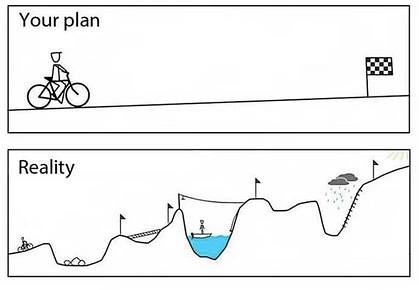
Plans go awry
Instead, the party infiltrated, then punched bad guys, then fled ahead of all the bad guys coming after them.
Sigh.
That said, in a role-playing game, people are going to play their roles in ways that don’t necessarily chart the most optimal course to success. So Faith is going to insist on going to the chapel (even when it’s suggested they stay put), and is going to act rudely to the rite and instruction going on there, and is going to punch the high priestess in the snoot.
Then the whole party is going to have to flee, like Indy away from the natives he was trying to steal the gold idol from. Because that’s just what the CAW planned for (rolls eyes).
It really did have this vibe.
I ran the flight from the barracks down to the boat as legit as I could, as the different internal castle defenses came into play. Mages. Bugbears. Water Serpents. Lots of mooks. Things got dicey at times (the unarmored Tabaxi who happens to be the only one with sailing experience, manning the tiller at the end of the boat, is going to be a natural target, every time he gets brought back from the near-dead), but they managed to, somehow, escape.
And there I was, back at the same conundrum as after Feathergale Spire. The group had hardly defeated Rivergard Keep, but were maintaining a steady course for Sacred Stone Monastery. Rivergard Keep’s fall was a milestone for 5th Level. What to do?
I decided, this time, to not award the milestone. At least, not yet.
Bits and Bobs
The chapel clearly had the Water Cult (Crushing Wave) sigil painted on the wall. A clue! A clue!
Again, it’s easy enough to blame the player for having their character act so fractiously. But Faith was a contradiction in terms as a character — simultaneously a naif and someone who would jump off a cliff if you told her you didn’t want to. Running into an imperious Cult “Priestess” (the players noted that the spells Drosnin was casting were magical, not clerical, generally true for all the ostensible worshippers of the Princes) was just the sort of thing that would set her off, aided and abetted by the Sorcerer who’d just as soon blow everything up as not. The brief attempt at diplomacy from the Dragonborn fighter simply wasn’t (yet) up to the task.
Not surprisingly, I had no idea this would happen (the CAW didn’t, either). Thus, I had no plans for how the small boat worked that they took, and as we were playing, I (and players) were frantically looking up how small watercraft work. Yeah, team!
(I didn’t even actually have a boat figure to use, because nobody is expected to be fleeing from the Keep on a boat. There’s a boat embedded on the map, but you can’t actually move it. I think I eventually created in Roll20 a rectangle 10×15 and sat the players down in that and moved it around on the map as they escaped. After the game, I crafted a boat for them next episode to use as they were on the river, which they promptly abandoned. Sigh.)
The party’s ability to zap the chain blocking the harbor exit was genius on their part. Using Gust of Wind to propel the craft was also pretty clever.
Shoalar (art by Laura Pines)
There was a small ship in the inner harbor of the Keep, owned and operated and occupied (below deck) by Shoalar Quanderil, a very interesting Genasi pirate. All sorts of fun stuff happens if the players attack the boat.
But, since nobody attacked his ship, or offered to pay him for going after the escapees, he remained below deck. He would be planned for a reappearance multiple times in the future, though only managing once on stage for quite some time.
Water Serpent token (in lieu of a token that has the text “WATER SERPENT”)
The water serpent (a transmogrified Raesh the Fathomer) was the first “magic weapons only” critter they’d run into. It would not be the last.
Jolliver didn’t do his own personal magical thing, largely because he had an entire castle of mooks and followers running off to do it for him.
Shoalar’s (big) boat. The party’s escape (little) boat.
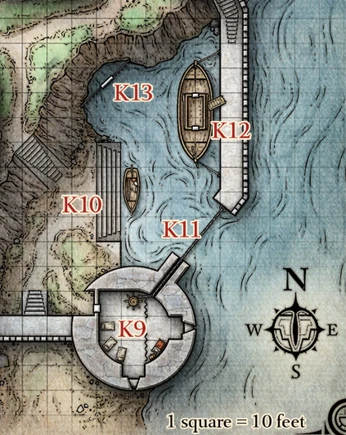
The Keep map is actually pretty cool, and the keep’s defenses (including the Bugbears, which kind of provoked a “Whoa, these guys really are the bad guys, not just reacting to Faith’s attacking them” reaction) were actually pretty spiffy. They took arrow fire, and magic fire, from different locations, and barely managed to make it out (pumping as many healing spells into Moony as they had available). I’ve seen the map for Rivergard Keep repurposed into other campaigns, and it’s definitely suitable for that, even if the main building gets a little difficult (in its open balconies) to manage.
That said, I did end up writing notes to myself all over the map to note things like “this is where the Portcullis is controlled from” or “Guards here respond to battle in K19, K21.”
Prototype Crushing Wave Cultists, also the basis for all their art assets.
Add this place to all the others where the generic cultist fighters (Reavers) were drawn up using artwork that in the actual books is labeled as “prototype” or experimental or “We played with the idea of doing crazy shit like this, but eventually decided against it.” I.e., the Roll20 art elements were pretty darned sketchy.
Jolliver
Similarly, Jolliver. He is (SPOILER!) a wereboar (not for any particular story-related reasons). His token has three alternates: full wereboar, transitional wereboar … and a token that has the text “Jolliver Grimjaw” written on it. (Mutter mutter.) So I had to craft a token to look like him in his human form, which I was happy to do, but don’t feel like, for the price of all this stuff, I should have had to.
For much of the campaign I made up titles for each session. Eventually I decided just to use the dungeon name, part X. But I was still doing the titles here, and, in keeping with that Quinn Martin motif, I could just hear the announcer intoning, “Tonight’s episode … River of Danger!”
So there’s two of the Haunted Keeps encountered and left behind, relatively intact. But the fate of Feathergale Spire and Rivergard Keep would be quite different, as the story was improvised forward by me. And while I’d had much, much less chance to do more human interaction with the water cultists at Rivergard than with the air cultists at Feathergale, there would eventually be some connections made that would last through the game.
There will be SPOILERS. If you are playing in a PotA game, please don’t read this. If you are DMing a PotA game, or are just a general D&D DM who wants to see what the ride was like … read on!
GM Recap
Session 9 (Day 15-17)
Moony scouted out some of the as-yet-unrevealed portions of Feathergale Spire (3), Nala contemplated the hungry ferocity of the Initiates, William camped out on the roof, and Faith had a dream.
The heroes were invited in the morning to a rooftop assembly where, under heavy Knight presence, Thurl asked them to investigate the possibly-evil, possibly-Black Earth monks of the Sacred Stone Monastery, far into the hills.
Choosing not to fight over it, the heroes traveled east to the Dessarin River and Rivergard Keep to gain transit up to the monastery. Along the way they were attacked by a trio of Ankheg (eek!).
They camped out overnight, short of their target, to regain spells and HP and so forth. DING! Level 4!
They arrived at Rivergard Keep. They were met at the heavily guarded gates by an officer named Holger, and were escorted into the presence of the apparent lord of the castle, Jolliver Grimjaw, who did not seem pleased to meet them.
Player Recap
After Savra leaves Moony and Nala, Moony quietly slips out and goes to the other room. Moony “Are any of you joiners?” He explains Savra’s offer and wonders if information might be gained by pretending to join. At Moony’s prompting, Faith provides extensive background on the elemental practices and realms. After some discussion, Moony returns to his room to share the knowledge with Nala.
A bit later William leaves the South room and walks up to the roof. There are a couple knights and their vultures on guard, looking out at the fog filled valley.
Nala is thinking over the dinner and remembers that there was something odd about the initiates. She realizes that the initiates only spoke when spoken to. There is a sameness about them, they move in a similar fashion and when at rest there hand steeple in a triangle pointing down. They are also hungry, lean but not emaciated.
Conceptual art for a Feathergale Knight … which is kind of all you get.
Moony gather up some tools and heads down to the entry hall. The initiate in the main hall does not pay attention to Moony, muttering to himself swaying slightly. Quietly opening the door off of the staircase, Moony finds a bunk room with 4 sleepers in the bunks. He moves onto the room off of the entryway; it is well lit with several initiates standing at windows looking out at the entrance. He steps back and quietly closes the door unnoticed. The final unexplored floor draws the curious cat. There are four doors on this level, all of them with raised bars on the outside. At the first door, he hears some chanting or praying on the other side. No noise comes from the second door, but it is well sealed. Through the third door, Moony hears sobbing; likely this is Savra’s room.
As he descends back to the main floor, the initiate is still standing at the window. He overhears the words free.. free.. Moving to a better spot to see, Moony observes that the initiate, while doing something on his chest, is chanting, “Free me, I must be free, I will be free, I am free”.
Another bad dream for Faith – Looking from a very great height, feeling weightless as you slowly circle the landscape, a narrow valley in the hills, a river winding through it … your eye catches on something below … your vision is narrowing, as though you were suddenly dropping, dropping, the screaming of the wind in your ears, sight fading to blackness but the screaming, the howling continues, like cries of wild beast, the angry shouts of the mad, echoing from the walls about you, screaming to be released to rend and slay and … Savra knocking on the door. Savra asks the group to join Thurl on the pinnacle. Faith explains that she needs 15 minutes to pray first, but will join them shortly. Faith asks Theren to look for William to let him know. Savra then goes and wakes Nala and Moony. They get ready and wait for Faith to finish her prayers before heading up together.
Theren arrives at the top of the stairs and William wakes up. There is the sound of a lot of bird flapping. In addition to the two guards, there are four mounted knights. Thurl is on the opposite side of the tower. He invites us over to him. The knights and Savra are not looking as friendly as they were last night. Savra appears to be angry at our turning down the offer of joining the knights. The others knights are giving her side-long looks and appear to side with her.
Thurl greets us and again toasts our victory. He says that we would make good knights, but … You are brave and honorable people. You would have made fine Feathergale Knights, if circumstances were different. But your lives’ paths, your station … and your narrow vision, all weigh in the balance. I have a proposal for you. To the east and into the hills lies the so-called Sacred Stone Monastery. Those reclusive monks harbor, I believe, great evil, perhaps even association with the Cult of the Black Earth — their very name reeks of their bound and stifled souls. Go there. See what you find. If there is evil, dash it upon the very stones they claim for their symbol, and mark yourselves champions for liberty . Do this for me, and I will know you are no threat to the freedom of my people, or the empowering of each individual in the realm. Do this for me, and you will be greatly rewarded.
Nala asks more about what Thurl is asking us to do. William senses that the party is a weapon being pointed at a target. He is more interested in the fate of the target than the party’s welfare. Thurl offers some rations for the trip. They go with Savra to collect the rations and head out. Thurl sees them to the gate and wishes them well.
The journey towards the river is quiet at first. The party discussed their impressions of strangeness about the tower.
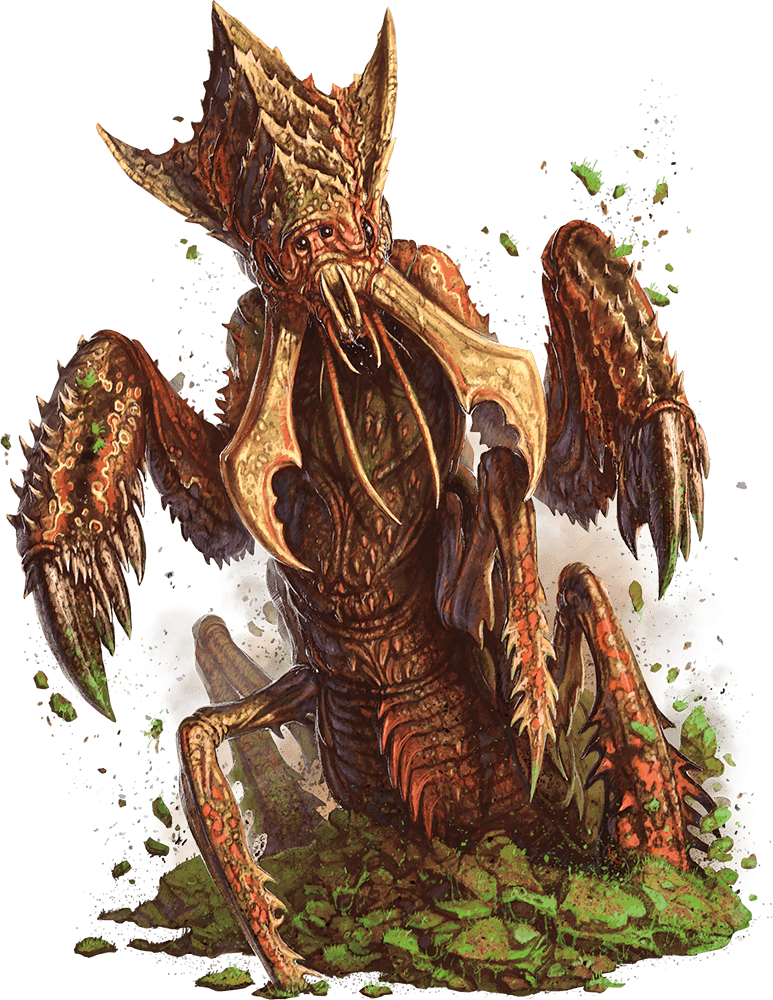
Shortly past the Shallow Graves, walking through the grasslands the party feels another tremor hit. This is different from the tremors they have been feeling lately. The earth upslope is breaking apart and starting to roll down hill. Abruptly, a giant insect erupts from the ground. Its long antenna twitching, hook-like limbs clawing out the dirt. The first Ankheg moves to attack as a second and third Ankheg emerge from the ground. Spells and arrows fly, weapons ring out, acid spews, but the fate of the Ankheg is set as one by one they go down. (The GM weeps as the final Ankheg misses his cool bite attack).
The party moves on and as it is getting dark they choose to camp for the night rather than press on toward the keep. Refreshed and unmolested overnight the group awakes. They feel stronger and more competent. After wondering at their own changes, they notice a wolf curled up on William’s bedroll.
Shortly after breaking breakfast they arrive at the gates of Riverguard Keep. They are questioned rather rudely by the guard. William explains that they merely want to go up-river and if they want proof of their good deeds, he can walk out and see the three giant insects that they killed last night. Faith offers to feed any in need and is snubbed. Moony takes over the conversation, reiterating that the group wants to catch a boat heading north. Eventually they pass into the castle yard and follow the guard to the great hall of the keep.
A large gentleman stands up from behind a table cluttered with papers and says “Who the devil are you?”
Game Notes
Sooner or later, the party is intended to defeat the Feathergale Knights.
This party declined, for the moment. Courteously.
Thurl Merosska
Which pulled me up short. I’d thought the confrontation on the spire-top was the moment that bloodletting would occur — the FKs were scary, but not that scary — but the party sort of knuckled forehead and told Thurl they’d be happy to go check out Sacred Stone Monastery.
I didn’t want to just start a melee from the FKs’ side — it made no sense as set up (especially as Thurl really was pointing them as a gun toward the Black Earth cult), and would feel very railroady.
Okay, fine … but … what about Milestone Leveling?
They hadn’t really taken down Feathergale Spire … though they had engaged with it a lot and learned from it. But Rivergard Keep was optimized for Level 4. I didn’t want the party wiped out (in my own way I was as paranoid about a TPK as the players), and I suspected it was a location that would not be easily escaped from if they got into a fight. (An interesting concern, given what happened the next session.)
So … I let them ding up to 4th Level. I’m still not sure if that was a mistake or not, but it wasn’t the last I made, certainly.
Bits and Bobs
All the cults have hand gestures that are used to signal who they are and, outside their strongholds, maybe signal others of their kind. These gestures (which sort of echo the cult symbols) are sometimes labeled in the Campaign As Written (CAW) as a way to prove bona fides when going into someplace secure.
But the number of opportunities to point out someone is doing something with their hands, without really lampshading it, are pretty limited. I tried, but it wasn’t something the party ever picked up on.
The creepy initiate at the window muttering about wanting to be free was, by the bye, doing more scarifying. But his back was turned, so Moony couldn’t see it.
I have no idea what Faith was dreaming about. A Manticore? Could be.
Poor Savra. She’s cut herself off from home, but still misses it. She wants to be Thurl’s indispensable lieutenant, but he just uses her. She meets some cool new people who seem to want to be friends, and then they turn down her offer to join her exclusive club. No wonder she’s crying during Moony’s search of the tower.
Faith’s player had her studiously praying every morning. Just a bit of character color … that I was able to do a very creepy thing with down the line …
Ankheg!
Hey, we got a hit on the Random Encounter Table for this level, and, hey, it was Ankhegs. Coolness! Even if they got taken down far faster than I expected (a common theme through the entire campaign).
The entrance into Rivergard Keep was much less friendly than that into Feathergale Spire, and the wrap-up on their being presented to Jolliver and having him snap out, “Who the devil are you?” was fun. I had no idea what the party was going to do the next time, but I suspected they’d be coming to blows with the pirate lord of Rivergard Keep.
The Landing Page
It was around this time that I started crafting a Roll20 landing page for the campaign — a map where all the players would land when they signed in each game before I shifted attention to the actual campaign map. I mean, sure, you can have the “campaign book cover” landing page as provided in Roll20, but it’s a scosh busy and also a snapshot from a moment of time in the campaign.
What I had evolved over time, but its elements included:
The campaign name
A cute campaign logo
The session number and day number of the session
The phase of the moon (which the druid asked for at one point)
A tableau of the player character tokens
A tableau (where it could be done without spoilers) of tokens of figures they were likely to (re)meet the next session
A tableau of tokens of prominent enemies they had encountered, with a note as to their status.
A list of outstanding questions (i.e., clues I had dropped, things they had thought might need more investigation, etc.), as a reminder of what they had been focused on last time (or what I wanted them to focus on this time). Some of it was sometimes a bit tongue in cheek. This list also showed up in the campaign page in Roll20.
A map of the Dessarin Valley, showing where they were (eventually maps of the dungeons they were in, with unexplored areas masked, showing where they were), as a reminder.
Once they got into the Temples and Nodes, a “band tour” listing of the places they had explored.
I eventually set up an amusing (to me, at least) layout as if this was all being done as a Quinn Martin production series intro:.
ELEMENTARY … a Hill-Consortium Production … Starring … [player character tokens] … with Guest Stars … [various likely folk they would encounter, no spoilers] … Special Guest Star … [usually the main baddie I expected them to face, no spoilers]. Tonight’s episode … [episode title].
To avoid spoilers, I crafted a series of “question mark” tokens I could fill in.
Yeah, it’s not the prettiest thing, and it sort of grew like Topsy, but it served my purposes.
You can google Roll20 landing page and actually get a lot of cool examples (and some templates for sale from enterprising entrepreneurs).
There will be SPOILERS. If you are playing in a PotA game, please don’t read this. If you are DMing a PotA game, or are a DM who wants to see what the ride was like … read on!
GM Recap
Session 9 (Day 15-17)
Moony scouted out some of the as-yet-unrevealed portions of Feathergale Spire (3), Nala contemplated the hungry ferocity of the Initiates, William camped out on the roof, and Faith had a dream.
The heroes were invited in the morning to a rooftop assembly where, under heavy Knight presence, Thurl asked them to investigate the possibly-evil, possibly-Black Earth monks of the Sacred Stone Monastery, far into the hills.
Choosing not to fight over it, the heroes traveled east to the Dessarin River and Rivergard Keep to gain transit up to the monastery. Along the way they were attacked by a trio of Ankheg (eek!).
They camped out overnight, short of their target, to regain spells and HP and so forth. DING! Level 4!
They arrived at Rivergard Keep. They were met at the heavily guarded gates by an officer named Holger, and were escorted into the presence of the apparent lord of the castle, Jolliver Grimjaw, who did not seem pleased to meet them.
Player Recap
After Savra leaves Moony and Nala, Moony quietly slips out and goes to the other room. Moony “Are any of you joiners?” He explains Savra’s offer and wonders if information might be gained by pretending to join. At Moony’s prompting, Faith provides extensive background on the elemental practices and realms. After some discussion, Moony returns to his room to share the knowledge with Nala.
A bit later William leaves the South room and walks up to the roof. There are a couple knights and their vultures on guard, looking out at the fog filled valley.
Nala is thinking over the dinner and remembers that there was something odd about the initiates. She realizes that the initiates only spoke when spoken to. There is a sameness about them, they move in a similar fashion and when at rest there hand steeple in a triangle pointing down. They are also hungry, lean but not emaciated.
Conceptual art for a Feathergale Knight … which is kind of all you get.
Moony gather up some tools and heads down to the entry hall. The initiate in the main hall does not pay attention to Moony, muttering to himself swaying slightly. Quietly opening the door off of the staircase, Moony finds a bunk room with 4 sleepers in the bunks. He moves onto the room off of the entryway; it is well lit with several initiates standing at windows looking out at the entrance. He steps back and quietly closes the door unnoticed. The final unexplored floor draws the curious cat. There are four doors on this level, all of them with raised bars on the outside. At the first door, he hears some chanting or praying on the other side. No noise comes from the second door, but it is well sealed. Through the third door, Moony hears sobbing; likely this is Savra’s room.
As he descends back to the main floor, the initiate is still standing at the window. He overhears the words free.. free.. Moving to a better spot to see, Moony observes that the initiate, while doing something on his chest, is chanting, “Free me, I must be free, I will be free, I am free”.
Another bad dream for Faith – Looking from a very great height, feeling weightless as you slowly circle the landscape, a narrow valley in the hills, a river winding through it … your eye catches on something below … your vision is narrowing, as though you were suddenly dropping, dropping, the screaming of the wind in your ears, sight fading to blackness but the screaming, the howling continues, like cries of wild beast, the angry shouts of the mad, echoing from the walls about you, screaming to be released to rend and slay and … Savra knocking on the door. Savra asks the group to join Thurl on the pinnacle. Faith explains that she needs 15 minutes to pray first, but will join them shortly. Faith asks Theren to look for William to let him know. Savra then goes and wakes Nala and Moony. They get ready and wait for Faith to finish her prayers before heading up together.
Theren arrives at the top of the stairs and William wakes up. There is the sound of a lot of bird flapping. In addition to the two guards, there are four mounted knights. Thurl is on the opposite side of the tower. He invites us over to him. The knights and Savra are not looking as friendly as they were last night. Savra appears to be angry at our turning down the offer of joining the knights. The others knights are giving her side-long looks and appear to side with her.
Thurl greets us and again toasts our victory. He says that we would make good knights, but … You are brave and honorable people. You would have made fine Feathergale Knights, if circumstances were different. But your lives’ paths, your station … and your narrow vision, all weigh in the balance. I have a proposal for you. To the east and into the hills lies the so-called Sacred Stone Monastery. Those reclusive monks harbor, I believe, great evil, perhaps even association with the Cult of the Black Earth — their very name reeks of their bound and stifled souls. Go there. See what you find. If there is evil, dash it upon the very stones they claim for their symbol, and mark yourselves champions for liberty . Do this for me, and I will know you are no threat to the freedom of my people, or the empowering of each individual in the realm. Do this for me, and you will be greatly rewarded.
Nala asks more about what Thurl is asking us to do. William senses that the party is a weapon being pointed at a target. He is more interested in the fate of the target than the party’s welfare. Thurl offers some rations for the trip. They go with Savra to collect the rations and head out. Thurl sees them to the gate and wishes them well.
The journey towards the river is quiet at first. The party discussed their impressions of strangeness about the tower.
Shortly past the Shallow Graves, walking through the grasslands the party feels another tremor hit. This is different from the tremors they have been feeling lately. The earth upslope is breaking apart and starting to roll down hill. Abruptly, a giant insect erupts from the ground. Its long antenna twitching, hook-like limbs clawing out the dirt. The first Ankheg moves to attack as a second and third Ankheg emerge from the ground. Spells and arrows fly, weapons ring out, acid spews, but the fate of the Ankheg is set as one by one they go down. (The GM weeps as the final Ankheg misses his cool bite attack).
The party moves on and as it is getting dark they choose to camp for the night rather than press on toward the keep. Refreshed and unmolested overnight the group awakes. They feel stronger and more competent. After wondering at their own changes, they notice a wolf curled up on William’s bedroll.
Shortly after breaking breakfast they arrive at the gates of Riverguard Keep. They are questioned rather rudely by the guard. William explains that they merely want to go up-river and if they want proof of their good deeds, he can walk out and see the three giant insects that they killed last night. Faith offers to feed any in need and is snubbed. Moony takes over the conversation, reiterating that the group wants to catch a boat heading north. Eventually they pass into the castle yard and follow the guard to the great hall of the keep.
A large gentleman stands up from behind a table cluttered with papers and says “Who the devil are you?”
Game Notes
Sooner or later, the party is intended to defeat the Feathergale Knights.
This party declined, for the moment. Courteously.
Thurl Merosska
Which pulled me up short. I’d thought the confrontation on the spire-top was the moment that bloodletting would occur — the FKs were scary, but not that scary — but the party sort of knuckled forehead and told Thurl they’d be happy to go check out Sacred Stone Monastery.
I didn’t want to just start a melee from the FKs’ side — it made no sense as set up (especially as Thurl really was pointing them as a gun toward the Black Earth cult), and would feel very railroady.
Okay, fine … but … what about Milestone Leveling?
They hadn’t really taken down Feathergale Spire … though they had engaged with it a lot and learned from it. But Rivergard Keep was optimized for Level 4. I didn’t want the party wiped out (in my own way I was as paranoid about a TPK as the players), and I suspected it was a location that would not be easily escaped from if they got into a fight. (An interesting concern, given what happened the next session.)
So … I let them ding up to 4th Level. I’m still not sure if that was a mistake or not, but it wasn’t the last I made, certainly.
Bits and Bobs
All the cults have hand gestures that are used to signal who they are and, outside their strongholds, maybe signal others of their kind. These gestures (which sort of echo the cult symbols) are sometimes labeled in the Campaign As Written (CAW) as a way to prove bona fides when going into someplace secure.
But the number of opportunities to point out someone is doing something with their hands, without really lampshading it, are pretty limited. I tried, but it wasn’t something the party ever picked up on.
The creepy initiate at the window muttering about wanting to be free was, by the bye, doing more scarifying. But his back was turned, so Moony couldn’t see it.
I have no idea what Faith was dreaming about. A Manticore? Could be.
Poor Savra. She’s cut herself off from home, but still misses it. She wants to be Thurl’s indispensable lieutenant, but he just uses her. She meets some cool new people who seem to want to be friends, and then they turn down her offer to join her exclusive club. No wonder she’s crying during Moony’s search of the tower.
Faith’s player had her studiously praying every morning. Just a bit of character color … that I was able to do a very creepy thing with down the line …
Ankheg!
Hey, we got a hit on the Random Encounter Table for this level, and, hey, it was Ankhegs. Coolness! Even if they got taken down far faster than I expected (a common theme through the entire campaign).
The entrance into Rivergard Keep was much less friendly than that into Feathergale Spire, and the wrap-up on their being presented to Jolliver and having him snap out, “Who the devil are you?” was fun. I had no idea what the party was going to do the next time, but I suspected they’d be coming to blows with the pirate lord of Rivergard Keep.
The Landing Page
It was around this time that I started crafting a Roll20 landing page for the campaign — a map where all the players would land when they signed in each game before I shifted attention to the actual campaign map. I mean, sure, you can have the “campaign book cover” landing page as provided in Roll20, but it’s a scosh busy and also a snapshot from a moment of time in the campaign.
What I had evolved over time, but its elements included:
The campaign name
A cute campaign logo
The session number and day number of the session
The phase of the moon (which the druid asked for at one point)
A tableau of the player character tokens
A tableau (where it could be done without spoilers) of tokens of figures they were likely to (re)meet the next session
A tableau of tokens of prominent enemies they had encountered, with a note as to their status.
A list of outstanding questions (i.e., clues I had dropped, things they had thought might need more investigation, etc.), as a reminder of what they had been focused on last time (or what I wanted them to focus on this time). Some of it was sometimes a bit tongue in cheek. This list also showed up in the campaign page in Roll20.
A map of the Dessarin Valley, showing where they were (eventually maps of the dungeons they were in, with unexplored areas masked, showing where they were), as a reminder.
Once they got into the Temples and Nodes, a “band tour” listing of the places they had explored.
I eventually set up an amusing (to me, at least) layout as if this was all being done as a Quinn Martin production series intro:.
ELEMENTARY … a Hill-Consortium Production … Starring … [player character tokens] … with Guest Stars … [various likely folk they would encounter, no spoilers] … Special Guest Star … [usually the main baddie I expected them to face, no spoilers]. Tonight’s episode … [episode title].
To avoid spoilers, I crafted a series of “question mark” tokens I could fill in.
Yeah, it’s not the prettiest thing, and it sort of grew like Topsy, but it served my purposes.
You can google Roll20 landing page and actually get a lot of cool examples (and some templates for sale from enterprising entrepreneurs).
There are a number of rules that deal with the basic question of “How do I get past that guy?” Note that all the below observations are caveated by class or racial powers that may say otherwise. Monks and rogues and some smaller creatures get special abilities to do some of this stuff.
Note also that if you use any of these, you still run the risk of an Attack of Opportunityif, once past, you continue running beyond someone’s reach.
Also, if the either of the opponents here is one of those that does damage to a melee attacker “within five feet,” I would as DM incur that penalty to these maneuvers as well (even if they are not, strictly speaking, melee attacks). In other words, if you are shoving, shoving past, or even tumbling around that flaming guy, you’re going to get burned (and if it’s the flaming guy trying to move through an occupied hex, the target’s going to get burned, regardless of whether the attempt was successful).
The Magic of the Five Foot Square
Guys in a couple of five foot squares
Okay, if you are doing Theater of the Mind, more power to you. I run on a 5-foot square grid.
Obviously a Medium creature (as most players and many opponents are) does not fill the entire square, like some sort of gelatinous cube. Instead, the square represents what war-gamers would call a “zone of control.” A player in a 5-foot square can be anywhere (and, in a sort of quantum fashion, everywhere) within it. Even if you are leaning waaaaaaaay over to one side to shoot arrows at that goblin behind partial cover, you are still blocking that orc from traipsing through the other side of your 5-foot square.
The basic rules of 5e (and D&D in general) is that, with some identified exceptions and weird edge cases, opposed beings cannot occupy the same 5-foot square. So, other than slaying that enemy in your way, how can you get past them?
Here is a summary of the ideas spelled out below …
If you are _____ than your opponent …
… then consider _____.
Bigger
Overrunning
Bigger (a lot) or Smaller (a lot)
Moving Through
Stronger
Shoving, Shoving Aside, or Overrunning
More Agile
Tumbling Past
Moving Through
You can move through a hostile creature’s space only if the creature is at least two Sizes larger or smaller than you. Remember that, even in those cases, another creature’s space is Difficult Terrain for you.
Cost: Difficult Terrain movement.
Shoving
There are a couple of possibilities here — a bog-normal Shove attack, or an optional Shove Aside.
Note that in neither case do you need to worry about “Difficult Terrain” as you are never deemed to be in the same square as the enemy (don’t think about it too hard).
If we think of You (Y) doing one of these attacks against the Enemy (E), here is where they would end up with a Shove (S) or an (optional) Shove Aside (A)
S  S  S
A  E  A
   Y
Shove
You can use a Shove as an attack in the round, pushing the target away from you 5 feet (think of the offensive line in a football game). Once you push them away, you can step into their space and then beyond.
For a Shove, the target can’t be more than one Size larger. You as the shover make a Strength (Athletics) roll vs. the target’s (choice of) Strength (Athletics) or Dexterity (Acrobatics).
You could also knock them Prone with a Shove attack but that doesn’t clear out the space for you to move through.
Cost: One Attack.
Shove Aside
This is an Optional Rule on DMG 272: Rather than using a Shove to move someone back (or Prone), you use Shove to move them to the side.
Essentially, this is a more difficult Shove attack (shifting someone at a 90 degree angle), with the same skill comparison, so you as the shover roll at Disadvantage. If successful, the opponent is shoved 5 feet to the side, meaning you can move through their square at no additional movement penalty.
As a DM, the added difficulty seems quite fair and I wouldn’t hesitate to allow this Optional Rule.
Cost: One Attack.
Tumbling Past
This is another Optional Rule, so check with your DM first. DMs, this can provide color, but it can also make your sneaky rogue types (who probably have a high DEX) a lot more dangerous.
This can be found in the DMG, page 272: As an Action or Bonus Action, you roll Dexterity (Acrobatics) vs the Dexterity (Acrobatics) of the one you’re trying to Tumble past; if you win, you can move through (but not stop in) the hostile creature’s space (as difficult terrain).
There’s no specific penalty for failure here — except that you’ve burned an Action or Bonus Action, successful or not.
Costs: Action or Bonus Action; Difficult Terrain movement.
Overrunning
Yet another Optional Rule, on DMG page 272, this is basically just shoving your way past the opponent (or using your Strength to do a Move Through).
As an Action or Bonus Action, you roll a Strength (Athletics) check vs the defender’s Strength (Athletics). You are at Advantage if of a larger Size, or Disadvantage if of a smaller Size. If successful, you can move through the square (as Difficult terrain).
Cost: Action or Bonus Action; Difficult Terrain movement
But what about Jumping Over them?
The Jumping rules really don’t allow this. Or don’t work well with it.
First, High Jumps don’t help, since they are only up-and-down, according to the rules. (Yes, Olympic High Jumps involve some horizontal distance, though often not much, I don’t think anyone is envisioning jumping backwards over an orc and then landing on their own back on a huge fluffy pad.)
Second — this is not an easy thing to do. Even under highly controlled non-combat situations.
You just can’t jump high enough on a Long Jump to reliably get over an opponent’s head. The height you achieve on a Long Jump, with a successful Strength (Athletics) check vs DC10, is (distance/4) feet; assuming the space a Medium creature controls space is not just 5×5, but 5x5x5, you would need a distance jumped of 20 feet (20/4=5) to get past them (i.e., with a Running Long Jump, that means you’d need a STR of 20).
Magic might help: a Jump spell (or Ring of Jumping) triples your jumping distance, thus your someone with a STR of, say 16, would theoretically be able to Jump 48 feet, clearing 12 feet high …
… although the irritating Jumping rules still, even with a spell, restrict your Jumping distance to your Speed. If your speed is 30, you can only jump 30 feet (or 20 if you are doing a Running Long Jump that takes a 10 foot run-up). That still lets you clear that 5 foot height (20/4), and it means you only need a Strength 10 to (barely) jump over an opponent. (Speed magic would help here even more.)
That said … is a 5 foot height being the vertical control zone actually a real thing? Eh … given that D&D tends to be a bit vertically challenged in terms of accommodating things that are above ground level, you could argue it for most Medium characters (esp. as weapons and armor aren’t generally pointed at / oriented toward / limber regarding upward attacks). If you remember the Golden Rule that D&D is not a physics simulator (it’s not even a combat simulator), it kinda-sorta works fine.
Since you would be flying over the enemy’s head, there is no Difficult Terrain consideration. Thank goodness for that.
Taller creatures will tend to be Large in Size, and thus fill up (or control) a 10-foot square space (a lot more to jump over), but even if they don’t, maybe the best way to handle it is with a higher DC on that Strength (Athletics) check (DM discretion).
What does happen if that Strength (Athletics) check to jump over something fails? In theory, just as with a non-opponent Long Jump, the jump fails at that point, and you end up, probably Prone, in the square in front of the enemy you tried to jump over. But we’ll leave those esoterica as an exercise for the student.
Sliding past/under, or jumping up-over, a bad guy is a pretty bad-ass cool move, the sort of thing that will have characters (or their players) bragging about over beers for months or years to come.
Which means, on an exceptional basis (e.g., in a boss fight) the DM should probably be willing to bend the rules at least a bit to allow such an attempt, even of the numbers don’t quite work out. The rules are there to let you know what should normally work and what normally shouldn’t. But ultimately, that judgment belongs to the DM — and a balls-to-the-wall unexpected heroic attempt … should get at least a bit of latitude.
Any changes here with 5.5e?
Why yes. Yes there are — fairly significant ones.
First, though it doesn’t apply specifically to this post’s topic, while in 5e moving through a friendly character’s square was considered Difficult Terrain, in 5.5e, it’s not — just a normal space to move through. This makes stack-ups at doorway a lot less painful.
Similarly, you can move through, at speed square of a Tiny creature.
It remains Difficult Terrain to move through the square of an Incapacitated creature (which as a house rule we include dead bodies), or of a creature that is two Sizes larger/smaller than you.
While in 5e you could not end movement in the same square of another creature, 5.5e allows it if it is an involuntary action (e.g., being hurled there telekinetically). If you find yourself unwillingly end your turn in such a square, you are Prone unless you are Tiny or are a larger Size than the other creature. Even if you go prone, the other creature is not affected unless it ends its turn in the same square.
A Shove is now a form of Unarmed Strike in 5.5e. Rather than doing an Athletics vs. Athletics/Acrobatics contest (5.5e really doesn’t like contests), instead, the shover just says they are doing so, and the target must make a
STRength or DEXterity Save (their choice) vs. DC = (8 + shover’s STRength mod + shover’s Proficiency Bonus)
A Shove is only possible if the target is no more than one Size larger than the shover.
The new 5.5e rules make no mention of the previously optional Overrun or Tumble Past or Shove Aside rules. The same is true for a lot of the Optional Rules in 5e’s DMG; whether these are a permanent simplification or wil be reintroduced in a later supplement remains unknown.
There will be SPOILERS. If you are playing in a PotA game, please don’t read this. If you are DMing a PotA game, or are a DM who wants to see what the ride was like … read on!
GM Recap
Session 8 (Day 15)
The heroes traveled to the hilltop where Larmon Greenboot had directed them. They found there the shattered (and only hours-old) body of Larrakh, as well as the hasty graves of a Dwarf craftsman, a Mirabar Army warrior, a Black Earth cultist (buried with their weapon), and a figure dressed in white with feathers on their cloak’s shoulders.
Surmising Larrakh might have been dropped from a great height, they headed toward Feathergale Spire, home of the rich boys’ flying club, the Feathergale Knights.
Approaching openly, they were welcomed in by Savra Hanadroum, the estranged daughter of Haeleeya Hanadroum, and introduced to the master of the club and castle, Thurl Merosska.
They attended the 10th anniversary feast of the Society, where many toasts were made, and the heroes encouraged to tell their stories. Thurl, in turn, talked of the evils lurking in Sumber Hills (and a bit of the History of the Dessarin Valley, in particular the loathed Cult of the Black Earth.
A Manticore was spotted. Theren, William, and Faith joined the night-fogged hunt for the abomination with four of the knights. Our three heroes distinguished themselves in the Manticore Encounter, and William was awarded the reward ring from Thurl. Thurl told them he might have a quest for them to undertake, to be discuss the next day.
As people prepared for sleep, Savra approached Nala and Moony for more info on the Black Earth infiltration of Red Larch. They told her about Larrakh‘s involvement, and their finding his dead body. She invited them to join the Feathergale Knights, that their bravery, honor, and magical abilities would be very helpful, especially as the Knights were learning about the magics of Elemental Air to combat their enemies. Nala declined, courteously, which Savra did not take well.
Player Recap
Lightly traveled road with some small cart paths branching off to homesteads, several of which are abandoned. They meet a couple on a cart with boxes, a shepherd with flock of sheep, and a group of well armed horsemen all heading towards town.
Something suddenly clicks for Faith, the dream from several nights past of being buried in stone until someone comes to help; it is really similar to the rescue of the boy Braelen.
Around mid-day they come across the split tree landmark Larmon told them of and evidence of a flock of sheep passing by. Traveling up the path to the crest of the hill. The path is steep. They are glad that they didn’t try to bring Buttercup and the cart.
On the crest there are four recently dug shallow graves covered in stones plus a fresh body – the center of some vultures’ attention. Shooing away the vulture they move closer and discover it is the body of Larrakh. There is a shattered staff and a broken crystal halberd near by. William examines the body. Larrakh was hit by several arrows and has suffered from a massive blunt force trauma. Looks like he fell from a very great height. Besides some gems and money, he has a chain with the Symbol of the Black Earth and several Mirabar trade bars. Removing the stone mask, Larrakh is still unfamiliar.
Looking around, there is a great view from the hill crest. They can see all the way to Red Larch and the Feathergale Spire to the NW surrounded by large birds.
The group moves onto the cairns. At Nala‘s recommendation, William looks around the site for other tracks. The first grave has a male dwarf in artisan robes. He has no possessions. The second grave has a female warrior in the surcoat of the Mirabar army. The third grave contains a human warrior is a strange stony armor, not unlike Larrakh’s. He is also wearing a necklace with the symbol of the Black Earth and has a short mace at his side. The last grave Human in a white robe with black feathers at his shoulders. All have died of arrow wounds or crushing blows.
William doesn’t find any trails, only broken arrows, a discarded javelin, and a torn grey cloak. Moony notes that the grave of the Black Earth fighter was given obvious deference. The constable had requested that the group determine if any attack was caused by bandits or other things dangerous to the homesteaders. This looks like it will not endanger Red Larch. Because of the connection to Mirabar, the group decides to go to Feathergale Spire to talk the the feather heads and see if they know anything.
The group approaches from the main path along the cliff edge rather than cross-country across the valley. **Insert color text here** The spire looks centuries old but with recent high quality repairs. The drawbridge is up and a couple of guards watch over from the spire crown. There is a bell on this side of the bridge. Moony rings (repeatedly). A woman opens a window from the gate house, greeting travelers, how can I help you? Nala briefly explain why we are here from Red Larch and asks for their assistance. “Your courtesy does us honor. You are welcome.” The bridge is lowered and they are greeted at the large double doors by a finely armored warrior who introduces herself as Savra Hanadroum. Nala introduces herself and the rest of the party. She steps back to allow the party to enter the tower. There are a couple of men in leather armor of a style similar to Savra’s There is a large steel eagle on one wall and fine tapestries on the others. They can see the controls to the bridge and the sturdy locks on the door. She brings they through to a circular staircase. At the top of the staircase is the top of the tower. There are green lawns and a large spyglass.
She introduces them to Thurl Merosska. He is very well dressed, extols the pleasures of flight. The human in the white robe with the black feathers would not be out of place in the tower. Nala describes scenes and asks if they may have seen anything. Thurl suggests that it is a topic better suited at dinner. They are celebrating the feather guild’s 10th anniversary. “Please join me and my knights at dinner tonight.” Thurl describes how the group goes up here to enjoy the wind and view. **Enter pseudo-philosophical crap here.**
Dwarves had built a mighty kingdom here. Their fortress which lay beneath the valley became a home to dark and loathesome creatures. About 600 years ago the Knights of the Silver Horn discovered and explored the ruins. They became quite wealthy and build several towers to keep the valley safe. That lasted for a few generations and then they too fell into disrepair. In our time they were called the Haunted Keeps. When Thurl decided to retire he and his friends decided to claim the tower and rebuild it. (Nala recognizes him now as a famous griffin racer.) Ten years ago today they set the first stone.
It appears that Thurl was not surprised to see the group at the tower. He invites them to take their leave in some room he will arranged for them to stay in. Faith reflects on the conversation with Thurl and feels that he is very happy that we have arrived. Maybe more pleased than the sight of new strangers might warrant. She also thinks that he is definitely dodging the questions about the bodies on the hill crest.
Mooney engages with Savra. He asks if she is related to Haeleya Hanadroum. She blanches slightly and affirms that Haeleeya is her mother. Moony exclaims Haeleeya’s virtue and caring for the community. Savra “Yes, she is caring for many but not all” Then rushes to show them their rooms off of the feasting hall.
The group walks into the first room together. There are two beds, two desks, and to chest. All very sturdy and comfortable. There is a window in the tower wall and tapestries on the others. There is a stack of books on the desk. They are basic books on writing and fighting and one titled Get Yours.
The group quietly discuss what they have learned or discerned. Theren moves to the other room set aside for them. Moony starts exploring the other rooms. One of the knights sitting at the main table, Sir Carelle, walks over to Moony and asks “Would you like me to give you a tour”? Moony immediately takes him up on the offer. When they enter the kitchen there are a few initiates are standing around a cauldron breathing in deeply. “Inhale the steam…Be the steam” Carelle starts to try and explain and Moony interrupts “So secret initiate stuff” Next is the solarium, chill now but would be pleasant in daylight. Carelle says that it is also very Moony compares it to a courtyard in a monastery. Next, the stalls of the lower levers. They continue to discuss the joys of flight and becoming one with your beasts. Finally, they adjourn back up main hall.
Savra comes to the rooms and invites the party to join the celebration. There they meet the other seven knights and Thurl. When everyone is seated, Thurl raise’s his glass with a toast. The table is served by four initiates. The knights praise their mounts, the joys of the sky, Thurl, and their adventures. The wine flows freely. Thurl, notices that Faith is not drinking and asks if the wine is not to her liking. Faith mentions that she doesn’t like wine and settles for water.
The group gives a summary on the bodies on the crest, the bandits on the road, and the hole opening up in the middle of Red Larch with the Dwarf ruins below. Moony leans over to Carelle and describes the adventure with the zombies and unicorns.
Nala notices that there is something odd about the initiates, but she can’t put her finger on it. They aren’t exactly acting like servants or devotees.
When the conversation turns to the graves. Nala describes finding the body of Larrakh and the graves from what appears to be a battle. Thurl: “The situation in the valley is dire. Some days ago there was an incursion, an invasion of murderous thugs, into the land we watch over. They were a cult cover everything over, bind people with shackles of stone. We drove them off to the East. There were 10 or 15. One of our own was lost.”
Nala describes the sighting of the people in the stone masks in Red Larch. Moony ask Carelle about the knight that was killed. He learns that he was not returned to Waterdeep, but Carelle believes that he is free and has joined the spirits of the sky.
Thurl slams the table and declares their support of the town of Red Larch as well as their own valley. ….
An initiate opens the doors and announces that the manticore is on the move again. “Now is the time to kill it for good.” He pulls a large golden ring and offers it as a reward for any who kills the beast.
Faith, Theren, and William join the hunt mounted upon hippogriffs. Faith sights the beast and Blesses the team’s endeavor. She then casts Guiding Bolt at the manticore and makes a critical hit. This is followed by Theren’s Chaos Bolt. When William’s turn comes, he casts Ensnaring Strike and hits the beast with an arrow. The manticore is restrained. He fails to free himself and plummets to the earth. His screams fill the air and he is crushed on the rocks below.
Much huzzahs greet the group as they return to the tower. After cheering their success, Thurl tosses William the promised ring. He totally misses the catch. It is very nice, heavy, gold, with a ruby and feather design. (Value 250g). “My friends you have impressed me, and that is not easily done. I think in the morrow, I can suggest an adventure that will help Red Larch as well as our little valley.”
Savra comes to Moony and Nala’s room begging and then demanding that they join the Feathergale Knights, to become air elementalists to fight the evil earth elementalists. She stormed off when both Moony and Nala said they preferred to keep their feet on the ground and that she should go and speak to Faith, William, and Theren since they actually fought and killed the Manticore.
Moony will be leaving after he no longer hears Savra in the hall so he can tell Faith, William and Theren her offer. Also, he will be trying to investigate the room on the lower level that was not a part of the tour.
Game Notes
The Red Larch vicinity is sideways
Why not create this in landscape orientation?
Nearly all of the maps in the game are oriented Top = North, as is true for most maps people encounter in life.
The “Red Larch Vicinity” map, laying out where some of the side quests out of Red Larch are situated, has North on the right. It confused my players every single time it got pulled up, since being zoomed in on the map to see things meant the compass rose wasn’t necessarily visible.
Is there a reason it’s oriented that way? No. It could just as easily be oriented with Top = North.
(The scale given is also wrong; 1 hex = 1 mile.)
If the map is sideways, their journeying out through it also gave the players a sense of how the Dessarin Valley was “going sideways” — abandoned homesteads (from the weather or the banditry) being a key clue.
The Shallow Graves
So I also created a map for the Shallow Graves setting, finding a random open space map and adding in where the graves were.
You might say, “But, Dave — nothing actually happens there!”
I know. But the problem with only having maps where things happen is that when there’s no map, the players assume, even unconsciously, that nothing is going to happen.
Also, I wanted to give them a visual sense, not just Theater of the Mind, as to the layout, and see how they investigated. Including an occasional, “Okay, where is everyone standing right this moment?” just to keep them on their toes.
The Long and Winding Road of the Mirabar Delegation
The campaign is filled with various notes and clues about what happened to the Mirabar Delegation and when, and, of course, they are scattered about the rule book. But nowhere is a concise, detailed description laid out. That may be why none of it actually makes much sense, both timewise (based on clues and hints various folk pass to the party) and spatially, which becomes even more clear when you map it out. Which Carl Jonard has done:
The biggest issue is if, for some reason, the Delegation went to Beliard, then got pursued and captured by the Black Earth at the identified Ambush Site … how the hell do they get over to the Shallow Graves location to the south of the Sumber Hills — apparently completely bypassing multiple routes over to Sacred Stone Monastery, the Black Earth destination?
(It also didn’t help that the original PotA Dessarin Valley maps had the wrong scale listed on them, and, in the electronic version I received, still do.)
I think even Jonard’s map underplays it, especially as it has the Black Earth party wandering around in the Sumber Hills, but never in the right direction.
Various folk have tried to rationalize this. Here’s my version, which worked well enough (even kinda-sorta time-wise)
The Mirabar Delegation sets forth from (derp) Mirabar. They include both Mirabar and Waterdeep delegates, as well as a Dwarvish Librarian and (last moment) the body of a young knight being sent home Summit Keep and the Knights of Samular. Everyone in Waterdeep is expecting them to just take the Long Road south to Waterdeep. Nobody from Mirabar sends word of any changed plans, despite the urgency of the MacGuffin.
The Delegation turns east off the Long Road at Westbridge, and later arrives in Beliard (other travelers at later times will mention this). The reason for this diversion this is twofold: taking the Knight of Samular back to Summit Keep, and because Teresiel has a supply of magic seeds for Goldenfields, further south (a chance for the dwarves in the group to see the fabulous Stone Bridge might also play into this). The plan is to go down the Dessarin Road to the Keep, continue on down to Womford, Teresiel splits off to Goldenfields, the rest of the Delegation heads up the Cairn Road to Red Larch and the Long Road, and they all meet up back in Waterdeep, easy-peasy.
All the cults have been raiding the valley for prisoners and booty. The reasons are sort of vague — manual labor, human sacrifice, creating an atmosphere of heightened terror upon which their cults can flourish, etc. Whatevs. But they are still operating in secrecy. Each cult has some advantages here:
The Howling Hatred uses aerial forces from Feathergale Spire, giving them speed and mobility.
The Crushing Wave dominates the Dessarin River, a rich trading route.
The Black Earth’s Temple is closest to the surface, making it easier to sent out sorties.
The Eternal Flame uses spies and rumors. They can afford to because they are more powerful.
At any rate, a large Black Earth raiding party intercepts the Delegation, chasing them off the Dessarin Road, killing most of the troops and taking the “important” people hostage.
But then what? The Black Earth raiding party obviously wants to get back to the Sacred Stone Monastery.
They don’t want to travel north — Beliard and the Stone Bridge are choke points and might betray the raiding party’s existence.
They can’t take the road south, because of Summit Hall and the knights there.
Unfortunately the old bridge across the Dessarin River, close to the Monastery is long since fallen. (Note: in retrospect, I would have made that very, very recent, so that it was their planned line of retreat.)
So they go westward, inland, along the traces of ancient dwarvish roads, turn south along the river, skirting past Summit Hall, down to the flats, until they can find (what turns out to be) a Crushing Wave ship to cross the river. The Black Earth and Crushing Wave are … somewhat cooperative, the Crushing Wave folk are always willing to be paid something valuable for service.
For some reason, they don’t book a trip all the way up the river to the base of the old bridge.; maybe it’s just too unwieldy an ascent for a group this size (that’s what I later decided), or maybe the only valuables they have — those antique books — are just enough to pay for a ferry across, nothing more. Or maybe the Crushing Wave have decided to subtly throw some sand into their operation — not block them, but slow them. That sounds like something the crafty Water Cult would do.
The Black Earth know they can circle around to get to the Monastery up the Larch Path, even if that brings them dangerously close to Feathergale Spire and the Howling Hatred. They choose not to cross-country north through the Sumber Hills to the Monastery — perhaps they know about dangers we don’t, or maybe the geography makes it a more difficult journey than it seems.
The worst case scenario happens: the Howing Hatred spot the Black Earth forces making their way cross-country, and attack them. The Howling Hatred take one of the hostages (Deseyna) but are driven off, taking losses. The Black Earth bury the dead (even the fallen air cultist; what better fate, from their viewpoint, than to stuff their body into the earth?) and continue on their way, cutting across to the Larch Path, up and over and around the long way, arriving at the Monastery with their prisoners, some of whom are put to work in the basement mines, some of whom are sent further below …
It’s convoluted and speculative and doesn’t line up well with the timing (though no proposed scenario actually does), but it created a narrative storyline for me to use as a touchstone. The players didn’t necessarily need to know all the details (MacGuffin!), but having the sense that the details made sense was very important.
But what about Larrakh?
In the Campaign As Written (CAW), Larrakh, if he escapes the Tomb, simply vanishes from the narrative.
Ho-hum.
I toyed with the idea at one point that he’d actually been sent to Red Larch as punishment for the fiasco of that Black Earth mission. The timing there never really gelled (it’s unclear how long he’s been in Red Larch, but it’s been longer than that).
But I did speculate on him heading back toward the Monastery after the Tomb fiasco. Rather than the obvious Larch Path, he heads toward Rivergard Keep, planning on booking a one-person passage toward that fallen bridge (where his Spider Climb spell would be very handy.
Alternately, he uses some mystical means to check in and is told to find out what happened to the raiding party at the Shallow Graves, so he heads that way.
One way or the other, he finds the Shallow Graves after the shepherd has come and gone. Unfortunately, he’s also spotted by the Feathergale Knights (telescope!), who come along, grab him, lift him up, and drop him from a very great height.
It was a waste of good bad guy, one one level, but it also provided some closure for the party about the guy who’d nearly taken them out — and indicated that there were other threats out there. It also made the site a bit more layered, with events happening in multiple timeframes.
On to Feathergale Spire!
Feathergale Spire is Backward
Sun from the south, bridge extending … east?
The picture of Feathergale Spire provided as a hand-out for the players shows it anchored to the east side of the valley, illuminated by the sun from the south, the Sumber Hills to the north in the background.
Spire on the west wall, bridge extending left.
The Sighing Valley map shows Feathergale Spire anchored to the west side of the valley. There is talk about parties approaching up a path along the cliff edge, but no path is shown. The southern part of the Sighing Valley is by far the most dangerous (the Manticores, the Griffons), but it would be the first area entered if one approached through the valley; it has that “as you explore further in” vibe, which makes no sense unless it’s actually to the north, but it’s not.
But the Sighing Valley also extends to the north.
Bridge extending west.
The Feathergale Spire dungeon map also shows the tower anchored to the west cliffside.
The Feathergale Spire text talks about the broad valley extending from there to the east.
Oh, and running out of the Sighing Valley is the Lost River … which is, truly, lost, as it shows up on none of the Dessarin Valley maps, nor in any description of the party crossing it or dealing with it as they head toward the Spire.
What a mess.
Feathergale Spire. The right way around.
I tried twisting the map around 180 degrees (with the idea that the river actually gets “Lost” into Knife Edge Gully), but that really didn’t help. In the end I just flipped the handout picture of the Spire on its vertical axis and called it I-hope-nobody-pays-attention.
(For all I know, the art was originally correct and some layout editor flipped it around to make it look “better” in the book, not realizing that obsessive-compulsive DMs would fret so over it.)
Somewhat more useful notes on Feathergale Spire
Feathergale Spire is the first of the Haunted Keeps, the first set of cultists encountered, the first gang of bad guys to engage with that aren’t Red Larch locals.
It’s possible (but probably hard) to stealth or assault the spire from without. An alternative is to decide on a ruse to enter — the CAW always recommends either “We’re bringing a message from Higher Ups,” or “We’re eager recruits” — then strike from within.
For some reason, this party was a bit apprehensive about dealing with these folk in a violent fashion. There were a lot of bad guys, a lot of them mounted on giant birds. The party was only 3rd level (though that’s what this was geared for), so they were leery about confrontation. That would lead to Interesting (and Complicating) Stuff for the DM.
Savra
Savra (in lieu of a “name” token); image from “Goblin Slayer!”
Savra Belabranta is the lieutenant of Thurl Merosska, the top dog at Feathergale Spire. She’s the only other named person in the place, and she greets the party as they arrive.
That is literally the extent of what is written about her.
Bo-ring.
I decided to play on a relationship that they had built up while in Red Larch. There was a woman there named Haeleeya Hanadroum, who ran a dress shop and bathhouse. Some of the party members had gotten pretty close to her.
She’s noted as a foreigner, and I imagined a woman from the south who had married a merchant from Waterdeep, moved with him to Red Larch, and who then, when her husband died, tried to raise their daughter — who was in near-perpetual conflict with her mom, and who, one day, when a dashingly handsome and powerful Feathergale Knight landed in town to get some supplies, rode off with him, leaving her dusty dead-end village behind.
Thus, Savra Belabranta became Savra Hanadroum.
I figured Savra was oriented around a few key points:
Still angry with her mom … but also missing her after a few years.
A go-getter and enterprising lieutenant to Thurl — for whom she has the equivalent of a schoolgirl crush (unrequited, because, I eventually decided Thurl only has eyes for Aerissi Kalinoth, the Prophet of Air, whom he wants to woo, wed, and supplant).
A devotee of the Howling Hatred … but mostly out of rebellion and because that’s what Thurl would want her to be.
In short, Rebellious Teen With Heart Of Gold Joins Local Mob Outfit, Makes Good. That covers all the elements of a potentially tragic or happy ending. My hope was that the party would see her as a sympathetic character, but a potential enemy, but someone they might be able to sway, but still a risk.
It all worked beautifully. Was it essential to the campaign? No, but it made a previously established relationship useful, it gave them a person to talk with and not just a nameless mook, and it helped emphasize the creepiness of the cultist life in a way that felt more real.
The other folk of Feathergale Spire
Thurl Merosska is the rich college jock who had great success in race car driving (or the local griffon-based equivalent), but then nearly lost it all in a crash. He’s now driven by ego, desire, and, under it all, fear. He’s happy to use the Howling Hatred to potentially lord it over all of Faerun — especially if it means he could take over Aerissi’s job, and if it meant that Yan-C-Bin’s power could keep him safe.
He’s horribly deluded, but he’s big and boisterous and charismatic and his own cautionary tale over the power of delusion. Under his command, Feathergale Spire is half sporting club, half cult recruitment station, with the folk trying to join up reduced to silent starvation, and his followers driven to acts of bravado and cruelty.
That said, Thurl is the classic case of the Guy Who Is The Hero In His Own Head. He is very easily able to see his endeavors in a noble fashion; his desire to protect Red Larch as his own little fiefdom is sincere (if exploitative), and his hatred for the antipodal Black Earth cult is fierce and couched not just in elemental antipathy but in the desire to win against the other team.
(Thurl’s efforts to rope the party into the inter-cult warfare isn’t the first time this trope is used in the campaign, but it carries some cachet given that the Black Earth has been doing nefarious things around them so far.)
Thurl also gave me an avenue for doing more infodumping about the history of the Haunted Keeps, even if a bit biased in its presentation.
The rest of the spire is occupied by the Feathergale Knights, almost all of them (Savra is a notable exception) the offspring of wealthy families in Waterdeep, all of them fans of flying mount riding, and all of them bought into the cult conspiracy behind their frat. I gave them all names (conveniently all starting with different letters), mixed up the genders a bit, and wrote out some quick personality notes. I probably went a bit overboard, but since the interactions were everything from riding competitions to the feasting table to potential combat, I wanted the dozen-plus Knights to stand out as at least slightly individuals (especially, as we moved forward, each new set of cultists would become more and more generic, and less and less conversed with).
Not so individual, though, were the Initiates, who are masked, sworn to silence, and basically the grunt workers in the castle. They, too, are wealthy scions and heirs, but have not yet proven themselves. They were damned creepy, once the party knew what to look for. If the Knights were all frat bros (and whatever the female equivalent is) of different types, the Initiates were the people standing over a cooking pot, chanting, “Breathe the steam … be the steam …”
The Initiates are properly labeled “Howling Hatred Initiate” in Roll20 but (a) that’s way too wide for a token on the Roll20 map, and (b) kind of on the nose in telling the players what’s going on here. I renamed them all as “Initiates” (and would do similarly with the low-level mooks of the other cults). Similarly, there’s one “Hurricane” in there — basically the Howling Hatred equivalent of a Monk — which I renamed to “Ascetic” to match the description and mask everything else.
I loved putting in each of the Knights’ rooms, almost like a Gideon Bible, a book called Get Yours, which, when examined, combined the motivational philosophies of Positive Thinking, the Prosperity Gospel, Ayn Rand, and How You Deserve It All. It felt very Howling Hatred-like, along with their constant drumming on mental “freedom” (unless you are an Initiate) and physical “purification” (though the Knights dine quite well).
The cult symbols here were very under wraps — literally. Rather than necklaces or cuff links or something, I had the cultists all regularly scarifying themselves on their chests with the Howling Hatred symbol. When the party finally discovered it, it was quite the moment.
Knights’ Quest
Hey, DMs! Here’s a cool scene where the party gets pulled into a Manticore hunt. Flying. At night. With no rules as to how any of that works. Enjoy!
Holy crap. I was terrified of running this encounter, but it was so cool and so a part of the Thurl vibe, I didn’t dare not. I did a whole bunch of reading about flying combat and 5e (it’s pretty crude), looked at a bunch of home brew rules, and ended up just abstracting the hell out of the actual movement (3D!) of it.
Everyone seemed to have a fun time anyway.
What next?
Thurl is obviously interested in making use of Our Heroes. We’ll see how next time. Of course, I also expected Our Heroes to resist and a big battle for Feathergale Spire to ensue …
This came up in my Princes of the Apocalypse game, related to Earth cult Burrowshark riders atop Bulettes, but the questions discussed apply to random folk on horseback just as much.
An historic note that may be of interest or illumination to some of the questions here: it is said that when the early indigenous peoples of the horse-less Americas — including in the sophisticated realms of the Aztecs and Incas — first saw the Conquistadors on horseback, they thought they were seeing some horrifying human-animal hybrid. The dividing line between the Rider and the Mount is the focus of most of the rules in 5e around mounted combat. As you might expect, the answers are not always intuitive ones, otherwise “anyone could do it.”
Main Caveat
As noted endless times before, D&D 5e is not an accurate simulator of reality; it’s a fairly effective (usable with minimal fiddling) simulator of reality, with just enough verisimilitude to make it both fun and grokkable. Also, even though it’s derived originally from military miniatures combat rules, Napoleon’s Old Guard didn’t have to deal with gigantic flying dragons with Liches piloting them, so its miniature/grid rules sometimes get weird.
Second Caveat
A lot of the below also depends on playing on a grid (square or hex; the examples I’ll give are for squares). If you are running Theater of the Mind, you can rule on this however you like, and nobody can say you nay (or neigh).
In other words …
In other words, Rules As Written (RAW) are pretty crappy (or, to be more delicate, inadequate to the task) on this overall subject. Let’s look at them — Mounted Combat rules (PHB 198).
Right. Time for my interpretation.
So here’s my first question: Where is the rider on their larger mount, and how does that attack the rider’s reach and the reach of those around the mount?
Where is the Rider on the Mount?
So, take the image to the right:
The Bulette is a Large creature, and so “occupies” a 10×10 space (4 squares). The Rider is a Medium creature, and so “occupies” a 5×5 space (1 square).
(Note that this would work the same for a Horse — a Large creature — and its Medium Rider.)
So some questions:
In which of the four squares of the Bulette does the Rider actually sit?
How does that affect the Rider’s ability to attack (their reach)?
How does that impact Area of Effect spells that only partially overlap the Mount?
What about Opportunity Attacks against the Bulette — will they also reach the Rider, or only if the Rider is “adjacent” to the attacker?
In the picture, I have the Rider in the upper right corner of the Bulette. The Rider is a 5 foot reach from Initiate 1, but 10 feet from Initiate 2. So …
Can Rider only attack Initiate 1?
Can Initiate 2 only attack the Bulette, not the Rider?
If the Rider wanted to attack Initiate 2, can the Rider just move to the lower left-hand corner of the Bulette? If so, does that cost Movement for the rider, and does it provoke an Opportunity Attack from Initiate 2?
If the Bulette moves one square diagonally down-right, both Initiates could presumably Opportunity Attack the Bulette, and Initiate 1 could Opportunity Attack the Rider … but could Initiate 2 Opportunity Attack the Rider?
If the Mount provokes an opportunity attack while you’re on it, the attacker can target you or the Mount.
But how can that be?
It can be, because where your token is in your occupied area, regardless of size, is only an approximation.
As a Medium creature, you “occupy” five feet square of space. But you don’t really occupy that space like a 5×5 wood frame.
Guys in a couple of five foot squares
There’s a lot of space there to shift around in. Heck, if on the opposite sides of the squares, those guys couldn’t even reach each other with swords.
Put another way, a Bulette is not really a circle with a radius of 5 feet. It does not actually occupy a 10×10 foot square.
A Burrowshark (Bulette rider) on a Bulette.
So looking at the picture, a Bulette is pretty wide. But not square. And that’s even more the case for horse. A horse is a Large (10×10) creature for game purposes, but for real purposes it should be more like 5×10.
The area a Large creature takes up (ditto for even bigger categories, but let’s keep it “simple”) is the area it “controls” in game terms, such that you cannot stop within it unless you are two size categories smaller or more. In a quantum sense, the creature exists within that area as an abstraction, a probability field, moving and shifting and occupying all that space such that a horse (or Bulette) can be attacked with 5-foot reach weapons from either side.
(Remember the Main Caveat about D&D rules, above.)
The same is true for the Rider, who exists as an abstract occupant of the entire area of their Mount, moving around and leaning as the Mount moves around, attacking and attacked by all 12 adjacent squares. That’s the only way of rationalizing “If the Mount provokes an opportunity attack while you’re on it, the attacker can target you or the Mount” (or the Mounted Combatant feat that lets the Rider force an Opportunity Attack to be on them, not their Mount).
Again, think of a knight on horseback in combat. He’s not sitting there like a 5×5 lump on a 10×10 bigger lump. The horse is wheeling around, rearing, as the knight guides it forward and back and side-to-side and about in circles, bending and leaning, raining blows in all directions.
Remember, Facing is an optional rule. If in a six second turn, a creature can attack both front and back, without spending any movement to do so, than the Rider on that creature can do the same.
So to go back to my questions above. In my informed opinion:
The Rider can attack both Initiate 1 and Initiate 2 — and be attacked by them.
If the Rider has the Bulette withdraw, both the Bulette and the Rider can potentially take an Opportunity Attack by either or both Initiates.
Now, as you can imagine, this is not immediately obvious, and not well-spelled out by the rules, and is subject to a lot of varying opinions. D&D 5e Designer Jeremy Crawford has provided a number of guidances here that don’t necessarily agree with my opinion.
Crawford also notes that being on a Mount doesn’t change a Rider’s size. Which I’m okay with, for effects that are determined by size/mass. A Medium Rider doesn’t really become Large, I am just considering them to be anywhere within the Large space occupied by their Mount.
Aura issues get weird — if the Rider has an aura extending ten feet away from them, is their abstracted location all-encompassing (the aura extends from the full Mount, not just a square (the rider) within it? Or do we still pick a square? I don’t have a good answer for that.
AoE issues are also weird — if that Fireball hits one, two, three squares of that four-square mount, does the Rider have to make a save? Or maybe a save at Advantage? Well, the Mount takes full damage and has to make its save. I would suggest that the Rider has to do the same. .
This gets even weirder when you consider long weapons, like lances, which explicitly Disadvantage you if you are attacking a creature five feet away. The only ruling that makes any sense to me here is that if there is a square within the area of the Mount that is ten feet away, then you can control the Mount to be there so that you are not at Disadvantage.
(Note that I keep referring to “you” as the Rider. The rules also apply when Uzbarkh the Unholy is the Rider bearing down on you.)
Does this begin to break down when you consider Huge Mounts or above — a character flying on an ancient red dragon is not going to simultaneously be on every square the dragon takes up, for attack or defense right? Except, again, the figures are shown on a grid as squares/circles, which means there’s a presumption of movement within the space, and if a dragon can bite in every direction on its turn, presumably the Rider on its neck can do the same with their sword.
I didn’t do this well when I was overseeing that Bulette battle. Going back to the mounted combat rules in the PHB:
While you’re mounted, you have two options. You can either control the Mount or allow it to act independently. Intelligent creatures, such as dragons, act independently.
You can control a Mount only if it has been trained to accept a rider. Domesticated horses, donkeys, and similar creatures are assumed to have such training. The initiative of a controlled Mount changes to match yours when you mount it. It moves as you direct it, and it has only three action options: Dash, Disengage, and Dodge. A controlled Mount can move and act even on the turn that you mount it.
An independent Mount retains its place in the initiative order. Bearing a Rider puts no restrictions on the actions the Mount can take, and it moves and acts as it wishes. It might flee from combat, rush to attack and devour a badly injured foe, or otherwise act against your wishes.
So, first off are Bulette’s intelligent creatures? The general threshold for Intelligent creatures is INT 4 (Animal Friendship, Awaken, and Detect Thoughts all fail if INT is higher than 3). Bulettes (and Horses) are INT 2, so they are not intelligent.
the GM might call for a Wisdom (Animal Handling) check. You also make a Wisdom (Animal Handling) check to:
control your Mount when you attempt a risky maneuver.
Note that AH is not actual training.You can only control your unintelligent Mount if it has been trained. And for combat purposes, a Mount really needs to be trained to the noise, smells, and pain of combat, otherwise it will be uncontrolled and probably try to run unless you’re spending all your actions on AH (to an unintelligent, untrained Mount, anything in combat is a “risky maneuver”).
To break the above down into a matrix:
Controlled Mount
Independent Mount
Unintelligent Mount
Requires training/AH to accept a Rider.
Use Rider’s Init.
Moves as directed (may need AH for dangerous sitches).
Can only Dash, Disengage, Dodge as actions.
Requires some training/AH to accept a Rider.
Has its own Init.
Can move and act as it pleases, including attacks.
With training/AH, can be guided by the Rider.
Intelligent Mount
N/A. Intelligent Mounts are always Independent
Has its own Init.
Can move and act as it pleases.
As it is intelligent, it may coordinate with the Rider if training or communication is possible.
So if we assume that the Burrowsharks have trained their Bulettes to combat (they have, plus there’s some mystic ju-ju going on), then they have two choices:
Keep the Bulette under control. Initiative is synchronized. The Bulette will only Dash/Disengage/Dodge, but is unlikely to break, flee, etc.
Let the Bulette be “independent” under its combat training. The Bulette and its Rider have different Initiatives (requiring more coordination), but the Bulette can Attack (no small thing). Note that it may sometimes choose to Attack (or Dodge, or whatever) differently than the Rider wants. (This is a bit more fuzzy when the GM is running both characters.)
D&D 5e does not, btw, demand DEX (or Athletics) saves for Riders whose Mounts do something the Rider doesn’t expect.
When I first did this kind of thing, I allowed the Bulette to act independently, but synced its Init with the Rider. I also had their attacks probably more coordinated than they should have been (combat training will let the Rider guide the attacks of their unintelligent Mount, just as the Rider can guide their movement, but the Mount remains independent and more likely to snap at what attacks it).
Something else to note here: the restrictions on a Controlled Mount are to Actions. One can posit that a Controlled mount should still have access to Bonus Actions (very rare) and Reactions, including Opportunity Attacks.
This didn’t come up last I ran mounted combats, but it could have. For the record:
If the Mount is moved against its will by an outside force (e.g., a Thunderwave spell), the Rider must make a DC 10 DEX save, or else fall off.
If the Rider is knocked Prone by an attack/spell/effect, the Rider must instead make a DC 10 DEX save, or else fall off.
If the Mount is knocked Prone, the Rider can use their Reaction to dismount as it falls and land on their feet, or else fall off.
Fall off = land Prone on a space within 5 feet of the mount. The RAW does not address the (very real in historic terms) danger in that last instance of having your mount fall atop you, probably doing substantial damage.
Surely they have improved this in 5.5e, right?
Given that 5.5e (2024) is a distillation of everything WotC and the community have learned over the last decade (since 2014) to improve any weaknesses in the fundamental engine, this would seem like a huge place to make changes and improvements.
Nope.
In fact, as far as I can tell, things here are worse. Less space is allocated, but the same text is used, such that some things have been clipped out:
There is now no provision for using your Reaction to save and land on your feet if the Mount is knocked Prone. In fact, it doesn’t actually address the issue of what happens if you make (or don’t make) your save if your Mount is knocked prone. The language has been simplified, and something has been lost.
The distinction between an Independent vs Controlled Mount is still there, but the definition between the two has been significantly cropped.
The language about when the Mount triggers an Opportunity Attack the Rider can be targeted is also gone. Intentional change, or editing oversight?
The Mounted Combatant feat has changed slightly. In 5e it said that an attack targeted on the Mount could be redirected to target the Rider; in 5.5e, it says an attack that hits the Mount can instead be redirected to hit the Rider, meaning a mounted combatant has no better AC than their mount does, regardless of the Rider’s armor. I suspect that one will be errataed away pretty quickly, but it hasn’t yet.) Or maybe it’s to make up for now getting a 1-point ASI with that feat.
The one place where maybe the 5.5e rules are better is on when a Controlled Mount acts. In 5e, its initiative is synced with the Rider, but it was still ambiguous as to whether the Mount’s actions took place simultaneous with the Rider’s, or as its own turn (immediately before or behind). In 5.5e, the Rider and Mount clearly share the same turn (“it moves on your turn as you direct it”), making things a bit more flexible.
Net-net, the 5.5e rules aren’t very good, but the 5e rules aren’t either. It would be nice to see that addressed some time.
I grew up in the era where you always had a mage in the party who took Detect Magic to spot the glowy magic items, and then Identify to suss out what it is.
5e has simplified this a great deal, though much of the info is semi-hidden in the DMG (p. 136). There are several ways of getting at whether an item has magical properties and, if so, what they are:
As the DMG says, the fastest and easiest way to reveal an item’s properties is with the Identify spell. Note that Identify can be done as a Ritual, so any wizard, bard, or cleric of divination can do it, taking 10 minutes and not burning a spell slot. If you don’t know the spell, then 10gp will hire someone (in an appropriate locale) to cast it for you.
You can also focus on a magic item with which you are in physical contact during a Short Rest. I usually require the characters to sort of wield the item more or less like they would — wear the boots, hold ring in your hand, wave the sword around a bit. At the end of the rest, you have learned the item’s properties and how to invoke them. This is the most common method, as it is relatively cheap and easy.
You can also try to do an Intelligence (Arcana) check to see if something about the object can identify it (“The elves often put wings on the leather of Boots of Flying” or “That is the symbol for the Orcish God of Fire” or “Rings that chime with that particular note are most likely magic, from the lost realm of Midoria”). This is much quicker than the Short Rest option, but likely less complete. (Some suggestions on how this might work.)
Alternately, you can guess from clues on the item itself, or can just start wielding it and figure out how it works.
Note that for scrolls, a tiny sip will let you know what it does without it (most likely) having an effect on you.
Attunement
Some magical items require more than just identification and working instructions to invoke its magical powers. Instead, they are of sufficient power that they require a mystical bond be created between the wielder and the item called Attunement.
If an item requires this, it is listed with the item. Until such an item is Attuned, its magical properties do not manifest (an unattuned +3 Vorpal Sword is just a very cool looking normal sword in combat). Note that some items can have a prerequisite (e.g., class, race) for Attunement.
Attunement takes an additional ShortRest (beyond the initial identification), in physical contact and focusing on the item. Practice use of or meditation over the item might be helpful here. At the end of the rest, “the creature gains an intuitive understanding of how to activate any magical properties of the item, including any necessary command words.” More complex or powerful items may require additional Short Rests or presentation of circumstances where an ability manifests. (“You suddenly feel no fear of the flames, realizing they are not harming you but humming softly.”)
An item can be attuned to only one person at a time, and a person can only attune to three unique items at a time.
Attunement ends if prerequisites are no longer met, if the item is over 100 feet away for at least 24 hours, if the owner dies, or if another creature attunes to the item. You can also voluntarily drop an attunement with another Short Rest.
Spell-casting items
Items that allow spells to be cast are cast at the lowest possible spell and caster level, don’t expend any spell slots, and require no components (unless otherwise specified). Rules for range, casting time, duration, and concentration apply (again, unless otherwise specified).
For items that depend on the user’s spellcasting ability, if you don’t actually have a native spellcasting ability (e.g., a Rogue with Use Magic Device), the ability modifier is +0 but your Proficiency Bonus does apply.
So what about in 5.5e?
Again, things are pretty much the same between 5e (2014) and 5.5e (2024), just organized differently or clarifying things a bit better..
TL;DR: Anything with magic items is expensive and difficult and unlikely under 5e.
For design reasons having to do with Bounded Accuracy and stuff like that, magic items — especially anything permanent, or anything to alter combat stats (TH, AC) — are rare as hen’s teeth in 5th Edition D&D.
The following is meant to provide guidelines. Bearing in mind how magic items can unbalance a campaign (especially weapons and armor with plusses), the DM should, as always, look for ways to make things fun and make things work for the story.
The rules on this stuff are something of a mess, to be honest, scattered in the PHB, the DMG, with major (optional) updates in XGE, which is what I’ll mostly follow (starting round XGE 134) None of it makes it easy along the lines of “I step into Ye Olde Magick Ytem Shoppe and …” For most stuff beyond the common, it’s a matter of searching out, then negotiating with buyers/sellers. This can literally take weeks.
It might be easier to go attack a dragon and check out their horde …
Buying the Easy Stuff
Okay, it’s not all that bad (or I won’t let it be in my game). Common stuff — the equivalent of picking up items at the local drug store — is relatively easy to find, if only because demand for it is there. In addition to XGE, I’ve found a very nice set of purchase tables (explained here) that discuss all sorts of purchasing (and selling) at different types of shops in different locals.
Some quick summaries of readily available items.
Rarity
Potion Cost (gp)
Scroll Cost (gp)
Common
50
Lvl 0 – 50
Lvl 1 – 100
Uncommon
250 – cities only
Lvl 2 – 250 – cities only
Lvl 3 – 500 – cities only
Rare
2500 – cities only, if at all
Lvl 4 – 2500 – cities only, if at all
Lvl 5 – 5000 – cities only, if at all
So, for example, a Common Potion of Healing is available at 50gp or so; quantities may be limited, and may vary by locale and shop. Especially as you get into Uncommon and Rare, the chances are high that stock and locations will be constrained.
Buying the Hard Stuff
Once you start getting beyond what gets stocked at the local Walgreens, it becomes a lot harder. Magic is rare, so finding it in a shop is situational (e.g., “Poor Drunken Bob used to be a mighty paladin. He finally hocked his +1 Greatsword with me last week. Only reason I’d carry something like that.”). It’s possible a shop in a trading town or small city might have something immediately on hand, but not guaranteed. The following is based largely on the “Downtime” rules in XGE.
Finding a magic item to purchase takes at least one workweek (5d) of effort, and 100gp in Expenses. You roll Charisma (Persuasion) to determine the quality of the seller, +1/extra work week you take, +1/extra 100gp you spend. (This also provides a wealthy lifestyle, so you can impress them). The roll is against the DC to Find in the table below.
Rarity
Level
Find
a seller
Asking Price (gp)
Example
Common
1+
DC 10
(1d6+1) * 10
Avg 45
Potion* of Healing 2d4+2
Uncommon
1+
DC 15
(1d6) * 100
Avg 350
Potion* of Greater Healing 4d4+4
Weapon +1 Adamantine Armor Wand of Magic Missiles
Rare
5+
DC 20
(2d10) * 1K
Avg 11K
Potion* of Superior Healing 8d4+8
Weapon +2
Armor +1 Wand of Fireballs
Very Rare
11+
DC 25
(1d4+1) * 10K
Avg 35K
Potion* of Supreme Healing 10d4+20
Weapon +3
Armor +2 Wand of Polymorph
Legendary
17+
DC 30
(2d6) * 25K
Avg 175K
Vorpal Sword
Armor +3 Ring of 3 Wishes
* Potions, scrolls, and other consumables cost only half price.
Rather than buying a (consumable) magic item, you can also hire a spell-caster to do something for you. Services for relatively common spells (Cure Wounds, Identify) are easy enough to find in a city, possibly even in a town, costing 10-50gp (plus any expensive material components) (PHB 159)
Temples are likely to provide the following spell services to the general public, assuming it’s a large enough establishment to have clerics that can do it:
Spell
Level
Cost (gp)
Cure Wounds
1
10
Prayer of Healing
2
50
Gentle Repose
2
50
Lesser Restoration*
2
50
Remove Curse
3
100
Revivify
3
400
Divination
4
210
Greater Restoration
5
450
Raise Dead
5
1000
*Outside of temples, itinerant priests can perform these.
Temples may perform other spells, but most likely only for adherents to the god in question.
Other magical services that can be relatively easily obtained outside of temples (in addition to the above spells that are not solely in cleric/adjacent classes):
Spell
Level
Cost (gp)
Identify
1
20
Prices, as with all things, can be affected by social interactions and local economic circumstances. I.e., you may be able to use Charisma (Persuasion) to sweet talk getting a desired service. On the other hand, if there is a major war or plague going on, such services may be swamped by the demand.
Selling a Magic Item
This is similar to buying one (and similarly comes from XGE, pp 133-34).
Unless you’re talking about something Common, most vendors can’t afford to buy such items, especially in smaller towns. You can pretty easily sell something to the local Walgreens that they regularly stock, or even something of the same rarity, but beyond that requires a vendor with resources, and likely some sort of Charisma (Persuasion) roll to assure the buyer of the quality.
For a more formal approach, you can find a buyer for one magic item by spending 1 work week and 25gp to spread the word. You can only sell one item at a time. Make a Charisma (Persuasion) check to determine the offer (you don’t have to take it).
Rarity
Base Price (gp) (half for consumables)
Common
100
Uncommon
400
Rare
4K
Very Rare
40K
Legendary
200K
DC Check Total
Offer % of base price
1-10
50%
11-20
100%
21+
150%
Every work week (5d) spent provides a 10% chance of a complication — also known as DM fun! Maybe someone else in the area is looking for such an item (making buyers eager to pick one up … or making buyers who have one want to get rid of the competition).
The net-net of all this is that magic items are not that much fun, certainly not that easily available with all the monster loot you keep finding, and you’ll have better luck knocking over dungeons until you find that +2 glaive you are looking for than to go to the local town and figuring to pick up such a thing at Ye Olde Magick Shoppe on the central square.
As a DM, if there’s something someone seems to need (or is jonesing for), it’s easier for me to tweak the treasure drops and provide it that way, than grinding folk through this.
So does 5.5e change any of this?
Since it’s based on the same underlying Bounded Accuracy principles, I wouldn’t expect many changes in 5.5e (2024). And, as far as I can tell at a quick glance, there aren’t that many. Mostly things are just reorganized and clarified. Higher level magic and things that increase damage or AC are rarer than hens’ teeth. A sidebar goes out of the way to say that the game is balanced without magic items, so they are in no way necessary.
Your players may disagree.
Chapter 7 of the DMG has a number of pages describing magic items (including how Potions and Scrolls work), commentary on magic item rarity and value, tracking of magic items and expectations of how many a party should have at given levels, crafting magic items, and a variety of magic items to use in the campaign. What I see looks much like the guidelines and tables in 5e.
The PHB has (in ch. 6) a nice new table on the cost of spellcasting services, as well as spell scroll crafting times and costs. Aside from that, things are pretty much the same.
So, as an example, the 6-foot tall Fighter with a Strength of 16 (+3 Bonus) can:
Do a Running Long Jump of 16 feet forward (clearing a 4 foot high obstacle)
Do a Standing Long Jump of 8 feet forward (clearing a 2 foot high obstacle)
Do a Running High Jump of 6 feet high (with a reach of up to 9 feet)
Do a Standing High Jump of 3 feet high (with a reach of up to 6 feet)
If you land in difficult terrain, you need a DC10 Dexterity (Acrobatics) check to not fall down prone.
You can extend your arms half your height above yourself during the jump. Thus, you can reach above you a distance equal to the (height of the jump ) + (1½ times your height). (See, putting a height value on your character sheet finally means something!)
Movement and Jumping
The RAW rule is, your jump in feet (up or across) counts against your Movement. That implies that if you have a Speed of 30, and you want to try and long jump 20 feet, you can only move 10 feet beforehand. (Jumps can’t split across turns.)
For example, the Jump spell or a Ring of Jumping lets you triple your Jump — so the Fighter described above would get a Running Long Jump of (16×3=) 48 feet, right? Nope. If their Speed is only 30, they can only Jump that far (or less, given the 10 foot lead-up to a Running Long Jump).
This limitation can be extended, though, through:
Speed magic (e.g., Haste, which doubles your Speed)
The Dash action (which effectively doubles your Speed for the turn).
There are cases with spells where it is possible to jump higher than 10 feet, which raises the question as to whether you then take damage upon landing again.
People can disagree, but I’d be inclined to say no, especially as magic is involved: if your (magically-enhanced) muscles can propel you upwards 20 feet, they can absorb the (same) shock in landing after returning to the ground. Because magic!
So, what about Jumping in 5.5e?
Pretty much all the same as with 5e for the basic jumps.
The Jump spell is handled a little differently, and more simply: each turn, the recipient of the spell can long jump 30 feet by spending 10 feet of movement. No calculations needed.
There will be SPOILERS. If you are playing in a PotA game, please don’t read this. If you are DMing a PotA game, or are a DM who wants to see what the ride was like … read on!
GM Recap
Session 5 (Day 14): Faith‘s sleep is disturbed by dream where she is being pressed into the ground by her sins and failures. The next day dawns warm and humid. After some logistical scurrying, the party gets swept up into a new problem — a sink hole twenty feet across at an intersection that has swallowed some kids and an adult. Their efforts to mount a rescue are hampered by some of the town’s leading citizens — Albaeri Mellikho, Ilmeth Waelver, Ulhro Luruth — who seem to want nobody going down the hole, certainly none of the “strangers,” and who make cryptic comments about the “Delvers” who keep the town safe.
Fending off their efforts, along with Elak Dornen, who brings along the constables deputies, the party goes in (sending the people who have fallen in back to the surface). They find themselves in a large, mined chamber, from which leads a passage and a stone door, beside which are two hooded cloaks and a water skin. Going through the door, they come to an intersection, which two half-open doors decorated with a relief of dwarvish warriors.
The Symbol of the Black Earth
They go down the left passage, and find a small room with three rat-eaten corpses. Disposing of the giant rats, they think two of the bodies might be the missing farmers. All three bodies had a mystic symbol carved in their foreheads.
The next room had a stone floating in a magical zero-gravity field in the center of the room.
The room after that was a large one, in the center of which was a statue of a dwarf.
Player Recap
Faith has a bad dream: Is it a dream? You feel a great weight on you, lying on your cold, cold, bed, like someone has stacked stones on your body, the weight of your sins, the disappointment of your elders. There is danger approaching — but are you safer trying to break free and run, or lie still and take your punishment? Faith chooses redemption through prayer and penance. That is when she falls out of bed. Moony “We aren’t on a ship, Faith, you shouldn’t be rolling out of bed if the room isn’t moving” Faith “Sometimes the world rolls.” Moony returns to sleep and Faith spends some time praying before going back to bed.
The Next Day: The air feels muggy after the storm. Breakfast is simple, crumble cake and small beer. After packing some supplies and crumble cake, the group stops by the Ironhead Arms to check out the wares and stock up on arrows. Nala goes to Haeleeya’s to see about a net for the drift globe.
As William hitches up Buttercup to the wagon, screams are coming from the East side of town. The party races to the sounds. There is a large sink-hole. Several kids and a woman have slid into the hole. Albaeri and Ulhro the Tanner are trying to get people to back away from the edge and yelling that this is a town matter. Faith lights her rope and tries to see into the hole. Unfortunately, the edge crumbles as she approaches and she slides in. William arrives with the wagon and Nala climbs up on the cart to get a better view. The hole is at least 20′ deep.
Faith finds four kids and the mother at the bottom of the hole along with a broken cart and some mounds of dirt. They are in a large chamber. Everyone is okay. The mom asks if Faith is there to help get them out. This is not a natural cavern. Faith explores while the kids and mom scream, afraid that she will leave them to die. She finds finds a locked door and a corridor to the north.
Meanwhile up at ground level. Moony follows Ulhro Luruth who runs down to #12 Elak Dornen. Ulhro is panicked. “I’m afraid it will disturb the Delvers” Elak “I’m not worried about the Delvers, I’m concerned about the outsiders.” Back at the hole, William appears to Kaylessa, to tell the crowd that we are there to help. She encourages us to save the kids. Ulhro and Albaeri keep pushing to keep this as town affair. Finally, Kaylessa says “You don’t speak for the people of this town.” About then Lymmura arrives and asks about the children screaming. Albaeri tries to send her away too. The crowd is not supporting the Fancy Boys Club.
William uses the rope to descend into the hole. Faith helps him to secure the rope to Tsali, the eldest child. Nala spreads out near the lip of the hole to help lift Sally over the edge. The edge crumbles and she ends up dangling slightly before the crowd pulls her back. The remaining children and mother make it safely out of the cavern.
Moony quietly follows Elak as he trots to the butcher shop. Moony overhears Elak yelling at Jalessa. She is giving as good as she gets. Harburk is not at your beck and call. Eventually, several constables come out head to the commotion. Back at the sinkhole. Ulhro knocks on the barber’s door.
Theren slips into the cavern. The discussion continues above. Theren uses prestidigitation to have a sea shanty, Moony doesn’t hear it, but Nala does. She convinces Elak that she will try to get her friends to leave the hole. Theren and adds the smell of rotten flesh to the illusion. William calls up to Nala, “Do you remember the circus? I think you should see what they are up to.” Nala, thinking that there are undead there, pulls the rope from Moony and “Falls” into the hole. Moony “Oh No!” He hands the rope to Elak, “What is this?” “It’s a rope. Don’t you have ropes in Red Larch? No wonder people are always falling in holes.”
Elak yells at the deputy to clear everyone out of sink hole. Deputy yells back “What do you want me to do? Go in the hole? Can you smell that?” Moony – “Yes, smells like something dead, probably zombies and unicorns.” Elak visible blanches at the mention of zombies. With that Moony scrambles down the side of the hole. The deputy calls to him from above. “Here now, Mr. Cat, please don’t do anything that causes more of the town to collapse. I’ll fetch Harburk and bring him back as soon as possible.”
While the groups decide what to do next. Moony finds some cloaks and water skins near the door down below. They look fresh, not dusty. The cavern looks like it was an very old mine. The floor is smooth and the walls have been worked. Moony opened the locked door and the group slowly moves down a hall with dressed walls. Two doors with reliefs of stern dwarves across the hall from each other. Doors are ajar. While the images are old and stylized, there is no writing or hidden secrets engraved in the panels.
Past the left door, there is a hall. Soon the smell of rotting flesh. It gets stronger as they move deeper into the mines. The tunnel opens up into a square room with three rotting bodies and a couple of giant rats gnawing on the bodies. Moony takes out the first rat and Nala finishes the second. And that is when the remaining rats swarm. They are quickly dispatched. The bodies look like they are a few weeks old. The skins are tan. The male body look a bit like Farmer Jowen, Senior. Something has been carved into their foreheads.
Continuing down the tunnel to the next room. There is a floating rock in the middle of the room. As Moony approaches the rock it is like he stepped into thin air, struggles, and land on the other side of the rock. His passage clips the rock which moves a few inches. They determine that there is a zone in the middle of the room that causes things to float. Faith tests it out and floats to the top of the room and plays around a bit. When the rock is pushed out of the zone it hits the floor.
Past the room with the rock, the hall ends in a door. Moony slowly pulls the door open and peeks inside. There is a statue of a dwarf in the center of a large room.
Fancy boys club: Albaeri, Ulhro, Elak, Ilmeth
Game Notes
After last time’s gab-fest enough events fall together to head toward the climax of the low-level Red Larch narrative: the Tomb of Moving Stones. Not only does this tie together a bunch of threads, but it kickstarts the players toward the next phase of the game, dealing with the Haunted Keeps.
The Sink Hole
The Sink Hole is hidden back in Chapter 6, in the “If your players are doing Levels 1-3” material, but is also mentioned up in Chapter 3 around the Red Larch section. The Tomb of Moving Stones is also back in Chapter 6, as it’s designed for Level 2. Yes, once again, the PotA book organization is kind of nutty.
It only comes into play (only collapses) if the players don’t find the other entrances. They’d gotten scared off their one check of Albeiri’s stoneworks, and never really delved into Ilmeth’s place, so Sink Hole it was.
There is no actual location given for the Sink Hole in the book (sigh), just “in the middle of Red Larch.” Some resource I found mentioned that the Tomb fits decently (if at an odd angle) if placed so that the Sink Hole is at the first intersection coming down the Larch Path, near Gaelkur’s (#17), so that’s where I put it.
There is no token or art given to represent the Sink Hole, so I provided my own on the map.
The Believers
Something is rotten in the little burg of Red Larch
Red Larch doesn’t have a city government — even its constable is a part-time job — but like all communities it has an informal government of the old, the rich, and the otherwise respected and/or influential.
Partially intersecting with that circle of influence are the Believers. To me, this group is the first test, not just of the player characters, but of the GM: what kind of cult horror film are you playing here?
It’s really, really easy with PotA to chalk up all the followers of the different elemental cults as crazed fanatics, making human wave charges and willing to destroy the world just because their gods command it. In other words, an Indiana Jones and the Temple of Doom.
Bo-ring.
Generic Cultist icon, used as mooks for all the different elemental cults.
I mean, sure, some of that. Not every encounter is going to be nuanced. Howling Hatred Cultist 7 in the room isn’t going to start engaging his fellows or the players on a discourse about the meaning of existence and what constitutes a moral vs immoral act. He’s probably going to wave his dagger and charge the infidels in the name of Yan-C-Bin.
And, sure, the book pretty much leans on the “all the cultists are there because they believe this, that, and another extremist thing, and the cult has further brainwashed them until they live or die for their deity’s victory” thing. Indeed, between different elemental sites, all the lowest-level cultist mook icons are the same.
Still boring, if that’s the only note you play.
“The Conspirators” by William Strang (1859-1921)
The Believers (or the “Fancy Boy Club” as the players started to call them, though some of them are not at all fancy) are a challenge for the GM. Are they simply mustache-twirling lunatics, killing their fellows at the behest of the Black Earth Priest in their midst? I mean, you can have them be that, in order to get into and out of Red Larch as fast as you can.
Or you can make them fellow townsfolk in a community that gets a lot of outsiders passing through, but a strong core fellowship within. They discovered something wonderful (the Moving Stones), came up with an explanation that satisfied them, and are now being manipulated by the Black Earth, step by step, from one sin to the next, into increasing darkness. Some are aware of this. Some are unaware. Some think it’s worth it to protect their town … or maybe their position … or maybe just their family. Others worry about what they will be asked to do next. And still others … well, yeah, sure, they’ve drunk the Kool-Aid.
Elak Dornen
Not considering how Elak Dornen is a different person than Marlandro Gaelkur or Ilmeth Waelvur or even Grund … and how each of them has their reasons for how they’ve gotten into (or pulled back from) the Believers … makes these guys cardboard cut-outs, and foretells a very, very long hack-and-slash campaign. Which, if that’s what you want, go for it.
I wanted a story.
So, here: the sink hole has opened up in the middle of a major intersection, and the Believers on the scene are in a panic — some because their crimes may be about to be revealed, some because the Tomb might be disturbed and the Delvers displeased, some because without the secret they feel they might lose influence, some a combination of those. Some try to wave the crowd back from fear, some invoke the solemnity of the power they wish to wield, some run for help from their fellows.
Characters, especially named characters, should be treated as individuals as much as possible. Sometimes that will be a stereotype — Elak Dornen as the one who considers himself the important (and smartest) person in town — but even just latching onto a trope can differentiate him from Albaeri, the other quarry owner but a very different person, at least as I played her.
Another thing I did — which, again, I did a lot of — was create in Roll20 and frequently linked to (including in the entries above) public-facing journal entries for each of the named characters and for the Believers as a whole” what the party knew, who in town seemed to know about them, who they were (links to their individual journal entries), what the party knew they’d done, etc.
This isn’t the Old Days. If you push lore and other information at players, don’t expect them to take notes and memorize it; this isn’t school. Stuff that characters in-world would remember because they’d speculate about it for hours around a campfire simply isn’t stuff that players will absorb unless they can easily retrieve it.
The Cult Symbols
The Elemental Evil symbols
This episode introduced the first of the four cult symbols, which would become increasingly important as the game continues. I had to find on the Internet or craft my own, of course, because the game did not include much in that way as things to use in art or tokens.
I ended up having special Roll20 handouts about each of the cults, including their symbols and significant people and places around them, to help the players keep track of what they knew and to add to the color text.
This also marked the episode I realized that the cult symbols — something spooky and secretive and not at all public — were published in every freaking corner of every campaign map. (Rolls eyes.) As far as I know, my players never noticed, but it bugged the hell out of me.
Cult Interrelationships
There’s a lot of info about the Cults in the PotA book, but, like everything else, it’s spread out in a lot of different places. Early days I built a diagram showing how the cults interrelated. I didn’t use it too long into the campaign — writing up stuff like this helps me internalize it — but feel free to use it or modify a copy to your own needs.
House Rules note
We learn by doing. The fight with the Giant Rats was the first case of a close melee/arrow combat in the game where the problem of “Do your friends block your ranged weapon shot?” The rules as written basically assume they do (or, rather, provide half-cover, AC+2). The party members (even when reminded it applied to the bad guys) didn’t think that made as much sense, so we borrowed from 3.5 rules for this house rule: and said that if the attacker can ignore the obstacle if it is closer to the attacker than to the target; i.e., if someone is right in front of you, it’s easy to shift in your 5-foot square to get a clean shot across the room; if someone is fighting right in front of your target, not so much (we also decided not to include the “you missed your target, did you hit your friend?” optional rule). (More discussion here.)
Bits and Bobs
I love dream entries, probably to a fault. Faith was suffering a crisis of conscience (or else getting a poke from a deity) for the killing she’d done.
Loved the bit of adding an illusory stench of dead bodies from the pit to discourage anyone coming down there.
Though nothing was provided in the game, I took time to draw a very nice hole on the map of Red Larch to show where the hole was.
Jalessa
I did have some favorites among the NPCs in Red Larch — Haeleeya, Kaylessa — but Jalessa was special. The owner of the butcher shop, and constable Harburk’s wife, she had a long-standing weariness about people calling her husband away from his real business (the shop), as well as a take-no-shit attitude about anyone who caused him or the town any grief. Even Elak Dornen can’t intimidate her. Always a favorite to bring back in when the party revisited the town, and she gets a fitting “reward” at the end of the campaign.
I was briefly afraid that the party was not going to go down the sink hole. The whole Tomb reveal would be a lot less interesting conveyed by townsfolk at the tavern that night. Fortunately, they went for it.
Small call-back, but having the bodies discovered down below include the missing farmers made all the improv work a couple of sessions earlier worth it. Though it did mean I had to go out and find some “dead body” dungeon map art to use, because despite being clearly mentioned in the text, the map has no such thing in that room. Sigh.
The session didn’t end on a cliffhanger as I prefer, but it was getting late and there was a melee just ahead, so it made sense to pause there.
There will be SPOILERS. If you are playing in a PotA game, please don’t read this. If you are DMing a PotA game, or are a DM who wants to see what the ride was like … read on!
GM Recap
Session 4 (Day 13): The party camped overnight, ignoring / coddling / threatening Oreioth; the next day they dealt with final exploration (and experimentation with light and shadows) of the traps and threats of his cave.
Returning to Red Larch under an increasing stormy weather, they turned the necromancer over to the Constable. Faith inquired with Lymmura Auldarhk about the mysterious sigil they’d seen. Theron and Nala reported to Kaylessa Irkell about how her predictions of “fell magic” had come true.
Moony and William enjoyed a hot bath at Haeleeya Hanadroum‘s establishment (where the proprietress mentioned something about a “fancy boys club” of local notables including Elak Dornen,Ilmeth Waelver, andAlbaeri Mellikho as both elders of the town but also part of a secretive midnight group that meets up atWaelvur’s Wagonworks). They then went on to Gaelkur’s establishment, told stories, and drank a lot.
Theren, Faith, and Nala eventually headed to dinner at the Helm. They noted Ghileeda, the servant girl at the Sword, chatting with Justran Daehl, the Cellerer, and then a table of Elak Dornen, Albaeri Mellikho, Aerego Bethendur, and Ilmeth Waelver. Dornen came over to the party, bought them a fine bottle of dessert wine for their efforts at Lance Rock, and then tried to find out when they were leaving town. Theren suggested he might hire them to clear out trouble along the Larch Path into the Sumber Hills.
Everyone eventually staggered back to the Inn for a good night’s sleep.
Player Recap
Camping at lance rock: Mr. Crazy Pants [Oreioth] is causing a fuss and Nala wakes Faith, who just threatens to bonk him on the head with a rock. William asks some questions and determines that he does not have any specific concerns and leaves him to Nala. William spends some time watching the stars and heads back to sleep. The next morning the Moony ties up the necromancer to the wagon and they head into the cave. Nala sneaks in, the lead in front has the Driftglobe and Faith casts light on her shield taking up the rear.
With the new dynamic lighting [Roll20!], they probe the remaining unexplored areas of the cave. Open path ends in a room with two large empty chests. Faith picks up a jug of alcohol from the large room with the slab and the stairs in case we need to clean anything. Moony inspect the door at the top of the stair. There is a small hole with a small round chamber with two large chests in it. He pulls a lever and a large quantity of rock fall on the chest from the first room that we explored.
In the end, there is no new treasure in the cave and no ripe berries near Lance Rock.
On the trip back to town, Oreioth pleads to return to his cave and the protection of his “army”. The group does not pay much attention. He goes on about the [Elemental Eye] sigil. Theren puts together pieces Oreioth ravings and wracks his brain for any arcana trivia, but comes up empty. Moony asks questions about unicorns and William’s goddess Mielikki. Faith notices that thunder and lightning is rolling in quickly.
Distribution of loot and leveling up: Nala will take the Driftglobe and Theren gets the wand of magic missiles. The group then discussed the new skills that they acquired.
Back in town: The group brings back Oreioth to the Harburk and the constable and let’s him know about the events of the cave and Orieoth’s raving. It is late afternoon/evening. Faith heads to the temple to pray to both of her gods and then talks to Lymmura. She brings up the topic of the missing farmers and their symbol of Chauntea. They discuss the possibilities. The farmers were practically devout, but not overly so. When pressed, she doesn’t have a specific ask for Faith or any rumors to pursue. “I think then tomorrow, I will go to the ‘person’ that you have turned over to constable to see if a friendly face will encourage more information.
Haeleeya Hanadroum
A Bath and Booze: Moony and William drop off Buttercup at the stables. Iraun takes the horse and wagon with little interest in the details. Moony asks about unicorns and Mielikki, He doesn’t have much to add. Later on they wander into Haeleeya Hanadroum’s bath house. It is late, but she is happy to heat the water for the men’s bath and adds some manly scents. Moony enjoys the bath, dries himself and tells Haeleeya about zombies and unicorns. She states if a unicorn was going to come to Red Larch, the “Elder Boys” would like to hear about it. They are a club of influential people in town that includes Albeiri the stone works owner and her competitor and Waelver the wagon works guy. They thinks that they are so clever, gathering in the night, but we who are alert notice them. They gather at Waelver’s wagon works.
Moony and William enjoy their time in the baths and eventually head to Gaelkur’s after a proper soak. They acquire some drinks and Moony tells them about the unicorn and the captive. William asks for “Milk Piss”. Gaelkur comes up with a clay jug and says, “I think this is something that may be like what you want”. William takes a swing of questionable liquid. The fermented goat’s milk is not what William expects, but it is boozy and not completely inconsumable. Though it smells like rancid milk with some interesting notes. Moony takes the questionable wine instead. He goes on about the necromancer and Faith’s need for manacles. William sits back and enjoys his rotten milk.
The folk drinking at Gaelkur’s are hanging on every word and debate visiting the constable to view the evil man. He is completely crazy. William agrees, “crazy pants.” The audience is mixed on the plans to visit the constable. Mooney pulls forth the needle and draws additional attention. Getting back to Faith’s need for manacles, everyone agrees that the smith is the most likely source. Mooney implies that the smithy is part of the cabal that runs the city behind the scenes. Finally, Gaelkur sets him straight, that the smith doesn’t have time to be part of boys club that Haeleeya was talks about. They spend the rest of the evening drinking and talking about unicorns and such. They are welcome any time. (More people have filled place but few have left.)
The Responsible Ones: Nala and Theren return to the inn and fill Kaylessa Irkell in on the adventure. She returns the room payment and promises a fine dessert wine for the group to celebrate. She is excited about the news, but doesn’t press too much about details, Nala gives her a full account.
The rain has stopped, Faith and the others have decided not to wait for Moony and William. They head for the Helm for dinner. The place is full and several parties are looking for a place to sit. Theren notices the parlor maid chatting with the wine steward Justran. They head for a table on the first floor that will accommodate the full group, if they ever appear. Theren attempts to overhear the conversation between Justran and the maid. Theren remembers that the maid had previous said she never takes hard spirits.
The group looks around and notes some familiar faces. Shortly they notice Elak Dornen who was at the table with his stoneworks competitor, Albeiri Nellikho. He offers the group drinks or some wine, noting the benefit the group has given the town. Nala accepts, with the caveat that Dornen join them. He orders some wine and sits at the table. He is the other quarry owner, who registered the complaint with the constable and the shenanigans. TheConstable is sometimes too hard working of a man. Do take care not offend him with your meddling with the town.
Happy Faith is not happy. She thinks that he is not happy with the party’s activities. Nala mentions the missing caravan and Elak has nothing to add. Dornen leaves politely. Justran arrives with the wine and says “There are not many who come away from a conversation with Master Dornen with a smile.” The wine is good.
Game Notes
So after a rollicking adventure the previous episode, things this time turned into … kind of a wandering dialog-fest, catching up with new acquaintances and making newer ones. Not necessarily bad conversations, but feeling a bit like players searching for what to do next and my not finding (or pushing) hooks to make it happen.
Something is rotten in the little burg of Red Larch
Largely my bad, though I did manage to get some clues building about the Believers (a.k.a. The Old Boys Network, or the “Fancy Boys” and the players started calling them) who run the town behind the scenes and have covert meetings at night). That sort of thing is impossible to keep secret in a small town, so it makes sense that various folk know about it, though not necessarily about what they are up to.
I also did some setup of the link between Ghileeda and Justran, and between them and the Believers. I also helped establish Dornen as the likely main man and tacit opposition they face in town. So that was good.
And we’re starting to get some special relationships being built. People like Haeleeya, the bath house owner, and that would give her a bigger role in later episodes. Gaelkur never played off quite as well as I liked, but he did recur further down the line, so that was good.
Still … too much dialog. Maybe I should have had a masked gang of thugs try and take out Moony and William on their way back from the dubious digs of Gaelkur’s, but it’s still just a bit too early for the bad guys to panic that way.
We did play around a bit (both GM and players) with the new Dynamic Lighting setup in Roll20. Despite some technical issues in its early implementation (and some still around), it is truly an awesome tool for someone who grew up on pencils and graph paper for game maps.
This is not a heavily Darkvisioned party (only two of the five), so figuring out light sources and sight lines turned out to be somewhat important early days.
So this one is short and sweet, but an important guideline to remember. It shows up in multiple 5e rulebooks, including the introductory material to the Players Handbook [PHB 7], repeated for emphasis in Xanathar’s and Tasha’s (emphasis mine):
Whenever you divide a number in the game, Round Down if you end up with a fraction, even if the fraction is one-half or greater.
That is, for those of you with an Excel frame of mind, always use TRUNC(), rather than ROUND() or CEILING().
A common example of this is with damage Resistance, which some monsters have. Resistance to a type of damage means it’s halved. If you do 15 points of fire damage to a creature with Resistance to Fire, they only take 7 points (15 / 2 = 7½, Round Down to 7).
Is there some deep, important, mystical and/or pragmatic reason to Round Down by default? No. I suspect things would all balance out decently enough if we handled rounding in a different fashion. But it is important that there be a rule so that one isn’t having to look up every case where fractions show up, seeing how the rounding should work for each. Consistency makes for faster, easier, less contentious gameplay.
Of course, as the preceding general rule in the PHB says, exceptions beat general rules, and there are places where there are specific exceptions to Rounding Down called out — either specifically changing how things should be rounded, or more often providing a minimum. For example, you regain half of your maximum Hit Dice used after a Long Rest, but the rules note a minimum of 1 Hit Die is recovered (otherwise 1st level characters would get nothing, as 1 HD / 2 = ½ HD, rounded down is 0 HD).
But unless an exception is called out, the general rule is always to Round Down.
And with 5.5e?
The same bedrock principle applies in 5.5e (2024), as seen on PHB page 8 and the Glossary:
Whenever you divide or multiply a number in the game, round down if you end up with a fraction, even if the fraction is one-half or greater. Some rules make an exception and tell you to round up.
It does seem to me, looking at the rules, that there are more exceptions called out, but not a lot.
There will be SPOILERS. If you are playing in a PotA game, please don’t read this. If you are DMing a PotA game, or are a DM who wants to see what the ride was like … read on!
There will be SPOILERS. If you are playing in a PotA game, please don’t read this. If you are DMing a PotA game, or are a DM who wants to see what the ride was like … read on!
GM Recap
Session 2 (Day 10-11) “Welcome to Red Larch”: After an overnight, quickly-melting snow, the party became acquainted with the town, visiting contacts and gathering clues.
Red Larch, courtesy of forgottenrealms.fandom.com
The constable, Harburk Tuthmarillar, wanted help with bandits.
Endrith Vallivoe, with the sundries shop, told Theren of an odd arrow-in-a-skull warning he’d heard of.
Faith, William, and Moony had a useful trip to Haeleeya’s Bathhouse and Dress Shop.
Moony learned the wonders of pickles from a half-orc named Grund.
Nala chatted up the family at Tarnlar’s, bought a cloak, and learned from the kids about a mysterious warning of plague at Lance Rock.
She also talked with Kaylessa Irkell, who pointed to “fell magic” and an “evil presence” at Lance Rock, and offered to hire the party to go investigate.
Nala and Moony stumbled upon the barber (and fence/pawn shop) of Marlandro Gaelkur.
Faith chatted with the priest Imdarr Relvaunder.
Theren talked to some workers from Mellikho Stoneworks and learned of their being watched by stone-masked, cloaked figures during night shifts.
The party visited the quarry at night to investigate, but were chased off by Albaeri Mellikho; the party then called it a night.
The next day, they traveled down the Cairn Road to check out old bandit camps … and appear to have found one.
Player Recap
Morning of the first day:
Breakfast of Champions: There is snow outside and the party heads down to breakfast. Crumble cake and small beer. Rough cooking because the kitchen had a fire and they are cooking outside. Moony enjoys the meats and William focuses on the porridge and eggs.
Harburk the Butcher and Constable: Shopkeeper identifies us easily as strangers and likely looking for Harburk. He tells us that the Mirabar caravan hasn’t come through town. Asks for some help with some trouble outside of Red Larch. Theren offers to help if the constable would help them with some additional questions. Harburk directs everyone to the contacts they ask about.
Endrith and the missing manuscript: Denies any knowledge of the manuscript. Prattles a bit about this and that and then mentions something odd. I heard about the weirdest thing the other day: Someone saw a skull pinned to a tree with a black arrow with a warning or curse attached to it. Located half days on the Larch path and then East into the Sumber Hills. Theren buys a map before heading back to the inn.
Nala meets Helvur the Taylor: The finest clothier within a 100 miles (frequently interrupted). Nala inquires of the Delegation and he denies knowledge of their passing. He asks about their composition so he might be prepared for their arrival. Talk of the weather and offers a selection of cloaks for the cold. Nala buys one (
Moony learns about baths: Haeleya Hanadroum owner of the bath house and dress shop, located on the North end of town. Elegant and slightly foreign looking woman is chatting with a couple of women who have obviously been to the bath. The dresses are very nice and fancy. William waves at the vase in the window and indicates the “friends” from Water Deep suggested that she might be helpful in his tasks. She speaks of weather, robbers, goblins, ghosts and earth moving. She is nothing if not a full of the gossip. She also recommends that we talk with Mistress Irkell at the inn. Quarry to the North has stopped working at night because of spooky things. Shift the conversation to Faith and dresses/accessories that she is looking at. William dissuades her from a fancy dress, but buys for her a scarf that is purple with gold and tassels. Moony tries to look into the baths to figure out what that is all about, but Haeleya intercepts him and explains the baths. He [a Tabaxi] is shocked and distressed. Haeleya suggests that there is a sunny bench out front if he prefers.
Trouble at Quarry Mellikho #18: She declines that there is anything wrong, but the worker for the quarry calls out about the “watchers.” Mellikho changes subject: But you are are interest in something They say that there is treasure in Trickle Rock cave. It is up Larch Path and on a trail at the forked tree. Friendly banter and disparaging of the other quarry on the South side of town.
Return to the Inn of the Swinging Sword #2: Nala seeks out Kaylessa Irkell. She blames all the troubles on fell magic coming from Lance Rock. “It is an evil place” She is willing to hire us to check it out. The group catches up and shares what they have learned and then head back to the constable. They learn the details of the bandits to the South and his opinions of the other happenings.
Wandering around town: Faith visits the temple and meets Imdarr Relvaunder, a priest of Tempest. He offers some advice to the young cleric on the honor of war and tells her about the Dwarf shrine of the Dancing Water in the hills. Moony meets Grund the half-orc pickle seller and discovers that he doesn’t like pickles or “strong water”. He also learns that there will be a market in 7 days. Moony and Nala discover Gaelkur’s, the barber/bar/pawn’s shop. William seeks out the caravan grounds. He chats with a lone dwarf merchant. He is heading to Waterdeep from Triboar. No trouble on the trip. William let’s him know about the bandits we met to the south. Nala returns to the tailor, a lady greets her. The cloak is almost done, she lets them know that she will be leaving early and would pick up the cloak early if convenient. Nala brings up the children’s adventure near Lance Rock. About 3 days ago they were hunting berries and goofing off when a Dwarf prospector appeared and shooed them away because there was plague.
Dinner at the Helm: The party gather for drinks and dinner. Theren walks over to a table of quarry workers and ask about the “Watchers”. They laugh and tell Theren he wants the Mellikho miners: They’re crazy. Later the other miners come in and Theren learns more about the “Watchers”. They showed up a couple of months ago when they were working the night shift. People in stone masks were watching them from the quarries edge. Best description is they are creepy. The group decides to wander to the quarry to see if the watchers show up. Mellikho is not happy and sends us on our way. William dances in the fields behind the inn under the moonlight. He and Moony sneak back in later that night.
The Next Day
Looking for Bandits Down the Cairn Road: Following the road out of town we find two sites that had been abandoned for a while. Approaching the third site, we smell meat cooking
Red Larch Contacts:
Harburk #11: Constable and Butcher. Has asked for our help.
Endrith Valivoe #22: Seller of oddities and Theren’s contact
Helvur Tarnlar #7: Runs a clothing store, reputedly the best for quality clothing for a hundred miles. His wife is Maegla Tarnlar, who appears to actually run the business. They have four rambunctious children: Vintul (m,10), Alia (f,9), Saeza (f,7), Thul (m,6).
Haeleya Hanadroum #15: Bath house and dress shop, located on the North end of town.
Albaeri Mellikho #18: Owner of Mellikho stoneworks. Middle-aged and potbellied. She is usually in the quarry itself, overseeing things, cajoling and cursing the sweating stonecutters here. When not in the pit, she becomes much more jovial.
Kaylessa Irkell – Inn of the Swinging Sword #2: Clean and well managed. The current home for the party. A recent fire destroyed the kitchen, so most meals are taken across the road at the Helm, (#3).
Imdarr Relvaunder #1: One of the visiting priests at the All-faiths Shrine in Red Larch. His holy symbol shows him to be a follower of Tempus, a god of War, Honorable Battle, and Unstinting Courage.
Grund #21: Half-Orc pickle vendor. Not too bright.
Marlandro Gaelkur #17: Barber, bar keep, fence and gathering spot. Shopkeeper and barber at Gaelkur’s in Red Larch. A slight man, quite the smiler, always willing to make a sale, or even buy something from you he thinks he can resell. A hint of an accent in his voice.
[Note: I think I gave my wife Inspiration for the length and detail of this player log.]
Game Notes
A lot of roles being played
So, to be open and honest, and as has already been mentioned to death: I am a story-teller. I love role-playing. I am big into the chit-chat between NPCs and PCs.
Not everyone is, and that’s including some in the group playing this campaign. So I did need to balance and temper how I handled RP and social interactions with spell-slinging and sword-ringing.
I will admit that I was not always balanced when it came to Red Larch.
Part of the problem was wanting to slowly set up the situations and information. I didn’t want clues to just pop up, or Quest Givers to be standing on the corner with question marks floating over their head. I wanted to more organically build the characters’ knowledge, have them figure out where to go (with appropriate nudges) and what was their priority.
That did make, though, for some slower sessions where nothing was set on fire or stabbed. Like this one. Mea culpa.
Still, by the time the session was over, they’d started learning about the whole Believers cult (though not by that name), had some clues as to the side quests outside of town (and were actually on their way to one), and were learning (from the get-go) about the weird weather. And I’d gotten to play a few dozen characters, which was fun (if a bit exhausting), at least for me.
There were some fun bits, too, and things that unexpectedly ended up lasting the entire campaign. Like the very nice winter cloak that Nala picked up, and was still carrying with her 2½ years (real-time) later.
Harburk
Red Larch is fun because the players will likely (and, here, did) revisit it multiple times over the PotA campaign, and each time it and its denizens will have evolved due to the player characters’ actions (or inactions). Harburk’s final fate many episodes later (in my game) had more tragic/heroic meaning once the players had gotten to know him, the jobs he did, and his relationship with his wife.
I always try to remember the writers truism that everyone is the hero of their own story. Thinking about who these people were, their part in their local society, and their motivations for acting as they did, not only made for better sessions early days, but built NPCs that could be revisited later on.
Deconstructing and Reconstructing Red Larch
As mentioned previously, the Red Larch stuff is rich, complex, and crap for organization in the book (or its VTT version).
I did some initial organization in a big spreadsheet (feel free to borrow, modify, and enjoy) of places in Red Larch, the people there, how they fit into the Level 1-3 adventures (“Trouble in Red Larch”) and, in a bit less detail, how they evolve for the Level 4 main adventure chain (“Rumors of Evil”).
But I realized pretty quickly that I was thinking too small. The Roll20 Journal is an incredible tool, basically a mini-wiki that you can add too, break apart, and cross-link to an extreme.
So … why have a bunch of individuals in a single, long document/handout. For that matter, why have a bunch of key locations in a single long document/handout, too?
Setting a trend for the entire campaign, I basically deconstructed and then reassembled in more usable bits all of Red Larch. I created individual Journal handouts for all the significant players, and for many of the significant buildings, grabbing imagery (for private use only) for both to make it all feel more real and more worthy of investment of attention and interest for the players.
It worked out, to my mind at least, swimmingly.
I paid money for this token?
I also created tokens for individual NPCs when they either did not exist or were just “names in a circle” tokens. I made use of both sets of generic tokens you can find out there on the Internet, or I took the images I’d found and used the the amazing TokenStamp tool to create them.
There are two ways to put together entries of this sort in Roll20:
Create a basic Journal Handout for the person, including a picture. Create a token from the picture. Stash the token, on the GM layer, somewhere on the map so you can find it. This is easy to setup, and quick to open, but can require a bit of searching for that token (which is non-functional) to deploy.
Create a basic Journal Character for the person, including a picture. Create and associate a token for the person. When you want them, drag them onto the map. This is a bit more difficult to set up, slower to pull up the hand-out, but easier to deploy a usable token.
I did a little of both of these, which was annoying later on.
What all this meant was that whenever the party encountered someone (or somewhere) for the first time, or even later, I had a handout I could share on the screen to set up or refresh the players’ memories, and, for characters, a token so that they could see at a glance who was where and chatting with whom in town.
All in all, I created many dozens of new Journal Handouts and tokens for the campaign as time went on, and reorganized the entire Journal to my use. It was a lot of work, but it helped me feel like I’d done my part, and it sure made my life easier.
CryptoCartography POI Markers
After a session or two, I also picked up a nice Roll20 marketplace item, POI Markers CC, that gave me some markers I could use to identify the various buildings around the Red Larch map (and, later, on the Dessarin Valley map). Not necessary, but a nice touch, and something I’ll use in the future. (No, I don’t get a kickback; I just like the product.)
Updating the Journal
I also made the effort to update those journal entries after each session to reflect the interaction the player characters had had with people and places, something that would come in handy for both players and the GM in the games to come.
This was a tactic I used, successfully, throughout the campaign. Trying to remember that weird engraving, or where you last saw Kaylessa, or where Lance Rock is? It’s all in the journal, not just for this visit to Red Larch, but for every visit to Red Larch.
As you approach town, you see Harburk running toward you.
Sorry, who’s he again?
(“Share With Players” the Harburk journal entry I have linked to this part of the campaign.
Oh, him. I ask how his wife is.
Ditto for every other town, location, group, individual, and noteworthy thing. It was a heck of a lot of extra work, but it made life a lot easier for me in-game, and for the players, too when they availed themselves of it. And by taking an hour or so after each session to do it and all the other note-taking, I did it while it was still fresh in my memory (which could be refreshed the following week).
My favorite part of the session
Grund
Playing Grund, the half-wit half-orc pickle briner living rough out at the market grounds, interacting with Moony the Tabaxi, was a hoot. Enough so that I brought Grund back a few times, later in the game.
So Invisibility is often one of those “DM Bane” spells or abilities. Sneak past all the guards, unable to be targeted, overhearing all the secrets, scouting out all the ambushes. It can be really annoying, if not an OP way to get around a lot of hard work.
But (spoilers!) in D&D 5e, it’s … useful, but not game-breaking.
A creature you touch becomes invisible until the spell ends [Concentration, up to 1 hour]. Anything the target is wearing or carrying is Invisible as long as it is on the target’s person. The spell ends for a target that attacks or casts a spell.
Well, that sounds ominous. Uber-rogues! Hidden assassins! Parties just waltzing through dungeons!
An invisible creature is impossible to see without the aid of magic or a special sense. For the purpose of hiding, the creature is heavily obscured. The creature’s location can be detected by any noise it makes or any tracks it leaves.
Attack rolls against the creature have disadvantage, and the creature’s attack rolls have advantage.
I.e.,
Impossible to see without the aid of magic or a special sense (see below for more detail).
Heavily Obscured — a Hazard defined as “A Heavily Obscured area—such as darkness, opaque fog, or dense foliage—blocks vision entirely. A creature effectively suffers from the Blinded condition when trying to see something in that area.”
It’s kind of funny to think of Invisibility as bringing an obscuring field (itself invisible) wrapped around you, but for purposes of the Hide action, that’s how it works. Being Heavily Obscured makes it much easier to Hide
An attacker is effectively “Blinded” while dealing with such a target (thus attacking at Disadvantage).
Still detectable by any noise it makes or any tracks it leaves (or any scent it gives off). A fairly common ruling, though not backed by RAW, is that this (under certain circumstances) represents a Disadvantage on Perception checks. Note that being detected doesn’t necessarily change the Disadvantage to attack such a target; in general, it mainly offers the opportunity to attack it.
“I have no visual or auditory or olfactory sign that there is anything near me. So I will not start swinging my sword.”
On the other hand, “I saw footsteps running through the puddle!” while not making you an easy target, does make your presence known and, potentially, able to be dealt with. “I hear a footstep, I see a splash in a puddle, I smell a familiar perfume — I swing, but I know I am at a Disadvantage.”
When you attack a target that you can’t see, you have Disadvantage on the attack roll. This is true whether you’re guessing the target’s location or you’re targeting a creature you can hear but not see. If the target isn’t in the location you targeted, you automatically miss, but the DM typically just says that the attack missed, not whether you guessed the target’s location correctly.
And …
When a creature can’t see you, you have Advantage on attack rolls against it.
What does that mean, basically?
Attack Rolls against an invisible creature have Disadvantage
Attack Rolls by an invisible creature have Advantage.
Which is pretty awesome, but is not game-dominating.
The Devil Is in the Details
Delving deeper, the Invisibility spell:
Requires Concentration. That makes it pretty good for “I will make you invisible, go scout ahead.” Less so for “Here, let me make you invisible mid-battle, as long as I OH MY GOD THE FIREBALL!”
Unless you are an Invisible Stalker, where Invisibility an innate condition that doesn’t require Concentration. Such cases will are clearly stated in the rules.
Ends when an Invisible creature attacks or casts a spell.
Prepping for an attack doesn’t drop the Invisibility (we’re not talking Romulan warbirds here)
For a Rogue, that attack that drops the spell is probably a Sneak Attack, since that gives them Advantage.
For a multi-turn spell-casting, starting the spell breaks the Invisibility.
I see you!
So what might counter Invisibility (beyond footprints or being noisy)?
Blindsight: “A creature with blindsight can perceive its surroundings without relying on sight.”
Tremorsense: “A monster with tremorsense can detect and pinpoint the origin of vibrations within a specific radius, provided that the monster and the source of the vibrations are in contact with the same ground or substance “
Truesight: A creature with truesight can, out to a specific range, see in normal and magical darkness, and see Invisible creatures and objects.
In general, the above are either (a) creatures living belowground or in the dark or in the Underdark, or (b) beings of a higher order.
How about magic?
See Invisibility does what it says on the tin: “see invisible creatures and objects as if they were visible” for an hour. Similarly, the 10th Level Divination Wizard class feature, “The Third Eye,” giver an option to “See Invisibility: You can see invisible creatures and objects within 10 feet of you that are within line of sight.”
(Note that a 2020 Sage Advice Compendium defines line of sight (in another context) as requiring being able to see something, leading some people to assert that the Third Eye feature does nothing because it only sees invisible things that are in line of sight. But this is very clearly “that would be within line of sight if they were visible” in meaning, and ruling otherwise is untoward nitpicking of the SA’s statement in a different context.)
Dispel Magic will work against an Invisibility spell just fine … but you need to be able to target it, meaning (most likely) a Perception roll first, with the caveats above.
Create Water is also a good sneaky way to be able to perceive an invisible creature, either through raindrops or through puddles.
And, just as a general note, Area of Effect spells are an excellent tactical counter to Invisibility (think “Depth charges vs suspected enemy submarine”).
Surprise. If you’re Invisible when you roll Initiative, you have Advantage on the roll.
Concealed. You aren’t affected by any effect that requires its target to be seen unless the effect’s creator can somehow see you. Any equipment you are wearing or carrying is also concealed.
Attacks Affected. Attack rolls against you have Disadvantage, and your attack rolls have Advantage. If a creature can somehow see you, you don’t gain this benefit against that creature.
Which all seems reasonable, but doesn’t actually define Invisibility — it almost arguably (and some folk have made the argument) doesn’t really state you can’t be seen.
The Invisibility spell simply conveys the Invisible condition to its target(s), which remains until the end of the spell duration or “immediately after the target makes an attack roll, deals damage, or casts a spell.” Greater Invisibility even lets you do those things and still be Invisible.
The rules on the Invisible condition contain nothing about using other senses (hearing, smell) other than special visual abilities to overcome the Invisibility (it’s implied by still being able to Attack, even at Disadvantage). More importantly, the rules no longer equate Invisibility with being Heavily Obscured, even though the effects (Disadvantage on Attack) are similar.
You have the Blinded condition while trying to see something in a Heavily Obscured space.
Though in the “Exploration” section of the PHB, it does get some definition:
A Heavily Obscured area—such as an area with Darkness, heavy fog, or dense foliage—is opaque. You have the Blinded condition when trying to see something there.
With the Hide action, you try to conceal yourself. To do so, you must succeed on a DC 15 Dexterity (Stealth) check while you’re Heavily Obscured or behind Three-Quarters Cover or Total Cover, and you must be out of any enemy’s line of sight; if you can see a creature, you can discern whether it can see you.
On a successful check, you have the Invisible condition while hidden. Make note of your check’s total, which is the DC for a creature to find you with a Wisdom (Perception) check.
You stop being hidden immediately after any of the following occurs: you make a sound louder than a whisper, an enemy finds you, you make an attack roll, or you cast a spell with a Verbal component.
This has three interesting implications:
First, if you have the Invisible condition, you don’t need to Hide because all Hide does is give you the Invisible condition.
Second, while we do not get anything explicit about how to detect a magically Invisible creature with other senses before they attack, do damage, or cast a spell, the Hide guidelines do provide some hints that could be used: a sound louder than a whisper, a suitable Perception roll against you, an attack, or a spell with a verbal component.
Third, the language that Hidden creatures gain the “Invisible” condition: does that mean the See Invisibility spell (“you see creatures and objects that have the Invisible condition as if they were visible”) or Truesight (“you see creatures and objects that have the Invisible condition”) should spot where people are hiding behind trees? RAW, it seems so, though that hardly appears to be the intent. Many people have spent a lot of time complaining about this.
But wait, there’s more. In a box under “Combat” and “Cover,” it discusses Unseen Enemies:
When you make an attack roll against a target you can’t see, you have Disadvantage on the roll. This is true whether you’re guessing the target’s location or targeting a creature you can hear but not see. If the target isn’t in the location you targeted, you miss.
When a creature can’t see you, you have Advantage on attack rolls against it.
If you are hidden when you make an attack roll, you give away your location when the attack hits or misses.
While that’s sort of focused on more conventionally hidden creatures, it also applies to magical invisibility as well.
Let’s mix it up even more.
In the order of combat rules on Initiative and Surprise, the rules read:
Surprise. If a combatant is surprised by combat starting, that combatant has Disadvantage on their Initiative roll. For example, if an ambusher starts combat while hidden from a foe who is unaware that combat is starting, that foe is surprised.
The term “hidden” isn’t defined anywhere. Is a person with the Invisible condition (from either a spell or from taking a Hide move) “hidden.” The “Surprise” section of the Invisible condition focuses just on the attacker getting Advantage on Init, not on this additional Disadvantage on Init for the defender.
In short, all of this in 5.5e is kind of a mess — things aren’t defined clearly, or where defined are simplified in unhelpful ways. The 5e rules had their own messy issues, but 5.5e has only made them, um, messier.
As a result, game tables will almost inevitably have to adopt some sort of house rules (probably borrowing from 5e rules). These could be as simple as defining the term “hidden,” acknowledging that in almost all Surprise situations there will be both Advantage and Disadvantage on Init, and some ground rules for how to actually detect Invisible creatures. Others might go for more elaborate revisions to the rules set.
There will be SPOILERS. If you are playing in a PotA game, please don’t read this. If you are DMing a PotA game, or are a DM who wants to see what the ride was like … read on!
GM Recap
Session 1 (Day 2-9): The party journeyed north on the Long Road in a caravan led by Lela Linber, into the Desserin Valley. After fending off an attack by bandits, the party arrived in the quaint village of Red Larch, picking up accomodations at The Swinging Sword, a place to worship at the Allfaiths Shrine, and discovering some tasty ale at the Helm at Highsun.
Player Recap
Morning of the first day:
Faith and the Feather Bed: Faith has never slept in a feather bed. It brings her odd dreams. She decides that she needs to make sure the master of the house is still in his coffin..
Breakfast and shopping: Moony heads to the market for some last minute shopping.
Nala stays at the house and sharpens her sword and then thinks to check in with Captain Gervain, the captain of the watch. After some polite conversation, Nala brings up the missing delegation. Upon hearing that she is investigating on Gemvocs’ behalf he gives her more information on the delegation. Also refers her to Helvur Tarnlar, the tailor in Red Larch, and to the Waterbaron of Yartar, Nestra Ruthiol.
Theren returns the book he borrowed and converses with Valkh about the upcoming trip. Valkh did not make the arrangements and couldn’t add much info.
Faith joins William as he heads to the market to do some last minute shopping. While Faith is distracted at another booth, an elf from the Emerald Enclave turns out to know of WIlliam’s plans to find the delegation. The elf offers no direct help, but does mention a person in Red Larch who is friendly to the enclave.
Theren enters the magic shop, where an elf engages in high-minded conversation, ending with a request to help locate a dwarf scholar who may be delayed or lost; they have manuscripts for the local library.
The Delegation:
Teresiel, a Silvermoon elf
Rhundorth, a dwarf from Mirabar
Deseyna Majarra, a Waterdhavian noble
Contacts in Red Larch:
Harburk – Constable of Red Larch – Recommended by Gemvocs
Helvur Tarnlar
Haeleeya Hanadroum
Other Contacts:
Nestra Ruthiol – Waterbaron of Yartar
Bruldenthar
Darathra Shendrel, the Lord Protector of Triboar
The Caravan:
Departure: We are passengers with food and conveyance paid for already. Not fancy, but we have our choice of seats. Warm welcome
Day 5 – Amphail: Well known for their horses and the heroic deeds of their founder. Boring town but decent food and friendly people. Some conversation about the vagaries of the weather. Faith visits the shrine and chats with a priest staying at the shrine. He has heard talk of strange weather and the moving of the earth to the North.
Day 6 – Attack: The caravan stops to collect water. Ambush by bandits while stopping for water. We manage to kill several and the rest flee. At Lena”s preferred camping site once again has water in the well.
Day 7 – Weather: Travel begins with cloudy skies followed by a short rainstorm. After about 15 minutes the clouds clear and the lovely spring weather returns. The caravan will be camping south of Red Larch tonight. Lena gave a good introduction to the town and the surrounding lands.
Red Larch
The Swinging Sword: We are met at the door by Kaylessa Irkell, the matron. The group takes a large bunk-room for the night. The room is large and clean if not luxurious. The kitchen is not available, but the Helm is the best choice for food in town.
Faith and Moony stop by the Allfaiths Shrine. There are some people talking behind closed doors and later Lymmura comes out of another door and chats with Faith. They later join the group at the Helm.
Justrin the cellarer comes by and checks on the group. Tharan says the house ale is OK. He has a glass of the “Branch” which is much better.
Game Notes
Factions
So the previous session I’d done a bit of this and that to try and get the party all on the same track toward the Dessarin Valley and the overall campaign.
It occurred to me that I might do a bit more. So while everyone was out and about doing shopping with their newfound spending money, I had some of them encounter appropriate representatives of the various Factions, pursuing their interests in the Mirabar Delegation.
William was visited by an Emerald Enclave ranger, asking him that, as long as he was off looking for the Delegation members, Teresiel was particularly important to the EE folk because of the magic seeds she was transporting to Goldenfields.
Nala was approached by her former boss in the City Watch, asking her to keep an eye out for the Delegation as a whole, due to the urgency of the diplomatic mission they were on and the importance to Waterdeep (and the Lords’ Alliance)
Theren met a Harper — appropriate, given his fears over his own magic. She asked him to look into Bruldenthar and the books he was transporting down for the Great Library.
Everyone passed on to the individuals the names of folk in Red Larch and elsewhere who might help, and further warnings about how some creepy magic stuff was going on off in the Dessarin Valley.
Again, the idea was to give some individual motivation to the players (not just the group motivation from Gemvocs), as well as pass on some contacts, and bump up the sense of worry over the area. It also let me establish the bigger picture of the Factions of Faerun (even if that never really goes far in this campaign) as well as explore some of the player backgrounds.
Other hooks
Faith, I decided, would Have A Dream. I tend to lean heavily (maybe too heavily) into using dreams to convey clues, moods, concerns, or opportunities coming up specific to a player. In her case, as she thinks of all the odd things she’d seen that day (her first out of the orphanage, and already on a quest!), and the white carriages in the streets …
… and how they curled around the odd house up the hill in the Street of Groves like wisps of smoke, and the very odd man who answered the door there, with his ugly face and polite manners, and the man who appeared from the smoke, despite (or maybe because) of how hard you prayed, and the strange story he told of a lost delegation up north, and a rising evil, and an eye opening, and you’re seeing an eye in the darkness …
… except the darkness is all around you pull back from the eye of another old man, except his irises are triangular which is very odd,and his beard looks to be of smoke, like the smoke from that incense
… and the old man is at a table, writing a scroll that looks like the message you got, with a golden quill like a gorgeous feather, but the words are all wrong, but that’s okay, it’s a dream, right …
… and he is looking at you and smiling, “One I have touched to one I have touched, the chain is forged another link, another volume, to end the rising destruction, and you go on a journey” …
… and you’re flying through the window across river and dell, field and forest, approaching a high series of hills lit by flames and lightning, gusts of windswept rain, and there is a hall, castle, on a high hill … flying over the walls, around a tower, through a great stained glass window … and a group of knights gathered in a circle, heads bowed, over … an empty casket.
“Something is missing. Find it. Tyr would have it restored. I would have its story concluded aright.”
The old man is smiling at her again. “Knowledge is power,” he says and winks and it’s morning and you’ve never slept in a featherbed before.
That’s Deneir, the god Faith was shifting away from, starting to point her toward the “find the lost body of the young Samular knight which was being transported back to Summit Hall with the Delegation” subplot. The character, a cleric, very much took that direction to heart.
I ran out of creative gas with Moony, so I asked him about his dreams. When in doubt, players can provide colorful detail about this kind of thing, and it gives the GM more hooks to use later to provide satisfying story.
The Road to Red Larch
So it could have been an easy thing to simply FF to “you arrive at Red Larch,” but I was still getting a feel for the tools and the system and the campaign, and I wanted the players (esp. the ones still feeling their way into 5e) to have a chance to do the same before the Real Story started.
Thus the caravan, which would serve a couple of purposes:
For me to get a feel for how the players would operate.
For the players to get a feel for the combat system.
For me to pass on some further background about the Dessarin Valley, etc.
So Valkh the half-orc majordomo bid them a hearty farewell. “I’ll be here on your return. If you return. The Master was a bit vague on that. But I’ll be here.” And they headed off to their reserved seats on a caravan going up the Long Road.
The Dessarin Valley, as laid out, is kind of an interesting place. There’s thousands of years of history (a lot of it defined in this campaign), but for the most part it’s small villages, a couple of large towns/small cities on the northern end, and the Long Road running up its left side, carrying the land trade between Waterdeep and the areas further to the north.
I’ve seen write-ups of the campaign which basically make Red Larch the back end of nowhere, but a better analogy is a small town along the Interstate. There’s a lot of travel that goes through town, and that allows for rumors and news to be passed along.
I sort of made up from whole cloth (the game really doesn’t discuss Waterdeep, even though it’s implied as a big city nearby the action, and a place where the party can go if they need to buy stuff or get resurrections, etc.) the vast caravansary outside Waterdeep’s city walls, as well as the caravan, its captain (Lela Linber), her crew running the wagons, and a couple of other travelers trailing along for mutual safety. I wanted it to feel real, part of the campaign, with the opportunity to start engaging with the mystery around them.
I actually probably wrote up too much, but I was getting my creative juices back flowing. So they never learned the story of Gimble Gerrick, the gnomish elixir salesman returning home to Conyberry where his husband and their three kids (fostered from his sister) lived. Or what was going on with the two mysterious dwarves in their own wagon, who always ate by themselves and never socialized. It was a start to creating that layered verisimilitude that makes the players feel like everything around them is real, not just the rails taking them to the next destination.
Lela
Lena was fun — a take-charge woman that, as long as it didn’t interfere with driving the caravan and keeping it safe, was happy to chat with paying passengers along the way. A friendly face, to make it clear as well that not everything was automatically going to be a threat. And she was part of Gemvocs’ web as well:
She knows Gemvocs from a letter she received five years ago to the day, suggesting she take the coastal route from Mirabar to Waterdeep, and mentioning what she was eating for breakfast. Being no fool, she did so, even though it added two tendays to the journey. She later found out that hill giants in the Crags, south of Mirabar, were attacking caravans on the Long Road, and she’d avoided getting embroiled in a great battle around Xantharl’s Keep. When she received word on arriving back in Waterdeep five days ago that she’d be taking five passengers with her to Red Larch, she assumed accordingly, and bought some extra provisions.
The trip was to take 7 days. Is that how long it actually is meant to take? I recall, as researching, that the travel time between Red Larch and Waterdeep was estimated quite differenetly in different places. Seven seemed a good compromise.
The trip gave the party a chance to learn a bit about the geography — as the players watched the Dessarin Valley map, and the characters got stories from Lena about each of the places they passed through. After five days, they were passing through Amphail. The next day saw some low hills to the east that Lena said she didn’t like to camp near (laying the groundwork for Rundreth Manor, if they ever went down that side quest, which they didn’t).
And, of course, at some point in the woods they were attacked by bandits, while some of the wagon crews were off with a big barrel down by a known creek. That battle wasn’t meant for much, just to blood the party — let them see how combat worked, mechanically, as well as, for the team, tactically.
(Besides, it was the second meeting and there hadn’t been any battle. That seemed near-blasphemous for a D&D game.)
I did try to tie things into the story — Lena had told them that banditry was on the rise, in part because of disruptions to the economy due to Bad Things Afoot in the Dessarin, in part because more evil / cranky / crazy folk seemed to be showing up over the last few years. That info would, like the weather, be repeated often.
Experience
PotA gives the option of tracking Experience through normal XP rewards or through Milestone Levels. We’d used Milestones in the Tyranny of Dragons game, and they’re awesome — a tonne less work for the GM, and a removal of penalties for missing a game, not being part of the main action, etc., while also not incenting Search & Destroy missions through every dungeon level.
The game provides clear guidelines of when leveling should occur (or what level people should be for different areas).
That said, Milestone Leveling is a little problematic in as sandboxy a campaign as PotA. Sometimes (as happened for us), missions / dungeons just aren’t properly completed, but as the party moves on to the next zone, they really need that bump. The result can be awarding things too quickly in some cases, too slowly (or with too long an interval) in others. And, without that XP counter, there’s no way for the players to anticipate that next ding.
It’s also a major criticism of PotA that there are no guard rails to keep players from wandering into a much harder zone than they can handle. I am not in favor of killing characters if it can be reasonably avoided, and TPKs are something I’ve managed to avoid during my entire GMing (and playing) career.
I ended up instituting some guard rails later on. For the moment, though, it was bothering me.
So we had a battle with bandits.
Weather
So Lena the next day tells them about how wonky the weather has been in the Dessarin Valley. Which is something the book is clear enough over and over. I found a fun discussion about a Random Weather Table for the game that I adapted, and tried to very faithfully to roll first thing every morning.
GM rolls 1d8 + roundup(partylvl/2) – 4 (min 0, max 8). This was my way of having the weather escalate; when the party reached 7, the full table would be in play.
0 Pleasant / Normal
1 Pleasant / Looming: Tomorrow, if you roll a 2-6, there is chance you will treat it as a 7 (Extreme Weather) instead (that chance is 25% per Pleasant day in a row). There is a sense of vague disquiet during the day.
2 Pleasant / Shaky: but several minor tremors throughout the day. The tremors are not severe enough to damage creatures or structures.
Each round of combat, there is a 10% chance of a tremor. All creatures standing on the ground must make a DC 10 Dexterity saving throw or fall prone. Creatures with more or fewer than 2 legs have Advantage on the saving throw.
While traveling overland, PCs have a 10% chance of encountering a landslide in hills or badlands, or a 20% chance in the mountains. Spotting the landslide ahead of time requires a Passive Perception of 15 or success on a DC 15 Wisdom (Survival) check. If successful, this provides Advantage on the following save, and no damage on success. Each character must make a DC 10 Dexterity Save, taking 6d6 bludgeoning damage on a failure or half as much on a success.
3 Pouring rain: Overland travel speeds are halved, and everything is lightly obscured. The DC of all tracking attempts increases by 10.
Characters near a river, lake, or swamp have a chance of encountering floodwaters equal to 20% per day of rain. Noticing an impending flood requires a DC 15 Wisdom (Perception) check. Noticing allows characters to make a Strength (Athletics) or Dexterity (Acrobatics) check to flee to higher ground before the floodwaters hit (the DC is between 10 and 20, based on how close the group is to higher ground). Characters swept up by the flood must make a series of DC 15 Strength (Athletics) checks to keep afloat.
After 1 failure, the character takes a level of Exhaustion.
After 3 failures, which need not be consecutive, the character begins to drown.
After 3 successes, which need not be consecutive, the character swims out of the floodwater, unless they find some other way to escape the flood sooner (such as being helped out by an ally).
4 Sunny, hot, and dry (or humid, if it rained yesterday): Every 4 hours that a character travels overland, they must succeed at a DC 10 Constitution saving throw or suffer a level of Exhaustion. Characters in heavy clothing or medium or heavy armor have Disadvantage on the saving throw. Characters resistant or immune to fire automatically succeed.
5 Cold and windy: Wisdom (Perception) checks based on hearing are at disadvantage. Overland flight speed is halved.
Characters without warm protective clothing or resistance or immunity to cold must make a DC 10 Constitution saving throw every 4 hours they are exposed to the wind. Characters engaged in vigorous activity, such as overland travel, have Advantage on the saving throw On a failure, they take a level of Exhaustion.
Each round of combat, there is a 50% chance of strong winds, or 25% if the characters are in a protected environment such as a box canyon or dense forest. During a round of strong winds, ranged weapon attacks are at Disadvantage. Flying creatures must land at the end of their turn or fall.
6 Overcast and Thunderous: Rumbles of thunder and strikes of lightning: Magnetic disturbances cause compasses to malfunction.
If a creature takes lightning damage in combat, the DM randomly selects 1 creature within 15 feet (including the creature that took the initial damage). The selected creature takes a further 1d10 lightning damage, which doesn’t trigger this effect.
7 Extreme weather: It will occur during the day at time 1d4 (1=Morning, 2=Mid-Day, 3=Afternoon, 4=Night). Roll 1d4 for result.
1 Snowstorm or Hailstorm (summer): The storm lasts 2d4 hours. Predicting its onset requires a DC 10 Wisdom (Survival) check.
Snowstorm: Use the rules for Extreme Cold (DMG p.110). — end of each hour DC10 CON check or 1 lvl of Exhaustion. Each hour produces 6″ of snowfall; ground with 1 foot or more of snow is difficult terrain. Snow melts at a rate of 1 foot per day, or 4 feet per day when it is hot out.
Hailstorm: Characters out in the open are pelted by hailstones, and each round must succeed at a DC 10 Dexterity saving throw or suffer 1d4 bludgeoning damage. When caught out in the open, characters can improvise a shelter with 1d4 rounds and a successful DC 10 Wisdom (Survival) check. Waiting out the storm in such a shelter still requires a DC 15 Constitution saving throw; on a failure, the character suffers a level of Exhaustion.
2 Tornado: PCs have an 80% chance of encountering a tornado in plains or badlands, a 20% chance in the mountains or on a lake or river, and a 50% chance elsewhere. Predicting the tornado’s arrival requires success on a DC 15 Wisdom (Survival) check and gives the characters 10 minutes to find shelter.
Spotting it requires a Passive Perception of 15 or success on a DC 10 Wisdom (Perception) check and gives the PCs one minute to find shelter. Shelter can be located with a DC 10 Wisdom (Perception or Survival) check, with disadvantage if you only have 1 minute to get there; or the PCs may already be near obvious shelter, such as a stone building. PCs under shelter when the tornado strikes must succeed on a DC 10 Constitution saving throw or suffer a level of Exhaustion.
PCs out in the open take a level of Exhaustion and are pelted by debris for 2d6 bludgeoning damage. They must then make a DC 20 Dexterity saving throw to evade the tornado. On a failure, they must make a DC 15 Strength saving throw to avoid being swept away. On a failure, the character takes 3d6 bludgeoning damage and is flung 3d6x10 feet up into the air (see Falling damage). On a success, the character takes half damage and is not flung.
3 Earthquake: The earthquake is severe enough to destroy buildings and cause avalanches.
Characters outdoors on relatively level terrain are safe from these effects. Otherwise, characters must make a DC 15 Dexterity saving throw. On a failure, characters in stone buildings or mountainous terrain take 10d6 bludgeoning damage, and characters in wooden buildings or hilly terrain take 6d6 bludgeoning damage. On a success, characters take half damage.
There is a 20% chance of a fissure opening beneath the characters (whether or not they were caught in an avalanche or building collapse). Anyone standing in the area of the fissure must succeed on a DC 10 Dexterity saving throw or fall 2d6x10 feet into it.
4 Wildfire: PCs have an 80% chance of encountering a wildfire in grassland or forest, a 20% chance in swampland or near a river or lake, and a 50% chance elsewhere. Use the rules for Extreme Heat (DMG p.110). Exposure without access to drinking water means rolling a CON save each hour or take 1 Level of Exhaustion — DC 5 the 1st hour, +1/hour after that. Medium or Heavy Armor, or in heavy clothing, means Disadvantage. Fire Resistance or Immunity, or adaptation to hot climes, means automatic save.
The wildfire moves 50 feet per round and is 2d4x100 feet wide. Spotting it more requires a Passive Perception of 15 or succeeding on a DC 10 Wisdom (Perception) check. Characters who spotted it ahead of time have 3d4 rounds to escape; otherwise the wildfire appears only 1d4x50 feet away. A character in the area of the wildfire must make a DC 15 Constitution saving throw: (1) Taking 2d10 fire damage and a level of Exhaustion on a failure (2) Taking half damage and no exhaustion on a success. (3) Taking half damage and a level of Exhaustion if they have Fire Resistance. (4) Taking no damage but a level of Exhaustion if they have Fire Immunity.
8 Same as yesterday (for Extreme weather, re-roll 1d4)
Overall it worked pretty well, despite looking kind of complex. It always gave NPCs something (the weather) to talk about, and the increasingly radical results escalated the tension about what the Elemental cults were up to. The main goal was to emphasize that whole ‘Tain’t Natural aspect of the Dessarin Hills.
Red Larch
As the session was coming to a close, the wagons reached the caravansary (here basically a raider-burnt barn and a muddy parking lot) south of Red Larch. They got some final travelogue from Lena about where the roads go from there (laying the groundwork for later adventures, including warnings about the Sumber Hills, and a tourist recommendation to visit Lance Rock), and about the town itself.
Red Larch is an amazing resource in this game. Half the buildings and seemingly half the residents are fleshed out to some degree. You could base a homebrew campaign out of Red Larch, easy.
Unfortunately, neither the campaign nor Roll20 make it all that easy.
The Roll20 Conversion of PotA
In the book, the material on Red Larch is scattered, in keeping with the whole What Level Are You Starting At? Question.
There’s a huge chunk in Chapter 2 (on pp. 18-29), which talks about the place in general, important people, groups, summaries of the 1st Level Adventures, summaries of the 3rd Level Adventures. Then there’s a lengthy section about each of the marked locations (shops, inns, etc.) in town, with more stuff about people in it (and sub-notes for the 1st Level vs 3rd Level shenanigans).
There’s another short section in Chapter 6 (p. 148-149), about key places and people. The rest of Chapter 6 details the 1st Level adventures around and in Red Larch (plus also some side quests once at Level 3).
But there’s also a small bit in Chapter 3 (p. 41) that summarizes the Level 3 clues in Red Larch, before going on to all the stuff you do once you leave town.
In other words, the information management here is an unholy mess, hardcopy or electronic, hampered by WotC’s inexplicable tendency to completely ignore the radical idea of having an index to the book, but also by key bits of information for a given spot or person being given in multiple places (usually, though not always, consistently).
In adopting the campaign to Roll20, in some ways, WotC has made it worse, because it’s lumped things together into journal entries that are far too long. That “lengthy section” in Chapter 2 about each of the marked locations in town? All one journal entry, which makes it nearly impossible to cross-reference everything needful.
I ended up myself breaking out every building and every person in Red Larch into their own journal entry, so that if I needed to walk into the Swinging Sword, I could do that and not worry about the notes in four other journal entries that I would have to manually scroll to. It was a lot of work — but by the time I was done, I knew the town, and people, of Red Larch a lot better.
I put all the Red Larch locations, and Red Larch people, into their own subfolders. This also gave me the opportunity to pull up some artwork for the locations and, even more important, create tokens for everyone. It is, frankly, shoddy work for a named person in the book not to even have a token on the screen, or have it be a generic “commoner” token, or even just a token with a name written on it. I wouldn’t have it.
(Which also gave me an opportunity to diversify the looks and genders of the folk being encountered. Just saying.)
I would ultimately end up breaking out a lot of the other large-chunk journal entries into smaller pieces for easier look-up and management. I never did it with a dungeon, but ultimately needing to make the info spread out into Chapters 2, 3, and 6 coherent and usable for me required a lot of extra work (which all paid off).
I also ended up creating a lot of new tokens, a lot of broken-out journal entries for named characters or places that didn’t come in the package.
One other thing I ended up doing: the Roll20 implementation had a bunch of material for monsters or major characters that consisted of two journal entries:
A character sheet that had all the info for that race and some notes from the game (in the bio page), the character sheet, and the attached token.
A handout that had a picture of the thing, to show to the players.
That makes little sense for Roll20. So I usually just used the main character sheet entry, moved all the secure info into the “GM Only” section, pasted the handout picture into the bio image (if not already there), and could then just share the character sheet journal with the players when I pulled it up for myself — I only needed to pull up one document, and they could only see the bits I wanted them to.
(I also tried to update locations and character sheets / journal entries with information as the party learned things. My goal — which mostly worked — was to avoid, “Hey, I don’t remember what Bob told us back at Feathergale Keep before we killed him. GM, what was that again?” They can look up Bob themselves, and the info is there. (Hell, I can look up Bob if I forget.)
In short, I did a lot of extra labor in reassembling the Roll20 implementation of this game. But it was worth it, and I learned a lot about the campaign it would have been easy to miss.
I want to set down the macros I’ve end up using over the past few years of playing D&D 5e on the Roll20 VTT.
(Yes, I owe a bigger article about Roll20 and its plusses and minuses. One day.)
Roll20 has a moderately rich macro language, and an mod/API setup sitting behind that for further extensions to what macros can do.
I have written very few of these; most I inherited (and then tweaked and refined and customized) from the guy who was DMing the game before me, or else found out on the Roll20 forums, or sub-Reddits, etc. I apologize to the original authors for losing their names.
In Bar Macros
These are macros that I indicate should be in the macro bar at the bottom of the page.
The PC macros have player character names in them. The full names need to match the names on their Character Sheet in the Journal for the macro language to pick up the values in their character sheet.
PC-Health
This creates a quick list in the chat for the GM of current and max HP for each character. Sometimes that’s more useful than looking at health bars.
This gives to the GM in Chat the Passive Perception and then an Active Perception roll for each character in the party. I find it works faster (and is often more useful) to roll this for everyone at once than select a token and do it for an individual character, even if there’s just once character I’m interested in.
I use this same macro for Insight (insight_bonus), Investigation (investigation_bonus), and Stealth (stealth_bonus).
We had an intelligent weapon in our Princes of the Apocalypse campaign. Rather than fumbling with the Chat each time I wanted to say something from Windvane (the weapon) to Faith (the person carrying Windvane), I wrote this macro, which was a lot faster to use. For recurring NPC→PC chat partners, this can be easily tailored for use.
/w Faith &{template:default} {{name= A soft whisper in your mind ... }} {{ ?{What message from Windvane?} }}
Token Actions
These macros are IDed in the macro as being Token Actions, i.e., they are only valid (and show up for use) after you select a token you control (the GM controls all tokens, the players generally only control their own).
This rolls Initiative for a player character, putting it up both in the Chat and into the Initiative Tracker.
Inspiration
This giver/taker of Inspiration is based on the work of Keith Curtis (see here and here), and uses the Dealer API in Roll20.
You’ll need to create an infinite 1-card deck with whatever symbol you want to use (I use a golden D20), and when you give Inspiration to a token, it “deals” that symbol atop their player ID at the bottom of the Roll20 screen and makes a little announcement in chat; when you take Inspiration, it takes it away. This makes Inspiration very visible to the GM and to the Players.
(Note that it does allow for multiple Inspiration to be given to a character, which is not how the rules operate, but that can be handled manually.)
Inspiration-Give
!deal --give --Inspiration
&{template:npcaction} {{rname=Congratulations!}} {{description=**@{selected|character_name}** has just been granted **Inspiration!**
[x](https://s3.amazonaws.com/files.d20.io/images/210322160/r0ri9AKLAaLbYyle0nhPCw/max.png)}}
The image URL is what that card image translated to, so that it shows up in the chat entry.
Inspiration-Use
!deal --take --Inspiration
&{template:npcaction} {{rname=Inspiration!}} {{description=**@{selected|character_name}** has just spent their **Inspiration!** }}
Light
This uses the invaluable TokenMod API by The Aaron. It applies various lighting and vision conditions to a character. It could use some tweaking, but it’s useful in its current state.
This let me easily roll Initiative for NPCs without going into their character sheets. I also have a tool that lets me execute a macro against multiple selected tokens, so that’s handy, too.
(Technically, the rules say that all creatures of a given type roll a single Init, but that’s an artifact of pencil-and-paper gaming; we can do better on a VTT and let each goblin have their own go.)
NPC-Save
It’s easier to have all the saves rolled for the highlighted NPC, even if it takes marginally longer to proc, than to select a save type. Everything is rolled twice in case there’s (Dis)Advantage. If there is not, I just take the 1st roll.
Another one that uses TokenMod. This takes an NPC token as provided in the game and turns on/off all the settings I want for it that differ from the Roll20 (or scenario) bog-standard. (What each element is doing should be pretty obvious.)
This lets a player or the GM make an ability roll on the prompt-selected Ability without going into their character sheet.
And, yes, there are those weird HTML special characters that are necessary to make it work and which have a tendency on this (and the succeeding macros) to get messed up (e.g., by re-opening the macro editor) at which point the macro will stop working and you need to cut and paste the text in again.
For our party druid, Circle of Stars, when he would take on his Starry Form. Good example of a macro that does something without choices. This one turns things on and off by reinvoking them in TokenMod.
Zeroes out the status markers on a character. Uses TokenMod API.
!token-mod --set statusmarkers
Status-Set
Adding (or turning off) a status marker on a token, grouped by broad function. The markers used are from my custom status marker set, but you can modify it to use any status markers, including the defaults. Again, uses the TokenMod API. You can undo any of the statuses by reinvoking it.
Just a shortcut to quickly put the Surprised status marker on a token (uses the name from my custom token marker set, so you can change it to whatever you use). Uses the TokenMod API.
 Part of an ongoing series of 5e (2014) Rules notes. See the end of the post for notes on 5.5e (2024) rules.