It’s a classic, so much so that it’s inspired a dozen memes. It’s every magic-user’s favorite 3rd Level spell: Fireball!
So, what does that bad boy look like?
A bright streak flashes from your pointing finger to a point you choose within range and then blossoms with a low roar into an explosion of flame.
Each creature in a 20-foot-radius sphere centered on that point must make a Dexterity saving throw. A target takes 8d6 fire damage on a failed save, or half as much damage on a successful one.
The fire spreads around corners.
It ignites flammable objects in the area that aren’t being worn or carried.
What’s not to like? Hitting everyone in a large radius with 8d6 of fire damage? It is Teh Awesome.
Of course, Fire is one of the most commonly resisted damage types (largely “thanks” to Fireball), and the save is on DEXterity, which is something a lot of bad guys have in abundance.
But, still, it’s pretty damned amazing. No wonder all the spellcasters cannot wait to get it, and then to use it.
So let’s talk about the rules.
The Rules of Fireball
Fireball has, traditionally in D&D, been a debate about physics, calculating the volume of the fireball, then the volume of the room, then figuring out the blowback if the latter is smaller than the former, etc.
5e has simplified this. Though the spell talks about an “explosion of flame,” the consensus is that, RAW, it acts more like a volume that is suddenly filled with roiling flame, as long as there is an open channel within range.
There’s no ka-boom that roars down the hallway like in Backdraft.
Walls and doors, etc., block the effect.
All this does mean that Fireball can affect folk out of line of sight. The following picture (source unknown) illustrates:
The magic user on the steps casts Fireball in the middle of the corridor ahead. (Properly speaking, spells should anchor on an intersection, not in the middle of a square or an edge. But I digress.)
The lady around the corner gets hit, even though she’s out of Line of Sight from both the caster and the center of the spell, because the fireball spreads around the corner — within the 20 foot radius.
The figure in the room, though, is not hit because the doors are all closed. If the upper door by the lady was open, though, that figure would get hit, even if it’s a lot longer to walk from the center of the spell to that figure than 20 feet.
Fireball AoE template
(I’ve seen some suggestion that the line-of-explosion has to go through full squares; that seems to be a DM call, though. Under that suggestion, the figure in the room would not get hit if the upper door was open, because the effect has to go through half-squares. This gets solved, though, by using a squares template, especially on a VTT, rather than drawing a circle.)
(And, no, we’re not going to worry, for purpose of area of effect, whether the doors catch on fire and burn through.)
A bright streak flashes from you to a point you choose within range and then blossoms with a low roar into a fiery explosion. Each creature in a 20-foot-radius Sphere centered on that point makes a Dexterity saving throw, taking 8d6 Fire damage on a failed save or half as much damage on a successful one.
Flammable objects in the area that aren’t being worn or carried start burning.
This is almost precisely the language 5e uses, but leaving out the very significant “the fire spreads around corners” verbiage. The implication is that total cover from the point of the explosion (not the PoV of the caster) shields the target. It’s no longer an instantly roiling sphere of flames; it’s an explosion (as the text has always implied).
Fireball remains a very nifty spell, don’t get me wrong. But 5.5e gives it a small nerf for cover.
Is there a limit on the number of spells you can cast on your turn? There’s no rule that says you can cast only X number of spells on your turn, but there are some practical limits. The main limiting factor is your Action. Most spells require an Action to cast, and unless you use a feature like the Fighter’s Action Surge, you have only one action on your turn.
By default, you can, pragmatically, cast one normal spell per turn, using the Cast a Spell Action. Most spells have a casting time of 1 Action. Easy peasy, right?
But what about spells that you can cast as a Bonus Action? There aren’t many, but they say it right in the spell timing. (It’s worth noting “Action” and “Bonus Action” are not interchangeable; if something is one, it cannot be done as the other.) So if you cast a Bonus Action spell, can you then cast a regular Action spell?
Bonus Action
A spell cast with a Bonus Action is especially swift. You must use a Bonus Action on your turn to cast the spell, provided that you haven’t already taken a Bonus Action this turn. You can’t cast another spell during the same turn, except for a cantrip with a casting time of 1 Action.
If you want to Cast a Spell that has a casting time of 1 Bonus Action, remember that you can’t cast any other spells before or after it on the same turn, except for cantrips with a casting time of 1 Action.
So, if you cast a spell, such as Healing Word, with a Bonus Action timing, you can cast another spell with your Action, but that other spell must be a cantrip, not a levelled spell.
But what about Sorcerers?
Sorcerers have a metamagic tool, though, called Quickened Spell.
Quickened Spell
When you Cast a Spell that has a casting time of 1 Action, you can spend 2 Sorcery Points to change the casting time to 1 Bonus Action for this casting.
So that lets you cast a levelled spell of 1 Action casting as a Bonus Action instead. But that doesn’t get rid of the limitation above: “If you want to Cast a Spell that has a casting time of 1 Bonus Action, remember that you can’t cast any other Spells before or after it on the same turn, except for cantrips with a casting time of 1 action.”
Does Quickened Spell allow a sorcerer to cast two spells a round of 1st level or higher?
No, the sorcerer must follow the rule for casting a spell as a Bonus Action and casting another spell on the same turn; the other spell must be a cantrip with a casting time of 1 Action.
Along this line, there is an Epic Boon that allows a spell you know to be turned into a Bonus Action spell permanently. But we needn’t delve into that right now …
Unless noted otherwise, the Bonus Action can go before or after the Action, but remember that you can only cast something as a Bonus Action if that’s its timing in the spell book, or if you use Quickened Spell to cast it.
But what about spells that give Bonus Actions?
If a spell gives you a Bonus Action, using that Bonus Action does not trigger this limitation effect (because you aren’t casting the spell in the Bonus Action). For example.
The rule on casting a spell as a Bonus Action (see PH, 202) applies only on the turn you cast the spell. For example, Spiritual Weapon can be cast as a Bonus Action, and it lasts for 1 minute. On the turn you cast it, you can’t cast another spell before or after it, unless that spell is a cantrip with a casting time of 1 Action.
Until Spiritual Weapon ends, it gives you the option of controlling its spectral weapon as a Bonus Action. That Bonus Action does not involve casting a spell, despite the fact that it’s granted by a spell, so you can control the weapon and cast whatever spell you like on the same turn.
But what about Action Surge?
One further edge exception to this is if you are a spellcaster who’s taken a couple of levels of Fighter (or are doing the Eldritch Knight fighter subclass).
Action Surge
Starting at 2nd Level, you can push yourself beyond your normal limits for a moment. On your turn, you can take one additional Action.
If you cast a second spell using Action Surge, you aren’t limited to casting a cantrip with it.
If you also cast a Bonus Action spell of some sort, though, those regular Action spells would be limited to cantrips (both of them). Because, again,
If you want to Cast a Spell that has a casting time of 1 Bonus Action, remember that you can’t cast any other spells before or after it on the same turn, except for cantrips with a casting time of 1 Action.
Well, then, what about Reaction Spells?
The rules about spellcasting actions also get bumped about by Reaction spells. Some spells (such as Shield) can be cast as a Reaction. You only get one Reaction per round, and Reactions (to others’ actions) usually take place outside of your turn. But … not always.
Reaction Timing
Certain game features let you take a special action, called a Reaction, in response to some event. Making Opportunity Attacks and casting the Shield spell are two typical uses of Reactions. If you’re unsure when a Reaction occurs in relation to its trigger, here’s the rule: the Reaction happens after its trigger completes, unless the description of the Reaction explicitly says otherwise.
Once you take a Reaction, you can’t take another one until the start of your next turn.
Reactions
Some spells can be cast as Reactions. These spells take a fraction of a second to bring about and are cast in response to some event. If a spell can be cast as a Reaction, the spell description tells you exactly when you can do so.
There are some weird edge cases where you might end up using a Reaction spell on your own turn. E.g., on my turn …
I Cast a Spell Fireball at the orcs.
I take a step forward, coming into range of the enemy wizard.
The enemy wizard fires off his Readied action of “Cast a Spell Magic Missile If I Step Within Range.”
I React with a Shield spell.
I react on my own turn, and that’s fine. And there’s no problem with effectively my casting two spells (my Action and my Reaction) because there’s no limitation on that; none of the conditions discussed above come into play because this doesn’t involve a Bonus Action.
But consider this case:
I use a Bonus Action to cast a Shillelagh cantrip.
I Cast a Spell Flame Bolt cantrip at the orcs (since I have already cast as a Bonus Action, I can only do a cantrip as my Cast a Spell action).
I take a step forward, coming into range of that enemy wizard.
The enemy wizard fires off his Readied action of “Cast Magic Missile If I Step Within Range.”
I React with a Shield spell … but I can’t.
Because Shield is not a cantrip and because I cast a Bonus Action spell and I can’t cast another leveled spell on my turn once I’ve done that. Again, as the rules say, once you’ve cast a spell as your Bonus Action, “You can’t cast another spell during the same turn, except for a cantrip with a casting time of 1 action.” That includes Reactions on my turn, just like it includes the second Action in an Action Surge.
If the enemy wizard acted right after my turn and fired the Magic Missile, then the Shield could be cast as a Reaction just fine, because I would not be Reacting on the same turn as when I cast a Bonus Action spell. Zany, but true.
Casting a Bonus Action spell does preclude casting a Reaction spell on the same turn.
In short …
So the answer to “How many spells can I cast on a turn?” seems to be:
Three levelled spells (Cast a Spell, Action Surge+Cast a Spell, Reaction) or
Three spells (Cast a Spell cantrip, Action Surge+Cast a Spell cantrip, Bonus Action)
If you don’t want to get into Action Surge, it looks like the number is two.
Bonus Action spells are really powerful in the flexibility they provide (more than one spell in a turn!), but they also gum up what else you can do, spellcasting-wise. Caveat incantor.
Any changes in this with 5.5e?
In theory, 5.5e (2024) has the same basic restrictions. In actuality, some wording alterations may (or may not) fundamentally changed things. (Remember, when in doubt, The Rule of Cool as well as The DM can dictate how they want rules to work.)
One terminology change: there is now a Magic Action for players to use, which combines casting spells with using magical items. Such things usually will note that they require a Magic Action.
One other terminology change. Instead of referring to “levelled spells” (for any spells with a level number, or over a Cantrip), 5.5e works off of “spell slots” or refers to spells that require a spell slot to use. That sounds similar, but there’s one key difference.
In the 5.5e PHB (p. 236) the rules note:
One spell with a Spell Slot per Turn On a turn, you can expend only one spell slot to cast a spell. This rule means you can’t, for example, cast a spell with a spell slot using the Magic action and another one using a Bonus Action on the same turn.
Which sounds like the 5e rules, except that it doesn’t take into account spellcasting that doesn’t use spell slots, like using magic items, including scrolls, or species magic features or class magic features. All of those are tracked and expended in a different way (e.g., species X can cast spell Y once per day). But they still don’t use spell slots — so are they legal to be stacked as a Bonus Action with a spell-slotted spell in the Magic action? Or to use as a Magic action spell alongside a Bonus Action slotted spell?
More importantly, was this change intentional, or an inadvertent result of the terminology change?
Is there a limit on the number of spells you can cast on your turn?
There’s no rule that states you can cast only X number of spells on your turn, but there are some practical limitations. The main limiting factor is your action. Many spells require an Action to cast, and unless a feature says otherwise, you only have one Action on your turn. You also must abide by the rule of only expending one spell slot to cast a spell on your turn.
So, for example, if you take your Bonus Action to cast Healing Word using a spell slot, you can also take the Magic action to cast Vicious Mockery—a cantrip which doesn’t require a spell slot.
The basic rule: you can only use a spell scroll if you are in a class that has the spell on its spell list.
Things seem pretty simple if you just look at the DMG’s description of Magic Items: Scrolls (DMG 139):
The most prevalent type of scroll is the spell scroll, a spell stored in written form …. A scroll is a consumable magic item. Unleashing the magic in a scroll requires the user to read the scroll. When its magic has been invoked, the scroll can’t be used again. Its words fade, or it crumbles into dust.
Unless the scroll’s description says otherwise, any creature that can understand a written language can read the arcane script on a scroll and attempt to activate it.
However, under Spell Scroll (DMG 200), the process is much more elaborate and restrictive (and in D&D, specific beats general):
A spell scroll bears the words of a single spell, written in a mystical cipher.
If the spell is on your class’s spell list, you can read the scroll and cast its spell without providing any material components. Otherwise, the scroll is unintelligible.
Casting the spell by reading the scroll requires the spell’s normal casting time. Once the spell is cast, the words on the scroll fade, and it crumbles to dust. If the casting is interrupted, the scroll is not lost.
If the spell is on your class’s spell list but of a higher level than you can normally cast, you must make an ability check using your spellcasting ability to determine whether you cast it successfully. The DC equals 10 + the spell’s level. On a failed check, the spell disappears from the scroll with no other effect.
That page also includes a table for determining the saving throw DC and attack bonus:
A wizard spell on a spell scroll can be copied just as spells in spellbooks can be copied. When a spell is copied from a spell scroll, the copier must succeed on an Intelligence (Arcana) check with a DC equal to 10 + the spell’s level. If the check succeeds, the spell is successfully copied. Whether the check succeeds or fails, the spell scroll is destroyed.
If you want to read a discussion of whether Spell Scrolls need to actually be scrolls, check here.
What if I just want to know what is on the scroll, just not cast it (yet)?
Since we don’t have Read Magic any more in D&D, how do we know what is on a scroll? That’s actually … a question without a very clear answer.
The Identify spell will do it. But short of that, the answer is, “It depends.”
If the spell scroll is just a recipe for the spell, then the normal rules of (1) reading scrolls and (2) identifying what it does apply:
you need to be able to read
you need to be able to cast the spell in order to read it (i.e., it has to be in your class spell list)
and you need to spend a Short Rest trying to puzzle it out, just like any other magic item.
A beneficent, organized, communicative spellcaster, in forming the scroll, might have put a label on it (“Spell of Fireball” in plaintext). In which case you’d have a pretty big clue as to what it is and does, assuming you could find a beneficent, organized, communicative spellcaster’s works. And that you could actually trust that was what it does.
In theory, you could just cast the spell by reading it for the first time, without actually knowing what it does until the very end. A charitable GM might even let you make some sort of roll (e.g., Intelligence (Arcana) vs 10 + spell level) if, as you realize at the last moment what it does, you wanted to abort casting it. (It would still suck up a turn’s Action, though, as a minimum cost.)
I would also be willing to entertain the idea that, if you simply spend a Short Rest focusing on a scroll, you should be able to get an impression of what it does even if you could not use it and/or read it. A sense of the type of magic (necromantic, evocation), aspects of it (heat, cold, water, steel), colors, a usable class (choirs singing, the smell of damp earth), that sort of thing.
Or maybe not. Since you cannot actually read the scroll without being able to cast it, it sort of plays like “language” (“Crap, this thing is in German. Anyone know German?”) … but it’s definitely not a language. I mean, it’s possible to have a scroll that is usable (intelligible) to a druid and a sorcerer, and second one to a sorcerer and a wizard, and a third to a wizard and a druid, and language simply doesn’t work like that. Instead, it’s as though the words and formulae tie into some sort of internal mindframe, some perception of reality, that is shared within some magic-using classes in some ways, but not non-magic-using classes (except, sorta, Rogues).
So more like, “Crap, this one is giving me a migraine looking at it, someone else want to give it a go?” Which might be the quickest way to deal with spell scrolls when found during an adventure, just having the various magic-users in the party pass each of them around until someone can read it. That is, you can quickly (if maybe painfully) tell if your class can use the spell, though you’ll need to spend that Short Rest to determine what precisely it is.
(Some interesting discussion here about this whole sub-question.)
What about Thieves?
Thieves are (in some cases) a weird exception to the above. At 13th level, Thief Rogues get “Use Magic Device” ability (PHB 97), giving them access to magical devices they would not be able to otherwise access.
By 13th level, you have learned enough about the workings of magic that you can improvise the use of items even when they are not intended for you. You ignore all class, race, and level requirements on the use of Magic Items.
Does the Thief’s Use Magic Device feature allow them to use spell scrolls? Yes. The intent is that a Thief can use spell scrolls with Use Magic Device
The thief would still have to make the ability check to actually cast the spell successfully, with the spellcasting ability = 0 (vs a DC of 10 + spell level), and without any proficiency bonus added in (basically a straight d20). If the spell requires a further spell attack roll, again the spellcasting ability is 0, but proficiency bonus does apply.
Do I have to Concentrate if I use a Spell Scroll to cast a spell that requires Concentration?
Some magic items [such as spell scrolls] allow the user to cast a spell from the item. The spell is cast at the lowest possible spell level, doesn’t expend any of the user’s spell slots, and requires no components, unless the item’s description says otherwise. The spell uses its normal casting time, range, and duration, and the user of the item must concentrate if the spell requires Concentration. Many items, such as potions, bypass the casting of a spell and confer the spell’s effects, with their usual duration. Certain items make exceptions to these rules, changing the casting time, duration, or other parts of a spell.
So scrolls give you the advantage of no components and no spell slots required. But you still have to concentrate/control the spells they cast.
Does any of this change in 5.5e?
The 5.5e (2024) edition rules do change some of the above.
Scrolls are now cast using the Magic Action in combat (which lets you cast a spell, or use a feature or magic item that requires a Magic action to activate).
The DMG (216) defines magical scrolls (beyond their physical description) as:
The most prevalent scroll is the Spell Scroll, a spell stored in written form. However, some scrolls, like the Scroll of Protection, bear an incantation that isn’t a spell.
Great.
Just like in 5e, when reading the scroll to unleash its power, the scroll itself (or the writing on it) is destroyed. The section concludes (on DMG 217; emphasis mine):
Any creature that can understand a written language can read a scroll and attempt to activate it unless its description says otherwise.
That sounds like the wide-open-reading clause in the 5e DMG. However, if you look up Spell Scroll in the 5.5e PHB under (ch. 6) Equipment > Adventuring Gear, you find …
If the spell is on your class’s spell list, you can read the scroll and cast the scroll using its normal casting time and without providing any Material components. If the spell requires a saving throw or attack roll, the spell save DC is 13, and the attack bonus is +5.
There’s nothing about spell scrolls in the Magic Items section of the PHB (p. 233), but in the Crafting rules right afterwards, it does talk about creating spell scrolls, much more clearly than 5e did.
A table is provided showing the time and cost of doing so (based on the spell level).
The scribe has to have Proficiency in Intelligence (Arcana) or in Calligrapher’s Tools, and must prep the spell each day while they are writing the scroll.
Any material items are consumed when the scroll is completed.
For leveled spells, the Scroll’s spell uses Spell Save DC and Spell Attack Bonus of the scribe. For cantrips, the Scroll’s spell works as though the caster were the scribe’s level.
Spell Scrolls also come up in the Wizard class description [PHB 167], talking about expanding a Wizard’s Spellbook:
You could discover a Wizard spell on a Spell Scroll, for example, and then copy it into your spellbook. […] When you find a level 1+ Wizard spell, you can copy it into your spellbook if it’s of a level you can prepare and if you have time to copy it. For each level of the spell, the transcription takes 2 hours and costs 50 GP. Afterward you can prepare the spell like the other spells in your spellbook.
Unlike in 5e, so far as I can tell, no Arcana roll is needed, nor is the Spell Scroll destroyed by doing so.
Thief and Use Magic Device
For this completely reworked Level 13 subclass feature, it notes (among other things):
You can use any Spell Scroll, using Intelligence as your spellcasting ability for the spell. If the spell is a cantrip or Level 1 spell, you can cast it reliably. If the scroll contains a higher-level spell, you must first succeed on an Intelligence (Arcana) check (DC 10 plus the spell’s level). On a successful check, you cast the spell from the scroll. On a failed check, the scroll disintegrates.
5e has very much simplified (perhaps oversimplified, some argue) the issue of dealing with water as an obstacle, a location for fighting, and a danger. Always remember, D&D is not a physics simulator (or, as some have countered, it is a horrendously and hilariously bad physics simulator).
Note that there are a lot of exceptions below for creatures that have a Swimming speed in their stat block.
Movement in the Water
Water is basically considered Difficult terrain if you don’t have a native Swimming speed. That is, each foot moved costs two feet of movement. If the terrain within the swim is itself Difficult (e.g., a strong current, a kelp bed, etc.), this might increase to each foot moved costs three feet of movement.
There is (remarkably) no distinction in speed between swimming underwater or swimming on the surface.
Don’t forget the Dash action, if you are doing nothing but movement.
Long-Distance Movement in the Water
Long-distance swimming
If you have a Swimming speed, you can swim all day without penalty; use Forced March rules from the PHB.
Otherwise (per DMG 116), you need to roll a CON Save vs DC 10 for each hour swimming. Failure means +1 level of Exhaustion. Beyond that, there is a cap on 8 hours of swimming per day.
Deep Water
The pressures and temperatures of deep water take their toll. Per DMG 116, for creatures lacking a Swimming speed:
if swimming over 100 feet deep, makes every hour count as two for Exhaustion checks and limits.
if swimming over 200 feet deep, makes every hour count as four for Exhaustion checks and limits.
Vision in the Water
Clear water, bright light — 60 foot visibility to notice an encounter
Clear water, dim light — 30 foot visibility to notice an encounter (Disadvantage to Perception).
Murky water / no light — 10 foot visibility to notice an encounter (Disadvantage to Perception).
Melee weapon attacks are at a Disadvantage (as you and/or your weapons are slowed by the drag of the water) …
… except for a thrusting/piercing weapon like a dagger, javelin, shortsword, spear, or trident.
This melee weapon restriction Rule-As-Written would seem to apply to fighting while on the surface (swimming), or even while partially immersed (imagine fighting in waist-deep water); I’m not sure that last makes sense, and an appeal to the DM might be possible. (I can see any sort of melee weapon attack being at Disadvantage when standing in, but not under, water, as you are partially Restrained.)
Ranged weapon attacks are possible underwater, but they are at a Disadvantage …
… except when using a crossbow, net, or a weapon thrown like a javelin, spear, trident, or dart.
They are an automatic miss if beyond normal range.
Material components may be difficult to manipulate while swimming or immersed in water. Arcane/Spiritual Foci are your friends!
Somatic components aren’t a problem, as only a single hand is needed for them.
Spells that require a to-hit roll do so at a Disadvantage (if above water, because of aiming while trying to stay afloat; if underwater, because of the murk and visual distortion underwater, and drag on your body).
Great way to resist Fire damage, Harry!
When you are fully immersed in water, you have Resistance to Fire damage.
But aside from that, spells don’t do anything tricky. For example, lightning does not electrify the whole area. (Remember (a) Bad Physics Simulator, and (b) it’s not actual lightning, it’s magic acting like lightning (handwaves)).
Going “Prone” underwater
If something should knock you Prone while in the water, you are instead tumbling/floundering … but suffering the same status effects as being Prone condition (including slowed movement, Disadvantage to attack, Advantage to adjacent attackers) until you “stand up” / regain control with half your movement. (References 1, 2, 3).
Drowning
The rules here are essentially the same as suffocation rules:
You can hold your breath for (CON mod + 1) minutes (with a minimum of 30 seconds or five rounds).
After that you survive (CON mod) rounds (minimum of 1) without needing more air.
After that, you are at 0 hp and are unconscious and dying. You can’t stabilize or heal until you can breathe — even if you make your three successful Death Saves, you only erase any unsuccessful ones and start the process over. You can be magically healed, but that can only get you back up to Step 2 unless you are out of the water by then.
Example: A creature with CON = 14 (CON mod = 2) can hold their breath for 3 minutes (30 rounds). After that, they start drowning/suffocating, and have 2 rounds (12 seconds) to reach air before dropping to 0 hp.
Note that 3 minutes (or even 1 minute) is a ridiculous amount of time in the game. People tend to be terrified of their character running out of air … the first time they get into underwater combat. (It’s still a real danger, but not a present one.)
Workarounds
Various races can either breathe underwater, or (such as Lizardfolk and Tortles) can hold their breath for longer, as defined in their stat blocks.
Wild Shape and Polymorph can change folk into creatures that can swim or breathe in water.
Anything that magically gives you a Swimming speed will be useful in the above.
Water Breathing is a spell that literally lets you breathe underwater for 8 hours. It’s a 3rd level for Druids, Rangers, Sorcerers, and Wizards, can affect up to ten people, doesn’t require concentration, and can be done as a ritual. Alternately, Water Walk (same parameters) lets you walk on water and not worry about having to breathe it.
Wait, that’s it?
But aren’t there some classic tropes that these rule ignore?
Yes.
“A Drowning Viking, possibly Olav Trygvason (968-1000) of Norway at the Battle of Svold on 9th September 1000”
There’s no provision for heavy armor or a full backpack dragging you to the bottom, etc.; if you are strong enough to wear it, you are strong enough to swim in it (handwaves) … which is good, because it takes 5 minutes to remove heavy armor.
There are no provisions for using up breath faster if you are (slowly) flailing about with your greatsword instead sitting still and preserving oxygen.
Again, largely this is because D&D is a crappy physics (and biology) simulator, and intentionally so. The game design thought seems to be “Does this complication take away from the fun? Does it mean extra calculations, rolls, and otherwise bogging-down of the game? Then simplify or eliminate it.”
(Note to self: if I ever decide this is too simplified, this site has some interesting homebrewed additions.)
Any changes here with 5.5e?
The rules in 5.5e (2024) for swimming (and drowning) aren’t changed too much from 5e (2014).
One place there is more clarification seems to be with when these swimming rules come into play for movement and combat. The Difficult Terrain definition notes it applies in waterbetween shin-deep and waist-deep. Water any deeper than that you are arguably either swimming (feet off the bottom) or most of your body is underwater and your movement (for moves and combat) are hampered enough that the swimming rules start to apply.
While you’re swimming, each foot of movement costs 1 extra foot (2 extra feet in Difficult Terrain). You ignore this extra cost if you have a Swim Speed and use it to swim. At the DM’s option, moving any distance in rough water might require a successful DC 15 STRength (Athletics) check.
That’s pretty close to 5e, if a bit more simplified.
The drowning rules are a little different (though, as before, they come up under Suffocation as a Hazard):
A creature can hold its breath for a number of minutes equal to 1 plus its CONstitution modifier (minimum of 30 seconds) before suffocation begins.
So far, so same.
When a creature runs out of breath or is choking, it gains 1 Exhaustion level at the end of each of its turns. When a creature can breathe again, it removes all levels of Exhaustion it gained from suffocating.
Here’s where things get interesting (and simpler in a useful way) in 5.5e. Rather than have a final CON-based seconds to get to air and then dropping to 0 hp, you “simply” start accruing Exhaustion each round, i.e.,
Your D20 Test rolls are reduced by (2 x Exhaustion level)
Your Speed is reduced by (5′ x Exhaustion level)
This is fully reversable, instantly, upon being able to breathe again.
But, if it goes on 6 rounds (6 levels of Exhaustion), you are dead. Not dying. Dead. No Death Saves or Stabilizing.
Simpler. Not necessarily more or less dangerous.
The rules on combat underwater remain the same as far as disadvantages and weapon / range limitations if you don’t have a Swim Speed. I could not find any commentary on spellcasting underwater, but presumably it is much the same.
There is still no distinction made for hauling around massive weight or armor and how well you can swim (or sink). There is also still no modification in the drowning rules for minimizing activity.
Deep Water swimming has been modified (DMG 68). Only a 100 foot level is specified; after swimming an hour at that depth or below, creatures without a Swim speed need to succeed on a DC 10 CONstitution Save or take a level of Exhaustion.
If water is particularly “frigid” (DMG 68), then creatures can be immersed in it up to CON minutes; after that, each minute requires a DC 10 CONstitution Save or take a level of Exhaustion.
5e has a system that interestingly modular, providing for a lot of flexibility, and occasional confusion.
5e has also given terminology a big stir, so sometimes folk (especially those coming from earlier editions, homebrews, or variant systems) get a little mixed up as to what’s being referred to as what. So forgive me if I digress a bit first …
Everything starts with Abilities
Abilities from a character sheet
Abilities are your five primary statistics (and some people still refer to them as your stats):
STRength, measuring physical power
DEXterity, measuring agility
CONstitution, measuring endurance
INTelligence, measuring reasoning and memory
WISdom, measuring perception and insight
CHArisma, measuring force of personality
Everything you as a character can do stems from or is primarily influenced by these stats. (And, just to start there, I remember back in the good old days when they were a bit more nonsensically ordered STR, INT, WIS, DEX, CON, and CHA — so D&D has shown a bit of rational evolution there.)
Your level as a Player Character in each of these Abilities is from 3-20, though, depending on how you build them at character creation, it’s rare you’ll start off above 18.
(And, yes, I am also old enough to remember when stats capped at 18 — or, rather, went to 18 plus a fraction. Strange days.)
In many ways, the actual Ability Score is meaningless; it’s the resulting Modifier that ultimately impacts the game mechanics, as modifying D20 die rolls associated with that Ability. Indeed, many character sheets emphasize the Modifier vs the Score (which begs the issue of why, aside from legacy / nostalgia reasons, we still need the Ability Score itself any more … but that’s a change for the next edition).
You could (and some systems can) run quite neatly with just these Abilities dividing up all your capability into six buckets. But since the golden days of D&D, people have wanted a bit more.
Skills!
Skills from a Character Sheet
Those Abilities are a bit broad for the level of tactical and adventuring crunchiness that D&D players consider the sweet spot. So long ago, lists of skills were developed that people could specialize in through some mechanic, influenced primarily by the Ability they are associated with.
So, for example, Sleight of Hand is a very different skill than, say, Acrobatics. Both are clearly associated with the Dexterity (“measuring agility”), but you can easily think of someone who would be mediocre at one but dazzling in the other.
The modifier on the D20 roll for any given skill starts with the modifier for the Ability it’s associated with. You can also have special Proficiency in a given skill (usually from your Class, or from a Feat, or even from a Race), which means you add your Proficiency Bonus in.
So with the character in question, when they make an Acrobatics roll, they roll a D20, add in their DEXterity Ability Modify (+1), and then (because it’s checked off as a Proficiency), their Proficiency Bonus (+2) — 1d20+3.
Mixing and Matching Abilities and Skills
You will almost never see a Skill written in official material like this:
Athletics
Instead, it will be written as
Strength (Athletics)
But why? Doesn’t Athletics imply Strength?
Not necessarily.
There are a couple of ways of looking at this. You are actually always rolling these checks on an Ability — this is a STRength check, this is a CONstitution check, this is an INTelligence check, etc. The Skills listed are only to help you narrow down which Ability you are rolling (“Oh, I’m trying Sleight of Hand, so this is going to be a DEX-based roll) or to indicate a specific proficiency in the technical aspects of what is essentially a Sub-ability, a Skill.
Okay, well, clearly, Athletics is going to be the technical Skill set. But what the Ability is is what actually matters. This isn’t a race across the pool where STRength is the deciding factor. This is going to be all about endurance … so you’re going to be using CONstitution as the active Ability.
So, yes, you will be rolling Constitution (Athletics).
To use the character sheet bits above, you’ll make a roll of 1d20 + 3 (CON modifier) + 2 (Proficiency Bonus for Athletics), for a 1d20 + 5.
(Yes, yes, the character in question has the same STRength and CONstitution, which means the die roll is the same in this one particular case, but I hope you see the point.)
So, yeah, sure, STRength normally powers Athletics, and WISdom makes sense with Perception … but it doesn’t have to be that way. The rules treat those as the default. If you can make a cogent argument for it to the DM, you can use any ability to power a skill, such that the skill roll becomes:
(If you are not using a VTT like Roll20, you’ll have to calculate this manually, but it’s pretty easy.)
This is both good story-tellilng — using the appropriate Ability for a given test — but it’s also something the the Players can use to their advantage (leaning into their stronger Abilities) or the DM can use to mix things up a bit.
Using Strength for Intimidation
As another example, from the PHB, you usually use CHArisma as the basis for your Intimidation rolls — bringing your force of personality to play in beating down their resistance. But if you’re some savagely-strong looking barbarian, maybe you just show your target how you can snap them in half as easily as this thick log waiting to go into the fireplace, with a Strength (Intimidation) roll.
Your intent here is still to intimidate, but rather through word and body language (CHArisma), you’re using force of sinew (STRength). But Intimidation as a skill has its own goals and techniques; if you have proficiency in them, you should be able to use them different ways.
Indeed, I can easily imagine other types of intimidation —
Intelligence (Intimidation): showing off your vast knowledge to cow a sage
Constitution (Intimidation): demonstrating how nonchalant you are standing in a bed of coals to make your torturers quail
Dexterity (Intimidation): plucking flies out of the air to daunt some fellow thieves
Yes, you could argue in that last case what you are really doing is Dexterity (Sleight of Hand) — but it’s not, because your purpose in the scene is not actually to catch flies, but to completely unnerve the person you are engaged with, to break their will and intent: thus Intimidation.
This Reddit thread has some other fun examples. If you’ve got a high CONstitution, you could argue for using it with a variety of non-CON-associated Skills:
Constitution (Deception): You jump into near-freezing water, but want to convince the others to Come on in,it’s fine, no, no, not cold at all, do you see me shivering?
Constitution (Sleight of Hand): You have the duke’s large signet ring hidden in your mouth, but the guards are checking everyone. Can you swallow it without anyone noticing?
Constitution (Animal Handling): Wrangling … that damned … cat … who is very liberal … with use of … teeth and claws …
Not all combinations are easy to think of examples for (Strength (History) … maybe something about how you were the only person back at the monastery strong enough to get Abbot Shang’s Book of Exceedingly Great Dimensions down from the shelf to study from it). But figuring out a way to lean a higher Ability into a Skill roll can give you a real boost … if you can talk the DM into it.
So does 5.5e change any of this?
The new 5.5e (2024) release includes some changes, but they are mostly cosmetic.
Unlike 5e, the default 5.5e character sheet [PHB 34] now lists skills under the abilities they are usually associated with. I think that’s a nice improvement.
In combat, the skills associated with some of the abilities get their own named Action types:
Influence – for usually CHArisma-based skills (plus WISdom (Animal Handling).)
Mixing and matching Abilities and Skills is still included in the rules, in a sidebar on PHB 14.
Each skill proficiency is associated with an ability check. For example, the Intimidation skill is associated with Charisma. In some situations, the DM might allow you to apply your skill proficiency to a different ability check. For example, if a character tries to intimidate someone through a show of physical strength, the DM might ask for a Strength (Intimidation) check rather than a Charisma (Intimidation) check. That character would make a Strength check and add their Proficiency Bonus if they have Intimidation proficiency.
One thing that strikes me is that, in a lot of areas, 5.5e has pivoted from rolling against Ability (Skill) to just rolling Ability checks, while at the same time really focusing on Proficiency as what reflects greater skills (this was mechanically true in 5e, as well, but not quite as prominently).
It’s also moved from a lot of contests(a character and opponent both roll their skill, the one with the highest final number wins) to checksof Skills and Abilities against a fixed DC. If that seems weird, though, consider that that is exactly what normal combat is (rolling a check of your weapon skill against a fixed AC, rather than a contest where the defending character gets to roll to dodge or deflect the blow).
Rolling skills to get something done can be a tense moment. The whole campaign might depend on how well you can sneak, or spot someone sneaking, or open that lock, or disarm that trap.
And, since a D20 provides a linear distribution of results, it’s quite possible to fail that roll.
Then what?
How to Succeed at Skill Rolls while Trying A Whole Bunch
So, what is a Skill (Ability) Check? Well, per PHB 174:
To make an Ability Check, roll a d20 and add the relevant Ability modifier. As with other d20 rolls, apply bonuses and penalties, and compare the total to the DC. If the total equals or exceeds the DC, the ability check is a success — the creature overcomes the challenge at hand. Otherwise, it’s a failure, which means the character or monster makes no progress toward the objective or makes progress combined with a setback determined by the GM..
What happens when you fail a Skill / Ability roll? Can you try again? How many times?
Can you try, try again?
Interestingly enough, there’s no easy answer there. I’ve read DMs assert that they only let a single roll happen; if you fail, that shows it’s just not doable (by you, at least). I’ve read others say you can only retry if the circumstances or your approach explicitly changes.
(I’ve also seen guidance that rolls should only be asked for if the results of failure are significant or interesting. So there’s that, too.)
To my mind, a lot depends on what it is you are trying to do (duh). As much as D&D tries to make all skills identical in their structure and use, they really aren’t. Some skills, in their application or in the circumstances at hand, lend themselves more or less to retries.
“I search the room.” Okay, you blew your Perception roll. Can you search it again, search it harder, search it in a way you didn’t before? Sure. Tell me what you’re doing differently.
“I try to convince the guard to let us pass.” Okay, you blew your Persuasion roll. Can you try again? Well, certainly not the same way or with the same line of argument. I mean, if she didn’t believe the Captain sent you when you said it once, she’s not going to believe it a second time.
“I try to remember my History to see if I know of the dread Egnarts.” If you fail, chances are you’re not going to succeed in “remembering” again, without explaining a very different approach.
In some cases, letting an attempt be retried is just fine. In other cases, retrying at a Disadvantage seems to make sense (“Oh, did I say the Captain? I meant the Duke, my uncle …”).
What does “failure” mean?
We tend to think of “failure” as “What I asked for didn’t happen.”
The lock didn’t pop open.
The guard wasn’t convinced.
The mule refuses to move.
But look at that definition of an Ability Check again, particularly on the “failure” part:
Otherwise, it’s a failure which means the character or monster makes no progress toward the objective …
Okay, that’s what we usually think of failure like.
… or makes progress combined with a setback determined by the DM.
Which is very modern “failing forward” game design for something like D&D, and, frankly, is something I never thought of for this system — and it’s something that makes sense, esp. if (a) the DM wants to move things along, and/or (b) you just barely missed your roll.
You hear a couple of tumblers in the lock move, but it doesn’t open; your next attempt will be at Advantage … but that will take more time.
You got the lock open … and the door opens wide, to reveal the room full of guards.
You got the lock open, but broke your favorite lockpick, putting you at Disadvantage in picking locks until you can get it replaced.
The guard grudgingly lets you pass, but sends a runner to check with the Captain, just in case.
The mule moves, but quite intentionally steps on your foot in doing so.
Those are all legitimate things for me as the DM to do (or you as the player to suggest).
Can’t I just “Take 10” or “Take 20”?
So those are D&D 3.5e rules, but 5.0 kinda-sorta has them. Kinda-sorta.
Taking 10 in 3.5e usually just meant “Act like I rolled a 10” so as to avoid the chance of a low roll (when a high roll wouldn’t really be needed).
This is mathematically the equivalent of using a Passive Skill in 5e. Which seems a little weird (“I’m searching the room … passively”).
When you have plenty of time (generally 2 minutes for a skill that can normally be checked in 1 round, one full-round action, or one standard action), you are faced with no threats or distractions, and the skill being attempted carries no penalties for failure, you can take 20. In other words, eventually you will get a 20 on 1d20 if you roll enough times. Instead of rolling 1d20 for the skill check, just calculate your result as if you had rolled a 20.
Taking 20 means you are trying until you get it right, and it assumes that you fail many times before succeeding. Taking 20 takes twenty times as long as making a single check would take.
Since taking 20 assumes that the character will fail many times before succeeding, if you did attempt to take 20 on a skill that carries penalties for failure, your character would automatically incur those penalties before he or she could complete the task. Common “take 20” skills include Escape Artist, Open Lock, and Search.
5e doesn’t have this … precisely. But on DMG 237, “Multiple Ability Checks,” there’s a “Take 20”-like mechanism:
Sometimes a character fails an ability check and wants to try again. In some cases, a character is free to do so; the only real cost is the time it takes. With enough attempts and enough time, a character should eventually succeed at the task. To speed things up, assume that a character spending ten times the normal amount of time needed to complete a task automatically succeeds at that task. However, no amount of repeating the check allows a character to turn an impossible task into a successful one.
So in cases where failure doesn’t incur a penalty (except burning time), you can spend ten times the normal amount of time (ask your DM for a SWAG) and just assume a success if the task is possible (which I read to mean, if rolling a 20 on the skill would allow it to succeed). This is a bit looser and more cinematic than 3.5’s rule, but there you go.
It does mean that, if the party is willing to take the time, the DM can dispense with Perception rolls in each room and just say, “After about an hour, you find the hidden compartment under the book case. And, no, that doesn’t count as a Short Rest.”
Is that a good thing? That’s up to you to decide.
Is there any change or clarification in 5.5e?
A bit. The intent is still there, it’s just made a little looser.
On DMG 28, “Trying Again”
Sometimes a character fails an Ability check and wants to try again. In many cases, failing an Ability check makes it impossible to attempt the same thing again. For some tasks, however, the only consequence of failure is the time it takes to attempt the task again. For example, failing a Dexterity check to pick a lock on a treasure chest doesn’t mean the character can’t try again, but each attempt might take a minute.
If failure has no consequences and a character can try and try again, you can skip the Ability check and just tell the player how long the task takes. Alternatively, you can call for a single Ability check and use the result to determine how long it takes for the character to complete the task.
The language is similar; the biggest difference (besides leaning on how it might not work) is that in 5e you could just assume “ten times the normal amount of time” would succeed, and in 5.5e, the DM gets to make the duration up.
This is another thing that can engender confusion until it gets spelled out plainly, especially since it’s about something that has changed over various D&D editions, varies with other D20-based games, and has been house-ruled for eons.
What happens when you roll a natural (that’s the face showing on the die) 20 on a d20? What happens when you roll a natural 1?
When is a die roll a different die roll?
There are, in 5e, three types of d20 rolls:
Attack rolls — rolls you make to successfully hit with an attack (against a given Armor Class (AC)).
Ability Checks — rolls you make to check against an ability or skill to see if you succeed in your attempt (against a given Difficulty Class (DC)).
Saving Throws — rolls you make to avoid or minimize the effect of a spell or other environmental hazard (against a given DC).
These are all done with a d20, but, despite that, each is treated independently in the rules.
For example, the Rogue’s Reliable Talent class ability (PHB 96) says “Whenever you make an ability check that lets you add your proficiency bonus, you can treat a d20 roll of 9 or lower as a 10.” That applies only to Ability Checks, not Saves or Attacks.
a naturally rolled20 is always a hit (and a critical hit, at that), regardless of modifiers or the target’s Armor Class.
a naturally rolled1 is always a miss, regardless of modifiers or the target’s Armor Class. (5e does not have a “fumble” rule.)
This auto-hit or auto-miss rule, though, does not apply to Saves or Ability Checks. For example, a natural 20 on a Saving Throw does not guarantee success. In fact, it just means that you have met or beat any DC of 20 or below. If the DC is 25, it doesn’t, Rules-As-Written, mean a thing other than you did not save.
That said …
Most DMs will do something to recognize a natural 20 (especially if it’s called to their attention), and sometimes a natural 1 as well, on a Save or Ability Check, even if the RAW doesn’t call for it.
This might be as simple as something narrated, calling out (without game effect) the natural beauty of the thing you did that you rolled a nat 20 on … or the gob-smacking ineptitude of the thing you did that you rolled a nat 1 on.
You dive for cover from the dragon’s breath, but mis-judge and fly through its center instead. You take [the standard] damage, but you can hear the dragon actually laughing at you.
Sometimes they may even given you a partial success for that nat 20.
You don’t manage a clean landing — but you’re on your feet, even if you’re going to be at half-speed next round.
or
Your valiant effort doesn’t succeed, but it came closer than you thought it would — take an Inspiration.
But don’t count on that, unless the DM is house-ruling something of that sort as a normal case.
What about in 5.5e (2024)?
Not a lot has changed in 5.5e, besides some nomenclature.
Ability checks, attack rolls, or saving throws, all of which involve rolling a D20, are now called “D20 Tests.” Certain spells and circumstances are called out in the rules for affecting D20 Tests, and thus they affect those three different types of rolls.
That said, crits still only happen with a nat 20 on an attack roll, and a nat 1 on an attack roll is still always a miss. Rolling a nat 1 or nat 20, as with 5e, has no rules-based effect if you are rolling for ability checks or saves.
This discussion has very little Rules-as-Written (RAW) basis; RAW really don’t address this.
This actually doesn’t come up very often, unless you have flying characters (insert cat hissing here). But sooner or later, at the very least you will encounter flying enemies — or else you’ll have people shooting down (or up) at you from a ledge in a big chamber, or things like that.
And inevitably the question will be asked: “How far away are you?”
D&D 5e has, as a design goal, relative simplicity, at least from older editions. It’s very easy to add a lot of complexity over a relatively niche cases, but this really does feel like something that we should be able to come up with a way to approach it. It strains (my) suspension of disbelief to ignore altitude differences, and it’s just the sort of thing that players will raise at the moment it becomes contentious that you probably don’t want to improv.
So let’s consider a couple of home-brew approaches, since the question of how to deal with it is, again, not addressed in RAW that I’ve been able to find.
How far away are you?
Let’s assume you are:
shooting at something that is
A feet away from you horizontally, and
B feet above you (or below you) vertically.
For range purposes, what is the actual distance C you are firing/throwing?
1. Pythagoras
Huzzah for ancient Greek geometers! The actual distance C is the square root of (A2 + B2 ).
This is geometrically accurate, but also requires a pocket calculator (or an online right angle calculator).
2. Diagonals
This is actually a pretty clever workaround: C = (A + (B/2)).
This “works” from extending the grid system and using the DMG 252 optional rules for diagonal movement (treat the first diagonal as 5 feet, the second as 10 feet, etc.).
In my games, we don’t use that style of movement because it’s a PitA and the basic grid rules on PHB 192 are fine enough — but for these purposes it makes for an easy head calculation.
But there’s a problem here we’re not talking about (yet)
This is all cool if you are just shooting lasers (or firing spells) — weapons that ignore gravity.
But a lot of these use cases are for when you twang with your bow, or throw something (often pointy).
Gravity is your enemy if you are twanging/throwing upward. It’s your friend, to a degree, when twanging/throwing downward.
Amusing memes aside, the high ground does carry an advantage. But beyond that, aiming at things above you (or below you) isn’t something that most people train on.
So that brings us another suggestion:
3. Simple Math
If you are twanging/throwing at something higher than you, the effective distance C is (A + B).
If you are twanging/throwing at something lower than you, the effective distance C is the greater of A or B.
This takes into account that gravity is a bitch (harder uphill ranges), while keeping things easy and rewarding the high ground.
4. Just fudge something
We’ve focused on figuring out range. A lot of tables just ignore that aspect, count the horizontal squares/hexes/distance (to see how it fits into the weapon range factors), and then apply a modifier to the attack based on high ground or low ground. In 3.5e, height advantage provided a +1. Some tables, in 5e, just apply Advantage for being higher, or Disadvantage for being lower (a rather extreme plus/minus, but 5e is about simplicity).
That’s a bit of a fudge that gives some feel and is easy to do, but it strikes me as a little too simple.
Let’s Test It
Target
1. Pythagoras
2. Diagonals
3. Simple Math
100 ft away, 30 ft up
104
115
130
30 ft away, 100 ft up
104
115
130
100 ft away, 80 ft up
128
140
180
100 ft away, 100 ft down
141
150
100
Which is “best”? Whichever one is easiest and feels right. My house rule inclination is to go with Option 3 for everything, or, if you are feeling a bit more adventuresome, use Option 3 for thrown/twanged attacks, Option 2 for magic attacks.
Note that this affects the Bad Guys as much as it does you.
So what do you do, Dave?
I’ve mostly adopted the Simple Math approach, with one add-on.
This hasn’t hit my campaign much, but I recently ran a combat where the players were going up against a flying dragon, and being able to quickly determine how far away they were, how far things would shoot, etc., was helpful.
Test Case: The target (destination) is 100 feet away and 30 feet higher/lower than you.
Case
Angle
Formula
Result from the test case
Ranged weapon or Flight
upward
sum of horizontal and vertical
100+30 = 130
Ranged weapon or Flight
downward
larger of horizontal or vertical
MAX(100,30) = 100
Ranged spell (no gravity)
either
sum of larger part + half smaller part
100 + 30/2 = 115
Note that in this example, the actual hypotenuse of a=100 and b=30 is c=104. So, esp. since we want to factor in gravity, that’s not bad. The Ranged spell case uses the diagonals math from above, since gravity doesn’t affect it.
One added case or application I came up during that session. It’s one thing to say, “Hey, that dragon is 40 feet away vertically and 50 feet in the air, so how far is that to shoot my bow?” (90 feet). It’s a bit different to day, “Hey, that dragon is 20 feet in the air and wants to zap that guy with his 60 foot ray attack — how close does he have to get?”
This works much the same, except you end up subtracting. Using the ranged spell formula, the 60 foot ray would extend (60 – 20/2) = 50 feet along the ground.
This gets a bit weirder when you get to cone attacks (sigh), since if your dragon has a 30 foot cone attack, what does that look like on the ground? If it’s 20 feet up, then its 30 foot cone goes (30 – 20/2) = 20 feet along the ground — but since it’s still a cone, it’s still 30 feet wide at the end (which will give VTTs fits to portray) and, theoretically, the person in the first 10 feet of that cone is probably under it and not affected as it passes over their head.
Sorry, I’m outta shortcuts for that. The DM handwaves a call as to who’s in that cone, and we move on.
How about 5.5e?
The 5.5e (2024) rules really don’t change any of this. You can find plenty of discussion about house rules for this through your favorite search engine.
There will be SPOILERS. If you are playing in a PotA game, please don’t read this. If you are DMing a PotA game, or are a DM who wants to see what the ride was like … read on!
GM Recap
Session 9 (Day 15-17)
Moony scouted out some of the as-yet-unrevealed portions of Feathergale Spire (3), Nala contemplated the hungry ferocity of the Initiates, William camped out on the roof, and Faith had a dream.
The heroes were invited in the morning to a rooftop assembly where, under heavy Knight presence, Thurl asked them to investigate the possibly-evil, possibly-Black Earth monks of the Sacred Stone Monastery, far into the hills.
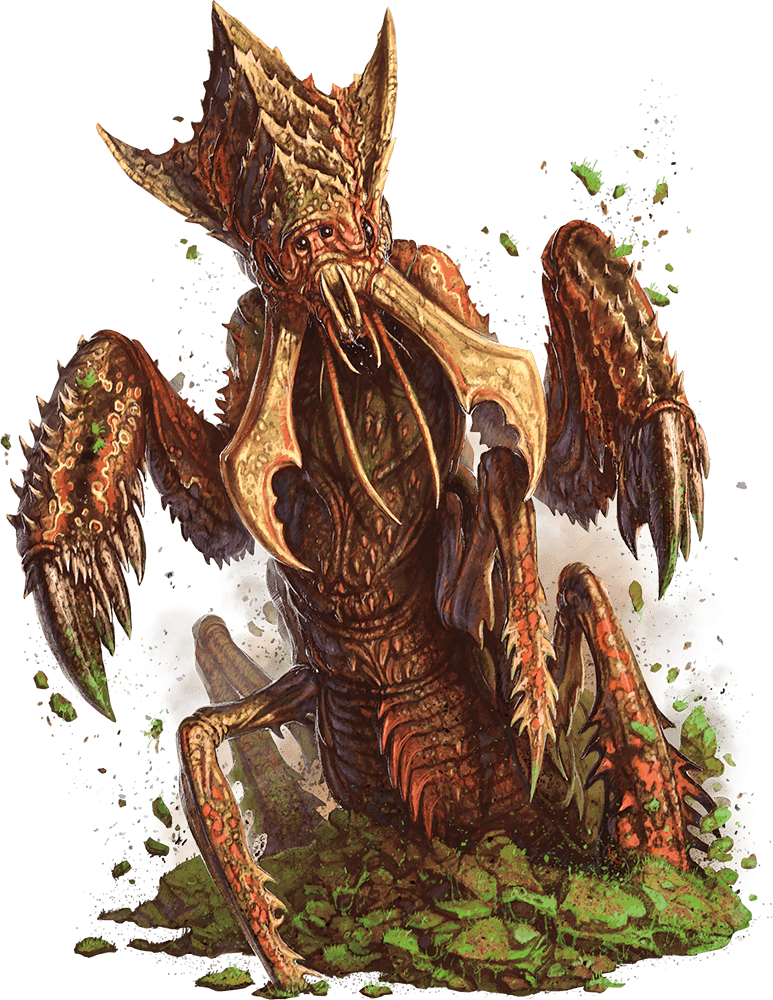
Choosing not to fight over it, the heroes traveled east to the Dessarin River and Rivergard Keep to gain transit up to the monastery. Along the way they were attacked by a trio of Ankheg (eek!).
They camped out overnight, short of their target, to regain spells and HP and so forth. DING! Level 4!
They arrived at Rivergard Keep. They were met at the heavily guarded gates by an officer named Holger, and were escorted into the presence of the apparent lord of the castle, Jolliver Grimjaw, who did not seem pleased to meet them.
Player Recap
After Savra leaves Moony and Nala, Moony quietly slips out and goes to the other room. Moony “Are any of you joiners?” He explains Savra’s offer and wonders if information might be gained by pretending to join. At Moony’s prompting, Faith provides extensive background on the elemental practices and realms. After some discussion, Moony returns to his room to share the knowledge with Nala.
A bit later William leaves the South room and walks up to the roof. There are a couple knights and their vultures on guard, looking out at the fog filled valley.
Nala is thinking over the dinner and remembers that there was something odd about the initiates. She realizes that the initiates only spoke when spoken to. There is a sameness about them, they move in a similar fashion and when at rest there hand steeple in a triangle pointing down. They are also hungry, lean but not emaciated.
Conceptual art for a Feathergale Knight … which is kind of all you get.
Moony gather up some tools and heads down to the entry hall. The initiate in the main hall does not pay attention to Moony, muttering to himself swaying slightly. Quietly opening the door off of the staircase, Moony finds a bunk room with 4 sleepers in the bunks. He moves onto the room off of the entryway; it is well lit with several initiates standing at windows looking out at the entrance. He steps back and quietly closes the door unnoticed. The final unexplored floor draws the curious cat. There are four doors on this level, all of them with raised bars on the outside. At the first door, he hears some chanting or praying on the other side. No noise comes from the second door, but it is well sealed. Through the third door, Moony hears sobbing; likely this is Savra’s room.
As he descends back to the main floor, the initiate is still standing at the window. He overhears the words free.. free.. Moving to a better spot to see, Moony observes that the initiate, while doing something on his chest, is chanting, “Free me, I must be free, I will be free, I am free”.
Another bad dream for Faith – Looking from a very great height, feeling weightless as you slowly circle the landscape, a narrow valley in the hills, a river winding through it … your eye catches on something below … your vision is narrowing, as though you were suddenly dropping, dropping, the screaming of the wind in your ears, sight fading to blackness but the screaming, the howling continues, like cries of wild beast, the angry shouts of the mad, echoing from the walls about you, screaming to be released to rend and slay and … Savra knocking on the door. Savra asks the group to join Thurl on the pinnacle. Faith explains that she needs 15 minutes to pray first, but will join them shortly. Faith asks Theren to look for William to let him know. Savra then goes and wakes Nala and Moony. They get ready and wait for Faith to finish her prayers before heading up together.
Theren arrives at the top of the stairs and William wakes up. There is the sound of a lot of bird flapping. In addition to the two guards, there are four mounted knights. Thurl is on the opposite side of the tower. He invites us over to him. The knights and Savra are not looking as friendly as they were last night. Savra appears to be angry at our turning down the offer of joining the knights. The others knights are giving her side-long looks and appear to side with her.
Thurl greets us and again toasts our victory. He says that we would make good knights, but … You are brave and honorable people. You would have made fine Feathergale Knights, if circumstances were different. But your lives’ paths, your station … and your narrow vision, all weigh in the balance. I have a proposal for you. To the east and into the hills lies the so-called Sacred Stone Monastery. Those reclusive monks harbor, I believe, great evil, perhaps even association with the Cult of the Black Earth — their very name reeks of their bound and stifled souls. Go there. See what you find. If there is evil, dash it upon the very stones they claim for their symbol, and mark yourselves champions for liberty . Do this for me, and I will know you are no threat to the freedom of my people, or the empowering of each individual in the realm. Do this for me, and you will be greatly rewarded.
Nala asks more about what Thurl is asking us to do. William senses that the party is a weapon being pointed at a target. He is more interested in the fate of the target than the party’s welfare. Thurl offers some rations for the trip. They go with Savra to collect the rations and head out. Thurl sees them to the gate and wishes them well.
The journey towards the river is quiet at first. The party discussed their impressions of strangeness about the tower.
Shortly past the Shallow Graves, walking through the grasslands the party feels another tremor hit. This is different from the tremors they have been feeling lately. The earth upslope is breaking apart and starting to roll down hill. Abruptly, a giant insect erupts from the ground. Its long antenna twitching, hook-like limbs clawing out the dirt. The first Ankheg moves to attack as a second and third Ankheg emerge from the ground. Spells and arrows fly, weapons ring out, acid spews, but the fate of the Ankheg is set as one by one they go down. (The GM weeps as the final Ankheg misses his cool bite attack).
The party moves on and as it is getting dark they choose to camp for the night rather than press on toward the keep. Refreshed and unmolested overnight the group awakes. They feel stronger and more competent. After wondering at their own changes, they notice a wolf curled up on William’s bedroll.
Shortly after breaking breakfast they arrive at the gates of Riverguard Keep. They are questioned rather rudely by the guard. William explains that they merely want to go up-river and if they want proof of their good deeds, he can walk out and see the three giant insects that they killed last night. Faith offers to feed any in need and is snubbed. Moony takes over the conversation, reiterating that the group wants to catch a boat heading north. Eventually they pass into the castle yard and follow the guard to the great hall of the keep.
A large gentleman stands up from behind a table cluttered with papers and says “Who the devil are you?”
Game Notes
Sooner or later, the party is intended to defeat the Feathergale Knights.
This party declined, for the moment. Courteously.
Thurl Merosska
Which pulled me up short. I’d thought the confrontation on the spire-top was the moment that bloodletting would occur — the FKs were scary, but not that scary — but the party sort of knuckled forehead and told Thurl they’d be happy to go check out Sacred Stone Monastery.
I didn’t want to just start a melee from the FKs’ side — it made no sense as set up (especially as Thurl really was pointing them as a gun toward the Black Earth cult), and would feel very railroady.
Okay, fine … but … what about Milestone Leveling?
They hadn’t really taken down Feathergale Spire … though they had engaged with it a lot and learned from it. But Rivergard Keep was optimized for Level 4. I didn’t want the party wiped out (in my own way I was as paranoid about a TPK as the players), and I suspected it was a location that would not be easily escaped from if they got into a fight. (An interesting concern, given what happened the next session.)
So … I let them ding up to 4th Level. I’m still not sure if that was a mistake or not, but it wasn’t the last I made, certainly.
Bits and Bobs
All the cults have hand gestures that are used to signal who they are and, outside their strongholds, maybe signal others of their kind. These gestures (which sort of echo the cult symbols) are sometimes labeled in the Campaign As Written (CAW) as a way to prove bona fides when going into someplace secure.
But the number of opportunities to point out someone is doing something with their hands, without really lampshading it, are pretty limited. I tried, but it wasn’t something the party ever picked up on.
The creepy initiate at the window muttering about wanting to be free was, by the bye, doing more scarifying. But his back was turned, so Moony couldn’t see it.
I have no idea what Faith was dreaming about. A Manticore? Could be.
Poor Savra. She’s cut herself off from home, but still misses it. She wants to be Thurl’s indispensable lieutenant, but he just uses her. She meets some cool new people who seem to want to be friends, and then they turn down her offer to join her exclusive club. No wonder she’s crying during Moony’s search of the tower.
Faith’s player had her studiously praying every morning. Just a bit of character color … that I was able to do a very creepy thing with down the line …
Ankheg!
Hey, we got a hit on the Random Encounter Table for this level, and, hey, it was Ankhegs. Coolness! Even if they got taken down far faster than I expected (a common theme through the entire campaign).
The entrance into Rivergard Keep was much less friendly than that into Feathergale Spire, and the wrap-up on their being presented to Jolliver and having him snap out, “Who the devil are you?” was fun. I had no idea what the party was going to do the next time, but I suspected they’d be coming to blows with the pirate lord of Rivergard Keep.
The Landing Page
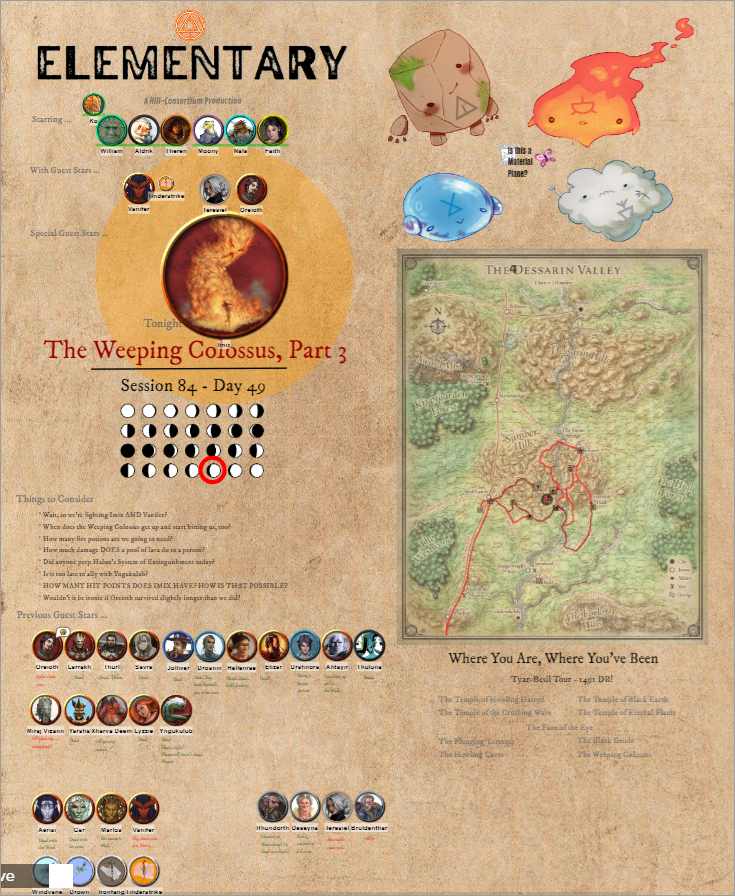
It was around this time that I started crafting a Roll20 landing page for the campaign — a map where all the players would land when they signed in each game before I shifted attention to the actual campaign map. I mean, sure, you can have the “campaign book cover” landing page as provided in Roll20, but it’s a scosh busy and also a snapshot from a moment of time in the campaign.
What I had evolved over time, but its elements included:
The campaign name
A cute campaign logo
The session number and day number of the session
The phase of the moon (which the druid asked for at one point)
A tableau of the player character tokens
A tableau (where it could be done without spoilers) of tokens of figures they were likely to (re)meet the next session
A tableau of tokens of prominent enemies they had encountered, with a note as to their status.
A list of outstanding questions (i.e., clues I had dropped, things they had thought might need more investigation, etc.), as a reminder of what they had been focused on last time (or what I wanted them to focus on this time). Some of it was sometimes a bit tongue in cheek. This list also showed up in the campaign page in Roll20.
A map of the Dessarin Valley, showing where they were (eventually maps of the dungeons they were in, with unexplored areas masked, showing where they were), as a reminder.
Once they got into the Temples and Nodes, a “band tour” listing of the places they had explored.
I eventually set up an amusing (to me, at least) layout as if this was all being done as a Quinn Martin production series intro:.
ELEMENTARY … a Hill-Consortium Production … Starring … [player character tokens] … with Guest Stars … [various likely folk they would encounter, no spoilers] … Special Guest Star … [usually the main baddie I expected them to face, no spoilers]. Tonight’s episode … [episode title].
To avoid spoilers, I crafted a series of “question mark” tokens I could fill in.
Yeah, it’s not the prettiest thing, and it sort of grew like Topsy, but it served my purposes.
You can google Roll20 landing page and actually get a lot of cool examples (and some templates for sale from enterprising entrepreneurs).
There are a number of rules that deal with the basic question of “How do I get past that guy?” Note that all the below observations are caveated by class or racial powers that may say otherwise. Monks and rogues and some smaller creatures get special abilities to do some of this stuff.
Note also that if you use any of these, you still run the risk of an Attack of Opportunityif, once past, you continue running beyond someone’s reach.
Also, if the either of the opponents here is one of those that does damage to a melee attacker “within five feet,” I would as DM incur that penalty to these maneuvers as well (even if they are not, strictly speaking, melee attacks). In other words, if you are shoving, shoving past, or even tumbling around that flaming guy, you’re going to get burned (and if it’s the flaming guy trying to move through an occupied hex, the target’s going to get burned, regardless of whether the attempt was successful).
The Magic of the Five Foot Square
Guys in a couple of five foot squares
Okay, if you are doing Theater of the Mind, more power to you. I run on a 5-foot square grid.
Obviously a Medium creature (as most players and many opponents are) does not fill the entire square, like some sort of gelatinous cube. Instead, the square represents what war-gamers would call a “zone of control.” A player in a 5-foot square can be anywhere (and, in a sort of quantum fashion, everywhere) within it. Even if you are leaning waaaaaaaay over to one side to shoot arrows at that goblin behind partial cover, you are still blocking that orc from traipsing through the other side of your 5-foot square.
The basic rules of 5e (and D&D in general) is that, with some identified exceptions and weird edge cases, opposed beings cannot occupy the same 5-foot square. So, other than slaying that enemy in your way, how can you get past them?
Here is a summary of the ideas spelled out below …
If you are _____ than your opponent …
… then consider _____.
Bigger
Overrunning
Bigger (a lot) or Smaller (a lot)
Moving Through
Stronger
Shoving, Shoving Aside, or Overrunning
More Agile
Tumbling Past
Moving Through
You can move through a hostile creature’s space only if the creature is at least two Sizes larger or smaller than you. Remember that, even in those cases, another creature’s space is Difficult Terrain for you.
Cost: Difficult Terrain movement.
Shoving
There are a couple of possibilities here — a bog-normal Shove attack, or an optional Shove Aside.
Note that in neither case do you need to worry about “Difficult Terrain” as you are never deemed to be in the same square as the enemy (don’t think about it too hard).
If we think of You (Y) doing one of these attacks against the Enemy (E), here is where they would end up with a Shove (S) or an (optional) Shove Aside (A)
S  S  S
A  E  A
   Y
Shove
You can use a Shove as an attack in the round, pushing the target away from you 5 feet (think of the offensive line in a football game). Once you push them away, you can step into their space and then beyond.
For a Shove, the target can’t be more than one Size larger. You as the shover make a Strength (Athletics) roll vs. the target’s (choice of) Strength (Athletics) or Dexterity (Acrobatics).
You could also knock them Prone with a Shove attack but that doesn’t clear out the space for you to move through.
Cost: One Attack.
Shove Aside
This is an Optional Rule on DMG 272: Rather than using a Shove to move someone back (or Prone), you use Shove to move them to the side.
Essentially, this is a more difficult Shove attack (shifting someone at a 90 degree angle), with the same skill comparison, so you as the shover roll at Disadvantage. If successful, the opponent is shoved 5 feet to the side, meaning you can move through their square at no additional movement penalty.
As a DM, the added difficulty seems quite fair and I wouldn’t hesitate to allow this Optional Rule.
Cost: One Attack.
Tumbling Past
This is another Optional Rule, so check with your DM first. DMs, this can provide color, but it can also make your sneaky rogue types (who probably have a high DEX) a lot more dangerous.
This can be found in the DMG, page 272: As an Action or Bonus Action, you roll Dexterity (Acrobatics) vs the Dexterity (Acrobatics) of the one you’re trying to Tumble past; if you win, you can move through (but not stop in) the hostile creature’s space (as difficult terrain).
There’s no specific penalty for failure here — except that you’ve burned an Action or Bonus Action, successful or not.
Costs: Action or Bonus Action; Difficult Terrain movement.
Overrunning
Yet another Optional Rule, on DMG page 272, this is basically just shoving your way past the opponent (or using your Strength to do a Move Through).
As an Action or Bonus Action, you roll a Strength (Athletics) check vs the defender’s Strength (Athletics). You are at Advantage if of a larger Size, or Disadvantage if of a smaller Size. If successful, you can move through the square (as Difficult terrain).
Cost: Action or Bonus Action; Difficult Terrain movement
But what about Jumping Over them?
The Jumping rules really don’t allow this. Or don’t work well with it.
First, High Jumps don’t help, since they are only up-and-down, according to the rules. (Yes, Olympic High Jumps involve some horizontal distance, though often not much, I don’t think anyone is envisioning jumping backwards over an orc and then landing on their own back on a huge fluffy pad.)
Second — this is not an easy thing to do. Even under highly controlled non-combat situations.
You just can’t jump high enough on a Long Jump to reliably get over an opponent’s head. The height you achieve on a Long Jump, with a successful Strength (Athletics) check vs DC10, is (distance/4) feet; assuming the space a Medium creature controls space is not just 5×5, but 5x5x5, you would need a distance jumped of 20 feet (20/4=5) to get past them (i.e., with a Running Long Jump, that means you’d need a STR of 20).
Magic might help: a Jump spell (or Ring of Jumping) triples your jumping distance, thus your someone with a STR of, say 16, would theoretically be able to Jump 48 feet, clearing 12 feet high …
… although the irritating Jumping rules still, even with a spell, restrict your Jumping distance to your Speed. If your speed is 30, you can only jump 30 feet (or 20 if you are doing a Running Long Jump that takes a 10 foot run-up). That still lets you clear that 5 foot height (20/4), and it means you only need a Strength 10 to (barely) jump over an opponent. (Speed magic would help here even more.)
That said … is a 5 foot height being the vertical control zone actually a real thing? Eh … given that D&D tends to be a bit vertically challenged in terms of accommodating things that are above ground level, you could argue it for most Medium characters (esp. as weapons and armor aren’t generally pointed at / oriented toward / limber regarding upward attacks). If you remember the Golden Rule that D&D is not a physics simulator (it’s not even a combat simulator), it kinda-sorta works fine.
Since you would be flying over the enemy’s head, there is no Difficult Terrain consideration. Thank goodness for that.
Taller creatures will tend to be Large in Size, and thus fill up (or control) a 10-foot square space (a lot more to jump over), but even if they don’t, maybe the best way to handle it is with a higher DC on that Strength (Athletics) check (DM discretion).
What does happen if that Strength (Athletics) check to jump over something fails? In theory, just as with a non-opponent Long Jump, the jump fails at that point, and you end up, probably Prone, in the square in front of the enemy you tried to jump over. But we’ll leave those esoterica as an exercise for the student.
Sliding past/under, or jumping up-over, a bad guy is a pretty bad-ass cool move, the sort of thing that will have characters (or their players) bragging about over beers for months or years to come.
Which means, on an exceptional basis (e.g., in a boss fight) the DM should probably be willing to bend the rules at least a bit to allow such an attempt, even of the numbers don’t quite work out. The rules are there to let you know what should normally work and what normally shouldn’t. But ultimately, that judgment belongs to the DM — and a balls-to-the-wall unexpected heroic attempt … should get at least a bit of latitude.
Any changes here with 5.5e?
Why yes. Yes there are — fairly significant ones.
First, though it doesn’t apply specifically to this post’s topic, while in 5e moving through a friendly character’s square was considered Difficult Terrain, in 5.5e, it’s not — just a normal space to move through. This makes stack-ups at doorway a lot less painful.
Similarly, you can move through, at speed square of a Tiny creature.
It remains Difficult Terrain to move through the square of an Incapacitated creature (which as a house rule we include dead bodies), or of a creature that is two Sizes larger/smaller than you.
While in 5e you could not end movement in the same square of another creature, 5.5e allows it if it is an involuntary action (e.g., being hurled there telekinetically). If you find yourself unwillingly end your turn in such a square, you are Prone unless you are Tiny or are a larger Size than the other creature. Even if you go prone, the other creature is not affected unless it ends its turn in the same square.
A Shove is now a form of Unarmed Strike in 5.5e. Rather than doing an Athletics vs. Athletics/Acrobatics contest (5.5e really doesn’t like contests), instead, the shover just says they are doing so, and the target must make a
STRength or DEXterity Save (their choice) vs. DC = (8 + shover’s STRength mod + shover’s Proficiency Bonus)
A Shove is only possible if the target is no more than one Size larger than the shover.
The new 5.5e rules make no mention of the previously optional Overrun or Tumble Past or Shove Aside rules. The same is true for a lot of the Optional Rules in 5e’s DMG; whether these are a permanent simplification or wil be reintroduced in a later supplement remains unknown.
I grew up in the era where you always had a mage in the party who took Detect Magic to spot the glowy magic items, and then Identify to suss out what it is.
5e has simplified this a great deal, though much of the info is semi-hidden in the DMG (p. 136). There are several ways of getting at whether an item has magical properties and, if so, what they are:
As the DMG says, the fastest and easiest way to reveal an item’s properties is with the Identify spell. Note that Identify can be done as a Ritual, so any wizard, bard, or cleric of divination can do it, taking 10 minutes and not burning a spell slot. If you don’t know the spell, then 10gp will hire someone (in an appropriate locale) to cast it for you.
You can also focus on a magic item with which you are in physical contact during a Short Rest. I usually require the characters to sort of wield the item more or less like they would — wear the boots, hold ring in your hand, wave the sword around a bit. At the end of the rest, you have learned the item’s properties and how to invoke them. This is the most common method, as it is relatively cheap and easy.
You can also try to do an Intelligence (Arcana) check to see if something about the object can identify it (“The elves often put wings on the leather of Boots of Flying” or “That is the symbol for the Orcish God of Fire” or “Rings that chime with that particular note are most likely magic, from the lost realm of Midoria”). This is much quicker than the Short Rest option, but likely less complete. (Some suggestions on how this might work.)
Alternately, you can guess from clues on the item itself, or can just start wielding it and figure out how it works.
Note that for scrolls, a tiny sip will let you know what it does without it (most likely) having an effect on you.
Attunement
Some magical items require more than just identification and working instructions to invoke its magical powers. Instead, they are of sufficient power that they require a mystical bond be created between the wielder and the item called Attunement.
If an item requires this, it is listed with the item. Until such an item is Attuned, its magical properties do not manifest (an unattuned +3 Vorpal Sword is just a very cool looking normal sword in combat). Note that some items can have a prerequisite (e.g., class, race) for Attunement.
Attunement takes an additional ShortRest (beyond the initial identification), in physical contact and focusing on the item. Practice use of or meditation over the item might be helpful here. At the end of the rest, “the creature gains an intuitive understanding of how to activate any magical properties of the item, including any necessary command words.” More complex or powerful items may require additional Short Rests or presentation of circumstances where an ability manifests. (“You suddenly feel no fear of the flames, realizing they are not harming you but humming softly.”)
An item can be attuned to only one person at a time, and a person can only attune to three unique items at a time.
Attunement ends if prerequisites are no longer met, if the item is over 100 feet away for at least 24 hours, if the owner dies, or if another creature attunes to the item. You can also voluntarily drop an attunement with another Short Rest.
Spell-casting items
Items that allow spells to be cast are cast at the lowest possible spell and caster level, don’t expend any spell slots, and require no components (unless otherwise specified). Rules for range, casting time, duration, and concentration apply (again, unless otherwise specified).
For items that depend on the user’s spellcasting ability, if you don’t actually have a native spellcasting ability (e.g., a Rogue with Use Magic Device), the ability modifier is +0 but your Proficiency Bonus does apply.
So what about in 5.5e?
Again, things are pretty much the same between 5e (2014) and 5.5e (2024), just organized differently or clarifying things a bit better..
TL;DR: Anything with magic items is expensive and difficult and unlikely under 5e.
For design reasons having to do with Bounded Accuracy and stuff like that, magic items — especially anything permanent, or anything to alter combat stats (TH, AC) — are rare as hen’s teeth in 5th Edition D&D.
The following is meant to provide guidelines. Bearing in mind how magic items can unbalance a campaign (especially weapons and armor with plusses), the DM should, as always, look for ways to make things fun and make things work for the story.
The rules on this stuff are something of a mess, to be honest, scattered in the PHB, the DMG, with major (optional) updates in XGE, which is what I’ll mostly follow (starting round XGE 134) None of it makes it easy along the lines of “I step into Ye Olde Magick Ytem Shoppe and …” For most stuff beyond the common, it’s a matter of searching out, then negotiating with buyers/sellers. This can literally take weeks.
It might be easier to go attack a dragon and check out their horde …
Buying the Easy Stuff
Okay, it’s not all that bad (or I won’t let it be in my game). Common stuff — the equivalent of picking up items at the local drug store — is relatively easy to find, if only because demand for it is there. In addition to XGE, I’ve found a very nice set of purchase tables (explained here) that discuss all sorts of purchasing (and selling) at different types of shops in different locals.
Some quick summaries of readily available items.
Rarity
Potion Cost (gp)
Scroll Cost (gp)
Common
50
Lvl 0 – 50
Lvl 1 – 100
Uncommon
250 – cities only
Lvl 2 – 250 – cities only
Lvl 3 – 500 – cities only
Rare
2500 – cities only, if at all
Lvl 4 – 2500 – cities only, if at all
Lvl 5 – 5000 – cities only, if at all
So, for example, a Common Potion of Healing is available at 50gp or so; quantities may be limited, and may vary by locale and shop. Especially as you get into Uncommon and Rare, the chances are high that stock and locations will be constrained.
Buying the Hard Stuff
Once you start getting beyond what gets stocked at the local Walgreens, it becomes a lot harder. Magic is rare, so finding it in a shop is situational (e.g., “Poor Drunken Bob used to be a mighty paladin. He finally hocked his +1 Greatsword with me last week. Only reason I’d carry something like that.”). It’s possible a shop in a trading town or small city might have something immediately on hand, but not guaranteed. The following is based largely on the “Downtime” rules in XGE.
Finding a magic item to purchase takes at least one workweek (5d) of effort, and 100gp in Expenses. You roll Charisma (Persuasion) to determine the quality of the seller, +1/extra work week you take, +1/extra 100gp you spend. (This also provides a wealthy lifestyle, so you can impress them). The roll is against the DC to Find in the table below.
Rarity
Level
Find
a seller
Asking Price (gp)
Example
Common
1+
DC 10
(1d6+1) * 10
Avg 45
Potion* of Healing 2d4+2
Uncommon
1+
DC 15
(1d6) * 100
Avg 350
Potion* of Greater Healing 4d4+4
Weapon +1 Adamantine Armor Wand of Magic Missiles
Rare
5+
DC 20
(2d10) * 1K
Avg 11K
Potion* of Superior Healing 8d4+8
Weapon +2
Armor +1 Wand of Fireballs
Very Rare
11+
DC 25
(1d4+1) * 10K
Avg 35K
Potion* of Supreme Healing 10d4+20
Weapon +3
Armor +2 Wand of Polymorph
Legendary
17+
DC 30
(2d6) * 25K
Avg 175K
Vorpal Sword
Armor +3 Ring of 3 Wishes
* Potions, scrolls, and other consumables cost only half price.
Rather than buying a (consumable) magic item, you can also hire a spell-caster to do something for you. Services for relatively common spells (Cure Wounds, Identify) are easy enough to find in a city, possibly even in a town, costing 10-50gp (plus any expensive material components) (PHB 159)
Temples are likely to provide the following spell services to the general public, assuming it’s a large enough establishment to have clerics that can do it:
Spell
Level
Cost (gp)
Cure Wounds
1
10
Prayer of Healing
2
50
Gentle Repose
2
50
Lesser Restoration*
2
50
Remove Curse
3
100
Revivify
3
400
Divination
4
210
Greater Restoration
5
450
Raise Dead
5
1000
*Outside of temples, itinerant priests can perform these.
Temples may perform other spells, but most likely only for adherents to the god in question.
Other magical services that can be relatively easily obtained outside of temples (in addition to the above spells that are not solely in cleric/adjacent classes):
Spell
Level
Cost (gp)
Identify
1
20
Prices, as with all things, can be affected by social interactions and local economic circumstances. I.e., you may be able to use Charisma (Persuasion) to sweet talk getting a desired service. On the other hand, if there is a major war or plague going on, such services may be swamped by the demand.
Selling a Magic Item
This is similar to buying one (and similarly comes from XGE, pp 133-34).
Unless you’re talking about something Common, most vendors can’t afford to buy such items, especially in smaller towns. You can pretty easily sell something to the local Walgreens that they regularly stock, or even something of the same rarity, but beyond that requires a vendor with resources, and likely some sort of Charisma (Persuasion) roll to assure the buyer of the quality.
For a more formal approach, you can find a buyer for one magic item by spending 1 work week and 25gp to spread the word. You can only sell one item at a time. Make a Charisma (Persuasion) check to determine the offer (you don’t have to take it).
Rarity
Base Price (gp) (half for consumables)
Common
100
Uncommon
400
Rare
4K
Very Rare
40K
Legendary
200K
DC Check Total
Offer % of base price
1-10
50%
11-20
100%
21+
150%
Every work week (5d) spent provides a 10% chance of a complication — also known as DM fun! Maybe someone else in the area is looking for such an item (making buyers eager to pick one up … or making buyers who have one want to get rid of the competition).
The net-net of all this is that magic items are not that much fun, certainly not that easily available with all the monster loot you keep finding, and you’ll have better luck knocking over dungeons until you find that +2 glaive you are looking for than to go to the local town and figuring to pick up such a thing at Ye Olde Magick Shoppe on the central square.
As a DM, if there’s something someone seems to need (or is jonesing for), it’s easier for me to tweak the treasure drops and provide it that way, than grinding folk through this.
So does 5.5e change any of this?
Since it’s based on the same underlying Bounded Accuracy principles, I wouldn’t expect many changes in 5.5e (2024). And, as far as I can tell at a quick glance, there aren’t that many. Mostly things are just reorganized and clarified. Higher level magic and things that increase damage or AC are rarer than hens’ teeth. A sidebar goes out of the way to say that the game is balanced without magic items, so they are in no way necessary.
Your players may disagree.
Chapter 7 of the DMG has a number of pages describing magic items (including how Potions and Scrolls work), commentary on magic item rarity and value, tracking of magic items and expectations of how many a party should have at given levels, crafting magic items, and a variety of magic items to use in the campaign. What I see looks much like the guidelines and tables in 5e.
The PHB has (in ch. 6) a nice new table on the cost of spellcasting services, as well as spell scroll crafting times and costs. Aside from that, things are pretty much the same.
There will be SPOILERS. If you are playing in a PotA game, please don’t read this. If you are DMing a PotA game, or are a DM who wants to see what the ride was like … read on!
GM Recap
Dwarf handout
Session 6 (Day 14): An inspection of the chamber found the dwarf statue to be the broken-and-reassembled remains of a petrified dwarf, with a note. A thin circle of gravel seemed to hold offerings to the statue–coins, gems, and a dagger (Reszur), the last of which Moony picked up.
A dire inscription
Cries for water led the team to the room to the west, where they found a room with an imposing black monolith of stone (with a “Displease Not the Delvers” inscription). They also found their pickle-making friend Grund, who insisted they had to leave and was willing to attack them to make it happen.
Grund was subdued, and under a pile of rocks, an 11yo boy, Braelen Hatherhand. Moments after freeing Braelen, who told them about the Believers, they were attacked by the fierce Bringers of Woe, dudes in leather armor, Symbol of the Black Earth on their chest, cloaks, and stone masks.
Choosing to press on, the party encountered the elderly Baragustas Harbuckler, a Believer standing guard at the Chamber of Moving Stones. He begged them not to disturb or anger the Delvers.
Module’s provided image for the Tomb of Moving Stones
In the massive chamber, the party found stone tables with skeletons on them, a room full rocks that floated when you stomp hard on the ground next to them, and an Earth Priest named Larrakh that nearly killed everyone before he fled.
The party recovered for a couple of hours, took a tunnel from the chamber to Waelvur’s Wagonworks, then backtracked to Mellikho Stoneworks, where they were greeted with wonderment and open arms.
Player Recap
Stepping into the large room with the statue of a Dwarf. There is a wooden frame supporting the statue and it looks like some parts have broken off. There is a circle of gravel around the statue. Within it there are coins, a dagger, and other items. There is a piece of paper stuck to the wooden frame. It says “Petrified Ironstar(?) dwarf, found 1459 DR in Red Larch West Quarry in broken condition.”
It is currently 1491. The tributes look newer, though the statue is more dusty. Ironstar is a tribe of dwarves. On closer examination, the dwarf looks like it was turned to stone and later pieced together. William and Faith both toss a copper inside the circle. Other than a gentle clink, nothing happens. Moony, reaches in and attempts to remove the dagger. The dagger comes free easily and Moony examines it further. The name (?) “Reszur” is graven on the dagger’s pommel. It is decorated with star motifs and a grip of night-blue leather. Moony notices dried blood coating the blade.
While investigating the left-hand door, Moony and William hear a noise. There are sounds coming from the opposite door. “Water please,” After checking for traps, Moony opens the door and moves in. There is a pillar in the room, it is engraved with the “Displease Not the Delvers”.
Grund steps out from behind the pillar. He recognizes Moony and tells him that he does not belong. Moony tries to bluff, but misses on the password. William tries “pickles” but also is incorrect. Grund grabs a club and rushes forward. The group decides to take Grund but not kill the simple giant. The group quickly subdues Grund and Nala manacles him.
From the pile of rubble, is a young boy, Braelen, about 11 years old. He asks for water which Faith gives him. I disobeyed my father and I didn’t deliver the message to Ilmeth the wagon master, so I am being punished. He talks about the Believers. Those that believe in the Delvers, the ones who came before. They make the stones move and my dad and the others elders interpret them. They keep us safe.
William notices some levers and chains beside the door. Moony goes to investigate. After some more questions, the child asks if he can leave. The group agrees and Moony asks about the way out. It is just down the tunnel off of the main cavern. William asks Braelen for the password: “A believer approaches.” They send him off with the other cloak, a waterskin, and some crumblecake.
There is a high pitched scream coming from the doorway the kid had just gone down. “We are the bringers of woe. We are here to satisfy your curiosity.” Faith raises her hands and thunder rolls from her, killing several and pushing their bodies back. Moony calls out as more come from the other door. The cultists are grunting and makes angry sounds. The group splits taking on the two groups. The neo-experimental religionists are focusing on the lightly armored party members, while the group takes down all comers. The cultists all have stone masks, leather armor and dark cloaks.
The party patches themselves up as best they can and moves to the unexplored door leaving the room with the Dwarf statue. Moony and William add a few things to their pockets. Moony hears a whistle on the other side. There is a passage illuminated by a lantern. Moony surprises an old man, Baragustas, whittling. He quakes in fear of Moony. The old man is a “Believer” watching the chamber. Faith enters and convinces him that they are not going to hurt him. Moony ties him up while he natters on about the Delvers. They move the stones when no one is not around. The Earth Priest interprets the movements. There have been dire portents of late. William asks if there is anyone in the chamber. He is uncertain. The priest may be in the chamber or others may have enter from the other entrance.
Going through to the “Chamber” they discover a large room with sarcophagus and many large stones. There are a couple of more floating stones. As Moony passes between two floating stones, they settle gently to the ground. The first sarcophagus turns out to be a stone table and has a skeleton resting on top of it. The chest has been crushed. Faith sees a figure rushing towards a stone table on the south side of the room and racing up the wall. He is wearing what appears to be stone armor and crystal glaive.
Faith and Nala go down. William moves up to stabilize Faith. Larrakh comes down off the wall and yells “Silly fools, Ogremoch will consume your souls and drag you to the depths of the earth.” Then he smacks William unconscious. Theran and Moony bravely continue the fight. After a large hit from the magic missile wand, “Black Earth take you!” and starts to run away. There is a large burst of speed and he leaves through a door on the far side. Theran stabilizes William. An hour later Faith and William regain consciousness. Faith heals Nala and the wounded party members take a short rest to regain some hit points.
Looking around the party discovers that the stones elevate when you stomp your foot near them. They also note that the stones tables are worn and the skeletons all have blunt trauma injuries. Moony discovers the hidden door the Larrakh left through. The door leads to a rough hewn tunnel that winds around. There is a choke point in the tunnel with debris and a canvas stretched across the tunnel. Past that debris looking back, the painting on the canvas and the fallen rock, make it look like a total cave-in. Past there, the party emerges into a shed in the wheel-wright’s yard. Someone across the yard spots them and calls out for the Master Waelver.
The party pulls back into the tunnels and heads towards the other exit to the North. This brings them back to the Mellikho Stoneworks. The passage ends in a wooden door and a container of sand holding a few torches. There is the sound of activity around the door, while there is no one in the immediate vicinity. Moony chooses to come out of the door and exclaims we are out of the hole at last. Nala joins him and also shields her eyes from the sun. The others follow them out into the sun. Albaeri Mellikho comes across the quarry, greeting them warmly.
Game Notes
Whoosh. A lot happens here. If “The Cave of the Necromancer” was an intro to dungeoning, “The Tomb of Moving Stones” is the next grade up, with traps, drama, multiple combats, and an opponent who outclasses the group (but who loses to Action Economy, as one does, every time).
I ended up rushing through the very ending, because the session ran long. That just sometimes happens. I started off the following game with some details I should have established at the end of this one.
I created a handout for the inscription on the statue, just because I wanted them to be able to easily reference it. That was probably overkill, especially as the players started making noises about how they might want to start investigating the West Quarry, which would be quite the dead end. I decided that the West Quarry had flooded a while back, so as to forestall any further investigation in that area, since it really didn’t matter overall.
Well, it matters to the extent that it (and the whole Tomb) all ties into the history of the Besilmer Kingdom of Dwarves five thousand years ago — but that really doesn’t get played up yet. The DM here, though, should read the background notes for the campaign and around this dungeon carefully to be aware of, and hint at, those multiple layers of history, which will pay off later.
Poor little Braelen
The kid being punished, Braelen, was kind of a weird one-off — look how awful the cultists are! — but I played with him in a couple of ways. First, I decided to spook the party into thinking they’d sent him off into the hands of cultists who’d killed him immediately (the scream) (Actually, they just cuffed him hard). Then when the party followed up later back in town, I was able to turn his home into the deeply abusive atmosphere that some of the party members decided to do something about in later episodes, with Faith eventually arranging for the kid to be fostered off in Waterdeep, resonating with her own life experience.
Did all this advance the overall campaign plot? Nope. But it was good character time, something that some of the players decided to care about, and I find that sort of thing is the mortar that holds the walls of the story together.
Ditto, in its own way, for Grund. You can play him as a looming menace, but I’d made the half-witted guy likable, with his pickle business and fascination for the Tabaxi in the group. So when they met him again in the Tomb, he was clearly torn between Important Job he’d been given and not wanting to hurt “Mister Kitty.”
As a result, he survived … and would circle back into the campaign later.
The attack by the Believer thug squad spanned two rooms, which gave the party some lessons on both splitting forces and line of sight. Learning occurred!
Between the Kid and the Old Dude standing guard (Baragustas — whom I think had not been mentioned elsewhere, so, hey, yet another denizen for Red Larch and another journal entry to build!), the party by this time had a pretty good idea of the conspiracy.
Larrakh, the Black Earth Priest
They were not ready for the Earth Priest, Larrakh, who was smart enough to (a) ambush them, and (b) do it spider-climbed up on the wall so that they couldn’t stab him. The party was also split up, searching the room, and the Roll20 dynamic lighting made it much easier for people to be unsure what was going on elsewhere in the room.
Being only 2nd Level, we had a couple of party members go down pretty hard (I like the 5e Death Save mechanic, which folk were introduced to here, much to their shock), at which point Larrakh got cocky and came down from the wall. Some lucky attacks from the rest of the party, and it was Dash + Expeditious Retreat time for Larrakh.
Which on one level was a bit of as problem, as the book mentions the possibility of his escape, but not what it means, story-wise (an issue that comes up with other villains all the way down the line). But it was also an opportunity for some shenanigans to be inserted later on, so, um, yay?
Being so man-handled by Larrakh came as something of trauma to the party. It made them a bit gun-shy for some time to come.
Larrakh also gave a shout-out to “Ogremoch,” someone they hadn’t heard of before … and so began building the lore of the Black Earth.
(Side note: the module, includes a bunch of imagery for various bad guy classes, but it also frames those drawings as “extreme” versions that were discussed and kinda-sorta rejected, without giving more reasonable alternatives.)
By the end of the scenario, the secrets of the Believers have been torn off the hinges. It’s all over, right?
By no means.
Resting
So, in the Real World, (a) injuries can take days, weeks, months to heal, and (2) we don’t have healing magic so who knows how that works?
D&D 5e’s current rules on Short Rests (1 hour, spend hit dice to regain HP) and Long Rests (6/8 hours, spells regained, all HP regained) are weird on one level (The Real World Doesn’t Work That Way!), but also convenient. HP are, of course, about more than bodily integrity — morale, exhaustion, mental fatigue, all of these play a role (which is why HP goes up when you level). The problem with accurate healing times is that they are simply Not Fun, unless you want to take weeks-long time outs in the campaign. Does 5e make it too easy to heal up? Mmmmaybe, but it also keeps the healing process from getting too much in the way of the story.
The problem is, players want to do it at the darnedest times.
Granted that they didn’t know this was the final chamber, and that they also wanted to wait for a couple of party members to regain consciousness. If they decided to then Rest, would they really really do it in the Spooky Chamber of Moving Stones? Even if they hunkered off to one side in case Larrakh came back?
Seems unlikely, but “when and where and how do we Short/Long Rest?” is a constant issue. Allowing people to rest willy-nilly makes resource consumption meaningless, and is narratively irritating. But restricting rest can be frustrating unless the players agree that it’s reasonable. The game in general tries to discourage people from resting in dangerous places (like the Keeps, the Temples, etc.), but generally does so by throwing Random Encounters at them, which is the worst (most time-consuming) way of doing so. I struggled with this the whole game.
Passwords
All through this campaign, there is the possibility of the party getting past guards and getting access to places by use of passwords and hand signs.
Which is cool and awesome and provides a way to advance that doesn’t involve steel and bloodletting.
Two problems:
First, there’s really no opportunity for the party to figure this out — to learn what the passwords are or even to reasonably suss them out. Even being a somewhat liberal DM who would have been happy for folk to do such a thing, and be willing to stretch it to reasonable pass-phrase alternatives … there was really nothing for the players to work from.
Which meant, second, that the party felt little motivation to take that approach (not helped by not really having a Face Man character). And, honestly, the advantage the module provides for knowing the Secret Words is relatively minimal.
It just feels like a lost opportunity in storytelling.
Bits and Bobs
Crumblecake
The party leaned into crumblecake. That I made up some images of it, and that NPCs talked about it all the time, got people bringing it up at every drop of a hat — including giving some to the half-starved Braelen.
My biggest regret from all this was that this dungeon has a lovely hallway trap setup that the party completely bypassed. I eventually had them discover it when they went back into the complex to search out the northern exit.
Why is Albaeri — one of the more nervous of the Believer leadership — greeting them with open arms as they exit the Tomb into her ? Ah, we will see next time.
So, as an example, the 6-foot tall Fighter with a Strength of 16 (+3 Bonus) can:
Do a Running Long Jump of 16 feet forward (clearing a 4 foot high obstacle)
Do a Standing Long Jump of 8 feet forward (clearing a 2 foot high obstacle)
Do a Running High Jump of 6 feet high (with a reach of up to 9 feet)
Do a Standing High Jump of 3 feet high (with a reach of up to 6 feet)
If you land in difficult terrain, you need a DC10 Dexterity (Acrobatics) check to not fall down prone.
You can extend your arms half your height above yourself during the jump. Thus, you can reach above you a distance equal to the (height of the jump ) + (1½ times your height). (See, putting a height value on your character sheet finally means something!)
Movement and Jumping
The RAW rule is, your jump in feet (up or across) counts against your Movement. That implies that if you have a Speed of 30, and you want to try and long jump 20 feet, you can only move 10 feet beforehand. (Jumps can’t split across turns.)
For example, the Jump spell or a Ring of Jumping lets you triple your Jump — so the Fighter described above would get a Running Long Jump of (16×3=) 48 feet, right? Nope. If their Speed is only 30, they can only Jump that far (or less, given the 10 foot lead-up to a Running Long Jump).
This limitation can be extended, though, through:
Speed magic (e.g., Haste, which doubles your Speed)
The Dash action (which effectively doubles your Speed for the turn).
There are cases with spells where it is possible to jump higher than 10 feet, which raises the question as to whether you then take damage upon landing again.
People can disagree, but I’d be inclined to say no, especially as magic is involved: if your (magically-enhanced) muscles can propel you upwards 20 feet, they can absorb the (same) shock in landing after returning to the ground. Because magic!
So, what about Jumping in 5.5e?
Pretty much all the same as with 5e for the basic jumps.
The Jump spell is handled a little differently, and more simply: each turn, the recipient of the spell can long jump 30 feet by spending 10 feet of movement. No calculations needed.
There will be SPOILERS. If you are playing in a PotA game, please don’t read this. If you are DMing a PotA game, or are a DM who wants to see what the ride was like … read on!
GM Recap
Session 5 (Day 14): Faith‘s sleep is disturbed by dream where she is being pressed into the ground by her sins and failures. The next day dawns warm and humid. After some logistical scurrying, the party gets swept up into a new problem — a sink hole twenty feet across at an intersection that has swallowed some kids and an adult. Their efforts to mount a rescue are hampered by some of the town’s leading citizens — Albaeri Mellikho, Ilmeth Waelver, Ulhro Luruth — who seem to want nobody going down the hole, certainly none of the “strangers,” and who make cryptic comments about the “Delvers” who keep the town safe.
Fending off their efforts, along with Elak Dornen, who brings along the constables deputies, the party goes in (sending the people who have fallen in back to the surface). They find themselves in a large, mined chamber, from which leads a passage and a stone door, beside which are two hooded cloaks and a water skin. Going through the door, they come to an intersection, which two half-open doors decorated with a relief of dwarvish warriors.
The Symbol of the Black Earth
They go down the left passage, and find a small room with three rat-eaten corpses. Disposing of the giant rats, they think two of the bodies might be the missing farmers. All three bodies had a mystic symbol carved in their foreheads.
The next room had a stone floating in a magical zero-gravity field in the center of the room.
The room after that was a large one, in the center of which was a statue of a dwarf.
Player Recap
Faith has a bad dream: Is it a dream? You feel a great weight on you, lying on your cold, cold, bed, like someone has stacked stones on your body, the weight of your sins, the disappointment of your elders. There is danger approaching — but are you safer trying to break free and run, or lie still and take your punishment? Faith chooses redemption through prayer and penance. That is when she falls out of bed. Moony “We aren’t on a ship, Faith, you shouldn’t be rolling out of bed if the room isn’t moving” Faith “Sometimes the world rolls.” Moony returns to sleep and Faith spends some time praying before going back to bed.
The Next Day: The air feels muggy after the storm. Breakfast is simple, crumble cake and small beer. After packing some supplies and crumble cake, the group stops by the Ironhead Arms to check out the wares and stock up on arrows. Nala goes to Haeleeya’s to see about a net for the drift globe.
As William hitches up Buttercup to the wagon, screams are coming from the East side of town. The party races to the sounds. There is a large sink-hole. Several kids and a woman have slid into the hole. Albaeri and Ulhro the Tanner are trying to get people to back away from the edge and yelling that this is a town matter. Faith lights her rope and tries to see into the hole. Unfortunately, the edge crumbles as she approaches and she slides in. William arrives with the wagon and Nala climbs up on the cart to get a better view. The hole is at least 20′ deep.
Faith finds four kids and the mother at the bottom of the hole along with a broken cart and some mounds of dirt. They are in a large chamber. Everyone is okay. The mom asks if Faith is there to help get them out. This is not a natural cavern. Faith explores while the kids and mom scream, afraid that she will leave them to die. She finds finds a locked door and a corridor to the north.
Meanwhile up at ground level. Moony follows Ulhro Luruth who runs down to #12 Elak Dornen. Ulhro is panicked. “I’m afraid it will disturb the Delvers” Elak “I’m not worried about the Delvers, I’m concerned about the outsiders.” Back at the hole, William appears to Kaylessa, to tell the crowd that we are there to help. She encourages us to save the kids. Ulhro and Albaeri keep pushing to keep this as town affair. Finally, Kaylessa says “You don’t speak for the people of this town.” About then Lymmura arrives and asks about the children screaming. Albaeri tries to send her away too. The crowd is not supporting the Fancy Boys Club.
William uses the rope to descend into the hole. Faith helps him to secure the rope to Tsali, the eldest child. Nala spreads out near the lip of the hole to help lift Sally over the edge. The edge crumbles and she ends up dangling slightly before the crowd pulls her back. The remaining children and mother make it safely out of the cavern.
Moony quietly follows Elak as he trots to the butcher shop. Moony overhears Elak yelling at Jalessa. She is giving as good as she gets. Harburk is not at your beck and call. Eventually, several constables come out head to the commotion. Back at the sinkhole. Ulhro knocks on the barber’s door.
Theren slips into the cavern. The discussion continues above. Theren uses prestidigitation to have a sea shanty, Moony doesn’t hear it, but Nala does. She convinces Elak that she will try to get her friends to leave the hole. Theren and adds the smell of rotten flesh to the illusion. William calls up to Nala, “Do you remember the circus? I think you should see what they are up to.” Nala, thinking that there are undead there, pulls the rope from Moony and “Falls” into the hole. Moony “Oh No!” He hands the rope to Elak, “What is this?” “It’s a rope. Don’t you have ropes in Red Larch? No wonder people are always falling in holes.”
Elak yells at the deputy to clear everyone out of sink hole. Deputy yells back “What do you want me to do? Go in the hole? Can you smell that?” Moony – “Yes, smells like something dead, probably zombies and unicorns.” Elak visible blanches at the mention of zombies. With that Moony scrambles down the side of the hole. The deputy calls to him from above. “Here now, Mr. Cat, please don’t do anything that causes more of the town to collapse. I’ll fetch Harburk and bring him back as soon as possible.”
While the groups decide what to do next. Moony finds some cloaks and water skins near the door down below. They look fresh, not dusty. The cavern looks like it was an very old mine. The floor is smooth and the walls have been worked. Moony opened the locked door and the group slowly moves down a hall with dressed walls. Two doors with reliefs of stern dwarves across the hall from each other. Doors are ajar. While the images are old and stylized, there is no writing or hidden secrets engraved in the panels.
Past the left door, there is a hall. Soon the smell of rotting flesh. It gets stronger as they move deeper into the mines. The tunnel opens up into a square room with three rotting bodies and a couple of giant rats gnawing on the bodies. Moony takes out the first rat and Nala finishes the second. And that is when the remaining rats swarm. They are quickly dispatched. The bodies look like they are a few weeks old. The skins are tan. The male body look a bit like Farmer Jowen, Senior. Something has been carved into their foreheads.
Continuing down the tunnel to the next room. There is a floating rock in the middle of the room. As Moony approaches the rock it is like he stepped into thin air, struggles, and land on the other side of the rock. His passage clips the rock which moves a few inches. They determine that there is a zone in the middle of the room that causes things to float. Faith tests it out and floats to the top of the room and plays around a bit. When the rock is pushed out of the zone it hits the floor.
Past the room with the rock, the hall ends in a door. Moony slowly pulls the door open and peeks inside. There is a statue of a dwarf in the center of a large room.
Fancy boys club: Albaeri, Ulhro, Elak, Ilmeth
Game Notes
After last time’s gab-fest enough events fall together to head toward the climax of the low-level Red Larch narrative: the Tomb of Moving Stones. Not only does this tie together a bunch of threads, but it kickstarts the players toward the next phase of the game, dealing with the Haunted Keeps.
The Sink Hole
The Sink Hole is hidden back in Chapter 6, in the “If your players are doing Levels 1-3” material, but is also mentioned up in Chapter 3 around the Red Larch section. The Tomb of Moving Stones is also back in Chapter 6, as it’s designed for Level 2. Yes, once again, the PotA book organization is kind of nutty.
It only comes into play (only collapses) if the players don’t find the other entrances. They’d gotten scared off their one check of Albeiri’s stoneworks, and never really delved into Ilmeth’s place, so Sink Hole it was.
There is no actual location given for the Sink Hole in the book (sigh), just “in the middle of Red Larch.” Some resource I found mentioned that the Tomb fits decently (if at an odd angle) if placed so that the Sink Hole is at the first intersection coming down the Larch Path, near Gaelkur’s (#17), so that’s where I put it.
There is no token or art given to represent the Sink Hole, so I provided my own on the map.
The Believers
Something is rotten in the little burg of Red Larch
Red Larch doesn’t have a city government — even its constable is a part-time job — but like all communities it has an informal government of the old, the rich, and the otherwise respected and/or influential.
Partially intersecting with that circle of influence are the Believers. To me, this group is the first test, not just of the player characters, but of the GM: what kind of cult horror film are you playing here?
It’s really, really easy with PotA to chalk up all the followers of the different elemental cults as crazed fanatics, making human wave charges and willing to destroy the world just because their gods command it. In other words, an Indiana Jones and the Temple of Doom.
Bo-ring.
Generic Cultist icon, used as mooks for all the different elemental cults.
I mean, sure, some of that. Not every encounter is going to be nuanced. Howling Hatred Cultist 7 in the room isn’t going to start engaging his fellows or the players on a discourse about the meaning of existence and what constitutes a moral vs immoral act. He’s probably going to wave his dagger and charge the infidels in the name of Yan-C-Bin.
And, sure, the book pretty much leans on the “all the cultists are there because they believe this, that, and another extremist thing, and the cult has further brainwashed them until they live or die for their deity’s victory” thing. Indeed, between different elemental sites, all the lowest-level cultist mook icons are the same.
Still boring, if that’s the only note you play.
“The Conspirators” by William Strang (1859-1921)
The Believers (or the “Fancy Boy Club” as the players started to call them, though some of them are not at all fancy) are a challenge for the GM. Are they simply mustache-twirling lunatics, killing their fellows at the behest of the Black Earth Priest in their midst? I mean, you can have them be that, in order to get into and out of Red Larch as fast as you can.
Or you can make them fellow townsfolk in a community that gets a lot of outsiders passing through, but a strong core fellowship within. They discovered something wonderful (the Moving Stones), came up with an explanation that satisfied them, and are now being manipulated by the Black Earth, step by step, from one sin to the next, into increasing darkness. Some are aware of this. Some are unaware. Some think it’s worth it to protect their town … or maybe their position … or maybe just their family. Others worry about what they will be asked to do next. And still others … well, yeah, sure, they’ve drunk the Kool-Aid.
Elak Dornen
Not considering how Elak Dornen is a different person than Marlandro Gaelkur or Ilmeth Waelvur or even Grund … and how each of them has their reasons for how they’ve gotten into (or pulled back from) the Believers … makes these guys cardboard cut-outs, and foretells a very, very long hack-and-slash campaign. Which, if that’s what you want, go for it.
I wanted a story.
So, here: the sink hole has opened up in the middle of a major intersection, and the Believers on the scene are in a panic — some because their crimes may be about to be revealed, some because the Tomb might be disturbed and the Delvers displeased, some because without the secret they feel they might lose influence, some a combination of those. Some try to wave the crowd back from fear, some invoke the solemnity of the power they wish to wield, some run for help from their fellows.
Characters, especially named characters, should be treated as individuals as much as possible. Sometimes that will be a stereotype — Elak Dornen as the one who considers himself the important (and smartest) person in town — but even just latching onto a trope can differentiate him from Albaeri, the other quarry owner but a very different person, at least as I played her.
Another thing I did — which, again, I did a lot of — was create in Roll20 and frequently linked to (including in the entries above) public-facing journal entries for each of the named characters and for the Believers as a whole” what the party knew, who in town seemed to know about them, who they were (links to their individual journal entries), what the party knew they’d done, etc.
This isn’t the Old Days. If you push lore and other information at players, don’t expect them to take notes and memorize it; this isn’t school. Stuff that characters in-world would remember because they’d speculate about it for hours around a campfire simply isn’t stuff that players will absorb unless they can easily retrieve it.
The Cult Symbols
The Elemental Evil symbols
This episode introduced the first of the four cult symbols, which would become increasingly important as the game continues. I had to find on the Internet or craft my own, of course, because the game did not include much in that way as things to use in art or tokens.
I ended up having special Roll20 handouts about each of the cults, including their symbols and significant people and places around them, to help the players keep track of what they knew and to add to the color text.
This also marked the episode I realized that the cult symbols — something spooky and secretive and not at all public — were published in every freaking corner of every campaign map. (Rolls eyes.) As far as I know, my players never noticed, but it bugged the hell out of me.
Cult Interrelationships
There’s a lot of info about the Cults in the PotA book, but, like everything else, it’s spread out in a lot of different places. Early days I built a diagram showing how the cults interrelated. I didn’t use it too long into the campaign — writing up stuff like this helps me internalize it — but feel free to use it or modify a copy to your own needs.
House Rules note
We learn by doing. The fight with the Giant Rats was the first case of a close melee/arrow combat in the game where the problem of “Do your friends block your ranged weapon shot?” The rules as written basically assume they do (or, rather, provide half-cover, AC+2). The party members (even when reminded it applied to the bad guys) didn’t think that made as much sense, so we borrowed from 3.5 rules for this house rule: and said that if the attacker can ignore the obstacle if it is closer to the attacker than to the target; i.e., if someone is right in front of you, it’s easy to shift in your 5-foot square to get a clean shot across the room; if someone is fighting right in front of your target, not so much (we also decided not to include the “you missed your target, did you hit your friend?” optional rule). (More discussion here.)
Bits and Bobs
I love dream entries, probably to a fault. Faith was suffering a crisis of conscience (or else getting a poke from a deity) for the killing she’d done.
Loved the bit of adding an illusory stench of dead bodies from the pit to discourage anyone coming down there.
Though nothing was provided in the game, I took time to draw a very nice hole on the map of Red Larch to show where the hole was.
Jalessa
I did have some favorites among the NPCs in Red Larch — Haeleeya, Kaylessa — but Jalessa was special. The owner of the butcher shop, and constable Harburk’s wife, she had a long-standing weariness about people calling her husband away from his real business (the shop), as well as a take-no-shit attitude about anyone who caused him or the town any grief. Even Elak Dornen can’t intimidate her. Always a favorite to bring back in when the party revisited the town, and she gets a fitting “reward” at the end of the campaign.
I was briefly afraid that the party was not going to go down the sink hole. The whole Tomb reveal would be a lot less interesting conveyed by townsfolk at the tavern that night. Fortunately, they went for it.
Small call-back, but having the bodies discovered down below include the missing farmers made all the improv work a couple of sessions earlier worth it. Though it did mean I had to go out and find some “dead body” dungeon map art to use, because despite being clearly mentioned in the text, the map has no such thing in that room. Sigh.
The session didn’t end on a cliffhanger as I prefer, but it was getting late and there was a melee just ahead, so it made sense to pause there.
There will be SPOILERS. If you are playing in a PotA game, please don’t read this. If you are DMing a PotA game, or are a DM who wants to see what the ride was like … read on!
GM Recap
Session 3 (Day 11-13) “The Lord of Lance Rock”
The party attacked and quickly subdued the brigands in the woods, with rapid, deadly exchanges of arrow fire. Faith killed her first person, and did not feel good about it. One of the bandits got away. They also freed a bear that had been caged by them. The goods in the brigand’s cave were put in their (?) wagon and brought back to town.
Constable Harburk Tuthmarillar was happy to see them, and the results, but upset that there had been another disappearance, a young couple from an outlying farm. He also warned Nala and Theren that Elak Dornen, an Important Man, had filed a complaint about their shenanigans at Mellikho Stoneworks.
Moony and William saw their new horse put away under the care of Iraun Thelder, the stable master at the inn.
Theren and Nala interviewed Tandelle Ethburk, a merchant traveling south from Mirabar. She knew something about the The Mirabar Delegation, and rumors of their working to strengthen or expand the Lords Alliance. She’s trying to get to Waterdeep before them; she says they should be just a few days behind her.
Kaylessa Irkell offered to William to hire the party to seek out the fell magics, dire circumstances, and darksome influences up at Lance Rock.
The next day the party journeyed to the farm the Constable spoke of, the home of Joen Endrath and his wife, Mira. There were no signs of foul play, but the dinner meal had been interrupted, and a clay holy symbol to Chauntea was missing. The horse in the stable was also gone. Joen’s father came by, and milked and left with the cows.
The Necromancer’s Symbol
The party continue to journey to Lance Rock, where they found a sign warning of plague, signed by the “Lord of Lance Rock.” Ignoring the warning, they entered a cave complex, fighting a variety of skeletons and zombies, and ultimately confronting the “Lord,” Oreioth, whom they defeated amongst his warnings about the blurry Necromancer’s Sigil and an Eye that was watching their every move.
They exited the caves to camp out overnight and regain their rest and health. Ding! Level 2!
Player Recap
Looking for Bandits Down the Cairn Road: Following the road out of town we find two sites that have been abandoned for a while. Approaching the third site, we small meat cooking. The party pauses and Moony moves ahead quietly to check things out. There are 5 brigands and a cart with a bear in a cage. A mighty battle ensues where the group learns all about cover and difficult terrain. One brigand runs off and the bear remains alive in the cage.
Crumblecake
William gives the bear some crumble cake and calms it down enough to be released safely. In a cave near by the group finds some money, goods, cheap weapons, and a worn down draft horse to pull the cart. We head back to the constables office with the loot and bodies.
Theren and Nala head to the constable/butcher’s office to report. The shop is closed, but the constable is at his house next door. Harburk applauds their success. He doesn’t recognize any of the brigands bodies and calls his “boys” to take care of them. He does note that more strange things are happening. Out of town of Cairn road, a farmer and his wife have been reported missing. The ground tremors have the whole town spooked. There is also a general discussion of increase in strangers passing through that don’t look like merchants. Finally, he tells them that a complaint was lodged about the shenanigans at the quarry. It wasn’t Mellikho, but came from Dornen the other quarry owner.
Faith visits the temple and contemplates the life she took today. She feels the weight of her actions. Lymmora, the acolyte of Chauntea, comes out from the back room and asks if there is anything she needs. Faith turns her down. Lymmora continues and asks if Faith might stop by tomorrow to discuss something and then leaves Faith in peace with a blessing.
Kaylessa
William and Moony head to the Swinging Sword to see about stabling the horse, Buttercup, and storing the cart. The one-eyed stable man, Iraun Thelder, says they have room and will fix up a stall. There are a couple of horses belonging to guests and one at the end, Daisy, that looks like it belongs to the inn. Moony strikes up a conversation with Iraun who turns out to be a retired sell-sword. They chat about the customers, a hobbit merchant and a lady travelling with a caravan from the North. William chats with Kaylessa about their adventure and asks for some water to be heated for baths. The conversation moves onto the “Fell Magic” of Lance Rock.
Theran and Nala join the woman travelling from the North in hopes of getting information on the delegation. They exchange introductions. Tandelle is a merchant from Mirabar and looks to profit from the upcoming negotiations. When she left Triboar the delegation had recently arrived. She is hoping to make it to Waterdeep before the delegation arrived. Since they will likely stay a few days in Triboar, she expects the delegation to arrive at Red Larch in a few days.
Down on the Farm: William takes an opportunity at breakfast to talk with Kaylessa about looking into the “Fell Magic” coming from Lance Rock, South West of town. The “dark influences” are causing the bad thing and making everyone nervous. She is willing to pay. It has been several years that she has felt the danger rising.
Faith returns to the temple and Lymmora offers her support and words of wisdom about the trauma of the day before. She also asks if Faith is intending to stay in town long. Lymmora says that there might be someone in town who could use the group’s help. They can talk again later.
The group picks up Faith on their way out of town. With Buttercup pulling the wagon, they follow the constable’s direction to Jowen and Mirra Endrath’s farm. The farm is quiet. The cows in the barn have not been milked in at least a day. The house is closed and the fireplace cold. There is an interrupted meal on the table. Nala notices that it looks like the evening meal and the lamps have burned down. Jowen’s father shows up and demands to know what is going on. Faith is the Power of Not Helping.
William steps up and explains that the constable sent them and that it looks like they up and left in the middle of dinner. Jowen Senior eventually agrees and notes that a clay holy symbol to Chauntea, (Goddess of agriculture) is missing from above the fireplace. We don’t see any tracks going anywhere but the field and road. The saddle is still in the barn, so they didn’t ride away. In the end Dad wants to milk the cows and get them back to his farm. Before he leaves, we ask him for directions to Lance Rock.
Lance Rock!: The group parts ways with the farmer and heads South. They find the path from the road that leads towards Lance Rock. The ride is pleasant with slight hills through mostly grassland. The occasional copse of trees breaks up the scenery. Soon they can see the rock about 6 miles away. Lance rock is a single pillar that juts out at a sharp angle. The stone is different from the surrounding limestone. As they approach the rock, Faith suddenly realizes what the farmer meant by folks coming here for picking berries – wink wink – nudge nudge.
Beyond the rock, there is a ravine with a sign that says “Come no closer lest you catch the disfiguring plague that afflicts me! The Lord of Lance Rock” Ignoring the sign, the party heads down the path single file. Moony stealthily goes ahead. Followed at a distance by Nala, William, Theren and Faith. The trail opens and Moony comes back to the group with the layout. There is a cave ahead with another sign warning of the plague. There are putrid smells coming from the cave. Before entering, Faith casts light on Nala’s sword. Moving closer and Nala yells announcing their presence, but not in an intimidating way. Again Moony scouts ahead, the air is thick, dank and cool with almost of feeling of fog.
A ways inside the cave there is a dead body. It’s probably been dead for four days and looks like he might have been disemboweled. William goes back to the cave entrance and gets the sign post to poke the body. As he rolls the body over, it reaches for William. Faith strikes first with Guiding Bolt doing significant radiant damage. Moony steps up with a sneak attack with his rapier. The body dies again. Nothing of interest on the body. To make Faith feel better, Theren sends a fire bolt at the zombie. The smoke of rotting flesh follows the party as the path opens into an open space.
There is a flat rock in the middle of the cavern. It looks like an altar with dried blood on the surface. As Moony enters into the space, he nimbly sidesteps around a falling box of rocks. The rocks are followed by two zombies jumping off of a ledge. The battle is joined and damage is exchanged. In the end the heroes are victorious. Theren confirms that the alter was used for necromancy.
There are two exits from the cavern. The group chooses to go left. Creeping down the narrow passage, Moony spies a zombie in a frilly dress and heavy makeup. Nala moves to steps to the front, but Faith passes her to check it out. The zombie lady is accompanied by a zombie man wearing a bearskin and a zombie hobbit in clown makeup. This zombie circus is a disturbing and ridiculous sight. The group is hampered by the narrow passage, but eventually fells the lady and the bear. They struggle to hit the zombie clown, either because of his small stature or absurd visage.
A warren of tunnels lead from the room. Moony eventually works his way to a room that looks like it has more alters. Returning to the group, they decide to go slowly forward with Faith in the lead. There are three flattened boulders inside the opening serving as tables that hold a variety of body parts. A hooded figure stands at the farthest slab. They appear to be drawing a long needle with thread through the flesh in front of it. Moony opens the battle with a sneak attack on the hooded figure. Several creeping hands with jagged claws are moving towards the group. Faith and William each take out a claw. Theren takes out the remaining three claws with magic missile.
Suddenly a UNICORN appears in the room. (DM: Don’t do anything yet, I need to deal with the unicorn!) [Note: the Sorcerer summoned a Unicorn via his Wild Magic, one of three times it happened in the entire adventure.] It descends in a kaleidoscope of color, rainbow colored sparks dance from it’s hooves as it touches down. The magnificent beast turns and glares at Theren. Nala continues to attack hooded figure. Faith resists the urge to pet the unicorn, but misses with her mace. William moves forward and throws himself at the ground before the unicorn and calls out “Mielikki, my goddess, how may I serve you?”
Theren runs past the unicorn to attack the zombie. The unicorn is a bit confused, first turning towards William and raises an eyebrow and then tracks offending sorcerer passing by and raises it’s other eyebrow. Glancing around the room, they eventually faces William. Through the unbelievable chiming tones he hears “Get to your feet, child”. Seeing the glittering unicorn, Moony is enchanted. “Pretty horsey” Moony says and he moves toward it.
Faith smashes the zombie’s head but it remains standing. William stands before his goddess and says “Thank you for coming and saving us from this great evil.” Theren gets another hit in but the zombie won’t die. The unicorn looks at William, it’s eyes are dark and filled with starry depths. “You are hurt, child,” It lowers it’s horn to touch William and heals him. Moony remains enchanted by the pretty horsey and asks it he can pet it. Nala gets another hit on the zombie; it remains stubbornly animated. Faith finally delivers the killing blow. She then move towards the unicorn, also wanting to pet it. Eventually, the unicorn give a soft snort at the group and with a final glare at Theren disappears.
Traveling further into the large cavern they come upon another workspace. There are stairs going up the right side of the wall towards the ceiling and a stone protrusion leveled into a rough table on the left. Saws, knives and other tools litter the surprisingly clean table. Just beyond the circle of magic light Theren and Moony see a group of skeletons. A voice yells from the darkness beyond, “Leave now or feel the wrath of the Lord of Lance Rock”. As the sound of footsteps recedes, the voice screams “Obey your master! Kill Them!”
The attack begins, blows are exchanged and Nala goes down while holding off three undead. Theren takes out one of the attackers. William jumps up on the table yelling to draw their attention. Unfortunately his bow shot misses. Faith says a short prayer to stabilizes Nala and jumps in front of the remaining two skeletons. Moony attacks and moves to Nala’s side. The skeletons attempt to hit Faith, but miss. Theren, Faith and Moony take the battle to the skeletons. William does not fall off of the table. Finally Theren and William finish them off.
After a short rest, everyone is back on their feet, ready to take on the “Lord of Lance Rock”. Faith leads the way on through the tunnels beyond the skeleton. They come upon a cavern. Purple tapestries line the walls and a pillar made from bones supports a glowing sphere in the center of the room. There is a blurry sigil hovering above the globe.
Oreioth, my favorite NPC
Faith sees a figure step into view from behind a tapestry. He is an attractive young man, Oreioth. “Can’t you see it? It’s the Eye! It sees your every move! Don’t you fear it?” Faith has no patience left and smites the lord of crazy. He grabs at her with something in his hand. Three darts shoot out from a wand and strike Faith. Her eyes flash with mystical light and injurious radiance hits Oreioth. The rest of the party joins in fight. As Nala passes the globe the sigil disappears. In the end, Faith pulls her final blow and drops the “Lord of Lance Rock” unconscious.
With Oreioth tied up, they investigate the room. Behind the tapestry there are niches for food, clothes, and treasure. The loot ranges from rare delicacies to stale crumble cake or worse. The glowing globe in the center is a Driftglobe. It produces light (Daylight spell) when activated and it will float after you. Oreioth’s weapon is a Wand of Magic Missiles.
The party decides to rest and recover before exploring further. They set up camp near Lance Rock for the night away from the cave. When they awaken in the morning they are Level 2.
Game Notes
This was really the first episode where I felt everything was firing on all cylinders. We had action and adventure. We had dialog. We had investigation. We had some interesting characters and some things that would become touchstones in later episodes.
Faith’s experience — her first kill — was a great little character bit. I can’t remember now if it was something I prompted for or something she raised, but it’s sort of a landmark experience, especially for such a naif. It’s always good to look for those “first time” experiences, good and bad. Characters are not just character sheets.
Side Quests
There are a slew of side quests around Red Larch, many more than you need (but I had to prep for all of them, depending on what the players might do). The party had gotten clues to all of them from the locals, some of which eventually paid off many, many episodes down the line (almost certainly better than they would have here).
The Bears & Bows fight against the guys in the woods with the bear is a great intro to D&D combat, including ranged and melee, concepts of Cover, Hiding, etc. It was also an encounter that, for some reason, I was expected to build my own map, complete with cave (or arrow point to where the cave was off-stage), cart, etc. (There’s also no mention in the section about a horse, which I had to add in back at the cave.)
Dear WotC: If you describe an encounter, provide a map. It’s not bad exercise for the GM to find the resources and do it, but it’s also something that should be covered in the $50 dropped for the book (or VTT campaign).
(Note: There were a lot of maps missing from this game. I made them all up. After the fact, I discovered that enterprising folk on Etsy and other places had done the same. I prefer my own efforts, but allocate your resources as you find most valuable.)
The Necromancer’s Cave at Lance Rock is also a cool little dungeon crawl (though, again, a picture of Lance Rock would have been nice), and was a fine intro to both me and the players of how Dynamic Lighting works in Roll20. It’s not an easy encounter for Level 1 characters, but I was pretty sure it wouldn’t turn into a TPK. The party was beginning to learn their SOPs for dungeoneering and combat, which was nice to see.
Oreioth the Necromancer is presumably intended to be killed here. Instead, in one of those weird twists with this party, they decided to capture him and bring him to justice back in Red Larch. Which was awesome because it was fun to play him as the crazy-pants egomaniac he was (intermixed with moments of existential dread because of What He’s Seen Coming — the Elemental Evil Eye thing).
The fact he was captured also meant that he could later escape and show up later on in the story at an appropriate or amusing moment. Again, setting up those threads is an important part of the GM’s job, and a bit of schtick that the players loved.
The Elemental Eye of Evil (if you unsquint)
I actually created a visual effect for the final scene here. It’s supposed to be, on re-reading, just the image of the Elemental Evil Eye, but I took all the parts, blurred and twisted it, and set that up as a puzzle image for the party as they would be progressing against the various elemental cults.
The neat thing is that the players actually remembered this symbol, and it made the eventual revelation of its in-focus instance, way down the line, much more exciting.
Two magic items from this encounter — the Driftglobeand the Wand of Magic Missiles — were useful for the rest of the campaign. Both of them, actually, ended up in the possession of Nala, the Dragonborn Fighter, who didn’t have Darkvision, and who didn’t have a decent ranged weapon. It’s a great example of how something the players pick up early can have an influence way down the line — and so how the DM should be mindful of same.
Night at the Improv
So there are all sorts of scary things going on around town. The party has already experienced the weird weather, and everyone talks about that (as townsfolk would) as well as the strangers passing through town, raids and disappearances of people, etc.
I mentioned to some party members about a couple who had apparently been kidnapped from their outlying farm. That’s a bit of “Oooh, scary things going on” that the module just throws out there. But the players asked where, and I told them the farm was (random numbers in my head) to the west …
“Oh, hey, that’s kind of on our way to Lance Rock. Let’s investigate.”
So in the middle of all of this, I had an unexpected / unplotted / unprepped visit to a improvised farmhouse where undefined people had been kidnapped. None of that’s in the book. And since they players were showing an active interest, I didn’t want to just do a “You visit the farm, but find no clues” handwave.
So I had to improv a farmhouse, and farm, and names, and what the scene looked like, etc. As they were being kidnapped by folk from town, the Believers, for fell purposes, I figured that there would be no sign of forced entry or even much of a struggle (“Oh, Mistress Mellikho, please, come in!”), but that the cultists would also nick the holy symbol at the fireplace. I needed to come up with names off the top of my head, how long ago it had all happened (and how that would affect the milk cows), and even add a dad to come along and take over the scene so that they could get a move on.
I mean, that could (and does) happen at any time in any campaign, but it’s a cautionary note to new DMs that, even if you have a big thick book full of campaign stuff, the players will still find a seam to peel back and explore through.
That said … it let me do something a bit creepy in a few episodes …
A quickly improvised Unicorn token
The other big improv moment this session was the Sorcerer rolling a 1 on his Wild Magic in the middle of the battle of Oreioth’s zombies, and summoning a Unicorn. Which, it turned out, I did not have an icon for, let alone any knowledge of what its stat block was like until I pulled it up, etc. Pay no attention to the GM tap-dancing behind the curtain!
It turned out to be a very fun encounter, since the unicorn was unamused about being summoned, but half the players broke off from the melee with zombies to pet or bow down to the unicorn. Hilarity ensued.
Leveling
It’s not strictly Rules As Written, but I prefer to level up after a Long Rest. The “I’m walking along and there’s a huge ‘Ding’ and I’ve gained new spell slots and abilities” has always been a bit too computer game for my taste.
So the party leveled after their Long Rest having cleared the Lance Rock complex. That milestone wasn’t clearly defined, but it seemed a good opportunity … and a way to escalate things with the goings-on at Red Larch.
Another Favorite Moment
Crumblecake
The campaign mentions that Red Larch is somewhat famous for a somewhat superior version of crumblecake, a meat-bits-protein-loaf kind of food that can be used as a provision or something you order at a tavern.
Add lots of jokes about crumblecake, but it became a fun little bit about people eating it, comparing it to crumblecake from other towns, the party taking it as provisions, even using it as feed for the bear they rescue.
It’s a small thing, but something entertaining and non-threatening to lean into.
So this one is short and sweet, but an important guideline to remember. It shows up in multiple 5e rulebooks, including the introductory material to the Players Handbook [PHB 7], repeated for emphasis in Xanathar’s and Tasha’s (emphasis mine):
Whenever you divide a number in the game, Round Down if you end up with a fraction, even if the fraction is one-half or greater.
That is, for those of you with an Excel frame of mind, always use TRUNC(), rather than ROUND() or CEILING().
A common example of this is with damage Resistance, which some monsters have. Resistance to a type of damage means it’s halved. If you do 15 points of fire damage to a creature with Resistance to Fire, they only take 7 points (15 / 2 = 7½, Round Down to 7).
Is there some deep, important, mystical and/or pragmatic reason to Round Down by default? No. I suspect things would all balance out decently enough if we handled rounding in a different fashion. But it is important that there be a rule so that one isn’t having to look up every case where fractions show up, seeing how the rounding should work for each. Consistency makes for faster, easier, less contentious gameplay.
Of course, as the preceding general rule in the PHB says, exceptions beat general rules, and there are places where there are specific exceptions to Rounding Down called out — either specifically changing how things should be rounded, or more often providing a minimum. For example, you regain half of your maximum Hit Dice used after a Long Rest, but the rules note a minimum of 1 Hit Die is recovered (otherwise 1st level characters would get nothing, as 1 HD / 2 = ½ HD, rounded down is 0 HD).
But unless an exception is called out, the general rule is always to Round Down.
And with 5.5e?
The same bedrock principle applies in 5.5e (2024), as seen on PHB page 8 and the Glossary:
Whenever you divide or multiply a number in the game, round down if you end up with a fraction, even if the fraction is one-half or greater. Some rules make an exception and tell you to round up.
It does seem to me, looking at the rules, that there are more exceptions called out, but not a lot.
There will be SPOILERS. If you are playing in a PotA game, please don’t read this. If you are DMing a PotA game, or are a DM who wants to see what the ride was like … read on!
There will be SPOILERS. If you are playing in a PotA game, please don’t read this. If you are DMing a PotA game, or are a DM who wants to see what the ride was like … read on!
GM Recap
Session 2 (Day 10-11) “Welcome to Red Larch”: After an overnight, quickly-melting snow, the party became acquainted with the town, visiting contacts and gathering clues.
Red Larch, courtesy of forgottenrealms.fandom.com
The constable, Harburk Tuthmarillar, wanted help with bandits.
Endrith Vallivoe, with the sundries shop, told Theren of an odd arrow-in-a-skull warning he’d heard of.
Faith, William, and Moony had a useful trip to Haeleeya’s Bathhouse and Dress Shop.
Moony learned the wonders of pickles from a half-orc named Grund.
Nala chatted up the family at Tarnlar’s, bought a cloak, and learned from the kids about a mysterious warning of plague at Lance Rock.
She also talked with Kaylessa Irkell, who pointed to “fell magic” and an “evil presence” at Lance Rock, and offered to hire the party to go investigate.
Nala and Moony stumbled upon the barber (and fence/pawn shop) of Marlandro Gaelkur.
Faith chatted with the priest Imdarr Relvaunder.
Theren talked to some workers from Mellikho Stoneworks and learned of their being watched by stone-masked, cloaked figures during night shifts.
The party visited the quarry at night to investigate, but were chased off by Albaeri Mellikho; the party then called it a night.
The next day, they traveled down the Cairn Road to check out old bandit camps … and appear to have found one.
Player Recap
Morning of the first day:
Breakfast of Champions: There is snow outside and the party heads down to breakfast. Crumble cake and small beer. Rough cooking because the kitchen had a fire and they are cooking outside. Moony enjoys the meats and William focuses on the porridge and eggs.
Harburk the Butcher and Constable: Shopkeeper identifies us easily as strangers and likely looking for Harburk. He tells us that the Mirabar caravan hasn’t come through town. Asks for some help with some trouble outside of Red Larch. Theren offers to help if the constable would help them with some additional questions. Harburk directs everyone to the contacts they ask about.
Endrith and the missing manuscript: Denies any knowledge of the manuscript. Prattles a bit about this and that and then mentions something odd. I heard about the weirdest thing the other day: Someone saw a skull pinned to a tree with a black arrow with a warning or curse attached to it. Located half days on the Larch path and then East into the Sumber Hills. Theren buys a map before heading back to the inn.
Nala meets Helvur the Taylor: The finest clothier within a 100 miles (frequently interrupted). Nala inquires of the Delegation and he denies knowledge of their passing. He asks about their composition so he might be prepared for their arrival. Talk of the weather and offers a selection of cloaks for the cold. Nala buys one (
Moony learns about baths: Haeleya Hanadroum owner of the bath house and dress shop, located on the North end of town. Elegant and slightly foreign looking woman is chatting with a couple of women who have obviously been to the bath. The dresses are very nice and fancy. William waves at the vase in the window and indicates the “friends” from Water Deep suggested that she might be helpful in his tasks. She speaks of weather, robbers, goblins, ghosts and earth moving. She is nothing if not a full of the gossip. She also recommends that we talk with Mistress Irkell at the inn. Quarry to the North has stopped working at night because of spooky things. Shift the conversation to Faith and dresses/accessories that she is looking at. William dissuades her from a fancy dress, but buys for her a scarf that is purple with gold and tassels. Moony tries to look into the baths to figure out what that is all about, but Haeleya intercepts him and explains the baths. He [a Tabaxi] is shocked and distressed. Haeleya suggests that there is a sunny bench out front if he prefers.
Trouble at Quarry Mellikho #18: She declines that there is anything wrong, but the worker for the quarry calls out about the “watchers.” Mellikho changes subject: But you are are interest in something They say that there is treasure in Trickle Rock cave. It is up Larch Path and on a trail at the forked tree. Friendly banter and disparaging of the other quarry on the South side of town.
Return to the Inn of the Swinging Sword #2: Nala seeks out Kaylessa Irkell. She blames all the troubles on fell magic coming from Lance Rock. “It is an evil place” She is willing to hire us to check it out. The group catches up and shares what they have learned and then head back to the constable. They learn the details of the bandits to the South and his opinions of the other happenings.
Wandering around town: Faith visits the temple and meets Imdarr Relvaunder, a priest of Tempest. He offers some advice to the young cleric on the honor of war and tells her about the Dwarf shrine of the Dancing Water in the hills. Moony meets Grund the half-orc pickle seller and discovers that he doesn’t like pickles or “strong water”. He also learns that there will be a market in 7 days. Moony and Nala discover Gaelkur’s, the barber/bar/pawn’s shop. William seeks out the caravan grounds. He chats with a lone dwarf merchant. He is heading to Waterdeep from Triboar. No trouble on the trip. William let’s him know about the bandits we met to the south. Nala returns to the tailor, a lady greets her. The cloak is almost done, she lets them know that she will be leaving early and would pick up the cloak early if convenient. Nala brings up the children’s adventure near Lance Rock. About 3 days ago they were hunting berries and goofing off when a Dwarf prospector appeared and shooed them away because there was plague.
Dinner at the Helm: The party gather for drinks and dinner. Theren walks over to a table of quarry workers and ask about the “Watchers”. They laugh and tell Theren he wants the Mellikho miners: They’re crazy. Later the other miners come in and Theren learns more about the “Watchers”. They showed up a couple of months ago when they were working the night shift. People in stone masks were watching them from the quarries edge. Best description is they are creepy. The group decides to wander to the quarry to see if the watchers show up. Mellikho is not happy and sends us on our way. William dances in the fields behind the inn under the moonlight. He and Moony sneak back in later that night.
The Next Day
Looking for Bandits Down the Cairn Road: Following the road out of town we find two sites that had been abandoned for a while. Approaching the third site, we smell meat cooking
Red Larch Contacts:
Harburk #11: Constable and Butcher. Has asked for our help.
Endrith Valivoe #22: Seller of oddities and Theren’s contact
Helvur Tarnlar #7: Runs a clothing store, reputedly the best for quality clothing for a hundred miles. His wife is Maegla Tarnlar, who appears to actually run the business. They have four rambunctious children: Vintul (m,10), Alia (f,9), Saeza (f,7), Thul (m,6).
Haeleya Hanadroum #15: Bath house and dress shop, located on the North end of town.
Albaeri Mellikho #18: Owner of Mellikho stoneworks. Middle-aged and potbellied. She is usually in the quarry itself, overseeing things, cajoling and cursing the sweating stonecutters here. When not in the pit, she becomes much more jovial.
Kaylessa Irkell – Inn of the Swinging Sword #2: Clean and well managed. The current home for the party. A recent fire destroyed the kitchen, so most meals are taken across the road at the Helm, (#3).
Imdarr Relvaunder #1: One of the visiting priests at the All-faiths Shrine in Red Larch. His holy symbol shows him to be a follower of Tempus, a god of War, Honorable Battle, and Unstinting Courage.
Grund #21: Half-Orc pickle vendor. Not too bright.
Marlandro Gaelkur #17: Barber, bar keep, fence and gathering spot. Shopkeeper and barber at Gaelkur’s in Red Larch. A slight man, quite the smiler, always willing to make a sale, or even buy something from you he thinks he can resell. A hint of an accent in his voice.
[Note: I think I gave my wife Inspiration for the length and detail of this player log.]
Game Notes
A lot of roles being played
So, to be open and honest, and as has already been mentioned to death: I am a story-teller. I love role-playing. I am big into the chit-chat between NPCs and PCs.
Not everyone is, and that’s including some in the group playing this campaign. So I did need to balance and temper how I handled RP and social interactions with spell-slinging and sword-ringing.
I will admit that I was not always balanced when it came to Red Larch.
Part of the problem was wanting to slowly set up the situations and information. I didn’t want clues to just pop up, or Quest Givers to be standing on the corner with question marks floating over their head. I wanted to more organically build the characters’ knowledge, have them figure out where to go (with appropriate nudges) and what was their priority.
That did make, though, for some slower sessions where nothing was set on fire or stabbed. Like this one. Mea culpa.
Still, by the time the session was over, they’d started learning about the whole Believers cult (though not by that name), had some clues as to the side quests outside of town (and were actually on their way to one), and were learning (from the get-go) about the weird weather. And I’d gotten to play a few dozen characters, which was fun (if a bit exhausting), at least for me.
There were some fun bits, too, and things that unexpectedly ended up lasting the entire campaign. Like the very nice winter cloak that Nala picked up, and was still carrying with her 2½ years (real-time) later.
Harburk
Red Larch is fun because the players will likely (and, here, did) revisit it multiple times over the PotA campaign, and each time it and its denizens will have evolved due to the player characters’ actions (or inactions). Harburk’s final fate many episodes later (in my game) had more tragic/heroic meaning once the players had gotten to know him, the jobs he did, and his relationship with his wife.
I always try to remember the writers truism that everyone is the hero of their own story. Thinking about who these people were, their part in their local society, and their motivations for acting as they did, not only made for better sessions early days, but built NPCs that could be revisited later on.
Deconstructing and Reconstructing Red Larch
As mentioned previously, the Red Larch stuff is rich, complex, and crap for organization in the book (or its VTT version).
I did some initial organization in a big spreadsheet (feel free to borrow, modify, and enjoy) of places in Red Larch, the people there, how they fit into the Level 1-3 adventures (“Trouble in Red Larch”) and, in a bit less detail, how they evolve for the Level 4 main adventure chain (“Rumors of Evil”).
But I realized pretty quickly that I was thinking too small. The Roll20 Journal is an incredible tool, basically a mini-wiki that you can add too, break apart, and cross-link to an extreme.
So … why have a bunch of individuals in a single, long document/handout. For that matter, why have a bunch of key locations in a single long document/handout, too?
Setting a trend for the entire campaign, I basically deconstructed and then reassembled in more usable bits all of Red Larch. I created individual Journal handouts for all the significant players, and for many of the significant buildings, grabbing imagery (for private use only) for both to make it all feel more real and more worthy of investment of attention and interest for the players.
It worked out, to my mind at least, swimmingly.
I paid money for this token?
I also created tokens for individual NPCs when they either did not exist or were just “names in a circle” tokens. I made use of both sets of generic tokens you can find out there on the Internet, or I took the images I’d found and used the the amazing TokenStamp tool to create them.
There are two ways to put together entries of this sort in Roll20:
Create a basic Journal Handout for the person, including a picture. Create a token from the picture. Stash the token, on the GM layer, somewhere on the map so you can find it. This is easy to setup, and quick to open, but can require a bit of searching for that token (which is non-functional) to deploy.
Create a basic Journal Character for the person, including a picture. Create and associate a token for the person. When you want them, drag them onto the map. This is a bit more difficult to set up, slower to pull up the hand-out, but easier to deploy a usable token.
I did a little of both of these, which was annoying later on.
What all this meant was that whenever the party encountered someone (or somewhere) for the first time, or even later, I had a handout I could share on the screen to set up or refresh the players’ memories, and, for characters, a token so that they could see at a glance who was where and chatting with whom in town.
All in all, I created many dozens of new Journal Handouts and tokens for the campaign as time went on, and reorganized the entire Journal to my use. It was a lot of work, but it helped me feel like I’d done my part, and it sure made my life easier.
CryptoCartography POI Markers
After a session or two, I also picked up a nice Roll20 marketplace item, POI Markers CC, that gave me some markers I could use to identify the various buildings around the Red Larch map (and, later, on the Dessarin Valley map). Not necessary, but a nice touch, and something I’ll use in the future. (No, I don’t get a kickback; I just like the product.)
Updating the Journal
I also made the effort to update those journal entries after each session to reflect the interaction the player characters had had with people and places, something that would come in handy for both players and the GM in the games to come.
This was a tactic I used, successfully, throughout the campaign. Trying to remember that weird engraving, or where you last saw Kaylessa, or where Lance Rock is? It’s all in the journal, not just for this visit to Red Larch, but for every visit to Red Larch.
As you approach town, you see Harburk running toward you.
Sorry, who’s he again?
(“Share With Players” the Harburk journal entry I have linked to this part of the campaign.
Oh, him. I ask how his wife is.
Ditto for every other town, location, group, individual, and noteworthy thing. It was a heck of a lot of extra work, but it made life a lot easier for me in-game, and for the players, too when they availed themselves of it. And by taking an hour or so after each session to do it and all the other note-taking, I did it while it was still fresh in my memory (which could be refreshed the following week).
My favorite part of the session
Grund
Playing Grund, the half-wit half-orc pickle briner living rough out at the market grounds, interacting with Moony the Tabaxi, was a hoot. Enough so that I brought Grund back a few times, later in the game.
So Invisibility is often one of those “DM Bane” spells or abilities. Sneak past all the guards, unable to be targeted, overhearing all the secrets, scouting out all the ambushes. It can be really annoying, if not an OP way to get around a lot of hard work.
But (spoilers!) in D&D 5e, it’s … useful, but not game-breaking.
A creature you touch becomes invisible until the spell ends [Concentration, up to 1 hour]. Anything the target is wearing or carrying is Invisible as long as it is on the target’s person. The spell ends for a target that attacks or casts a spell.
Well, that sounds ominous. Uber-rogues! Hidden assassins! Parties just waltzing through dungeons!
An invisible creature is impossible to see without the aid of magic or a special sense. For the purpose of hiding, the creature is heavily obscured. The creature’s location can be detected by any noise it makes or any tracks it leaves.
Attack rolls against the creature have disadvantage, and the creature’s attack rolls have advantage.
I.e.,
Impossible to see without the aid of magic or a special sense (see below for more detail).
Heavily Obscured — a Hazard defined as “A Heavily Obscured area—such as darkness, opaque fog, or dense foliage—blocks vision entirely. A creature effectively suffers from the Blinded condition when trying to see something in that area.”
It’s kind of funny to think of Invisibility as bringing an obscuring field (itself invisible) wrapped around you, but for purposes of the Hide action, that’s how it works. Being Heavily Obscured makes it much easier to Hide
An attacker is effectively “Blinded” while dealing with such a target (thus attacking at Disadvantage).
Still detectable by any noise it makes or any tracks it leaves (or any scent it gives off). A fairly common ruling, though not backed by RAW, is that this (under certain circumstances) represents a Disadvantage on Perception checks. Note that being detected doesn’t necessarily change the Disadvantage to attack such a target; in general, it mainly offers the opportunity to attack it.
“I have no visual or auditory or olfactory sign that there is anything near me. So I will not start swinging my sword.”
On the other hand, “I saw footsteps running through the puddle!” while not making you an easy target, does make your presence known and, potentially, able to be dealt with. “I hear a footstep, I see a splash in a puddle, I smell a familiar perfume — I swing, but I know I am at a Disadvantage.”
When you attack a target that you can’t see, you have Disadvantage on the attack roll. This is true whether you’re guessing the target’s location or you’re targeting a creature you can hear but not see. If the target isn’t in the location you targeted, you automatically miss, but the DM typically just says that the attack missed, not whether you guessed the target’s location correctly.
And …
When a creature can’t see you, you have Advantage on attack rolls against it.
What does that mean, basically?
Attack Rolls against an invisible creature have Disadvantage
Attack Rolls by an invisible creature have Advantage.
Which is pretty awesome, but is not game-dominating.
The Devil Is in the Details
Delving deeper, the Invisibility spell:
Requires Concentration. That makes it pretty good for “I will make you invisible, go scout ahead.” Less so for “Here, let me make you invisible mid-battle, as long as I OH MY GOD THE FIREBALL!”
Unless you are an Invisible Stalker, where Invisibility an innate condition that doesn’t require Concentration. Such cases will are clearly stated in the rules.
Ends when an Invisible creature attacks or casts a spell.
Prepping for an attack doesn’t drop the Invisibility (we’re not talking Romulan warbirds here)
For a Rogue, that attack that drops the spell is probably a Sneak Attack, since that gives them Advantage.
For a multi-turn spell-casting, starting the spell breaks the Invisibility.
I see you!
So what might counter Invisibility (beyond footprints or being noisy)?
Blindsight: “A creature with blindsight can perceive its surroundings without relying on sight.”
Tremorsense: “A monster with tremorsense can detect and pinpoint the origin of vibrations within a specific radius, provided that the monster and the source of the vibrations are in contact with the same ground or substance “
Truesight: A creature with truesight can, out to a specific range, see in normal and magical darkness, and see Invisible creatures and objects.
In general, the above are either (a) creatures living belowground or in the dark or in the Underdark, or (b) beings of a higher order.
How about magic?
See Invisibility does what it says on the tin: “see invisible creatures and objects as if they were visible” for an hour. Similarly, the 10th Level Divination Wizard class feature, “The Third Eye,” giver an option to “See Invisibility: You can see invisible creatures and objects within 10 feet of you that are within line of sight.”
(Note that a 2020 Sage Advice Compendium defines line of sight (in another context) as requiring being able to see something, leading some people to assert that the Third Eye feature does nothing because it only sees invisible things that are in line of sight. But this is very clearly “that would be within line of sight if they were visible” in meaning, and ruling otherwise is untoward nitpicking of the SA’s statement in a different context.)
Dispel Magic will work against an Invisibility spell just fine … but you need to be able to target it, meaning (most likely) a Perception roll first, with the caveats above.
Create Water is also a good sneaky way to be able to perceive an invisible creature, either through raindrops or through puddles.
And, just as a general note, Area of Effect spells are an excellent tactical counter to Invisibility (think “Depth charges vs suspected enemy submarine”).
Surprise. If you’re Invisible when you roll Initiative, you have Advantage on the roll.
Concealed. You aren’t affected by any effect that requires its target to be seen unless the effect’s creator can somehow see you. Any equipment you are wearing or carrying is also concealed.
Attacks Affected. Attack rolls against you have Disadvantage, and your attack rolls have Advantage. If a creature can somehow see you, you don’t gain this benefit against that creature.
Which all seems reasonable, but doesn’t actually define Invisibility — it almost arguably (and some folk have made the argument) doesn’t really state you can’t be seen.
The Invisibility spell simply conveys the Invisible condition to its target(s), which remains until the end of the spell duration or “immediately after the target makes an attack roll, deals damage, or casts a spell.” Greater Invisibility even lets you do those things and still be Invisible.
The rules on the Invisible condition contain nothing about using other senses (hearing, smell) other than special visual abilities to overcome the Invisibility (it’s implied by still being able to Attack, even at Disadvantage). More importantly, the rules no longer equate Invisibility with being Heavily Obscured, even though the effects (Disadvantage on Attack) are similar.
You have the Blinded condition while trying to see something in a Heavily Obscured space.
Though in the “Exploration” section of the PHB, it does get some definition:
A Heavily Obscured area—such as an area with Darkness, heavy fog, or dense foliage—is opaque. You have the Blinded condition when trying to see something there.
With the Hide action, you try to conceal yourself. To do so, you must succeed on a DC 15 Dexterity (Stealth) check while you’re Heavily Obscured or behind Three-Quarters Cover or Total Cover, and you must be out of any enemy’s line of sight; if you can see a creature, you can discern whether it can see you.
On a successful check, you have the Invisible condition while hidden. Make note of your check’s total, which is the DC for a creature to find you with a Wisdom (Perception) check.
You stop being hidden immediately after any of the following occurs: you make a sound louder than a whisper, an enemy finds you, you make an attack roll, or you cast a spell with a Verbal component.
This has three interesting implications:
First, if you have the Invisible condition, you don’t need to Hide because all Hide does is give you the Invisible condition.
Second, while we do not get anything explicit about how to detect a magically Invisible creature with other senses before they attack, do damage, or cast a spell, the Hide guidelines do provide some hints that could be used: a sound louder than a whisper, a suitable Perception roll against you, an attack, or a spell with a verbal component.
Third, the language that Hidden creatures gain the “Invisible” condition: does that mean the See Invisibility spell (“you see creatures and objects that have the Invisible condition as if they were visible”) or Truesight (“you see creatures and objects that have the Invisible condition”) should spot where people are hiding behind trees? RAW, it seems so, though that hardly appears to be the intent. Many people have spent a lot of time complaining about this.
But wait, there’s more. In a box under “Combat” and “Cover,” it discusses Unseen Enemies:
When you make an attack roll against a target you can’t see, you have Disadvantage on the roll. This is true whether you’re guessing the target’s location or targeting a creature you can hear but not see. If the target isn’t in the location you targeted, you miss.
When a creature can’t see you, you have Advantage on attack rolls against it.
If you are hidden when you make an attack roll, you give away your location when the attack hits or misses.
While that’s sort of focused on more conventionally hidden creatures, it also applies to magical invisibility as well.
Let’s mix it up even more.
In the order of combat rules on Initiative and Surprise, the rules read:
Surprise. If a combatant is surprised by combat starting, that combatant has Disadvantage on their Initiative roll. For example, if an ambusher starts combat while hidden from a foe who is unaware that combat is starting, that foe is surprised.
The term “hidden” isn’t defined anywhere. Is a person with the Invisible condition (from either a spell or from taking a Hide move) “hidden.” The “Surprise” section of the Invisible condition focuses just on the attacker getting Advantage on Init, not on this additional Disadvantage on Init for the defender.
In short, all of this in 5.5e is kind of a mess — things aren’t defined clearly, or where defined are simplified in unhelpful ways. The 5e rules had their own messy issues, but 5.5e has only made them, um, messier.
As a result, game tables will almost inevitably have to adopt some sort of house rules (probably borrowing from 5e rules). These could be as simple as defining the term “hidden,” acknowledging that in almost all Surprise situations there will be both Advantage and Disadvantage on Init, and some ground rules for how to actually detect Invisible creatures. Others might go for more elaborate revisions to the rules set.
I want to set down the macros I’ve end up using over the past few years of playing D&D 5e on the Roll20 VTT.
(Yes, I owe a bigger article about Roll20 and its plusses and minuses. One day.)
Roll20 has a moderately rich macro language, and an mod/API setup sitting behind that for further extensions to what macros can do.
I have written very few of these; most I inherited (and then tweaked and refined and customized) from the guy who was DMing the game before me, or else found out on the Roll20 forums, or sub-Reddits, etc. I apologize to the original authors for losing their names.
In Bar Macros
These are macros that I indicate should be in the macro bar at the bottom of the page.
The PC macros have player character names in them. The full names need to match the names on their Character Sheet in the Journal for the macro language to pick up the values in their character sheet.
PC-Health
This creates a quick list in the chat for the GM of current and max HP for each character. Sometimes that’s more useful than looking at health bars.
This gives to the GM in Chat the Passive Perception and then an Active Perception roll for each character in the party. I find it works faster (and is often more useful) to roll this for everyone at once than select a token and do it for an individual character, even if there’s just once character I’m interested in.
I use this same macro for Insight (insight_bonus), Investigation (investigation_bonus), and Stealth (stealth_bonus).
We had an intelligent weapon in our Princes of the Apocalypse campaign. Rather than fumbling with the Chat each time I wanted to say something from Windvane (the weapon) to Faith (the person carrying Windvane), I wrote this macro, which was a lot faster to use. For recurring NPC→PC chat partners, this can be easily tailored for use.
/w Faith &{template:default} {{name= A soft whisper in your mind ... }} {{ ?{What message from Windvane?} }}
Token Actions
These macros are IDed in the macro as being Token Actions, i.e., they are only valid (and show up for use) after you select a token you control (the GM controls all tokens, the players generally only control their own).
This rolls Initiative for a player character, putting it up both in the Chat and into the Initiative Tracker.
Inspiration
This giver/taker of Inspiration is based on the work of Keith Curtis (see here and here), and uses the Dealer API in Roll20.
You’ll need to create an infinite 1-card deck with whatever symbol you want to use (I use a golden D20), and when you give Inspiration to a token, it “deals” that symbol atop their player ID at the bottom of the Roll20 screen and makes a little announcement in chat; when you take Inspiration, it takes it away. This makes Inspiration very visible to the GM and to the Players.
(Note that it does allow for multiple Inspiration to be given to a character, which is not how the rules operate, but that can be handled manually.)
Inspiration-Give
!deal --give --Inspiration
&{template:npcaction} {{rname=Congratulations!}} {{description=**@{selected|character_name}** has just been granted **Inspiration!**
[x](https://s3.amazonaws.com/files.d20.io/images/210322160/r0ri9AKLAaLbYyle0nhPCw/max.png)}}
The image URL is what that card image translated to, so that it shows up in the chat entry.
Inspiration-Use
!deal --take --Inspiration
&{template:npcaction} {{rname=Inspiration!}} {{description=**@{selected|character_name}** has just spent their **Inspiration!** }}
Light
This uses the invaluable TokenMod API by The Aaron. It applies various lighting and vision conditions to a character. It could use some tweaking, but it’s useful in its current state.
This let me easily roll Initiative for NPCs without going into their character sheets. I also have a tool that lets me execute a macro against multiple selected tokens, so that’s handy, too.
(Technically, the rules say that all creatures of a given type roll a single Init, but that’s an artifact of pencil-and-paper gaming; we can do better on a VTT and let each goblin have their own go.)
NPC-Save
It’s easier to have all the saves rolled for the highlighted NPC, even if it takes marginally longer to proc, than to select a save type. Everything is rolled twice in case there’s (Dis)Advantage. If there is not, I just take the 1st roll.
Another one that uses TokenMod. This takes an NPC token as provided in the game and turns on/off all the settings I want for it that differ from the Roll20 (or scenario) bog-standard. (What each element is doing should be pretty obvious.)
This lets a player or the GM make an ability roll on the prompt-selected Ability without going into their character sheet.
And, yes, there are those weird HTML special characters that are necessary to make it work and which have a tendency on this (and the succeeding macros) to get messed up (e.g., by re-opening the macro editor) at which point the macro will stop working and you need to cut and paste the text in again.
For our party druid, Circle of Stars, when he would take on his Starry Form. Good example of a macro that does something without choices. This one turns things on and off by reinvoking them in TokenMod.
Zeroes out the status markers on a character. Uses TokenMod API.
!token-mod --set statusmarkers
Status-Set
Adding (or turning off) a status marker on a token, grouped by broad function. The markers used are from my custom status marker set, but you can modify it to use any status markers, including the defaults. Again, uses the TokenMod API. You can undo any of the statuses by reinvoking it.
Just a shortcut to quickly put the Surprised status marker on a token (uses the name from my custom token marker set, so you can change it to whatever you use). Uses the TokenMod API.
 Part of an ongoing series of 5e (2014) Rules notes. See the end of the post for notes on 5.5e (2024) rules.
 From PHB 241.
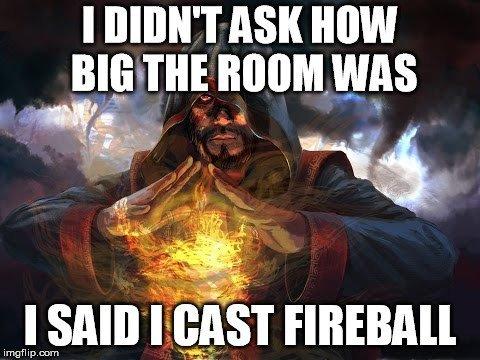
 So how about in 5.5e?