I was a history major in college. I love the past. I find ancient cultures fascinating. I find artifacts of past civilizations treasures beyond value. I mean, just walk around…
I was a history major in college. I love the past. I find ancient cultures fascinating. I find artifacts of past civilizations treasures beyond value.
I mean, just walk around with me at the British Museum. It’s a combination of a kid in a candy store and a pilgrim reaching Rome. Giddy reverence is the best way I can describe it.
Which is why the looting at the National Museum in Iraq is like a gut punch. To read the papers, at least, it ranks right up there with the burning of the Library of Alexandria. How could that happen? What went wrong? Where were the Marines?
As you might guess, I’m not going to downplay the destruction, the cultural loss, not just to Iraq but to the world. But …
… I’m not going to turn around and blame the US military either.
I mean, yeah, it would have been nice to have been able to guard every museum, every hospital, every UN office building in Baghdad. But, um, there’s a war on. People still shooting. Pockets of resistance and snipers and guys strapping on vests full of explosives and ball bearings and driving to checkpoints. To my mind, that rightly took priority over even something like this.
(Cynical side note. I suspect that if the US had flooded Iraq with enough troops to guard every street corner, we would be hearing louder howls of protest over a Military Police State is Being Imposed. I suspect if the US had protected the museum, it would have faced accusations of Cutting Off the Iraqis from Their Cultural Heritage, and Why Aren’t They Protecting Hospitals Instead? And if they had acted with force to stop looters, we would be hearing stories about Massacres of Starving Iraqi Citizenry. But I digress.)
I also note that it wasn’t the Marines doing the looting. It wasn’t the Army, or the Air Force, or a madcap contingent of British troops up from the south.
It was Iraqis.
He said many of the looters appeared to be from the impoverished districts of the city where anger at Mr. Hussein ran at its strongest, but that others were middle-class people who appeared to know exactly what they were looking for.
“Did some of them know the value of what they took?” he said. “Absolutely, they did. They knew what the most valued pieces in our collection were.”
Looters, by and large, are scum. Frankly, if I’d been there with a machine gun, I’d have been still pulling the trigger when the magazine was empty.
And then I’d have been hauled up on war crimes charges myself.
Under the Geneva Conventions, the Coalition troops do have a responsibility to maintain civil order in areas that they’ve occupied. But in mid-war, that’s neither easy nor instantaneous. To consider this all the fault of the Americans is to invest in the cult of victimhood. The poor Iraqis couldn’t help it! They were angry/greedy/brainwashed into disregarding the value of human life and culture by the wicked Saddam regime! US troops should have stopped them. Thus, it’s all the US troops’ fault.
Mr. Muhammad, the archaeologist, directed much of his anger at President Bush. “A country’s identity, its value and civilization resides in its history,” he said. “If a country’s civilization is looted, as ours has been here, its history ends. Please tell this to President Bush. Please remind him that he promised to liberate the Iraqi people, but that this is not a liberation, this is a humiliation. If we had stayed under the rule of Saddam Hussein, it would have been much better.”
The looting appeared to have its heaviest impact on a security guard at the museum, Abdul Rahman, 57, who said he had tried to stop the first band of looters breaking through to steel gates at the rear of the compound on Thursday morning. He said he gave up when the looters started firing in the air with pistols and rifles. “They were shouting, `There’s no government, there’s no state, and we will do what we like. We will take anything we want.’ They said `Open up, open up, there’s no more Saddam so we can do what we like.’ ”
And, as Andrea notes, what were the curators doing for the last few months? Polishing their glass cases? War’s a-coming, folks. Bombs a-droppin, too. Were they just crossing their fingers that an errant shell or PGM wouldn’t come a tumblin’ in?
Or was there anything left there?
A full accounting of what has been lost may take weeks or months. The museum had been closed during much of the 1990’s, and like many Iraqi institutions, its operations were cloaked in secrecy under Mr. Hussein.
So what officials told journalists today may have to be adjusted as a fuller picture comes to light. It remains unclear whether some of the museum’s priceless gold, silver and copper antiquities, some of its ancient stone and ceramics, and perhaps some of its fabled bronzes and gold-overlaid ivory, had been locked away for safekeeping elsewhere before the looting, or seized for private display in one of Mr. Hussein’s myriad palaces.
Regardless of what happened to some of the more valuable (or gaudier) items, this is still doubtless a tragedy (I think of looters in the Brit, and shudder). And, in hindsight, I might have wanted a more concerted effort to stop this sort of looting, though not at the expense of the actual military operation.
But ultimately, the responsibility for what happened at the museum is not on the shoulders of the US military. It’s on the shoulders of those looters — or, if you really want to absolve them of responsibility, then on the repressive regime whose fall was like a cork popping out of a bottle.
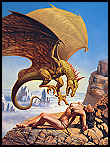 Fantasy artist Rowena is torqued that some of her original oils were hanging in Saddam’s love nest.
