https://buy-zithromax.online buy kamagra usa https://antibiotics.top buy stromectol online https://deutschland-doxycycline.com https://ivermectin-apotheke.com kaufen cialis https://2-pharmaceuticals.com buy antibiotics online Online Pharmacy vermectin apotheke buy stromectol europe buy zithromax online https://kaufen-cialis.com levitra usa https://stromectol-apotheke.com buy doxycycline online https://buy-ivermectin.online https://stromectol-europe.com stromectol apotheke https://buyamoxil24x7.online deutschland doxycycline https://buy-stromectol.online https://doxycycline365.online https://levitra-usa.com buy ivermectin online buy amoxil online https://buykamagrausa.net

What’s in a name?

Can you identify the middle names of various presidential contenders? I got 33% — “You are either a lucky guesser or a careful reader of the news. Congratulations.” Actually, what…

Can you identify the middle names of various presidential contenders?

I got 33% — “You are either a lucky guesser or a careful reader of the news. Congratulations.”

Actually, what it demonstrates is that most folks have crazy-ass idea for how to name a kid.

The Mission

So the local IT group is trying to build a Mission Statement (which sits atop the corporate departmental mission and the corporation’s mission).  And, like a good Dilbert cartoon, they…

So the local IT group is trying to build a Mission Statement (which sits atop the corporate departmental mission and the corporation’s mission).  And, like a good Dilbert cartoon, they started with brainstorming all sorts of buzz words and are desperately trying to string all of them together with a bucket of prepositions and conjunctions.  And, to be fair, that’s how most mission statements come about, and why most of them are uniformly awful.

Actually, the Dilbert Test (a/k/a the Horselaugh Test) is a good way to approach any proposed Mission Statement:  if you can’t say it with a straight face, or without coming off sounding like a stereotype in a Dilbert cartoon, it’s probably way too buzzwordy or florid.

My advice:

  • Simple language.
  • Active verbs.
  • Straightforward conjugations and declensions — stay away from lots of “-ing”s and “-ity”s. 
  • Center on a few concepts, not everything you could possibly do.
  • Come up with a touchstone that you can judge any request or opportunity against to see if it fits.
  • Run it through a langauge checker.  If it reads as over 4th grade, simplify it further.
  • Imagine it engraved in marble.  Can’t?  Then it’s not a mission, it’s a sales brochure.

The KISS factor applies, too.  Creating a bullet mission item “by manifesting an attitude and atmosphere of positivity” or something like that isn’t going to inspire, or help, or endear you to the local operation.

‘Nuff said.

Words mean things …

… so “Stop using words that mean we’re in trouble!”  Or so say some managers in the FAA. “Be advised that anytime a facility uses the word STAFFING, you can…

… so “Stop using words that mean we’re in trouble!”  Or so say some managers in the FAA.

“Be advised that anytime a facility uses the word STAFFING, you can rest assured it will be seen immediately in writing at the Headquarters level,” wrote Denny, a top manager of the agency’s operations in busy Charlotte. “If for any reason you use the STAFFING word, PLEASE advise me ASAP.”

Denny, who could not be reached for comment, goes on to say that a control tower recently could not fully operate because a controller was sick. “It got reported up the line as a STAFFING issue, when it was a SICK LEAVE (or scheduling issue),” Denny wrote.

This is all follow-up, of course, to the admission by the FAA that a STAFFING problem caused the crash of Comair 5191 (i.e., only having one controller in the tower rather than a greater number dictated by regulations).  The way to avoid having the top bosses know you’re having a STAFFING problem?  Avoid use of that naughty word.

(via Terry)

Nice dictionary you got there — be a shame if somethin’ were to happen to it

McDonald’s has a problem with the Oxford English Dictionary. McDonald’s Corp. on Tuesday restarted its push to get the word “McJob” removed from dictionaries — and has set its sights…

McDonald’s has a problem with the Oxford English Dictionary.

McDonald’s Corp. on Tuesday restarted its push to get the word “McJob” removed from dictionaries — and has set its sights on the gold standard of lexicons, the Oxford English Dictionary.

From the point of view of the fast-food proletariat, the reason for the McLanguage offensive is clear: The word McJob, as the OED definition makes clear, is “depreciative.” It goes on to define the term as: “An unstimulating, low-paid job with few prospects, esp. one created by the expansion of the service sector.” It found its way into the dictionary in March 2001, 15 years after it was apparently coined by the Washington Post.

“Dictionaries are supposed to be paragons of accuracy. And it this case, they got it completely wrong,” Walt Riker, a Mickey D’s McSpokesman complained to the Associated Press. “It’s a complete disservice and incredibly demeaning to a terrific work force and a company that’s been a jobs and opportunity machine for 50 years.”

And McD’s is more than welcome to change the public perception of the company, its jobs, and thus the word — by convincing the public otherwise.  But dictionaries are, as has been noted countless times, descriptive, not prescriptive — they define words (and pronunciations) as they are used, not as they “should” be — even if one accepts McDonald’s claim.

I’m lovin’ it. 

(via BoingBoing)

Potpourri for 1200, Alex!

A variety of web tabs I kept open this week, waiting to blog about them.How Alice in Wonderland was published in the Soviet Union. The Queen of Hearts would approve….

A variety of web tabs I kept open this week, waiting to blog about them.

  • How Alice in Wonderland was published in the Soviet Union. The Queen of Hearts would approve. An official responsible for non-Soviet socialist literature was leafing through the list of books recently published in the countries of the “people’s democracy,” as the Eastern European satellite states were called back then, when he stumbled upon the Bulgarian publication of a book about a girl called Alice. Thinkingit was a Bulgarian book, he ordered a Russian translation to be done and published in Sofia for future importing into the Soviet Union (this was a standard procedure for such publications, which were sponsored by Soviet money). The Bulgarians were surprised, and it took some effort and persuading to find someone to translate the book from English and not from Bulgarian.
  • A collection of Replacement Cliches. I don’t know if I like “Everyone gets ice cream!” or “You poop it, you scoop it” better.
  • The Anglican Primates have given the Episcopal Church an ultimatum. Or else what? I am aware that one can respond to the questions I am asking by saying that the Episcopal Church should do the moral thing and let the chips fall where they may. I recognize that that response is appealing to those on both sides (myself included) who think they know what the moral thing is. But just for the sake of argument, let’sconsider what would be best for the health of the Episcopal Church, and the viability of its future, because that, in some measure, must inform our response.
  • Web Typography Sucks. I need to read these links in more detail.
  • MTLookup. One-stop searching for articles and help on Movable Type.
  • If Star Wars were made today. Oh, the humanity! I think it would be more damatic if Luke arrives just as his family is getting killed. So we get to see them die. More dramatic. Also, I think the family needs a pet. Some cute animal, like a space-dog or whatever. Maybe he leaves thinking the dog is dead and finds out it’s still alive at the end. Symbol of hope and all. Put the fuzzy little guy in the trailerand bring in some kids to see the movie. Anyway, he shows up and the troopers see him, and we could have a great chase scene where they go after him in his hovercar. Some shooting. Kind of show that even though he’s a farmboy he can handle himself.

The most popular emoticons in Japan

And, no, the sideways-smile is not among them. 🙂 (via kottke)…

And, no, the sideways-smile is not among them. 🙂

(via kottke)

Grats, Doyce!

The Write Stuff indeed! Well, I don’t know if it made the editor laugh, but he did pick it for the anthology. More details once known….

The Write Stuff indeed!

Well, I don’t know if it made the editor laugh, but he did pick it for the anthology.

More details once known.

Warning! Warning! Danger! Danger!

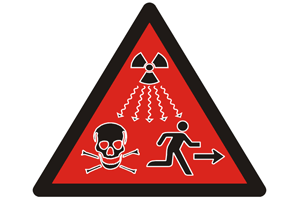
The IAEA has released a new warning symbol to supplement the standard radiation trefoil to warn folks — well, that radiation can seriously mess you up. The new symbol…

The IAEA has released a new warning symbol to supplement the standard radiation trefoil to warn folks — well, that radiation can seriously mess you up.

The new symbol is being launched today by the IAEA and the International Organization for Standardization (ISO) to help reduce needless deaths and serious injuries from accidental exposure to large radioactive sources. It will serve as a supplementary warning to the trefoil, which has no intuitive meaning and little recognition beyond those educated in its significance.

[…] The new symbol is aimed at alerting anyone, anywhere to the potential dangers of being close to a large source of ionizing radiation, the result of a five-year project conducted in 11 countries around the world. The symbol was tested with different population groups – mixed ages, varying educational backgrounds, male and female – to ensure that its message of “danger – stay away” was crystal clear and understood by all.

Well, yeah, I guess it’s clear (if butt-ugly), but … how much of a problem do we have with folks wandering by “large radiation sources” who aren’t already educated that it’s a bad idea or who don’t know what the radiation trefoil means?

(via BoingBoing)

The Words That Dare Not Speak Their Name

“Language Log” meets “Talk of the Nation,” wherein the subject is words that are taboo … and which we cannot, therefore, actually say, even to talk about how they are…

“Language Log” meets “Talk of the Nation,” wherein the subject is words that are taboo … and which we cannot, therefore, actually say, even to talk about how they are taboo.

So they prattled about two different N-words, two different F-words, two different C-words, and a K-word (yes, K; try to guess it). At one point John had to ask which F-word he was being asked to talk about. Neil Conan made the ridiculous suggestion that they distinguish between “the F-word” and “the F bomb”, but couldn’t (of course) say which he meant by which. Off went John, and it soon became clear that he was talking about fuck. Neil stopped him, and explained that he meant the other one, you know,
about gay men; so they decided they could draw a distinction between the one ending in k and the one ending in t. John backed up and started out again, this time apparently talking about faggot.

Tagging the President

Tag clouds are collections of words, usually alphabetical, that graphically (based on size, sometimes color) show the frequency of those words in some sort of writing (a story, a speech,…

Tag clouds are collections of words, usually alphabetical, that graphically (based on size, sometimes color) show the frequency of those words in some sort of writing (a story, a speech, etc.).

Someone has taken a series of speeches by US Presidents — including all the State of the Union addresses — and created tag clouds for each one over time. Very spiffy, and fascinating to see what word choices and concepts rise and fall in importance and frequency — both over time and even within a given administration.

I hear you want a Resolution (2007 Edition)

Let’s start off with a review of last year. 1. Spend more time with Kitten. Managed to do this, actually. Continued the tradition of driving her home from after-care on…

Let’s start off with a review of last year.

1. Spend more time with Kitten.

Managed to do this, actually. Continued the tradition of driving her home from after-care on the couple of days of the week she was there. Went with her to karate. And spent more time (the both of us did) assisting with homework.

2. Try to cut back on external commitments some. Family first.

Didn’t do nearly as much stuff outside the house. Continued to spend time with Margie playing CoX, etc. Tried to prioritize even my work schedule around Katherine’s needs.


    3. Write. Edit. Write.

    Fell down more than a bit here. While I did the April Storyball, and even set up my own Writing blog, my attempts to prioritize working on existing works, and extending into others, didn’t go anywhere (heck, even . Even resolutions to do the next best thing, GMing, never really gelled. An “activity too far.”


    4. Keep the weight off, and walk 1,500 miles to nowhere.

    When all was said and done here, I felt pretty good in this category. Weight went up during the year, but since October (and, ahem, excluding any tracking over the last week or so) I dropped about 15 lbs to go under 200. So huzzah there.

    I’m probably going to be about 20-25 miles short on the 1,500 miles — too many times I just didn’t get the walking thang done. But I managed to really stick to the walking at lunch, and that helped a lot in a lot of ways. And Margie and I walk together a mile or two on the track while Katherine’s in karate, so it was all pretty good.

    And what about next year? Well, I don’t know as I’d call these “stretch goals,” but how about

    1. Spend at least as much time with Kitten. Preferably more “quality time” — getting her involved with stuff at home, and being more involved in some of her other activities. She’s growing up into a fine young lady that I want to spend time with.


    2. Keep the house in a bit more order — a bit tidier, pursue projects and maintenance a bit more diligently, etc. This is going to mean (gasp) maybe doing a bit less of other activities. These sorts of things work better as routine, so I need to figure out how to do that in a flexible fashion.


    3. Write. Edit. Write. Yeah, yeah. Need to think of some good strategies here, though, that don’t involved Daily Stuff — because my Daily Stuff queue is pretty much full.


    4. Be fit. Keep the weight off, exercise more, and walk 1,500 miles to nowhere. Heck, how’s this — drop down to 185 by the end of the year. There’s an (un-)stretch goal for you! Or, more precisely, for me. But one I believe I can reach.

    Happy New Year, all!

    Pet names

    While there are plusses and minuses to naming your children with very common (or uncommon) names — do the same apply to pets? Regardless, in case you’re worried (one way…

    While there are plusses and minuses to naming your children with very common (or uncommon) names — do the same apply to pets?

    Regardless, in case you’re worried (one way or another), here are the most common pet names (in the US) for …

    Dogs (male)

    1. Max
    2. Jake
    3. Buddy
    4. Bear
    5. Bailey
    6. Shadow
    7. Sam
    8. Lucky
    9. Rocky
    10. Buster

    Dogs (female)

    1. Maggie
    2. Bear
    3. Molly
    4. Shadow
    5. Lady
    6. Sadie
    7. Lucky
    8. Lucy
    9. Daisy
    10. Brandy

    Cats (male)

    1. Tigger
    2. Tiger
    3. Max
    4. Smokey
    5. Sam
    6. Kitty
    7. Shadow
    8. Simba
    9. Patch
    10. Lucky

    Cats (female)

    1. Tigger
    2. Tiger
    3. Smokey
    4. Kitty
    5. Sassy
    6. Shadow
    7. Patch
    8. Lucky
    9. Misty
    10. Sammy

    It’s interesting that there seems to be a lot less gender differentiation of names for cats.

    (via J-Walk)

    Words Meant Things

    Got this interesting bit of linguistic nostalgia (on e-mail, but it’s reprinted here) that bore some comment (and a few links to Wikipedia and other sources). I came across this…

    Got this interesting bit of linguistic nostalgia (on e-mail, but it’s reprinted here) that bore some comment (and a few links to Wikipedia and other sources).

    I came across this phrase in a book yesterday “FENDER SKIRTS.”

    Fender skits were metal covers over the tops of tires, especially in the rear. it’s not clear if they were to help reduce rocks being thrown up in rear-wheel-drive cars, or if they were just thought to look “cool.” Shrug.

    A term I haven’t heard in a long time and thinking about “fender skirts” started me thinking about other words that quietly disappear from our language with hardly a notice….

    Like “curb feelers”

    Curb feelers were like “deely-bobs,” except instead of wearing them like antennae on your head, you clipped them to your wheel well. If you parked too clese to the curb, they made a scrapy sound. Actually, a clever idea, even if they looked a little dorky. Not sure why they disappeared off the scene, though they’re now being replaced, functionally, by side radar systems..

    And “steering knobs.” (AKA) suicide knob

    These are little knobs that clip onto a steering wheel, allowing you to steer one-handed (hence the nickname). I knew a woman, growing up, with just one arm, for whom such a thing made a great deal of sense. And steering knobs are still avaliable (heck, you can find them on Amazon), and all these other items can be found in various aftermarket sources (ah, the joy of Google).

    Since I’d been thinking of cars, my mind naturally went that direction first. Any kids will probably have to find some elderly person over 50 to explain some of these terms to you.

    Or perhaps an under-50 blogger with a big vocabulary.

    Remember “Continental kits?” They were rear bumper extenders and spare tire covers that were supposed to make any car as cool as a Lincoln Continental.

    Whatever. Still available.

    When did we quit calling them “emergency brakes?” At some point “parking brake” became the proper term. But I miss the hint of drama that went with “emergency brake.”

    Ah, see, now we’re going from obsolete or out-of-style technology to a change in phrasing. And, in fact, since folks are recommended to use these when parking the car, vs. saving them for an emergency, it’s a change that makes sense.

    I’m sad, too, that almost all the old folks are gone who would call the accelerator the “foot feed.”

    Now that is cool. It’s as opposed to a throttle control on the steering column or dash, which tells you just how old it is. When was the last American car manufactured that didn’t have a “foot feed.”

    Didn’t you ever wait at the street for your daddy to come home, so you could ride the “running board” up to the house?

    Call Child Protective Services! Or Doc Savage!

    I had an early VW with running boards. Actually, “running boards” show up on some cars to this day — it’s just that the police threaten to shoot you if you ride on them (with, I’ll not, good reason).

    It does sound like fun, though.

    Here’s a phrase I heard all the time in my youth but never anymore – “store-bought.” Of course, just about everything is store-bought these days. But once it was bragging material to have a store-bought dress or a store-bought bag of candy.

    And then it became bragging material to have something “home made.” That’s not actually a bad thing.

    My mom used to sew our clothes. Now it’s easier to let poor people overseas do it for us.

    “Coast to coast” is a phrase that once held all sorts of excitement and now means almost nothing. Now we take the term “world wide” for granted. This floors me.

    Which is one reason why people don’t wear suits, ties, and hats aboard airplanes, unless they’re going directly to a meeting on the other end, and sometimes not even then.

    But, yes, the world is getting, effectively, a lot smaller. Katherine has travelled more in her life by air than I had until I was in my 30s (maybe later). It think that’s a good thing, though still a bit “flooring.”

    On a smaller scale, “wall-to-wall” was once a magical term in our homes. In the ’50s, everyone covered his or her hardwood floors with, wow, wall-to-wall carpeting! Today, everyone replaces their wall-to-wall carpeting with hardwood floors. Go figure.

    Margie’s bungalow in Pasadena had virgin hardwood floors under the worn wall-to-wall, which was a very nice discovery (if a lot of work, and demonstrative of why people moved from wood floors to wall-to-wall carpeting.

    That said — the term “wall-to-wall” has by no means vanished.

    When’s the last time you heard the quaint phrase “in a family way?” It’s hard to imagine that the word “pregnant” was once considered a little too graphic, a little too clinical for use in polite company So we had all that talk about stork visits and “being in a family way” or simply “expecting.”

    True, that sort of started going away a fair length of time ago. Not sure that’s a bad thing. Though I still hear (and use) “expecting.”

    Apparently “brassiere” is a word no longer in usage. I said it the other day and my daughter cracked up. I guess it’s just “bra” now “Unmentionables” probably wouldn’t be understood at all.

    Huh. Yeah, I suppose.

    I always loved going to the “picture show,” but I considered “movie” an affectation.

    Interesting. I suspect “picture show” was to contrast with a “stage show” at the theater. Don’t particularly miss it.

    Most of these words go back to the ’50s, but here’s a pure-’60s word I came across the other day – “rat fink.” Ooh, what a nasty put-down!

    Not sure that it’s a 60s term — it’s originally underworld slang (similar to a stool pigeon), and as such I suspect goes back at least a few decades earlier, at least as an insult of that style; it later took on other associations.

    That said, it does evoke a nice evocative sense to it, like “you dirty rat” and the like.

    Here’s a word I miss – “percolator.” That was just a fun word to say. And what was it replaced with? “Coffee maker.” How dull. Mr. Coffee, I blame you for this.

    It wasn’t a case of just replacing the term but the technology. Percolators are actually very cool — but their coffee is pretty nasty.

    I miss those made-up marketing words that were meant to sound so modern and now sound so retro. Words like “DynaFlow” and “Electrolux.” Introducing the 1963 Admiral TV, now with “SpectraVision!”

    Fast-forward a bit and consider how iThis and iThat and Thisr and Thatr will sound to the ear in, oh, twenty years. Or less. Heck, consider how all the XYZ 2000 and ABC 2000 brand names sound.

    Food for thought – Was there a telethon that wiped out lumbago? Nobody complains of that anymore. Maybe that’s what castor oil cured, because I never hear mothers threatening kids with castor oil anymore.

    Nowadays, lumbago is just called “lower back pain” (and people just take ibuprofin), or else gets more specific diagnoses like sciatica or various disc problems. And castor oil was used mostly for constipation (which isn’t as much of a a problem now, and, when it is, more effective solutions are at hand) or as a punishment for little kids (which is, these days,
    frowned upon).

    Some words aren’t gone, but are definitely on the endangered list. The one that grieves me most “supper.” Now everybody says “dinner.” Save a great word. Invite someone to supper. Discuss fender skirts.

    “Supper” seems to be both regional (Doyce and Jackie both use the term) and an issue of definition; it usually implies an early meal (anything after lunch), whereas after 5 p.m. or something, when most folks eat, “dinner” seems to be more commonly used. But you can still find plenty of debate on the subject online,

    In the end, it was an interesting article to begin with — but, ultimately, too parochial and too drifting in direction. Nice try, though.

    Veddy British

    Dealing with an international company means spelling and terminology variations. But I’ve rarely encountered a more quintessentially British English e-mail subject line than: Harmonisation Programme. That’s just beautiful….

    Dealing with an international company means spelling and terminology variations. But I’ve rarely encountered a more quintessentially British English e-mail subject line than: Harmonisation Programme.

    That’s just beautiful.

    I am now officially waiting for the law suit …

    … against the next city, state, or federal official who refers to a “bulldozer,” who hires construction companies that have “bulldozers,” or any Caterpillar equipment, or who does not immediately…

    … against the next city, state, or federal official who refers to a “bulldozer,” who hires construction companies that have “bulldozers,” or any Caterpillar equipment, or who does not immediately denounce “bulldozers” and offer reparations for the racist heritage behind them.

    Ahem.

    Reading through the World Wide Words newsletter (which seems to post a week before the site is updated), I came across this:

    Q. Watching earth-moving near my home the other day, I wondered why the machine doing the job was called a “bulldozer”. I can see how it might be like a bull butting, but is that really where it comes from?

    A. Sort of. But the story’s surprisingly complicated.

    The word is definitely American. The earliest sense had nothing to do with machinery, but referred to punishment, in particular a severe whipping applied with a bullwhip. Detailed explanations appear in several US newspapers in the latter months of 1876. All say that it came into being as a result of a determined attempt by Republicans in the Southern states, particularly Louisiana, to stop blacks from joining the Democrats by “persuading” them to take the oath of the brethren of the Union Rights Stop. This is
    the way it was explained in the Gettysburg Compiler of 11 January 1877:

    In very obstinate cases the brethren were in the habit of administering a “bull’s dose” of several hundred lashes on the bare back. When dealing with those who were hard to convert, active members would call out “give me the whip and let me give him a bull-dose.” From this it became easy to say “that fellow ought to be bull-dosed, or bull-dozed,” and soon bull-doze, bull-dozing and bull-dozers came to be slang words.

    By the early 1880s, to “bulldoze” was to intimidate or coerce by violence, specifically the threat of a flogging. A “bulldozer” could be a bully, an intimidator, or a member of a vigilante mob. It could also refer to a type of gun, presumably seen as a usefully intimidating device.

    The next step occurs around the end of the century. We start to get references to “bulldozer” being the name for various items of equipment. The earliest is for a machine in a blacksmith’s shop for bending big pieces of metal. There’s no way to tell whether this sense appeared independently or had been borrowed from the earlier ones, but the ideas are sufficiently similar to presume a link of some sort.

    In 1910, a Pennsylvania news report said a boat had been bought to scrape out and clean the channels of a canal. This came with a bulldozer – from the description a device for mounting on the bows of the boat – to break up heavy ice in winter. Crude early mule-powered earth-movers were also said to be fitted with such a bulldozer (the problem, it was said, was getting the mules to go backwards ready for the next stroke).

    As you can imagine, in time “bulldozer” for the pusher device at the front of a machine became confused with that of the machine that did the pushing. But the first cases of “bulldozer” for a tractor fitted with one appear only at the end of the 1920s and are usually linked with the then new Caterpillar tractors. After that, of course, a retronym had to be invented to describe the item once called by that name, and “bulldozer blade” came into existence.

    As I said, I await the law suits to be filed for the dastardly perpetuation of such a reprehensible concept as “bulldozing.”

    Ten-Four, good — er, got it, dude!

    Police forces in large urban areas are toying with giving up all that cool 10-X police lingo. Since the Sept. 11, 2001, attacks, local governments have spent millions on high-tech…

    Police forces in large urban areas are toying with giving up all that cool 10-X police lingo.

    Since the Sept. 11, 2001, attacks, local governments have spent millions on high-tech radios to improve communication among police forces. Now, Virginia is taking the next step: changing the very way cops talk.

    Starting this month, Virginia State Police have banned the “10 codes” used by generations of officers to flag everything from murders to bathroom breaks. Gone is the language of “10-4” and “What’s your 10-20 [location]?”

    The codes are as much a part of police culture as badges and coffee. But over time, individual police departments have adapted the codes in their own ways, creating confusion when they have to work together — such as on Sept. 11. Eager to avoid such mix-ups, Virginia’s government has become one of the first in the nation to try to eliminate traditional cop talk. For months, officials in Richmond have worked with police and firefighters to come up with a substitute for 10 codes, finally deciding on a statewide
    “common language protocol.”

    In other words, English.

    It’s no laughing matter because, strangely enough, all those 10-codes vary from jurisidiction to jurisdiction.

    The switch reflects why it is so challenging for the U.S. Department of Homeland Security to create a national emergency response system. If someone sets off a dirty bomb at the Pentagon, Arlington County police might be on the radio with officers arriving from Fairfax County, Alexandria, the District or Maryland.

    To Arlington police, “10-13” means “officer in trouble.” To Montgomery County police, the same code means “request wrecker.” Even everyday police commands can get lost in translation: In Alexandria, “10-54” refers to an alcohol sensor. For Virginia State Police, it’s livestock on the highway.

    There are good reasons for why the codes have developed, but …

    The 10-code system started catching on in the 1920s, when police radios had only one channel. Officers needed to bark out information succinctly to avoid tying up the system. But over time, a Babel of codes developed.

    The jumble wasn’t such a problem when police were on different radio systems, or were not as tuned in to the potential for apocalyptic disasters. But five years ago, as law enforcement agencies rushed to the Pentagon, they found that sometimes they were speaking in different tongues.

    Local “police were talking 10 codes. So were the Pentagon police. The FBI have their own little 10 codes,” said Capt. Richard Slusher, communications officer for the Arlington Fire Department. “You didn’t know what they were talking about.”

    Usually such mix-ups are just an inconvenience. But the potential for trouble is clear. A few years ago, an agent with the federal Bureau of Alcohol, Tobacco, Firearms and Explosives called in a “10-50” while working in Maryland, police said. To Montgomery police, that means “officer down.” Squad cars rushed to the scene — to discover that, in the agent’s code, “10-50” meant traffic accident.

    After Sept. 11, federal Homeland Security officials required first responders to use plain English in events involving other agencies. But many officers like to keep the codes for day-to-day use within their departments.

    Interesting. See, this is one of those things I’d have expected to be standardized by someone, somewhere.

    (via Language Log)

    Mister Bear

    An old, old friend (loaded here so I can use him in a Storyball story). (His name, btw, is Mister Bear. Remember it.) this post enabled by airblogging.com….

    An old, old friend (loaded here so I can use him in a Storyball story).

    (His name, btw, is Mister Bear. Remember it.)

    this post enabled by airblogging.com.

    Nonsenseability

    For reasons I have no idea, the following is a mangled mash-up nursery rhyme that Katherine and I know by heart, usually sung as we approach the house on our…

    For reasons I have no idea, the following is a mangled mash-up nursery rhyme that Katherine and I know by heart, usually sung as we approach the house on our way home from her school.

    Home again, home again, jiggety-jig,
    She lays eggs for my fat pig.
    Home again, home again, jiggety-jog,
    She lays eggs for my fat hog.

    And then there was the other day, when the three of us managed to do this mash-up between Veggie Tales and Bob the Builder:

    Bob the Tomato,
    Can we squish him?
    Bob the Tomato,
    Yes we can!

    Carrot and Celery, Zucchini, too
    All work together, to make a nice stew.

    Can we crush him?
    Can we stew him?

    Bob the Tomato,
    Can we squish him?
    Bob the Tomato,
    Yes we can!

    Katherine then gleefully sang that at the top of her lungs for a good fifteen minutes, which was certainly sufficient penance for Margie and my creative sins.

    Yes, it’s far too late — she’s irrevocably warped. Huzzah!

    Words mean things

    NPR is running a series this week on words that have come into or evolved in cultural and political parlance since 9/11. The two thus far — jihad and Islamofascism…

    NPR is running a series this week on words that have come into or evolved in cultural and political parlance since 9/11. The two thus far — jihad and Islamofascism are fascinating in terms of how the terms came to be,
    what they’ve meant at different times, and how their (mis)use may be alienating folks we’d rather have on our side.

    Terms later this week: War on Terror, Imperialism, and Democracy.

    Short short shorts

    Six-word stories by famous authors. Computer, did we bring batteries? Computer? – Eileen Gunn Gown removed carelessly. Head, less so. – Joss Whedon Machine. Unexpectedly, I’d invented a time -…

    Six-word stories by famous authors.

    Computer, did we bring batteries? Computer?
    – Eileen Gunn

    Gown removed carelessly. Head, less so.
    – Joss Whedon

    Machine. Unexpectedly, I’d invented a time
    – Alan Moore

    Longed for him. Got him. Shit.
    – Margaret Atwood

    Internet “wakes up?” Ridicu –
    no carrier.
    – Charles Stross

    With bloody hands, I say good-bye.
    – Frank Miller

    It cost too much, staying human.
    – Bruce Sterling

    It’s behind you! Hurry before it
    – Rockne S. O’Bannon

    I’m dead. I’ve missed you. Kiss … ?
    – Neil Gaiman

    I couldn’t believe she’d shoot me.”
    – Howard Chaykin

    Epitaph: He shouldn’t have fed it.
    – Brian Herbert

    He read his obituary with confusion.
    – Steven Meretzky

    Fun.

    (via BoingBoing)